Computational Thinking
and Artificial Intelligence
for CBSE — Classes 3 to 8
PiyushAI delivers India’s first complete, chapter-aligned workbook series for Computational Thinking and Artificial Intelligence for CBSE Classes 3–8. Built by IIT Madras faculty — the same experts who shaped the CBSE CT & AI Curriculum 2026–27.
What is Computational Thinking and Artificial Intelligence for CBSE?
Computational Thinking and Artificial Intelligence for CBSE is a structured curriculum framework mandated by the Central Board of Secondary Education (CBSE) for all affiliated schools from the 2026–27 academic year. Guided by NEP 2020 and the NCF-SE 2023, it integrates computational thinking (CT) and AI literacy across Classes 3 to 8 — covering over 20 million students.
The curriculum was co-authored by an expert committee that includes faculty from IIT Madras Bodhan AI Foundation, MNIT Jaipur, Azim Premji University, and NITTTR Bhopal. It positions CT as the cognitive foundation students need before engaging with AI — and builds both progressively across six years of schooling.
Research confirms that skills like decomposition, pattern recognition, abstraction, and algorithmic reasoning are the same reasoning processes that power AI and machine learning systems. Teaching them from Class 3 means students don’t just use AI — they understand it.
| Stage | Classes | Annual Hours | Focus |
|---|---|---|---|
| Preparatory | 3, 4, 5 | 50 hrs | CT integrated into Math & TWAU |
| Middle | 6, 7, 8 | 100 hrs | Advanced CT + AI Literacy + Projects |
The CBSE curriculum is platform-independent — it does not mandate any specific software or device. Schools choose their own resource providers. This is where PiyushAI’s chapter-aligned workbooks and AI Foundation Handbook fill the gap.
Our founder was part of the academic circle that contributed to developing this very curriculum at IIT Madras — giving PiyushAI unmatched insight into what schools actually need to implement it well.
The right partner for CBSE CT & AI — built from the inside
Every other provider sells generic coding or STEM content and relabels it for CBSE. PiyushAI was built specifically around the CBSE Computational Thinking and Artificial Intelligence curriculum — from the ground up.
Chapter-Exact CBSE Alignment
Every exercise maps to a specific CBSE CT & AI learning outcome. Workbooks follow the same table of contents as CBSE Math, Science, and TWAU textbooks — teachers can use them during regular class hours without redesigning lessons.
IIT Madras Academic Credibility
Developed by a former instructor at IIT Madras with 5 years of teaching Computational Thinking and AI at IIT Madras — the same institution listed in the CBSE expert committee that authored the CT & AI curriculum framework. No other publisher can claim this.
Platform Independent by Design
The CBSE CT & AI curriculum explicitly values platform-agnostic content. Our workbooks and handbooks work with or without devices — no app subscriptions, no locked-in software, no additional cost to schools or parents.
AI Ethics Woven Throughout
Digital citizenship, AI bias, privacy, and responsible use of technology aren’t separate modules — they’re integrated into exercises across all classes. Students who finish Class 8 are ethically equipped digital citizens, not just AI users.
Spiral Learning Progression
Pattern recognition introduced in Class 3 reappears with algebraic complexity in Class 7. Algorithmic thinking in Class 4 becomes route optimisation in Class 8. Skills deepen every year — exactly as CBSE’s spiral curriculum design requires.
Teacher-Ready from Day One
Every student workbook comes with a Teacher Manual — complete with lesson plans, full answer keys, pedagogy notes, common error guides, and rubrics for competency-based assessment. No teacher needs a computer science background to deliver this curriculum.
The four CT skills at the heart of the CBSE Computational Thinking curriculum
These four competencies are the building blocks the CBSE CT & AI curriculum develops from Class 3 to Class 8. They are also the cognitive foundations of artificial intelligence — making each exercise both a thinking skill and a step toward AI understanding.
Pattern Recognition
- Number, shape & letter sequences
- Multi-rule & dependent patterns
- Algebraic generalisation (Class 6–8)
- Real-world data trend analysis
Algorithmic Thinking
- Step-by-step procedures & flowcharts
- Grid navigation & pathfinding
- Conditional branching (if-then logic)
- Route optimisation problems
Decomposition
- Multi-clue mystery problems
- Constraint satisfaction puzzles
- Scheduling & project planning
- Budget & resource problems
Abstract Thinking
- 3D spatial & symmetry reasoning
- Code, symbol & number systems
- Generalisation across representations
- AI abstraction case studies (Class 8)
| Resource | Link |
|---|---|
| Class 6 Abstract Thinking | View Module |
| Class 6 Algorithmic Thinking | View Module |
| Class 6 Pattern Recognition | View Module |
| Download Sample Teacher Handbook | Download PDF |
| IIT Madras BS Degree CT YT Playlist | Watch Playlist |
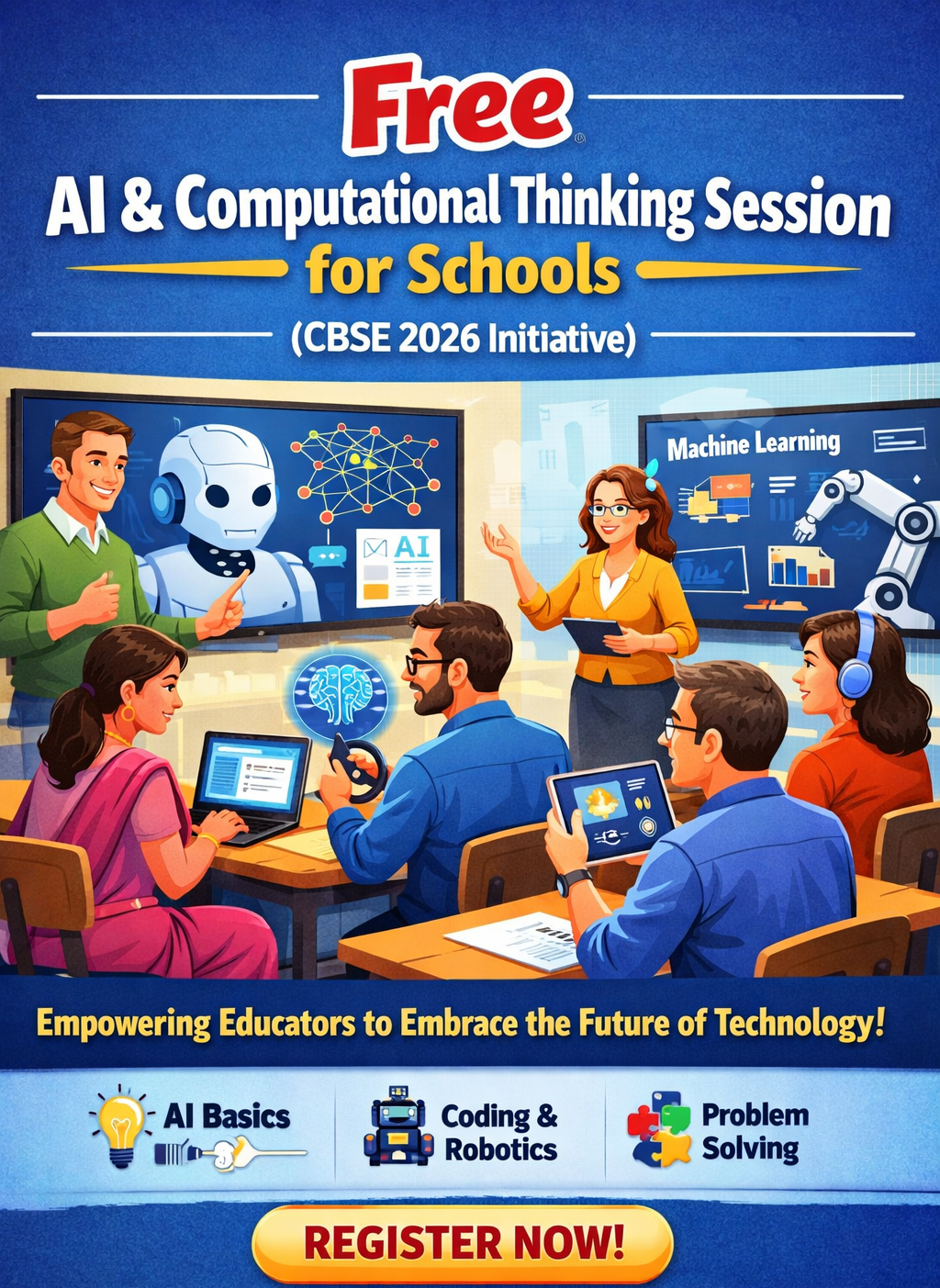
Complete resources for CBSE Computational Thinking and AI — Classes 3 to 8
Every product in the PiyushAI range is built exclusively for the CBSE CT & AI curriculum 2026–27. Nothing repurposed. Nothing generic. Everything your school needs to implement the mandate from day one.
Student Workbook Series · Classes 3–8
Six workbooks — one per class — built chapter-by-chapter to match CBSE Math, Science, and TWAU textbooks. Every chapter includes CT exercises graded from warm-up to challenge, covering all four CBSE CT skills.
Teacher Manual · Classes 3–8
The Teacher Manual turns any Math, Science, or TWAU teacher into a confident CT educator — no computer science background required. Covers every workbook chapter with full pedagogical support.
AI Foundation Handbook · Classes 6–8
Covers the full 20-hour CBSE AI literacy syllabus per class. From “What is Artificial Intelligence?” to supervised learning, NLP, Computer Vision, and no-code AI project tools — written for 11–14 year olds.
Teacher Certification Program
40-hour blended certification that qualifies Math, Science, and Computer teachers to deliver CBSE Computational Thinking and AI confidently. Online weekend cohorts plus a 1-day in-person workshop.
Digital Practice Portal
Web and mobile platform with auto-generated CBSE CT practice problems, AI literacy video modules, student progress tracking, and teacher analytics — aligned to the Class 3–8 curriculum.
Free Sample Chapter
See exactly how our CBSE Computational Thinking content works in your classroom — request a complete sample chapter for any class level. Free, no commitment.
Request Free Sample →What students learn in the CBSE Artificial Intelligence curriculum
The CBSE AI curriculum for Classes 6–8 allocates 20 dedicated hours per class per year to AI literacy. PiyushAI’s AI Foundation Handbook covers this syllabus completely — with illustrated concepts, relatable examples, and no-code hands-on activities.
Students explore what Artificial Intelligence is, how it differs from simple automation, and how machine intelligence compares to human thinking. They are introduced to the three types of machine learning — supervised, unsupervised, and reinforcement — through real-world examples. The module covers basic data types (text, numbers, images, sound), simple data organisation, and digital ethics including online safety, passwords, and understanding digital footprints.
Students learn three core predictive techniques: regression (predicting numbers from past data), classification (grouping by learned rules), and clustering (finding hidden similarities). They explore the three major AI domains — Computer Vision, Natural Language Processing (NLP), and Data Science — with examples like image recognition, translation tools, and chatbots. The module covers AI applications in healthcare, education, transport, and communication, along with data visualisation and a critical examination of AI bias and fairness.
Students work through the complete AI project cycle: Define Problem → Collect Data → Test AI Tools → Reflect & Improve. They use no-code AI tools such as image classifiers and chatbot builders to experience real AI development. The module covers bias identification in datasets, strategies for fairness and inclusivity, and a full treatment of AI ethics — privacy, misinformation, accountability, and the values that guide responsible AI design. Students complete a self-directed AI reflection project.
Developed by IIT Madras Alumni . Built for every CBSE school in India.
The CBSE CT & AI Curriculum 2026–27 was co-authored by the IIT Madras Bodhan AI Foundation. PiyushAI’s content is developed by Piyush Wairale, former instructor at IIT Madras BS Degree with five years of hands-on Computational Thinking and AI teaching experience at IIT Madras — the same depth and academic rigour, made practical for Classes 3 to 8.
Get your school CBSE CT & AI ready in 4 steps
CBSE Computational Thinking and Artificial Intelligence — Questions Answered
Everything school leaders, teachers, and parents ask about the CBSE CT & AI curriculum and how PiyushAI helps implement it.
Ready to implement CBSE CT & AI in your school?
The 2026–27 CBSE mandate for Computational Thinking and Artificial Intelligence is live. Schools that act now get trained teachers, prepared students, and a head start over those scrambling later.