
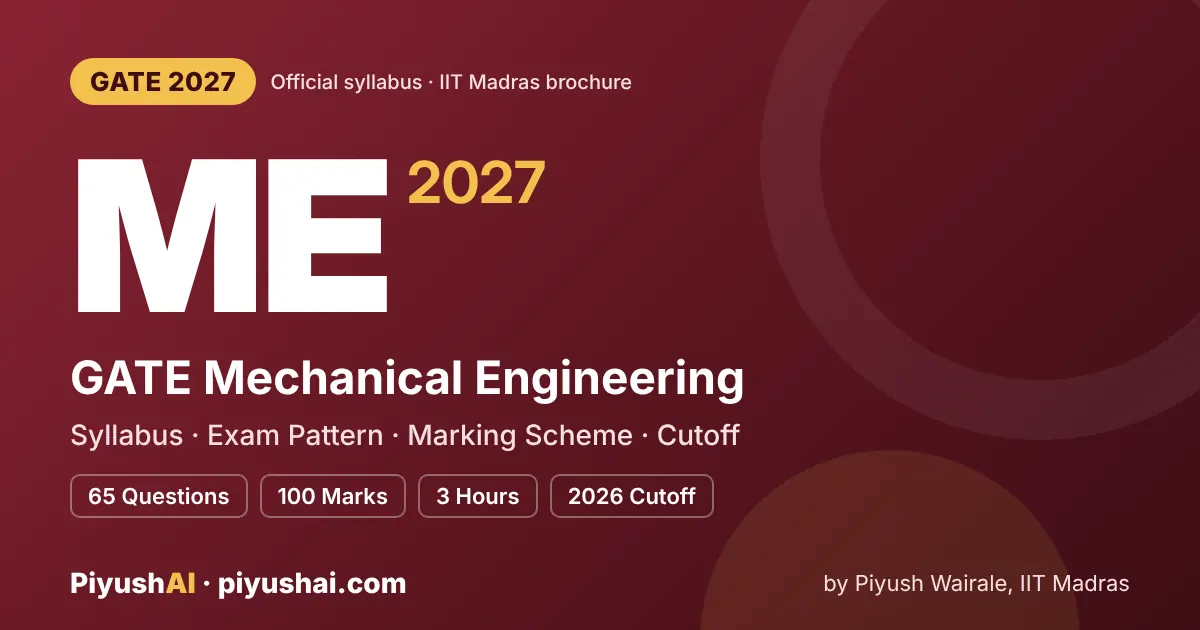
GATE ME 2027 syllabus, quick answer: GATE ME 2027 has 65 questions for 100 marks in 3 hours: General Aptitude carries 15 marks, Engineering Mathematics 13 marks and core Mechanical Engineering subjects 72 marks. The exam is a Computer Based Test conducted by IIT Madras on 6 to 21 February 2027. MCQs carry negative marking (1/3 or 2/3); MSQ and NAT questions do not. Below is the complete, official GATE ME 2027 syllabus with the section-wise structure, GATE 2026 cutoffs and a preparation plan.
📋 Table of Contents
- GATE ME 2027 overview
- Exam pattern and marks distribution
- Question types and marking scheme
- GATE ME 2027 syllabus (official)
- General Aptitude syllabus
- GATE 2026 cutoff and statistics
- Allowed second papers
- Important dates and eligibility
- Preparation strategy
- What a GATE ME score gets you
- GATE ME course, notes and test series
- FAQs
GATE Mechanical Engineering (ME) 2027: Overview
GATE Mechanical Engineering (ME) is one of the core engineering papers, with 59,612 candidates appearing in 2026. It is used for M.Tech admissions at IITs and IISc and by many PSUs. The syllabus is grouped into Engineering Mathematics and three broad sections: Applied Mechanics and Design, Fluid Mechanics and Thermal Sciences, and Materials, Manufacturing and Industrial Engineering.
Who usually takes this paper: B.E./B.Tech. Mechanical, Production, Automobile and allied programme students and graduates, and AMIE candidates.
| Particular | Details |
|---|---|
| Exam name | GATE 2027: Mechanical Engineering |
| Paper code | ME |
| Organising institute | IIT Madras |
| Mode | Computer Based Test (CBT), English only |
| Exam dates | 6, 7, 13, 14, 20 and 21 February 2027 (two sessions a day) |
| Duration | 3 hours (4 hours with compensatory time for eligible PwD candidates) |
| Questions / marks | 65 questions / 100 marks |
| Question types | MCQ, MSQ, NAT |
| Calculator | On-screen virtual scientific calculator only |
| Result date | 19 March 2027 |
| Score validity | 3 years |
| Official website | gate2027.iitm.ac.in |
GATE ME 2027 Exam Pattern and Marks Distribution
GATE ME 2027 has 65 questions for 100 marks in 3 hours: General Aptitude carries 15 marks, Engineering Mathematics 13 marks and core Mechanical Engineering subjects 72 marks.
| Section | Questions | Marks | Notes |
|---|---|---|---|
| General Aptitude (GA) | 10 | 15 | 5 × 1 mark + 5 × 2 marks |
| Engineering Mathematics | Part of 55 | 13 | Paper-specific maths questions |
| Mechanical Engineering (core subject) | Part of 55 | 72 | Mix of 1-mark and 2-mark questions |
| Total | 65 | 100 | 3 hours, CBT |
Question Types and Marking Scheme
| Question type | What it is | Marks | Negative marking |
|---|---|---|---|
| MCQ | Four options, exactly one correct | 1 or 2 | −1/3 for a 1-mark MCQ, −2/3 for a 2-mark MCQ |
| MSQ | Four options, one or more correct; full marks only for the exact correct combination | 1 or 2 | None (and no partial marks) |
| NAT | Numerical answer typed on a virtual keypad (integer or decimal) | 1 or 2 | None (and no partial marks) |
GATE questions test four abilities: Recall, Comprehension, Application, and Analysis and Synthesis. For NAT answers, round off only at the final step, to the number of decimal places asked in the question.
GATE ME 2027 Syllabus (Official, IIT Madras)
The GATE 2027 syllabus has been revised for most papers, so use this version rather than older lists. Here is the section-wise summary of the GATE ME 2027 syllabus, followed by the complete official topic list as published in Appendix D of the GATE 2027 Information Brochure.
| # | Section |
|---|---|
| 1 | Engineering Mathematics |
| 2 | Applied Mechanics and Design |
| 3 | Fluid Mechanics and Thermal Sciences |
| 4 | Materials, Manufacturing and Industrial Engineering |
Complete GATE ME 2027 syllabus: topic-wise
Section 1: Engineering Mathematics
Linear Algebra: Matrix algebra, systems of linear equations, eigen values and eigen vectors.
Calculus: Functions of single variable, limit, continuity and differentiability, mean value theorems, indeterminate forms; evaluation of definite and improper integrals; double and triple integrals; partial derivatives, total derivative, Taylor series (in one and two variables), maxima and minima, Fourier series; gradient, divergence and curl, vector identities, directional derivatives, line, surface and volume integrals, applications of Gauss, Stokes and Green’s theorems.
Differential Equations: First order equations (linear and nonlinear); higher order linear differential equations with constant coefficients; Euler-Cauchy equation; initial and boundary value problems; Laplace transforms; solutions of heat, wave and Laplace’s equations.
Complex Variables: Analytic functions; Cauchy-Riemann equations; Cauchy’s integral theorem and contour integral formula; Taylor and Laurent series.
Probability and Statistics: Definitions of probability, sampling theorems, conditional probability; mean, median, mode and standard deviation; random variables, binomial, Poisson and normal distributions.
Numerical Methods: Numerical solutions of linear and non-linear algebraic equations; integration by trapezoidal and Simpson’s rules; single and multi-step methods for ordinary differential equations.
Section 2: Applied Mechanics and Design
Engineering Mechanics: Free-body diagrams and equilibrium; friction and its applications including rolling resistance, belt-pulley, brakes, clutches, screw jack, wedge, vehicles, etc.; plane trusses and frames; virtual work; kinematics and dynamics of rigid bodies in plane motion; impulse and momentum (linear and angular) and energy formulations.
Mechanics of Materials: Stress and strain, elastic constants and their relationships; stress and strain components transformations in 2D; Mohr’s circle for plane stress and plane strain; thin-walled pressure vessels; shear force and bending moment diagrams; bending and shear stresses; concept of shear centre; deflection of beams; torsion of circular shafts; Euler’s theory of columns; energy methods; thermal stresses; strain gauges and rosettes; Mechanical properties of materials, toughness, hardness, impact strength.
Theory of Machines: Displacement, velocity and acceleration analysis of plane mechanisms; dynamic analysis of linkages; cams; gears and gear trains; flywheels and governors; balancing of reciprocating androtating masses; gyroscope.
Vibrations: Free and forced vibration of linear systems with single and two degrees of freedom, damping estimation and effects; vibration isolation, transmissibility ratio; resonance; critical speeds of shafts; Control system, PID controller, transfer function.
Machine Design: Design for static and dynamic loading; failure theories; fatigue strength and the S-N diagram; principles and design of machine elements such as bolted, riveted and welded joints; shafts, gears, belt drives, rolling and sliding contact bearings, brakes and clutches, springs.
Section 3: Fluid Mechanics and Thermal Sciences
Fluid Mechanics: Fluid properties; fluid statics, forces on submerged bodies, stability of floating bodies; control-volume analysis of mass, momentum and energy; fluid acceleration; differential equations of continuity and momentum; concept of velocity potential; Bernoulli’s equation; dimensional analysis; viscous flow of incompressible fluids, boundary layer, elementary turbulent flow, flow through pipes, head losses in pipes, bends and fittings; One dimensional high speed compressible fluid flow; flow through converging and converging-diverging nozzles.
Heat Transfer: Modes of heat transfer; one dimensional heat conduction, resistance concept and electrical analogy, heat transfer through fins; unsteady heat conduction, lumped parameter system, thermal boundary layer, dimensionless parameters in free and forced convective heat transfer, heat transfer correlations for flow over flat plates and through pipes; boiling and condensation; effect of turbulence; heat exchanger performance, LMTD and NTU methods; radiative heat transfer, Stefan- Boltzmann law, Wien’s displacement law, black and grey surfaces, view factors, radiation network analysis.
Thermodynamics: Thermodynamic systems and processes; properties of pure substances, behaviour of ideal and real gases; zeroth, first and second laws of thermodynamics, calculation of work, heat, energy changes and entropy changes in various processes; application of first and second laws for analysis of closed and open systems; thermodynamic property charts and tables, availability and irreversibility; thermodynamic relations.
Applications: Power Engineering: vapour and gas power cycles, concepts of regeneration and reheat; I.C.
Engines: Air-standard Otto, Diesel and dual cycles; Basics of Combustion: Air- Fuel Ratio, Equivalence Ratio; Refrigeration and air-conditioning: Vapour and gas refrigeration and heat pump cycles, properties of moist air, psychrometric chart, basic psychrometric processes; Turbomachinery: Impulse and reaction principles, velocity diagrams, Pelton-wheel, Francis and Kaplan turbines, steam and gas turbines, Air and gas compressors, pumps and pump characteristics.
Section 4: Materials, Manufacturing and Industrial Engineering
Engineering Materials: Crystal structure of common metals, phase diagrams, heat treatment; Properties and applications of engineering materials – metals and alloys, polymers, composites and ceramics; Engineering and true stress-strain diagrams.
Casting, Forming and Joining Processes: Different types of casting processes; Patterns, moulds and core; Solidification and cooling, riser and gating design, casting defects; Plastic deformation and yield criteria; Hot working and cold working; Principles of bulk forming and sheet forming processes and estimation of load in these processes; Fundamentals of powder metallurgy and its applications; Principles of welding, brazing, soldering; Solid-state welding processes, adhesive bonding; Non-destructive testing methods.
Machining and Machine Tool Operations: Basic machining operations and machine tools; Single-point and multipoint cutting tools; Geometry of single-point turning tools – ASA and ORS systems; Mechanics of machining; Cutting tool materials, tool life and tool wear; Economics of machining; Abrasive machining processes; Principles and applications of non-traditional machining processes; Principles of work holding, jigs and fixtures.
Additive Manufacturing: Principles of different types of additive manufacturing processes for engineering materials; Additively manufactured products – advantages, limitations, and applications.
Metrology and Inspection: Limits, fits and tolerances; Linear and angular measurements; Comparators;
Interferometry; Form and finish measurement; Alignment and testing methods; Tolerance analysis in manufacturing and assembly; Principle of coordinate- measuring machine (CMM).
Computer Aided Manufacturing and Automation: Basic concepts of CAD/CAM and their integration tools; NC/CNC machines and CNC programming; Pneumatic, electro-pneumatic, and hydraulic actuators for automation; Programmable logic controllers.
Production Planning and Control: Work study, Productivity, Forecasting models, Aggregate production planning, Scheduling, Materials requirement planning, Six sigma, Lean manufacturing, Inventory Control – deterministic models, safety stock, inventory control systems, Quality and reliability concepts for product lifecycle analysis.
Operations Research: Linear programming, Simplex method, Transportation, Assignment, Network flow models, Simple queuing models, PERT and CPM.
General Aptitude (GA) Syllabus: 15 Marks, Common to All Papers
| Area | Topics |
|---|---|
| Verbal Aptitude | Basic English grammar, vocabulary (words, idioms, phrases in context), reading comprehension, narrative sequencing |
| Quantitative Aptitude | Data interpretation (graphs, charts, maps, tables), ratios, percentages, powers, exponents, logarithms, permutations and combinations, series, mensuration and geometry, elementary statistics and probability |
| Analytical Aptitude | Deduction and induction, analogy, numerical relations and reasoning |
| Spatial Aptitude | Translation, rotation, scaling, mirroring, assembling and grouping, paper folding, cutting and patterns in 2D and 3D |
GATE ME 2026 Cutoff, Qualifying Marks and Statistics
These are the official GATE 2026 figures for Mechanical Engineering from the GATE 2026 Statistical and Performance Report (IIT Guwahati). They are the best guide to what to expect in GATE ME 2027. Qualifying marks are out of 100; the qualifying GATE score for the general category is always 350.
| Paper | Registered | Appeared | Qualified | Qualified % |
|---|---|---|---|---|
| Mechanical Engineering (ME) | 76,823 | 59,612 | 10,970 | 18.4% |
| Paper | GEN | OBC-NCL / EWS | SC / ST / PwD |
|---|---|---|---|
| Mechanical Engineering (ME) | 25.2 | 22.6 | 16.7 |
| Paper | Highest marks | Mean of top 0.1% (or top 10) | Average marks | Std. deviation |
|---|---|---|---|---|
| Mechanical Engineering (ME) | 96.67 | 74.58 | 13.35 | 11.86 |
What this means for you: in GATE 2026 the average ME candidate scored 13.35 marks, while the top 0.1% averaged 74.58. Crossing the general qualifying mark of 25.2 puts you in the top 18% of candidates, but admissions to top IITs and PSU interview calls usually need a score far above the qualifying line.
How the qualifying marks and GATE score are calculated
For each paper, the general-category qualifying mark is max(25, min(40, μ + σ)), where μ and σ are the mean and standard deviation of the marks of all candidates who appeared. OBC-NCL/EWS qualifying marks are 90% and SC/ST/PwD qualifying marks are about two-thirds of the general value.
Your GATE score (out of 1000) is computed as Score = 350 + 550 × (M − Mq) / (M̄t − Mq), where M is your marks (normalised marks for multi-session papers), Mq is the general qualifying mark and M̄t is the mean marks of the top 0.1% or top 10 candidates, whichever is larger. A score of 350 corresponds to the qualifying mark and 900 to the top-candidate average.
Which Papers Can Be Combined with GATE ME 2027?
You may appear in one or two GATE papers. As per the tentative list in the GATE 2027 brochure, the second paper allowed with ME as the primary paper is: Aerospace Engineering (AE), Data Science and Artificial Intelligence (DA), Instrumentation Engineering (IN), Naval Architecture and Marine Engineering (NM), Production and Industrial Engineering (PI), Engineering Sciences (XE), Robotics and Automation (RA), Computer Science and Information Technology (CS). The fee for two papers is twice that of one paper.
GATE 2027 Important Dates, Fee and Eligibility
| Event | Date |
|---|---|
| Registration (regular period) | 2 to 27 September 2026 (closed) |
| Extended period with late fee | Up to 12 October 2026 (closed) |
| Special window (late fee) | 15 October 2026, 10:30 AM to 16 October 2026, 10:29 AM (closed) |
| Exam city notification | 4 January 2027 |
| Admit card | To be announced on GOAPS |
| GATE 2027 exam | 6, 7, 13, 14, 20 and 21 February 2027 |
| Result | 19 March 2027 |
Application fee per paper (regular period): ₹1,000 for female, SC, ST and PwD candidates and ₹2,000 for all others; ₹1,500 and ₹2,500 respectively in the extended period and special window.
Eligibility: candidates in the third or higher year of any undergraduate degree, or who have completed a government-approved degree in Engineering, Technology, Architecture, Science, Commerce, Arts or Humanities, are eligible. M.B.B.S./B.D.S./B.V.Sc. students from the fifth semester and M.Sc./M.A./MCA students from the first year are also eligible. There is no age limit. All dates are as per the brochure and subject to change, so always confirm on the official website.
GATE ME 2027 Preparation Strategy
- The three big sections are almost equally important. Plan a balanced rotation so that no section stays untouched for more than a week.
- Applied Mechanics and Design: engineering mechanics, strength of materials, theory of machines, vibrations and machine design are numerical and very scoring.
- Fluid Mechanics and Thermal Sciences: thermodynamics cycles, heat transfer, fluid mechanics and turbomachinery need formula sheets and repeated practice.
- Materials, Manufacturing and Industrial Engineering has many 1-mark recall questions plus numericals on machining, metrology and operations research.
- The 2026 average in ME was only 13.35 while the topper scored 96.67. The qualifying mark (25.2) is easy to cross; PSU calls usually need much higher scores.
- Solve previous GATE papers (2007 to 2026 are available on the official website) section by section, then as timed full-length papers.
- Practise every numerical with the GATE virtual calculator, since no physical calculator is allowed.
- From December, take one full mock a week in the real interface and analyse every mistake, especially negatively marked MCQs.
What Can You Do with a GATE ME 2027 Score?
GATE ME scores are used for M.Tech/PhD admissions and by PSUs such as IOCL, NTPC, BHEL, ONGC, GAIL, SAIL and others listed in the GATE brochure that recruit mechanical engineers through GATE.
Under MoE guidelines, admitting institutes give at least 70% weightage to GATE performance for M.Tech admissions with scholarship. Qualifying GATE does not by itself guarantee admission, a scholarship or a job; each institute and employer applies its own criteria.
GATE ME 2027 Course, Notes and Test Series
Get structured guidance for GATE Mechanical Engineering from Piyush Wairale (IIT Madras) on www.piyushwairale.com. Start with the section that is common to every paper, then build your subject preparation:
Best GATE Aptitude Test Series 2027
General Aptitude is 15 of your 100 marks in GATE ME. Topic-wise tests, full GA mocks in the real interface and solved PYQs from 2010 to 2026.
GATE Engineering Mathematics courses
Linear Algebra, Calculus and Probability and Statistics taught for GATE, for the 13-mark Engineering Mathematics section.
All GATE courses, notes and test series
Browse every GATE course, notes package and test series in the PiyushAI store.
Engineering Mathematics courses: Linear Algebra · Calculus · Probability and Statistics
Writing two papers in GATE 2027?
Adding GATE DA as your second paper?
DA is an allowed second paper with ME. Get the complete GATE DA 2027 course and test series.
Adding GATE RA as your second paper?
RA is an allowed second paper with ME. Get the complete GATE RA course, notes and test series.
GATE 2027 courses, notes and test series by Piyush Wairale (IIT Madras)
Free lessons on YouTube (@piyushwairaleiitm)
GATE ME 2027: Frequently Asked Questions
What is the GATE ME 2027 exam pattern?
GATE ME 2027 has 65 questions for 100 marks in 3 hours: General Aptitude carries 15 marks, Engineering Mathematics 13 marks and core Mechanical Engineering subjects 72 marks. Questions are MCQ, MSQ and NAT, and each carries 1 or 2 marks.
Is there negative marking in GATE ME 2027?
Yes, but only for MCQs. A wrong 1-mark MCQ costs 1/3 mark and a wrong 2-mark MCQ costs 2/3 mark. MSQ and NAT questions have no negative marking, and there is no partial marking for any question.
What was the GATE ME 2026 cutoff?
The GATE 2026 qualifying marks out of 100 were Mechanical Engineering (ME): 25.2 (GEN), 22.6 (OBC-NCL/EWS), 16.7 (SC/ST/PwD).
When is the GATE ME 2027 exam?
GATE 2027 will be held on 6, 7, 13, 14, 20 and 21 February 2027 in forenoon (9:30 AM to 12:30 PM) and afternoon (2:30 PM to 5:30 PM) sessions. The paper-wise schedule will be published on the official website, and results are scheduled for 19 March 2027.
Which IIT is conducting GATE 2027?
IIT Madras is the organising institute for GATE 2027. The official website is gate2027.iitm.ac.in.
Which papers can be combined with GATE ME 2027?
Mechanical Engineering (ME) can be combined with AE, DA, IN, NM, PI, XE, RA or CS.
Is GATE ME a single-session paper?
ME was a single-session paper in GATE 2026; only CS and CE were multi-session. The 2027 session plan will be published by IIT Madras with the exam schedule.
How long is the GATE ME 2027 score valid?
The GATE 2027 score is valid for three years from the date the results are announced.
Sources: GATE 2027 Information Brochure, IIT Madras (gate2027.iitm.ac.in); GATE 2026 Statistical and Performance Report, IIT Guwahati. Last updated 27 October 2026.
More GATE 2027 guides: GATE 2027 syllabus and exam pattern for all 30 papers | GATE General Aptitude 2027 | GATE AE 2027 | GATE AG 2027 | GATE AR 2027 | GATE BM 2027 | GATE BT 2027 | GATE CE 2027 | GATE CH 2027 | GATE CS 2027 | GATE CY 2027 | GATE DA 2027 | GATE EC 2027 | GATE EE 2027 | GATE ES 2027 | GATE EY 2027 | GATE GE 2027 | GATE GG 2027 | GATE IN 2027 | GATE MA 2027 | GATE MN 2027 | GATE MT 2027 | GATE NM 2027 | GATE PE 2027 | GATE PH 2027 | GATE PI 2027 | GATE RA 2027 | GATE ST 2027 | GATE XE 2027 | GATE XH 2027 | GATE XL 2027
Recent Post
GATE PE 2027 Petroleum Engineering syllabus, exam pattern, marks distribution, 2026 cutoff and prep tips, based on the official IIT Madras brochure.
GATE ES 2027 Environmental Science and Engineering syllabus, exam pattern, marking scheme, 2026 cutoff and prep tips from the IIT Madras brochure.
GATE RA 2027 Robotics and Automation syllabus, exam pattern, marks distribution, 2026 cutoff and prep tips, based on the official IIT Madras brochure.
GATE MA 2027 Mathematics syllabus, exam pattern, marks distribution, 2026 cutoff and prep tips, based on the official IIT Madras brochure.
GATE MT 2027 Metallurgical Engineering syllabus, exam pattern, marks distribution, 2026 cutoff and prep tips, based on the official IIT Madras brochure.
GATE NM 2027 Naval Architecture and Marine Engineering syllabus, exam pattern, marking scheme, 2026 cutoff and prep tips from the IIT Madras brochure.
Learn Daily, Wherever You Are
Free lectures, exam updates, PYQ discussions, and job alerts — delivered through our YouTube channel and Telegram communities.

[…] tentative list in the GATE 2027 brochure, the second paper allowed with PI as the primary paper is: Mechanical Engineering (ME), Engineering Sciences (XE). The fee for two papers is twice that of one […]