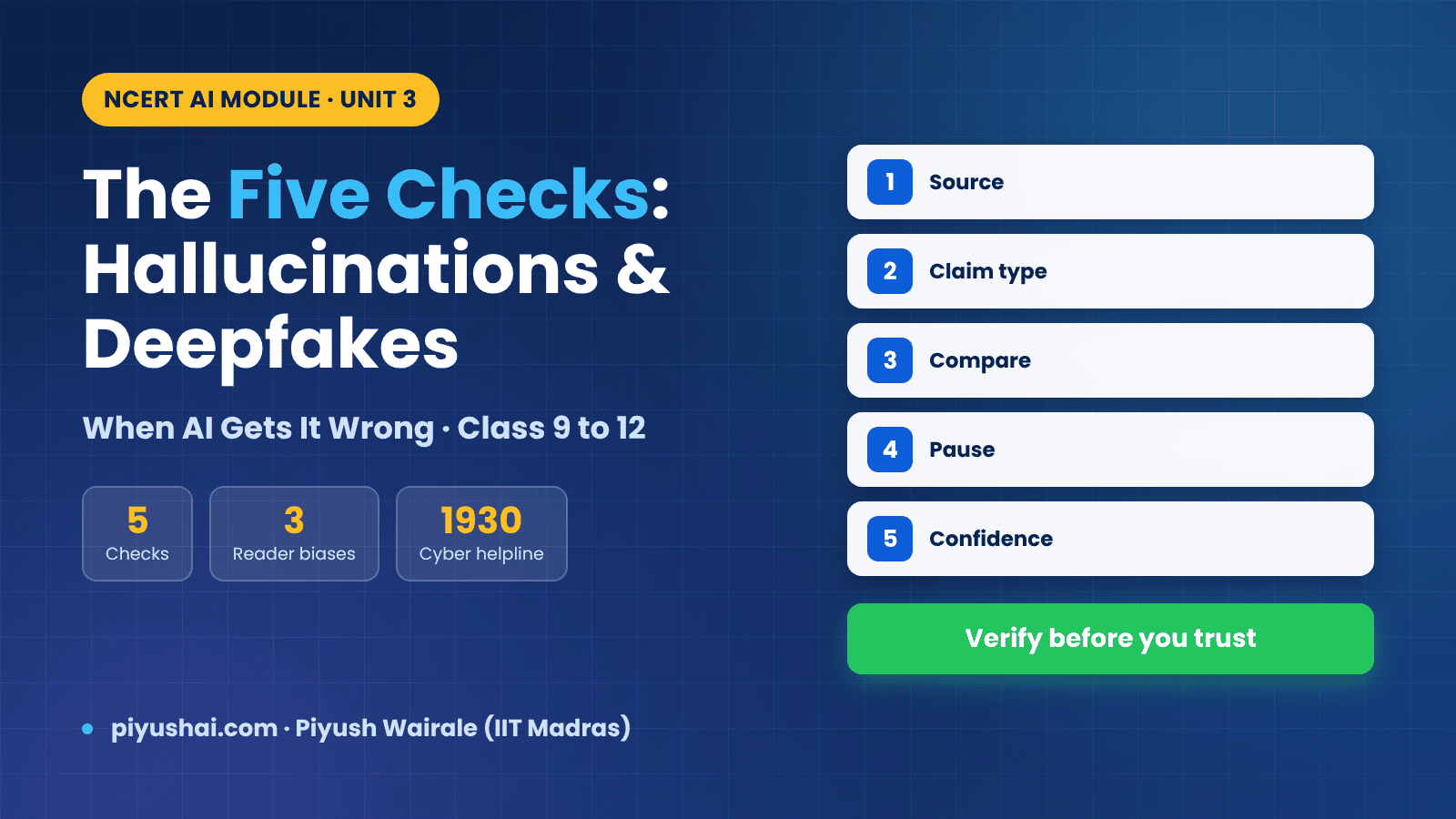
Unit 3 of NCERT’s new Computational Thinking and AI module is called “When AI Gets It Wrong”, and it may be the most useful single lesson any Class 9 to 12 student learns about AI. It teaches why AI systems can be confident and still wrong, how deepfakes work and where to report them, how our own minds fool us when reading AI output, and a five-step habit called the Five Checks for deciding whether to trust anything an AI produces.
This guide explains the whole unit in plain language for students, teachers and parents. If you are new to the module, start with our complete guide to the NCERT CT and AI module for Classes 9 to 12.
Unit 3 is on pages 39 to 53 of the official NCERT textbook
⬇ Download Official NCERT Textbook (PDF)Unit 3 at a glance
| Central question | How do we check confidence? |
| Computational thinking habit | Evaluation (with algorithmic thinking) |
| Teaching time | 5 of the 20 hours (Hours 9 to 13) |
| Sections | 3.1 Confident but Wrong, 3.2 Why models fail, 3.3 Deepfakes and Synthetic Media, 3.4 Where Your Own Thinking Enters, 3.5 The Five Checks, 3.6 What Good Evaluation Means, 3.7 Your Careful-use Checklist |
| Portfolio output | Personal Verification Checklist, plus an optional Hallucination Hunt |
Confident but wrong: a problem you and machines share
The unit opens with the Müller-Lyer illusion: two lines of equal length that look different because of the arrowheads at their ends. Even after you measure them and know they are equal, one still looks longer. NCERT uses this to make a simple point: feeling sure is not the same as being right. Humans produce false certainty, and so do machines. Learning to spot it in yourself makes it easier to spot in an AI tool.
Why AI models fail: five named reasons
| Failure | What it means | Example from the module |
|---|---|---|
| Hallucination | An AI assistant produces fluent, confident text containing invented facts, names, dates or sources | Most common for specific facts the model was not well trained on: a small town, a little-known person, a narrow topic |
| Distribution shift | The real-world input differs from what the system was trained on | A face system trained on indoor photos struggles with an outdoor photo at dusk; a spam filter falls behind as spam changes |
| Edge cases | Examples that sit right on the boundary between two categories | A mango that is half green and half golden: ripe or unripe? |
| False positives and false negatives | Flagging something that should not be flagged, or missing something that should be caught | A UPI safety check holding a routine payment (false positive); face recognition failing in poor light (false negative) |
| Overconfidence on small evidence | A high score that measures pattern match, not the chance of being correct | “This face matches: 92 per cent” does not mean it is right 92 times out of 100 |
An important point for students: a hallucination is not the AI “lying”. The system produces the most plausible-looking continuation from patterns in its training data, and sometimes that continuation is an invented fact. The effect on a reader who trusts it is the same.
The module’s Myth/Reality box puts it well. Myth: if an AI gives an answer with 97 per cent confidence, it is probably right. Reality: unless the system has been carefully calibrated, that number is an internal score, not a reliable probability. Treat it as a clue, not a verdict.
Deepfakes and synthetic media
NCERT separates two terms. Synthetic media is any video, audio or image generated or altered by AI, and it has many harmless uses, such as dubbing a film into many languages or restoring old footage. A deepfake is a harmful kind of synthetic media: AI-generated or manipulated media of a real person, usually made to deceive or shared without their consent.
The unit names three harms clearly:
- Fraud: a scammer phones an older relative using an AI-cloned voice of a family member and asks urgently for money.
- Image deepfakes: a person’s face placed onto another body without consent. The targets are overwhelmingly women and girls, and the harm is real even though the image is fake.
- Fake content of well-known people: fabricated video or audio of a public figure that spreads faster than anyone can check it.
If a student comes across such material, the module’s instruction is clear: do not forward it, tell a trusted adult, and report it on the National Cyber Crime Reporting Portal at cybercrime.gov.in or call the helpline 1930.
Classroom activity: Spot the Manipulation
Students watch a short public clip (a press conference, a news bulletin, a documentary segment, never classmates or private individuals) once normally, then again looking at one detail at a time:
- the eyes and the reflections in them
- the mouth and how it shapes each word
- the hairline and the edges of the face
- the skin texture
- the lighting on the face compared with the background
- whether the voice matches the mouth movements
Most clips will be real, and that is the point. The goal is not to find a deepfake but to build the habit of looking at the parts rather than trusting the whole. Without a projector, the same check works on a printed photo. NCERT adds an honest warning: modern synthetic media may show no visible flaws at all, so looking closely is the start of verification, not the whole of it.
Where your own thinking enters: three reader biases
An AI output is produced for a reader, and how carefully that reader reads often decides whether a wrong answer is caught. The module names three biases to watch for:
- Confirmation bias: we check less when the AI agrees with what we already believe.
- Anchoring: the first version we read shapes how we read everything after it. If an AI says a poem is “about loss”, you may miss the humour in it.
- Authority overtrust (automation bias): neat formatting and exact-looking figures make an answer feel expert, so questioning it can feel almost rude.
These biases get stronger when we are tired, hurried or already half-convinced, which is exactly when to be most careful.
The Five Checks: NCERT’s verification habit
This is the heart of the unit. The Five Checks work for any AI output: a chatbot paragraph, a translation, a photo, a video or a recommendation. Once practised, all five take only a few minutes.
| Check | The question | What to actually do |
|---|---|---|
| 1. Source | Where did this come from? | Which tool, and when? Was it copied, edited or forwarded before reaching you? Every step on that path is a place it could have changed. |
| 2. Claim type | What kind of claim is this? | Easy to check (“Bhopal’s Upper Lake is one of India’s oldest man-made lakes”), harder (“this idea was first proposed by…”), or unverifiable (“the poet was thinking of his mother”). Treat unverifiable claims as opinion. |
| 3. Compare | Do other sources agree? | If the AI cited a source, open it and confirm it says that. For important claims, check at least two independent sources: a textbook, a reliable website, a teacher. |
| 4. Pause | Am I confident enough to put my name to it? | Re-read before you forward, share or submit. Forwarding an unchecked claim makes you a link in the chain that spreads it. |
| 5. Confidence | How sure am I, honestly? | When you pass something on, say so: “I think this is right, but I have not double-checked.” Overstated confidence makes uncertain information look certain. |
Notice the design: the first three checks examine the AI’s output, and the last two examine your own behaviour. The output can be wrong, but how you treat it decides what happens next. NCERT compares the whole routine to looking both ways before crossing a road: slow and deliberate at first, then automatic.
Worked example: a forwarded video of a politician
This is one of the unit’s own assignment questions. Here is how the Five Checks apply:
- Source: who forwarded it, and where did they get it? Is there an original upload from a known news organisation or the politician’s official account?
- Claim type: it is a specific factual claim (“this person said this, on this occasion”), so it calls for a specific check.
- Compare: has any reliable news outlet reported the statement? Does the full, longer video exist, and does the clip match it?
- Pause: an inflammatory clip is designed to be forwarded quickly. That urge is the signal to stop.
- Confidence: if you mention it at all, say what you could and could not confirm.
What “good” means when evaluating AI
Section 3.6 shows that accuracy alone is not enough. A system that is 99 per cent accurate can still be dangerous if the one mistake is a confident wrong medical diagnosis. The module introduces four other standards:
- Fairness: does it work equally well across different groups of users?
- Robustness: does it stay accurate when the input changes a little?
- Calibration: when it says 90 per cent sure, is it right about 90 per cent of the time?
- Explainability: can a person understand why it produced this answer?
A medical screening tool may put robustness and calibration first; a courtroom support tool needs explainability above almost everything. These trade-offs are decided by people, not by the system.
Stretch for Class 12: confusion matrix, precision and recall
| Should have been flagged | Should not have been flagged | |
|---|---|---|
| System flagged it | True positive | False positive |
| System did not flag it | False negative | True negative |
Precision asks: of everything the system flagged, how much was really a problem? Recall asks: of all the real problems, how many did it catch? Improving one often worsens the other. A sensitive medical screening test has high recall but flags many healthy people; a cautious spam filter has high precision but lets some spam through. Students preparing for engineering or data science later will meet these again in detail.
Your Careful-use Checklist
Section 3.7 gives a starter checklist that students adapt into their own one-page version for the Curious Notebook:
| Habit | When to use it |
|---|---|
| Read it twice | Before trusting any AI output: once for the gist, once for the specifics |
| Find one independent source | For any specific factual claim that matters |
| Spot-check two or three details | For long outputs, where hallucinations hide |
| Check the dates | For prices, leaders, scores and recent events |
| Ask what kind of claim it is | Fact, opinion or taste need different checks |
| Pause before forwarding | Always |
| Mark your confidence | Whenever passing anything on |
| Take longer on high-stakes topics | Medical, legal, financial, or anything affecting another person |
The module’s Inclusivity Lens adds a thoughtful note: most fact-checking sources are in English or behind paywalls, so a reader working in Manipuri or Santali, or using a screen reader, has fewer sources to compare against. Students are asked to include at least one habit almost anyone can use, such as asking a knowledgeable person, a library or a public broadcaster.
The Hallucination Hunt
The unit’s optional portfolio challenge is the Hallucination Hunt. Students pick an area they know well (a sport, a regional festival, a local historical figure, their school’s history), ask an AI assistant five detailed questions, and sort the answers into right, wrong and hallucinated. For at least two claims they must show the independent source used to check it, and for each wrong answer they name the type of error: hallucination, distribution shift, edge case, or overconfident but vague.
Teacher tip: a local topic works far better than a famous one. AI tools are usually strong on well-known facts and weakest on the small town, the local temple or the school’s founding year, which is exactly where students know more than the machine. That reversal is the lesson. Without devices, run one Hunt on the projector and let students write their own observations.
Practice questions from Unit 3
- In your own words, what is a hallucination in an AI assistant? Give one situation where it would matter and one where it would not.
- Give an example of a confident-but-wrong moment from your own life, and a hesitant-but-right one.
- Which of the three reader biases are you most likely to fall into, and why?
- Walk through the Five Checks on a forwarded video of a politician saying something inflammatory.
- An AI summarises a 2,000-word article you have not read. Name three things you would check in the summary and why.
- Stretch: a school allows AI assistants for assignments if output is verified before submission. Would this work? What would make it succeed or fail?
Frequently asked questions
What are the Five Checks in the NCERT AI module?
Source, Claim type, Compare, Pause and Confidence. The first three check the AI’s output; the last two check your own behaviour before you share or rely on it.
What is an AI hallucination?
When an AI assistant produces confident, fluent text that contains invented facts, names, dates, quotations or sources. It happens because the system generates plausible continuations from patterns, not because it intends to deceive.
What is the difference between synthetic media and a deepfake?
Synthetic media is any AI-generated or AI-altered video, audio or image, and has many legitimate uses. A deepfake is a harmful kind of synthetic media of a real person, usually made to deceive or shared without consent.
Where can students report a deepfake in India?
On the National Cyber Crime Reporting Portal at cybercrime.gov.in, or by calling the cyber helpline 1930. Students should not forward the material and should tell a trusted adult.
Does a 95 per cent confidence score mean the AI is right?
Not necessarily. Unless the system is calibrated, the score shows how strongly the input matched a pattern, not the probability of being correct. Treat it as a clue, not a verdict.
More on the NCERT CT and AI module: Complete module guide + PDF · Unit 2: Train and Break experiment · 20-hour lesson plan for teachers
PiyushAI offers CT and AI teacher training and the PiyushAI School Lab for schools. Founded by Piyush Wairale (M.Tech, IIT Madras).
Source: NCERT, An Introductory Module on Computational Thinking and Artificial Intelligence for the Secondary Stage (Grades 9 to 12), Unit 3, First Edition, October 2026 (ncert.nic.in).
Recent Post
Gemini 4 Carbon is Google DeepMind's new frontier model, ranked first on the Artificial Analysis Intelligence Index v5.0 but released only to vetted cyber defenders for now. Here is what it is, how it works, benchmarks, pricing, limits, safety and what it means for Indian students.
DeepTutor, the open-source AI tutor from the University of Hong Kong, hit number one on GitHub trending in late October 2026. Here is what DeepTutor is, how it works, how to install it, what its research really shows, the privacy risks, and what it means for Indian students and teachers.
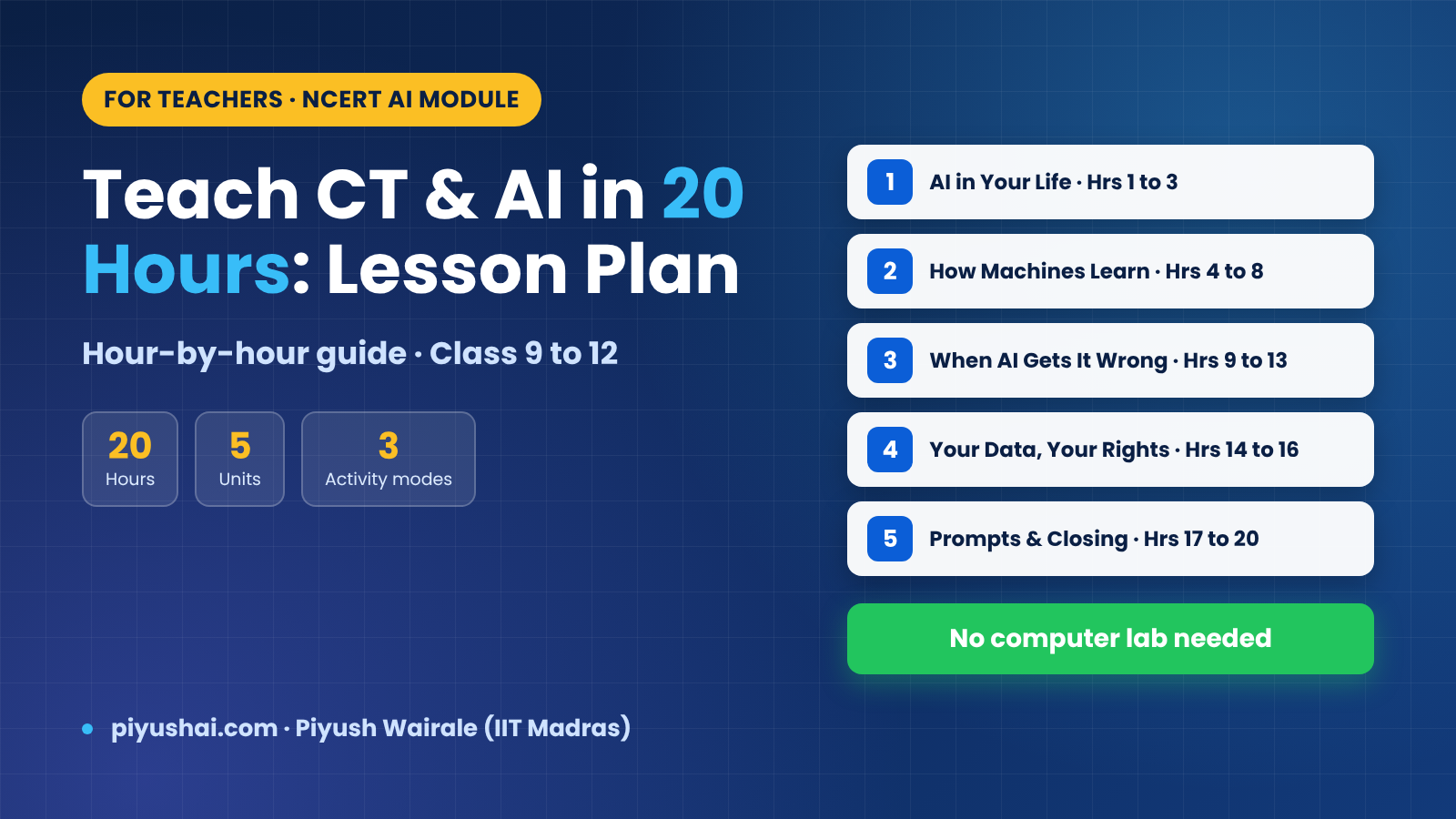
An hour-by-hour plan for teaching NCERT's 20-hour Computational Thinking and AI module to Classes 9 to 12, based on the official Note for the Teacher. Covers the three activity modes, core and enrichment activities for every hour, Curious Notebook assessment, handling sensitive topics, and practical tips for schools with no computer lab.
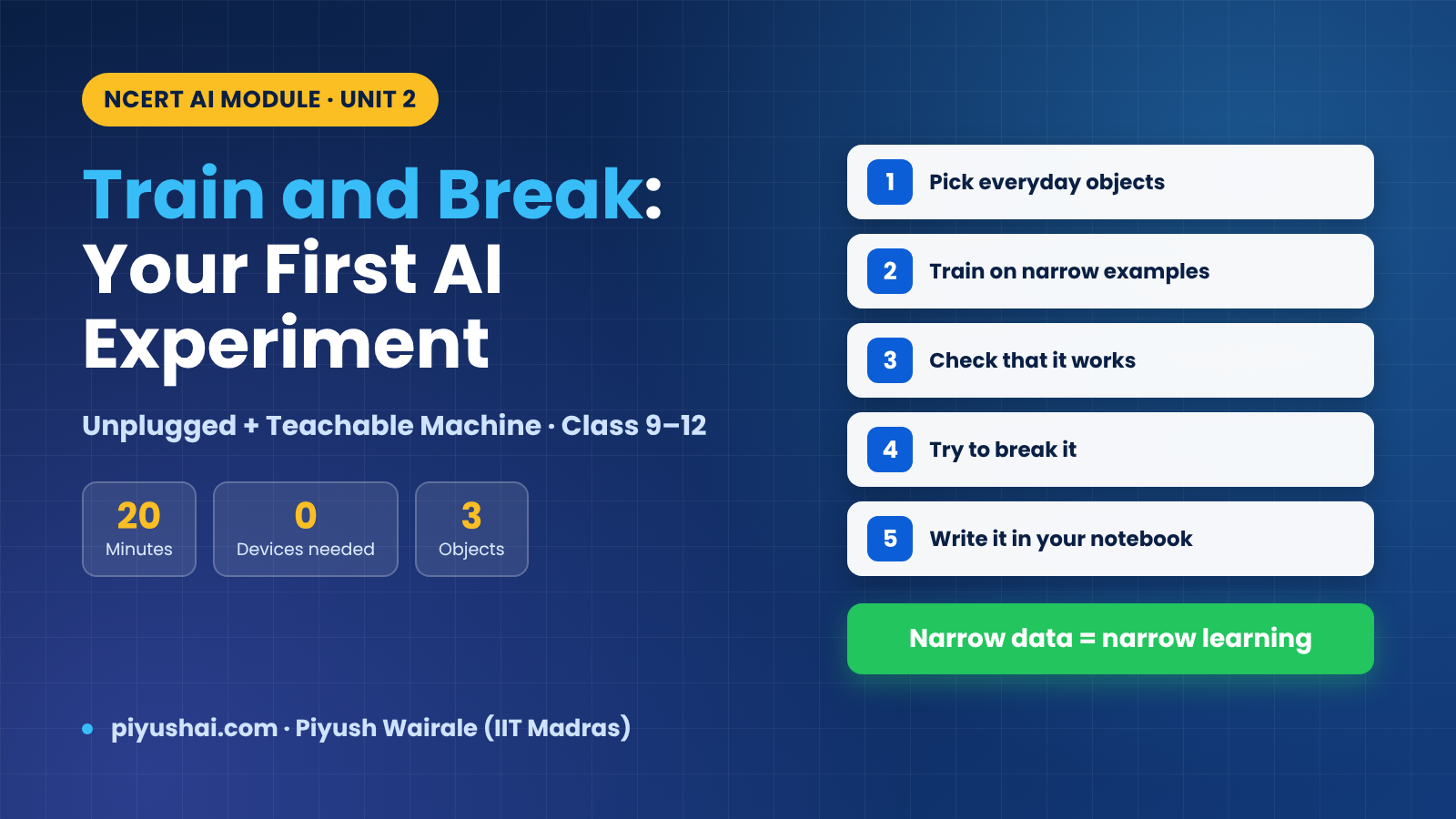
Train and Break is the main hands-on activity in Unit 2 of NCERT's Computational Thinking and AI module for Classes 9 to 12. Here is how to run it step by step, both as the unplugged Human Classifier and on a free image-classifier tool, plus the concepts it teaches (training, validation, test and live data, overfitting) and the Curious Notebook write-up.
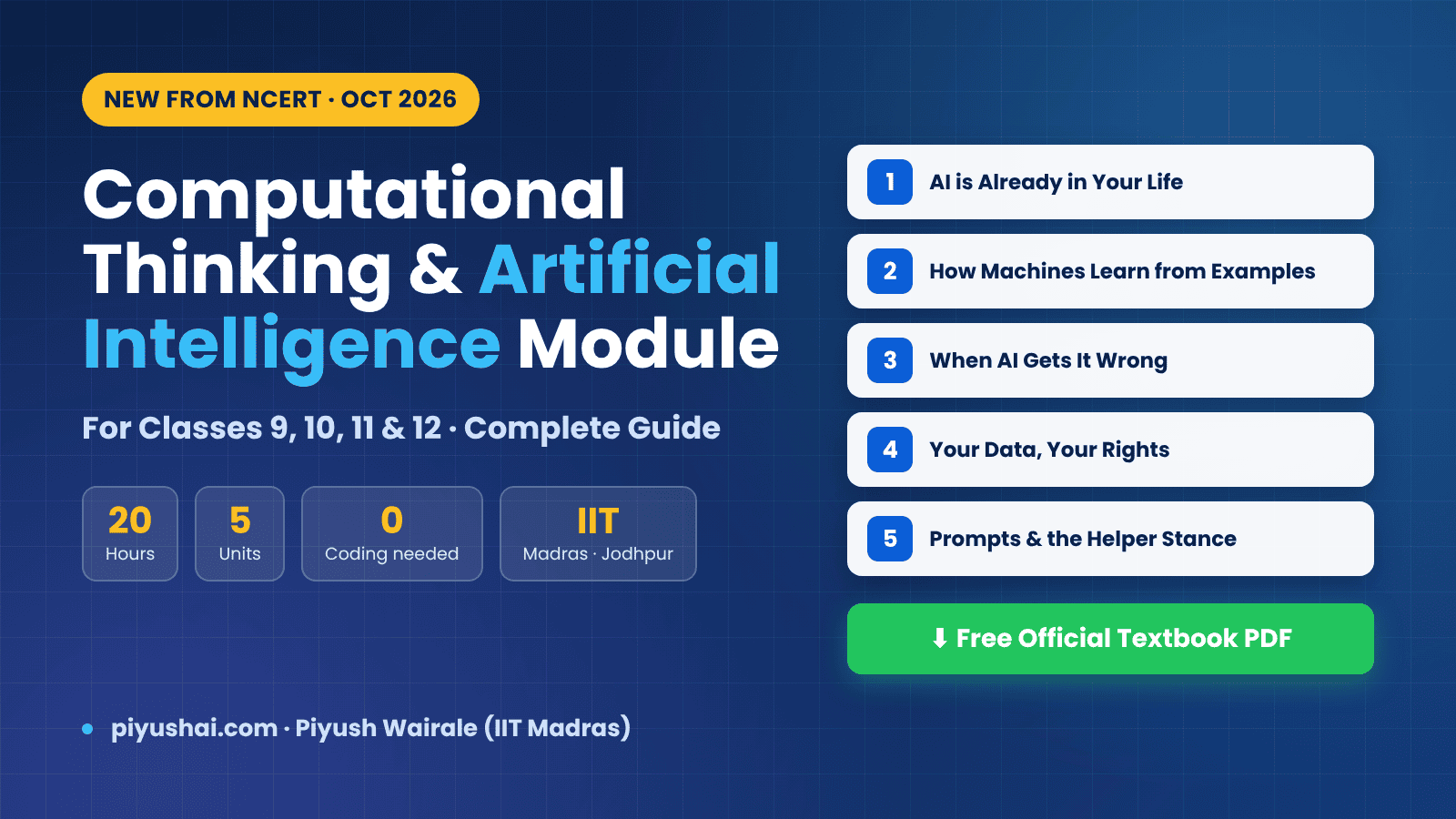
NCERT has released a 20-hour, five-unit Computational Thinking and AI module for Classes 9 to 12, developed with IIT Madras and IIT Jodhpur. Here is the complete unit-wise breakdown, the 20-hour plan, the Five Checks, the Curious Notebook assessment, and the official NCERT textbook PDF download.
A complete five-hour teaching guide for Chapter 4 of CBSE Class 6 AI: digital footprints, privacy, passwords, online safety and ethical use of technology. Includes period plans, six diagrams, three unplugged activities, a worksheet with answer key, misconceptions, a rubric and India-specific reporting channels for schools.
Learn Daily, Wherever You Are
Free lectures, exam updates, PYQ discussions, and job alerts — delivered through our YouTube channel and Telegram communities.