
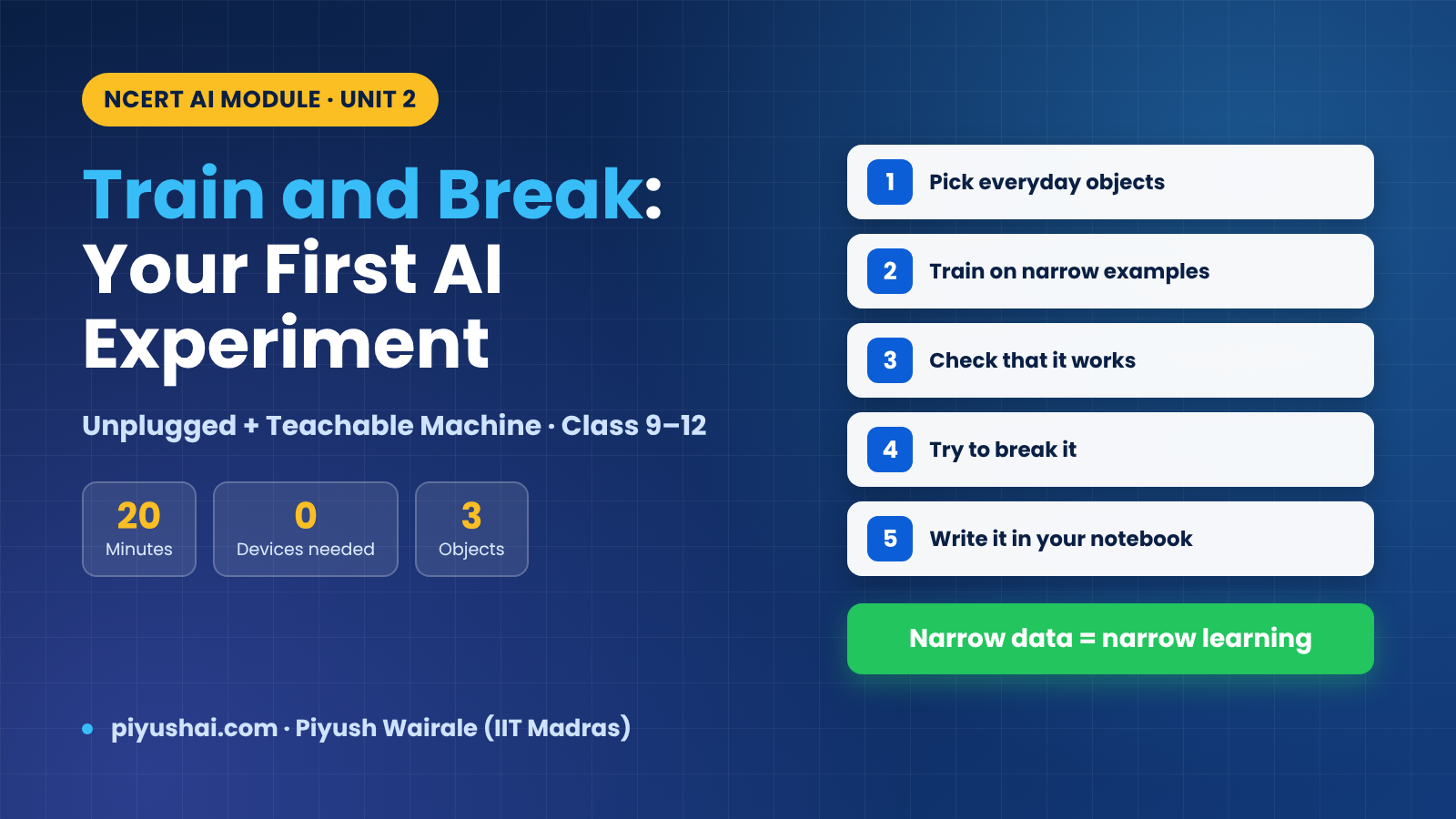
“Train and Break” is the first real AI experiment in NCERT’s new Computational Thinking and AI module for Classes 9 to 12. Students train a simple classifier on everyday objects and then deliberately try to make it fail. It is the main hands-on activity of Unit 2, “How Machines Learn from Examples”, and it can be run with no devices at all.
This guide explains the idea behind the activity, gives step-by-step instructions for both the unplugged and the computer versions, and covers the Curious Notebook write-up. For the full module overview, see our complete guide to the NCERT CT and AI module.
Train and Break is Section 2.9 (pages 33 to 38) of the official NCERT textbook
⬇ Download Official NCERT Textbook (PDF)The story behind it: Karthik’s afternoon
The module introduces the activity through Karthik, a Grade 10 student in Visakhapatnam. In his robotics club he trains a no-code image classifier on three things from his desk: his blue pen, his red pen and his eraser, with twenty photos of each from different angles. It works beautifully.
Then he tries to break it. Against a white wall instead of his green desk: still works. Held sideways: still works. Then he holds up a friend’s blue pen of a different brand, and the classifier says “eraser”.
Why? All twenty blue-pen photos were of his own pen. The classifier never learned the concept “blue pen”. It learned “Karthik’s pen”. To Karthik, a different brand of pen is obviously still a pen. To a system that does not understand what a pen is, the difference was everything. As NCERT puts it, this is the whole unit in one afternoon: a learning system can be excellent on its training examples and unhelpful on the cases you actually care about.
The concepts students need first
By Section 2.9, students have already met the ideas the experiment tests. A quick recap:
- Rules versus learning from examples (2.2): a rule-based system follows rules a person wrote; a learning system finds patterns in examples.
- Examples, features, labels and categories (2.3): each example carries a label; the system works out which features separate the categories.
- Bias from training data (2.5, 2.6): uneven examples produce uneven performance, and the categories themselves are human choices.
- Recognising is not understanding (2.7): a system that has classified ten million cat photos does not know that a cat is alive, purrs or catches mice.
- Three ways machines learn (2.8): supervised (labelled examples), unsupervised (finding groups without labels) and reinforcement learning (learning by trying). Train and Break uses supervised learning.
The four kinds of data, using Karthik’s project
| Kind of data | What Karthik used | What it is for |
|---|---|---|
| Training data | 20 labelled photos each of the blue pen, red pen and eraser, on a table in good light | The system learns from these |
| Validation data | 5 more photos of each, kept aside during training | Checking progress and adjusting settings during training |
| Test data | 5 photos of each, on a different day in different light, hidden until the end | Judging, once, how well it actually learned |
| Live data | Anything shown later: a friend’s pen, a different eraser | What the system meets in real use |
NCERT’s analogy for validation data is a good one to use in class: it is the rehearsal audience for the school play, honest and helpful, but not the final show. And if a system does well on training data but badly on test data, it has overfitted: memorised the examples instead of learning the pattern, much like cramming for an exam.
A safety rule before you start
Use only everyday objects: pens, erasers, books, water bottles, fruit. Never use faces, classmates, Aadhaar or ID cards, or personal documents as things to classify, in any version of the activity. In the camera version, if a phone is one of the objects, switch it off first so no notifications or photos appear. The lesson works just as well with objects, and it builds the right habit from the start.
Version 1: The Human Classifier (unplugged, about 20 minutes)
This is the main version and needs nothing but objects already in the classroom. A few students act as the “learning system” and learn only from the examples they are shown.
- Set up: choose three or four students as the “classifier” and bring them to the front. Pick one category, for example “pen”. The rest of the class is the trainer.
- Train: show the classifier group eight to ten pens that are deliberately similar, say all blue ballpoints of the same kind. Each time the class says “this is a pen”. Show a few non-pens too (an eraser, a ruler) and say “this is not a pen”. The classifier group may watch but not ask questions.
- Test: show new objects one at a time and ask the group to call out “pen” or “not a pen”, with no help:
- another identical blue pen (they will likely get it right)
- a fat marker, a fountain pen, a pencil or an oddly shaped pen (they will hesitate or get it wrong)
- something pen-shaped that is not a pen, like a thin torch or a chopstick (they may wrongly say “pen”)
- Discuss: where did they get it right and where did they slip? Did they learn “pen” or “blue ballpoint pen”? What training examples would have taught the broader idea? How is this like, and unlike, how you learned what a pen is?
The lesson: a learning system, human or machine, learns from the examples it is given. Narrow examples produce narrow learning.
Teacher tip: the activity only works if the training set is genuinely narrow. Resist the urge to include “a few different ones to be fair”. The failure is the point, and the chopstick moment usually gets the biggest laugh and the clearest understanding.
Version 2: Train and break it on a computer
For classrooms with computers or tablets and internet, students repeat Karthik’s experiment with a free, no-code, browser-based image classifier. NCERT’s teacher plan names Teachable Machine as one option, and the textbook includes a QR code to a current tool and a ready-made demo.
- Work in pairs. Pick three objects from your desk.
- Take about 20 photos of each, then train the classifier.
- Test it on the same objects to confirm it works.
- Now try to break it: a different brand of pen, a different-coloured eraser, a friend’s book, a new background, different lighting.
- Note what worked, what failed, and why.
For an enrichment round, NCERT suggests “What Changed?”: retrain the classifier with more varied data (several brands of pen, several backgrounds) and test the same breaking cases again. Students see the fix work, and also see how much effort varied data takes.
If there is only one screen, run Version 2 as a teacher demo after the class has done Version 1. NCERT’s guidance across the module is to “change the mode, not to leave out the unit”.
The Curious Notebook write-up
Straight after the activity, each student writes three lines: one example that worked surprisingly well, one that broke surprisingly easily, and one sentence on why it broke. These are reused in Unit 3, where Karthik’s “it looked confident and was wrong” becomes the central problem of trusting AI.
The unit’s portfolio piece is a one-page Train-and-Break Notes in four parts:
- (a) What three things did you classify, and why did you choose them?
- (b) Two examples where the classifier worked well. What did it get right?
- (c) Two examples where it broke. What was different about those cases?
- (d) One sentence on what you would do differently if you trained it again, and what examples you would add.
Why this matters for India
The module draws the lesson out to real stakes. Indian languages, faces, handwriting, crops and dialects all need to be in the training data if a system is to work for the people who use it. Bhashini, for example, works very well for some Indian language pairs and is still improving for others, largely because of how many examples exist for each pair. A system trained on a narrow group works less well for everyone else. The fix is simple in principle (collect varied examples) and hard in practice (it takes time, effort and money). As NCERT tells students, the examples they choose to gather in their working lives will decide who these systems end up working for.
Practice questions from Unit 2
- What is the difference between a rule-based system and a learning system? Give one everyday example of each.
- A friend says “my phone’s face unlock learns my face every time I use it”. Is this likely true? What would you check?
- Give one situation where treating recognition as understanding could cause a real problem.
- Why might Bhashini work better for some Indian language pairs than others? What would it take to close the gap?
- Three classmates give you 100 handwriting samples each. Predict two ways the classifier might surprise you when a fourth classmate writes a sample.
Frequently asked questions
What is the Train and Break activity in the NCERT AI module?
It is the main hands-on activity of Unit 2, where students train a classifier on everyday objects and then deliberately try to make it fail, to see that a learning system only learns what its examples show.
Can Train and Break be done without computers?
Yes. The main version is the unplugged Human Classifier, where a group of students act as the learning system. It takes about 20 minutes and needs only classroom objects.
Which tool can be used for the computer version?
Any free, no-code, browser-based image classifier. NCERT’s teacher plan mentions Teachable Machine, and the textbook provides a QR code to a current tool and demo.
What is overfitting, in simple terms?
When a system memorises its training examples instead of learning the general pattern, so it does well on those examples and badly on anything new. NCERT compares it to cramming for an exam.
Why should students not use faces in the activity?
Faces, classmates and ID documents are personal data. Everyday objects teach exactly the same lesson while building safe data habits from the start.
More on the NCERT CT and AI module: Complete module guide + PDF · Unit 3: The Five Checks and deepfakes · 20-hour lesson plan for teachers
PiyushAI offers CT and AI teacher training and the PiyushAI School Lab for schools. Founded by Piyush Wairale (M.Tech, IIT Madras).
Source: NCERT, An Introductory Module on Computational Thinking and Artificial Intelligence for the Secondary Stage (Grades 9 to 12), Unit 2, First Edition, October 2026 (ncert.nic.in).
Recent Post
DeepTutor, the open-source AI tutor from the University of Hong Kong, hit number one on GitHub trending in late October 2026. Here is what DeepTutor is, how it works, how to install it, what its research really shows, the privacy risks, and what it means for Indian students and teachers.
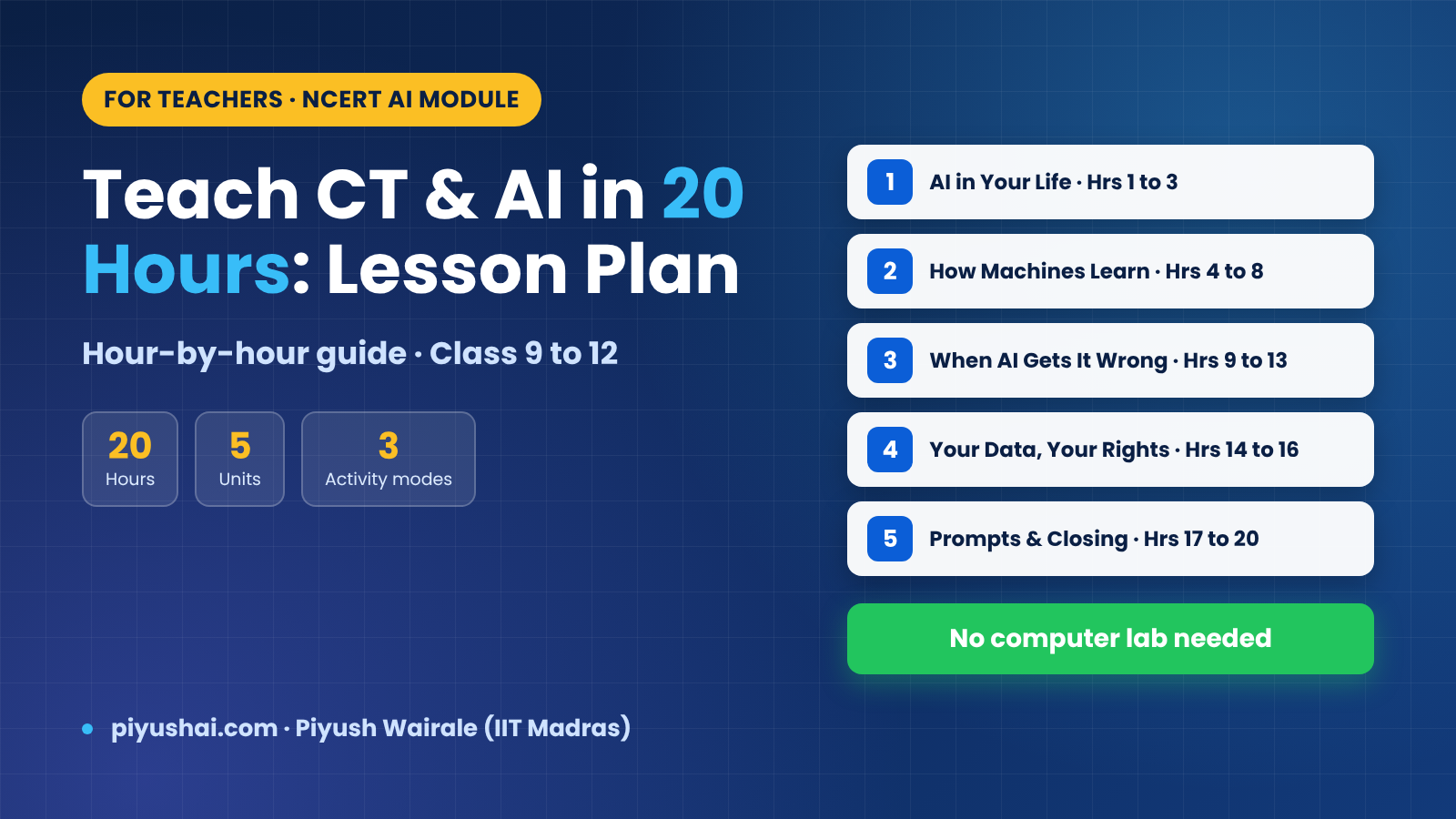
An hour-by-hour plan for teaching NCERT's 20-hour Computational Thinking and AI module to Classes 9 to 12, based on the official Note for the Teacher. Covers the three activity modes, core and enrichment activities for every hour, Curious Notebook assessment, handling sensitive topics, and practical tips for schools with no computer lab.
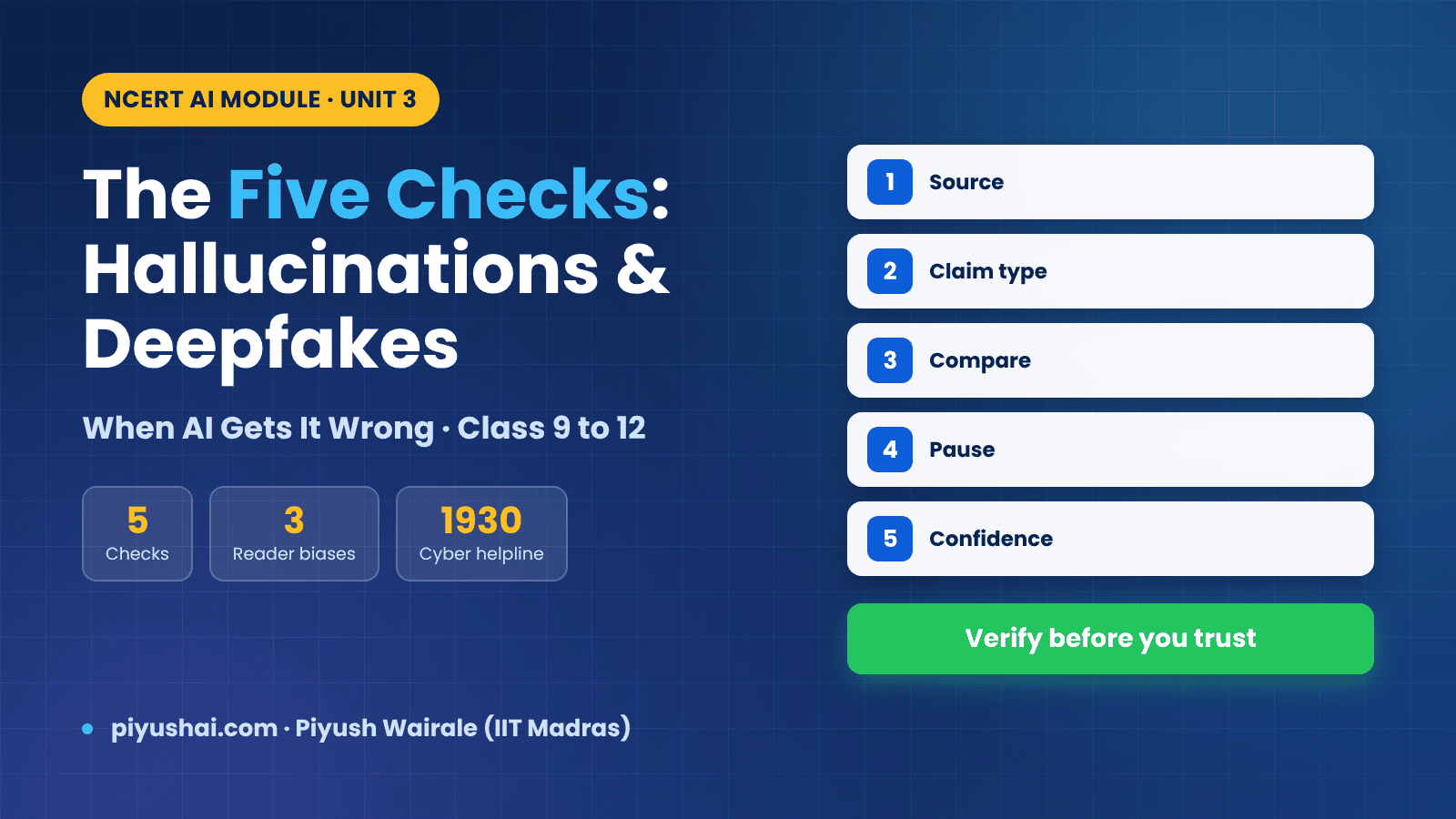
Unit 3 of NCERT's Computational Thinking and AI module, "When AI Gets It Wrong", teaches Class 9 to 12 students why AI is confidently wrong, how deepfakes work, the three reader biases, and the Five Checks: Source, Claim type, Compare, Pause and Confidence. Full explainer with the Hallucination Hunt activity and answers to the unit's key questions.
NCERT has released a 20-hour, five-unit Computational Thinking and AI module for Classes 9 to 12, developed with IIT Madras and IIT Jodhpur. Here is the complete unit-wise breakdown, the 20-hour plan, the Five Checks, the Curious Notebook assessment, and the official NCERT textbook PDF download.
A complete five-hour teaching guide for Chapter 4 of CBSE Class 6 AI: digital footprints, privacy, passwords, online safety and ethical use of technology. Includes period plans, six diagrams, three unplugged activities, a worksheet with answer key, misconceptions, a rubric and India-specific reporting channels for schools.
CBSE Class 6 AI Chapter 3 gives five hours to simple pattern recognition and decision making. This guide covers what the syllabus asks, six diagrams you can copy to a blackboard, a period-by-period plan, three unplugged activities, a worksheet with answers, misconceptions, a rubric and interdisciplinary project ideas.
Learn Daily, Wherever You Are
Free lectures, exam updates, PYQ discussions, and job alerts — delivered through our YouTube channel and Telegram communities.

[…] on the NCERT CT and AI module: Complete module guide + PDF · Unit 2: Train and Break experiment · 20-hour lesson plan for […]