Last updated: 24 October 2026
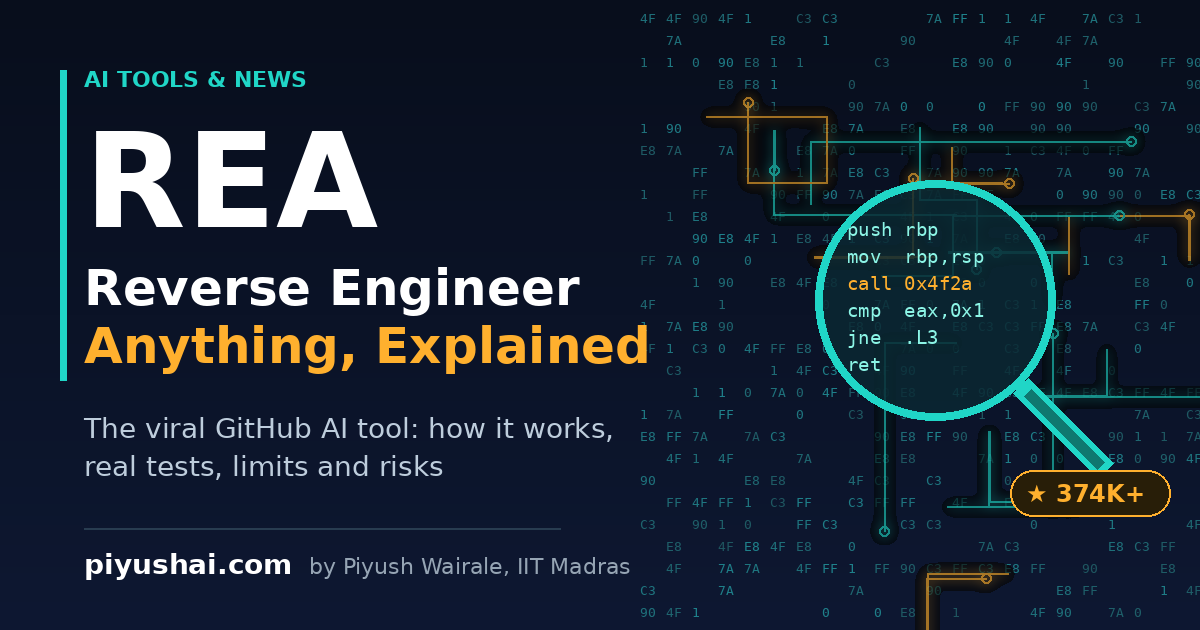
In the first three weeks of October 2026, an open-source project called REA, short for Reverse Engineer Anything, became one of the fastest-growing repositories in GitHub history. On 6 October it had fewer than 10,000 stars. By 12 October it had crossed 110,000, by 17 October it was past 290,000, and as of today the official repository morluto/rea shows roughly 374,000 stars and 93,000+ forks.
The pitch is simple and provocative: see a feature you like in any app, and let your AI coding agent work out how it is built, right down to the binary, then help you build your own version. That pitch has excited developers, worried software companies, attracted malware scammers and started a serious debate about where legitimate reverse engineering ends and cloning begins.
In this post I break down what REA really is (and is not), how it works under the hood, how to set it up, what independent testers found, the security and legal risks, and why I think every computer science, GATE DA and cybersecurity student in India should understand this moment.
Quick summary
- What it is: An MCP (Model Context Protocol) server plus a set of agent workflow instructions (“skill”) that lets AI coding agents such as Claude Code, Codex, Cursor and Gemini CLI call professional reverse-engineering tools.
- What it is not: A new decompiler. It orchestrates existing engines like Ghidra, IDA Pro and Hopper.
- Licence and install: MIT licensed, free, distributed as the npm package
rea-agents. Setup isnpx rea-agents setup. - Origin: The repository was created on 14 April 2026 by developer morluto, the npm package dates from July, and it only went viral in October.
- Reality check: It returns pseudocode, assembly, module maps and evidence, not the original source code. Results on large, obfuscated or exotic targets are mixed.
- Warning: A fake copy of the repository distributed a Windows trojan. Install only from the official GitHub repo, rea.tools, or the
rea-agentsnpm package.
What is reverse engineering, in one paragraph?
When developers ship software, they usually ship the compiled result (a .exe, an Android APK, a bundled Electron app), not the human-readable source code. Reverse engineering is the discipline of working backwards from that shipped artefact to understand how it works: reading machine instructions, decompiling them into approximate C-like pseudocode, tracing which function calls which, watching network traffic and runtime behaviour. It has always been central to malware analysis, security auditing, interoperability (making your software talk to someone else’s), repairing abandoned hardware and preserving old games. It has also always been slow, expert work. That is precisely the barrier REA attacks.
How REA works
REA sits between your AI agent and a toolbox of analysis engines. The flow looks like this:
- You ask a question in plain language, for example: “Understand how search works in this notes app, show me the evidence, and build a similar feature for my project.”
- The agent calls REA through MCP. MCP is the open standard that lets AI agents use external tools. REA exposes a large catalogue of analysis tools (independent testers counted around 200 in recent versions).
- REA routes the job to the right engine. For a native binary it drives Hopper, Ghidra or IDA (or GNU objdump and Rizin for offline inspection). For JavaScript or Electron apps, .NET assemblies, PyInstaller executables and many file formats, it uses built-in static parsers with no external engine required.
- REA returns findings with evidence. Pseudocode, assembly, strings, symbols, call graphs, imports, IPC routes and so on, along with the limitations of each conclusion.
- The agent reasons over the evidence, asks follow-up questions of the tools, explains the behaviour to you, and can write and test an independent implementation.
A useful idea that comes through in coverage of REA’s workflow is the separation of findings into what was directly seen, what was inferred, and what remains unknown. AI agents are notorious for stating guesses with the same confidence as facts, so forcing that distinction is one of the more genuinely valuable parts of the design. Analysis runs locally on your machine, although whatever the tools return is sent to your agent’s model provider under that provider’s data policy.
What REA can analyse
The official README lists a remarkably wide range of targets. The main ones:
| Target | What you get back | Needs |
|---|---|---|
| Native binaries (Windows, macOS, Linux) | Pseudocode, assembly, strings, symbols, calls, references | Hopper, Ghidra or IDA |
| JavaScript / Electron apps | Modules, imports, source maps, routes, IPC, native add-ons | Node.js only |
| Websites | Page structure, scripts, network observations, screenshots | A Chrome-family browser |
| .NET assemblies | Metadata, CIL instructions, native dependencies | Nothing extra (static) |
| Android APKs and devices | Manifest, classes, decompiled methods, signatures; logs and dumps via adb | JADX and a JDK; adb for devices |
| Go and Rust binaries | Compiler version, modules and crate dependency info | Built-in |
| Firmware | Regions, extraction, hand-off to native analysis | Binwalk / Unblob on Linux |
| Network captures (HAR, pcap) | Requests, responses, endpoints, DNS, TLS SNI | tshark for pcap |
| AI model files (GGUF, safetensors) | Metadata, tensor declarations, totals | Built-in |
| Game formats (Unity IL2CPP, Godot PCK) | Type and method names, archive inventory | Built-in |
It also covers GPU code objects (CUDA and HIP), WebAssembly, EVM smart-contract bytecode, SQLite databases, Erlang BEAM files, PE certificates and imports, recorded Linux crashes and even recorded logic-analyser signals. Few human reverse engineers are fluent across all of these, which is exactly why pairing them with an agent is attractive.
How to set it up (official method)
REA needs Node.js 22, 24 or 26 (check the README for exact minimum point releases) plus npm.
# Guided setup: choose your agent, review proposed changes, approve
npx rea-agents setup

# Optional: install the CLI for regular terminal use
npm install --global rea-agents
rea --help

# Static analysis of an extracted JavaScript/Electron app, no native engine needed
npx -y rea-agents@latest analyze-javascript-application /absolute/path/to/app --json

# Keep it updated (releases are frequent)
rea update
Setup registers the MCP server with your chosen agent and backs up existing configuration. For deep native analysis you need one of Hopper, Ghidra or IDA. Ghidra, released by the US National Security Agency, is free and open source and is the sensible choice for students. Commercial tools like IDA Pro and Hopper must be properly licensed; the REA README states clearly that it grants no tool licences and that cracked copies or shared keys are not authorised.
The showcases: what REA has actually done
The project’s own case studies are deliberately narrow and verifiable:
- DX-Ball (1996 Windows game): REA followed a sound call into the helper that converts a ball’s position into stereo pan, and the reconstructed C passed 3,205 test cases against the original x86 code and reproduced all 63 compiled function bytes.
- Notion (Electron app): Traced how the clipboard API travels from the renderer through preload and IPC into the main process, and how the rich clipboard format is structured.
- TH04 (PC-98 era DOS game): Recovered 16-bit bullet-ring angle calculations and compared reconstructed C++ against historical compiler output.
Community projects have gone further. A Finnish developer, Tuomo Tuunanen, recreated the snowball-fight minigame from the 1990 game Ski or Die using REA and released the source. Others have used it to study obfuscated web frontends and rebuild individual app features such as a screen recorder’s floating camera bubble.
One widely shared result deserves careful framing. Reverse engineer Maurice Heumann ran a dozen Claude Code and Codex agents in parallel to reconstruct about 99% of a shooting game’s functions into C++, with 83% compiling byte-for-byte identical to the original. That is a stunning result, but he used Hex-Rays’ official IDA MCP integration, not REA. REA is the most famous name in this wave, but the underlying shift (AI agents driving decompilers) is bigger than any one repository.
What independent testers found: the limits
Stars measure curiosity, not capability. Hands-on reviews paint a more balanced picture:
- It does not recover original source code. Output is pseudocode, assembly and relationships between modules. Variable names, comments and the developer’s architecture are generally lost; the agent’s “rebuild” is a new implementation inspired by evidence.
- Static Electron analysis can miss things. A HackerNoon reviewer ran REA against a real 100 MB Electron app and checked its claims against the unpacked source with grep. Some counts were right, others (such as preload entry points and exposed API members) were reported as zero when they were not. To REA’s credit, it was explicit about what it had dropped, and when no native engine was installed it gave a clear “provider unavailable” error rather than guessing.
- It works best on narrow, well-defined questions. In a comparison on the bzip2 compression library, REA correctly traced a target function along with its callers and callees. Asking it to “clone this entire app” produces shallow, plausible-looking but fragile results.
- Weaker models struggle. Testers reported that some local open-weight models ignored REA’s tools entirely and even tried to read binary files as text. The quality of the agent model matters as much as the tool.
- Hard targets remain hard. Heavy obfuscation, anti-analysis protections, very large binaries and unusual architectures still need skilled humans.
The fair summary: REA has dramatically lowered the barrier to entry for reverse-engineering research and for building approximate substitutes of specific features. It has not made professional tooling or professional expertise obsolete, and it has not shown that large commercial software can be automatically “open-sourced”.
Security warning: the fake REA trojan
Viral projects attract impersonators. On 13 October 2026, a user reported a copy of the repository hosted under an organisation named “rea-tools” that mirrored the README but added a “Windows Standalone .exe” download section. That installer was flagged as malware by Microsoft Defender and multiple VirusTotal engines. The fake has since disappeared, but many look-alike repositories using names like “REA-Github” and “Reverse-Engineer-anything” still circulate.
Rules to follow:
- Install only from github.com/morluto/rea, rea.tools, or the
rea-agentspackage on npm. The official README now says this prominently. - The official project does not ship a graphical Windows “REA.exe” installer. Treat any such file as malware.
- Remember that any MCP server you connect gives your AI agent new powers on your machine. Understand what it can read and run before you connect it, and do not point agents at untrusted binaries on a machine holding sensitive data. Use a virtual machine for anything suspicious.
The ethics debate: preservation or “AI slop” cloning?
Reactions have split sharply. Supporters see REA as democratising a discipline long locked behind expensive tools and years of experience: repairing bricked IoT devices, keeping old software alive, auditing apps for privacy and security problems, and achieving interoperability with closed formats. Critics, including a widely discussed 404 Media piece, describe it as a new “Wild West” in which features are decompiled, cloned and repackaged at scale, potentially flooding the market with low-quality knock-offs and eroding the incentive to build original software.
Even within the project’s own discussions, maintainers and contributors have pushed back on requests to treat live commercial platforms as an extraction pipeline for building competitors. The project’s disclaimer limits intended use to lawful research, education, interoperability, preservation and analysis of software you own or are authorised to examine.
My view as an educator: the tool is neutral, the intent is not. Studying how something works and building your own independent implementation is how engineering has always progressed. Copying someone’s code, assets or brand, bypassing licence checks or breaking into systems is not engineering, and AI does not change that line.
Is reverse engineering legal in India?
This is general information, not legal advice. Consult a lawyer for any specific situation.
Indian law recognises some legitimate space for studying software. Section 52 of the Copyright Act, 1957 lists acts that are not infringement, and these include, for a lawful possessor of a program, acts needed to obtain information essential for interoperability with an independently created program (Section 52(1)(ab)), and observing, studying or testing a program’s functioning to determine the ideas and principles behind it (Section 52(1)(ac)). Ideas and functionality are generally not protected by copyright; specific code and creative expression are.
However, several things can still get you into trouble:
- Licence agreements (EULAs): Many commercial licences contractually prohibit reverse engineering.
- Unauthorised access: Probing servers, APIs or accounts you are not authorised to access can fall under the Information Technology Act, 2000 (for example Sections 43 and 66).
- Circumvention and piracy: Bypassing licence checks or protection measures, or redistributing copied code and assets.
- Trade secrets and patents: Functionality can be protected through other routes even when code is not copied.
The safe zone for students is clear: practise on your own programs, open-source software, intentionally vulnerable training binaries (CTF challenges, “crackme” exercises), and old software you lawfully own, and keep your work to understanding and independent re-implementation.
Why this matters for Indian students and educators
REA is a perfect case study of where AI is taking technical careers. Notice what it does not remove: the need to understand what the tools are telling you. An agent can hand you assembly and pseudocode in seconds, but deciding whether that evidence is right, whether an inference is safe to build on, and whether a result is legal and ethical still requires real fundamentals.
The subjects that make you good at this are the same ones in your syllabus:
- Computer Organisation and Architecture: instruction sets, registers, calling conventions, memory layout.
- Programming and Data Structures in C: pseudocode from decompilers looks like C; you must be able to read it fluently.
- Operating Systems: processes, system calls, linking and loading, executable formats like ELF and PE.
- Compiler Design: why compiled code looks the way it does, and why “byte-identical” reconstruction is so impressive.
- Computer Networks: reading packet captures and API traffic.
- AI agents and LLM behaviour: understanding hallucination, tool use and the seen/inferred/unknown discipline.
Cybersecurity roles in India, from SOC analysts and malware researchers to positions in organisations like CERT-In and the IT officer cadres of banks and PSUs, increasingly value exactly this mix of fundamentals and AI fluency. A practical learning path: learn C and basic x86 assembly, install Ghidra and solve beginner crackme challenges by hand, then add an AI agent with REA and compare what it finds with what you found. The comparison is where the learning happens.
Frequently asked questions
What does REA stand for?
Reverse Engineer Anything. The npm package is called rea-agents and the official site is rea.tools.
Is REA free?
Yes. REA’s own code is MIT licensed. Some engines it can drive, such as IDA Pro and Hopper, are commercial; Ghidra is free.
Which AI agents work with REA?
Any agent that supports local MCP servers. The setup wizard directly supports Claude Code, Codex, Cursor, Gemini CLI, Grok Build and others.
Can REA give me the source code of any app?
No. It gives evidence (pseudocode, assembly, module relationships, runtime observations). Any “rebuilt” feature is a new implementation, and its accuracy depends on the target, the agent model and your verification.
Does REA upload my files?
Analysis runs locally. The results the tools return go to your AI agent, so your model provider’s data policy applies to that output.
Is it safe to install?
The official package from the official repository is widely used. Fake copies have carried malware, so verify the source, avoid any standalone .exe installer, and analyse untrusted files only inside a virtual machine.
The bottom line
REA did not invent a new technology; it connected two existing ones, decompilers and AI coding agents, and made the combination one command away. That is why it went viral, and why it matters. For developers it is a powerful research assistant. For software companies it is a wake-up call that client-side code is less opaque than ever. For students it is a reminder that AI amplifies fundamentals rather than replacing them: the people who understand architecture, operating systems and compilers will get far more out of tools like REA than those who only know how to type a prompt.
Sources and further reading
- REA official repository (morluto/rea)
- KuCoin News: REA surges by 100,000 stars in a week
- HyperAI: REA goes viral, tests reveal limitations
- BigGo Finance: REA hits 327,000 stars
- HackerNoon: testing REA on a real Electron app
- Fact-check: what is true about REA, including the fake trojan copy
- 404 Media: “Reverse-Engineer Anything” is the new Wild West of AI
- KDnuggets: the rise of AI software clones
- MindStudio: how the REA workflow structures an investigation
Written by Piyush Wairale (M.Tech, IIT Madras), founder of PiyushAI Edtech. Star counts and version details change daily; figures are as reported on or before 24 October 2026.
Recent Post
Nothing Found
Learn Daily, Wherever You Are
Free lectures, exam updates, PYQ discussions, and job alerts — delivered through our YouTube channel and Telegram communities.