
Last updated: 28 November 2026
Preparing for BHEL ET Mechanical 2027? The BHEL ET Mechanical Test Series and Notes by Piyush Wairale (IIT Madras) has 30 tests on the official pattern (5 full mocks of 240 questions, 10 Mechanical subject tests, 5 reasoning, 5 English and 5 GK tests) plus detailed PDF notes built around the topics BHEL actually asks. Now Rs 199 (down from Rs 499). New to BHEL? Start with the free BHEL ET Mechanical PYQ 2025 PDF with solutions.
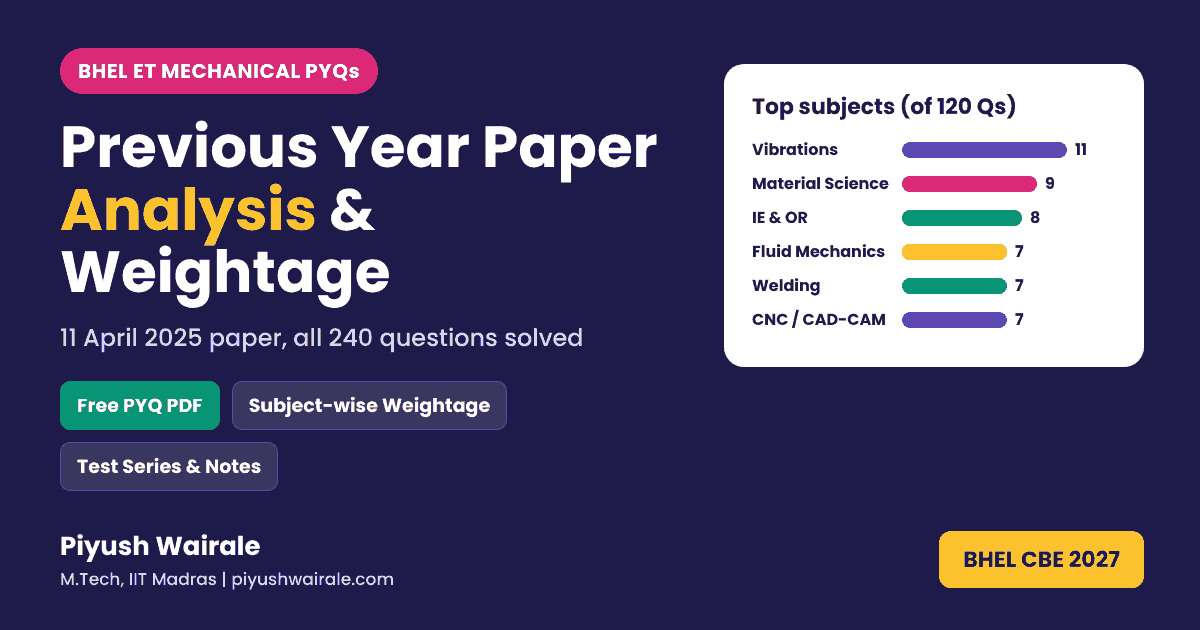
BHEL ET Mechanical PYQs are the best guide to what Bharat Heavy Electricals Limited asks in its Engineer Trainee exam. We solved and classified every question of the BHEL Engineer Trainee (Mechanical) paper held on 11 April 2025 (Shift 2): 120 Mechanical questions, 50 reasoning, 20 GK and 50 English. The short answer: Manufacturing, Materials and Industrial Engineering carry about 35% of the technical section, Vibrations is the single biggest subject (11 questions), and only 9 of 120 technical questions were numerical. The paper rewards wide, fact-level theory coverage far more than GATE-style long numericals.
Quick answer: BHEL ET Mechanical paper analysis (2025)
- Pattern: 240 MCQs in 150 minutes: Mechanical 120, Reasoning 50, General English 50, General Knowledge 20; +1 per correct answer, minus 1/4 per wrong answer, no calculator.
- Most-asked technical areas: Manufacturing and Materials (42 Qs incl. Industrial Engineering), Engineering Mechanics and Design (34), Mechanical Electives such as IC engines, hydraulics, safety and tribology (28), Fluid and Thermal Sciences (16).
- Top 5 subjects: Vibrations 11, Material Science 9, Industrial Engineering and OR 8, then Fluid Mechanics, Hydraulics and Pneumatics, IC Engines, Welding and CNC/CAD/CAM at 7 each.
- Question style: 111 of 120 technical questions are theory, definitions, formulas or one-step facts; only 9 needed calculation.
- Reasoning: half quantitative aptitude (25 Qs), half logical reasoning (25 Qs), with puzzles, alphanumeric series and coding in every set.
BHEL ET Mechanical Exam Pattern (as seen in the PYQ)
| Section | Questions | Marks | Share |
|---|---|---|---|
| Mechanical Engineering (Discipline) | 120 | 120 | 50% |
| Test of Reasoning and Aptitude | 50 | 50 | 20.8% |
| General English | 50 | 50 | 20.8% |
| General Knowledge | 20 | 20 | 8.3% |
| Total | 240 | 240 | 150 minutes |
The 11 April 2025 paper ran from 2:00 PM to 4:30 PM. That is about 37 seconds per question, so speed on theory questions matters more than depth on any one numerical. BHEL’s official pattern for 2027 (Advt. 02/2026) keeps the same 240-question, 150-minute structure with 1/4 negative marking. See the BHEL Engineer Trainee Mechanical 2027 recruitment guide for eligibility, dates and the official syllabus.
BHEL ET Mechanical Subject-wise Weightage (Technical Section)
Every one of the 120 Mechanical questions in the 2025 paper was mapped to a subject. Here is the weightage, highest first:
| # | Subject | Questions | Weightage |
|---|---|---|---|
| 1 | Vibrations (free, damped, forced, isolation, measurement) | 11 | 9.2% |
| 2 | Material Science (properties, heat treatment, polymers, superconductors, nanomaterials) | 9 | 7.5% |
| 3 | Industrial Engineering and Operations Research (LPP, assignment, PERT/CPM, queuing, inventory, forecasting) | 8 | 6.7% |
| 4 | Fluid Mechanics | 7 | 5.8% |
| 5 | Hydraulics and Pneumatics (valves, actuators, pumps, accumulators) | 7 | 5.8% |
| 6 | IC Engines and Automobile | 7 | 5.8% |
| 7 | Welding (arc physics, processes, shielding gas, soldering) | 7 | 5.8% |
| 8 | CNC, CAD/CAM and CIM (M-codes, FMS, MES, NURBS) | 7 | 5.8% |
| 9 | Theory of Machines (balancing, gyroscope, cams, Coriolis) | 6 | 5.0% |
| 10 | Mechatronics, Control and Robotics (PID, DAQ, sensors, grippers, state space) | 5 | 4.2% |
| 11 | Industrial Safety | 5 | 4.2% |
| 12 | Machine Design | 4 | 3.3% |
| 13 | Refrigeration and Air Conditioning (incl. cryogenics) | 4 | 3.3% |
| 14 | Casting | 4 | 3.3% |
| 15 | Metal Forming and Advanced Manufacturing | 4 | 3.3% |
| 16 | Optimisation Techniques (geometric programming, KKT, NSGA-II) | 4 | 3.3% |
| 17 | Tribology and Lubrication | 4 | 3.3% |
| 18 | Engineering Mechanics | 3 | 2.5% |
| 19 | Strength of Materials | 3 | 2.5% |
| 20 | Heat Transfer | 3 | 2.5% |
| 21 | Turbomachinery and Power Plant | 3 | 2.5% |
| 22 | Metrology (gauges, slip gauges, limits and fits) | 3 | 2.5% |
| 23 | Thermodynamics | 2 | 1.7% |
| Total | 120 | 100% |
Weightage by BHEL’s official syllabus groups
BHEL’s official Mechanical syllabus has five topic groups. Mapping the 2025 PYQs to them shows where the marks really come from:
| Official syllabus group | Subjects counted | Qs |
|---|---|---|
| Materials, Manufacturing and Industrial Engineering | Material Science 9, Welding 7, CNC/CAD/CAM/CIM 7, Casting 4, Forming 4, Metrology 3, IE and OR 8 | 42 |
| Engineering Mechanics and Design | Vibrations 11, Theory of Machines 6, Machine Design 4, Optimisation 4, Engineering Mechanics 3, SOM 3, Turbomachinery 3 | 34 |
| Fluid Mechanics and Thermal Sciences | Fluid Mechanics 7, RAC 4, Heat Transfer 3, Thermodynamics 2 | 16 |
| Mechanical Electives I | IC Engines and Automobile 7, Mechatronics and Robotics 5, Tribology 4 | 16 |
| Mechanical Electives II | Hydraulics and Pneumatics 7, Industrial Safety 5 | 12 |
7 Key Insights from BHEL ET Mechanical PYQs
- It is a theory paper. Only 9 of 120 technical questions needed calculation (spring frequency, wheel reaction, Joule-Thomson cooling, gripper force, Hungarian assignment, LPP, geometric programming, limits and fits, M/D/1 queue). The rest test definitions, formulas, properties and process facts.
- Electives are not optional. Hydraulics and pneumatics, industrial safety, tribology, IC engines and mechatronics gave 28 questions (23%). These are topics most GATE-focused students skip, so they are an easy edge.
- Vibrations is the biggest single subject. 11 questions on logarithmic decrement, damping models, transmissibility, transducer mounting, misalignment spectra and the Myklestad-Prohl method.
- Manufacturing is asked fact by fact. M-codes, shielding gases, HAZ, pattern materials, runner shape, evaporative pattern casting, nibbling and dry etching: all one-line facts.
- Industrial Engineering and Optimisation together gave 12 questions, including advanced items like the two-phase method, KKT/LICQ, geometric programming degree of difficulty and NSGA-II.
- About one in six technical questions is a “NOT / INCORRECT” statement question. Read every option; these cost the most negative marks.
- Core thermal topics were light. Thermodynamics (2) and Heat Transfer (3) carried only 5 questions, unlike GATE. Cover them, but do not over-invest.
BHEL ET Previous Year Questions: Reasoning, English and GK Analysis
Test of Reasoning and Aptitude (50 questions)
| Quantitative Aptitude (25) | Qs | Logical Reasoning (25) | Qs |
|---|---|---|---|
| Ratio, proportion, mixture, ages | 4 | Alphanumeric series (symbol counting) | 4 |
| Mensuration and geometry | 4 | Puzzles (box stacking, circular seating) | 4 |
| Simple and compound interest | 2 | Number and letter series | 3 |
| Time and work, pipes | 2 | Letter analogy (# : % type) | 3 |
| Profit, loss and discount | 2 | Odd one out (letter clusters) | 3 |
| Percentage | 2 | Coding-decoding | 2 |
| Average, mean, mode | 2 | Mathematical operations | 2 |
| Speed, time and distance | 2 | Syllogism | 2 |
| Number system | 2 | Direction sense | 1 |
| Algebra and trigonometry | 2 | Blood relation | 1 |
| Probability | 1 |
Note: BHEL’s official 2027 reasoning break-up lists Venn diagrams, analogies and data interpretation (10 each). The 2025 paper had no Venn diagram or DI set and leaned on arithmetic and puzzles instead, so prepare both styles.
General English (50 questions)
| Topic | Qs |
|---|---|
| Reading comprehension (2 passages x 5) | 10 |
| Spelling and misspelt words | 10 |
| Fill in the blanks (prepositions, tenses, adjectives) | 10 |
| Sentence rearrangement (PQRS) | 9 |
| Antonyms | 8 |
| Synonyms | 3 |
General Knowledge (20 questions)
| Area | Qs | Examples from the paper |
|---|---|---|
| Indian Economy and Development | 8 | HDI and GII dimensions, sectors of economy, 1991 reforms, GDP growth |
| Indian Geography | 7 | Monsoon rainfall, forests, farming types, groundwater use |
| Government Schemes | 3 | Sagarmala, PMGSY, National Mission on Micro Irrigation |
| Current Affairs | 2 | Bihta dry port, child labour survey |
Download BHEL ET Mechanical PYQ 2025 with Solutions (Free PDF)
The complete BHEL ET Mechanical 2025 previous year paper (11 April 2025, Shift 2) is available as a free PDF with detailed solutions for all 240 questions: Mechanical, Reasoning, General Knowledge and English.
| What is inside the free PYQ PDF | Details |
|---|---|
| Paper | BHEL Engineer Trainee (Mechanical), CBT held on 11 April 2025, Shift 2 |
| Questions | All 240: Technical 120, Reasoning 50, GK 20, English 50 |
| Solutions | Step-by-step solution for every question, with concept, formula and shortcut |
| Answer key | Official answers, with a note wherever the key differs from the standard textbook view |
| Format | Two-column PDF by Piyush Wairale (IIT Madras) |
| Price | Free |
Free download: BHEL ET Mechanical PYQs with Solutions (2025 Paper). Solve it as a timed mock (150 minutes, no calculator), then check every answer with the detailed solutions.
Sample BHEL ET Mechanical PYQs with Answers
Ten questions from the 11 April 2025 paper, with the official answer and a one-line solution:
| Question (BHEL ET Mechanical 2025) | Answer and solution |
|---|---|
| A spring-mass system has natural frequency 10 Hz. The spring is cut into three equal parts; two are joined in parallel and then in series with the third. Change in frequency? | Increases by about 41%. Each part is 3k; (3k + 3k) in series with 3k gives 2k, so f becomes √2 times. |
| Nitrogen enters a J-T valve at 5 MPa and 300 K and leaves at 0.1 MPa (μJT = 0.26 K/bar). Exit temperature? | About 288 K. ΔT = 0.26 x 49 = 12.7 K, so T = 300 – 12.7 ≈ 287.3 K. |
| A gripper with 4 fingers, μ = 0.25 holds a 100 N part. Gripping force? | 100 N. F = W / (μ n) = 100 / (0.25 x 4). |
| M/D/1 queue: λ = 2/min, μ = 3/min. Average time in the system? | 0.67 min. Wq = λ / [2μ(μ – λ)] = 1/3; W = 1/3 + 1/3. |
| Degree of difficulty of a geometric program with 6 terms and 2 variables? | 3. D = N – (n + 1) = 6 – 3. |
| Throat thickness of a fillet weld is about ___ times the leg size. | 0.707. t = s cos 45°. |
| Match M07, M03, M05, M06. | M07 coolant on, M03 spindle forward, M05 spindle stop, M06 tool change. |
| Which welding process has the minimum heat-affected zone? | Electromagnetic (magnetic pulse) welding: solid state, completed in microseconds. |
| Which slip gauge grade is used for inspection? | Grade 0. Grade 00 is for lab reference, Grade 1 for setting, Grade 2 for workshop. |
| Maximum efficiency of a 50% reaction (Parsons) turbine? | 2cos²α / (1 + cos²α), at blade speed ratio u/V = cos α. |
Practise BHEL-level questions under exam conditions. The BHEL ET Mechanical Test Series gives you 5 full mocks (240 questions, 150 minutes, 1/4 negative marking, no calculator) and 10 subject tests covering every syllabus group above, including the elective topics most students skip.
How to Use BHEL ET Mechanical PYQs in Your Preparation
| Step | What to do |
|---|---|
| 1. Fix your subject order | Study in weightage order: Manufacturing and Materials, Vibrations and TOM, IE and OR, then the electives (hydraulics, IC engines, safety, tribology, mechatronics), then fluids and thermal. |
| 2. Make one-page fact sheets | Since 111 of 120 questions are theory, build short notes of definitions, formulas, codes, grades, processes and standard values for each subject. |
| 3. Drill “NOT / INCORRECT” questions | For every topic, list the common false statements (for example, flexible rotors run above critical speed, Philips refrigerators are for cryogenics). These questions decide your negative marks. |
| 4. Keep numericals quick | The few numericals are one-formula problems. Practise them without a calculator in under 60 seconds each. |
| 5. Split time across sections | Aim for about 60 to 65 minutes on the technical section, 45 on reasoning, 30 on English and 10 on GK. |
| 6. Take full mocks | From week 6 onwards, take one full 240-question mock per week and analyse every wrong answer by subject. |
BHEL ET Mechanical Notes and Test Series
The BHEL ET Mechanical Notes and Test Series on piyushwairale.com is built on the official BHEL pattern and this PYQ analysis, so you spend time on the topics BHEL actually asks.
| Feature | Why it matters for BHEL |
|---|---|
| 5 full-length mocks | Exact CBE simulation: 240 questions, 150 minutes, +1 and minus 1/4 marking, no calculator |
| 10 Mechanical subject tests | Cover all five official syllabus groups, including the electives that gave 28 questions in 2025 |
| 5 reasoning, 5 English, 5 GK tests | Sectional practice for the 120 non-technical marks |
| Detailed PDF notes | Topic-wise fact sheets for quick revision before 27 January 2027 |
| By Piyush Wairale (IIT Madras) | Former IIT Madras BS Degree instructor; 20,000+ students taught for GATE, PSU and government engineering exams |
About 8 weeks to the BHEL CBE on 27 January 2027. Join the BHEL ET Mechanical Test Series and Notes and practise the exact question style analysed on this page, now at Rs 199 (down from Rs 499).
FAQs: BHEL ET Mechanical PYQs
Which subject has the highest weightage in BHEL ET Mechanical?
In the 11 April 2025 paper, Vibrations had the most questions (11 of 120), followed by Material Science (9) and Industrial Engineering and OR (8). By syllabus group, Materials, Manufacturing and Industrial Engineering carried 42 questions (35%).
How many questions are asked in the BHEL ET Mechanical exam?
240 multiple-choice questions in 150 minutes: 120 Mechanical, 50 Reasoning, 50 General English and 20 General Knowledge, with +1 for a correct answer and minus 1/4 for a wrong answer.
Are BHEL ET Mechanical questions numerical or theory-based?
Mostly theory. Only 9 of 120 technical questions in the 2025 paper needed calculation, and each was a one-formula problem. The rest tested concepts, definitions, process facts and standard values.
Is the BHEL ET Mechanical paper similar to GATE?
Partly. Core subjects overlap, but BHEL asks many elective topics outside the GATE syllabus (hydraulics and pneumatics, industrial safety, tribology, mechatronics, IC engines), about 23% of the technical section in 2025, and far fewer long numericals.
Where can I get BHEL ET Mechanical previous year questions with solutions?
The full BHEL ET Mechanical 2025 paper (11 April 2025, Shift 2) with detailed solutions for all 240 questions is a free PDF download on piyushwairale.com: BHEL ET Mechanical PYQs with Solutions (2025 Paper). For full practice in the same style, the BHEL ET Mechanical Test Series and Notes by Piyush Wairale on piyushwairale.com has 30 tests and detailed PDF notes.
What is the best test series for BHEL ET Mechanical 2027?
Choose one that follows BHEL’s official pattern (240 questions, 150 minutes, 1/4 negative marking, no calculator) and covers the elective topics. The BHEL ET Mechanical Test Series on piyushwairale.com has 5 full mocks, 10 Mechanical subject tests and 15 sectional tests for reasoning, English and GK, plus PDF notes.
Which reasoning topics are asked in BHEL ET?
In 2025, half of the 50 reasoning questions were quantitative aptitude (ratio, mensuration, interest, work, profit, percentages) and half were logical reasoning (alphanumeric series, box and seating puzzles, series, analogies, coding, syllogism, directions, blood relations).
Related Links
- BHEL Engineer Trainee Mechanical 2027: eligibility, salary and official syllabus
- BHEL Engineer Trainee Recruitment 2027: all 200 posts
- BHEL Supervisor Trainee (Mechanical) 2027
- BHEL ET Mechanical Test Series and Notes
- Free PDF: BHEL ET Mechanical PYQs with Solutions (2025 Paper)
- BHEL Careers (official)
Analysis by PiyushAI based on the BHEL Engineer Trainee (Mechanical) CBT held on 11 April 2025 (Shift 2) and the answers marked correct in its response sheet. Subject classification is by PiyushAI and is not an official BHEL breakdown. The exam pattern for 2027 is from BHEL’s official documents; verify details on careers.bhel.in.
About the author: Piyush Wairale (M.Tech, IIT Madras) is the founder of PiyushAI Edtech, a former instructor at the IIT Madras BS Degree programme and has taught 20,000+ students for GATE, PSU and government engineering exams. Based in Amravati, Maharashtra. YouTube | LinkedIn

Recent Post
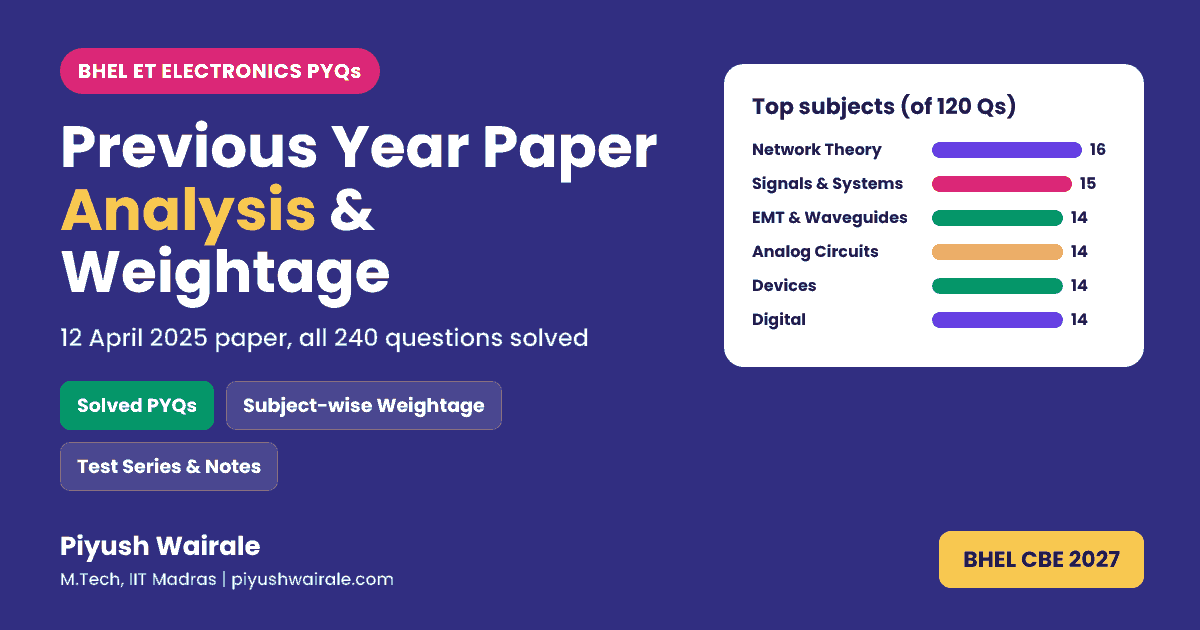
BHEL ET Electronics PYQs analysed: subject-wise weightage of the 12 April 2025 BHEL Engineer Trainee Electronics paper. Network Theory 16 Qs, Signals and Systems 15 Qs, Electromagnetics and Waveguides 14 Qs. Topic-wise questions, reasoning, English and GK breakdown, sample solved PYQs and the BHEL ET Electronics Test Series and Notes.
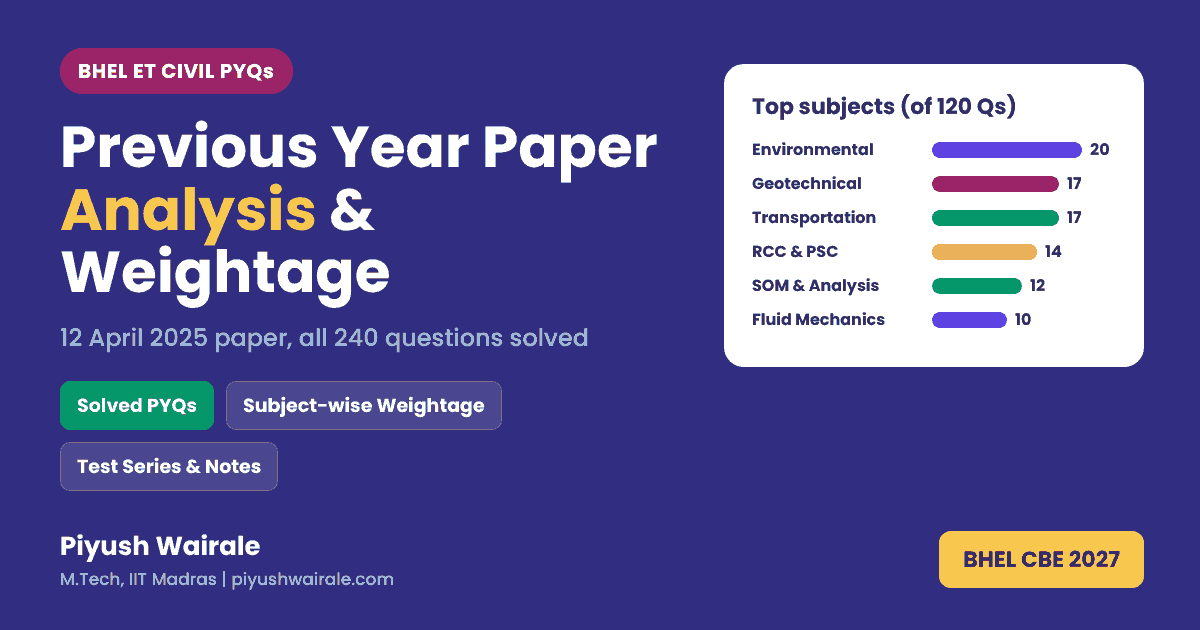
BHEL ET Civil PYQs analysed: subject-wise weightage of the 12 April 2025 BHEL Engineer Trainee Civil paper. Environmental Engineering 20 Qs, Geotechnical Engineering 17 Qs, Transportation Engineering 17 Qs. Topic-wise questions, reasoning, English and GK breakdown, sample solved PYQs and the BHEL ET Civil Test Series and Notes.
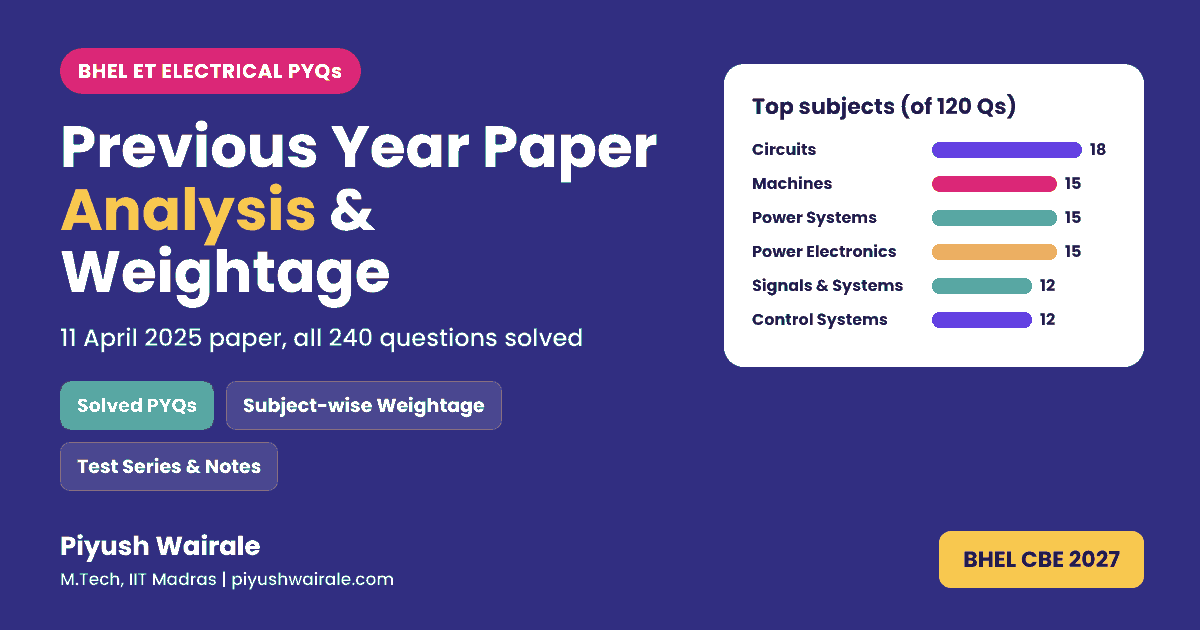
BHEL ET Electrical PYQs analysed: subject-wise weightage of the 11 April 2025 BHEL Engineer Trainee Electrical paper. Electrical Circuits 18 Qs, Electrical Machines 15 Qs, Power Systems 15 Qs. Topic-wise questions, reasoning, English and GK breakdown, sample solved PYQs and the BHEL ET Electrical Test Series and Notes.
NLC India Recruitment 2026 (Advt. 11/2026): 145 executive posts for experienced professionals in Mechanical, Electrical, Civil, Mining, Chemical, C&I, HR, Legal, Security and more. Apply 20 November to 19 December 2026. Post-wise vacancy, experience, age limit, CTC up to Rs 29 lakh and selection process.
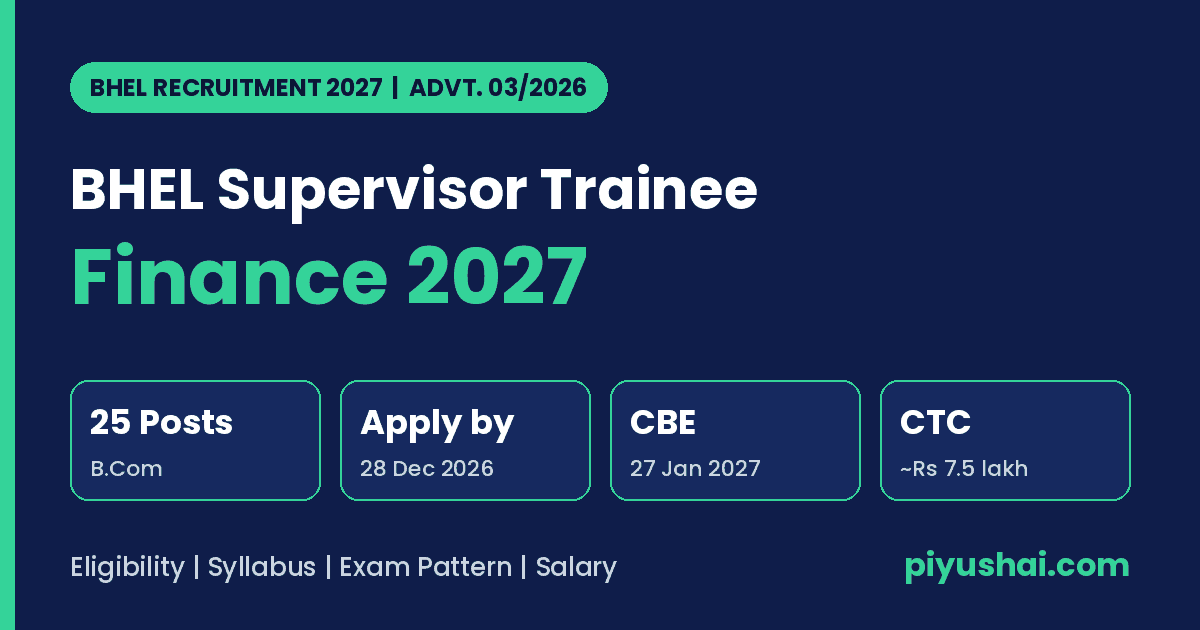
BHEL Supervisor Trainee (Finance) Recruitment 2027 (Advt. 03/2026): 25 posts. Full-time regular Bachelor's degree in Commerce (B.Com). Upper age 27 years. Apply 25 November to 28 December 2026; CBE on 27 January 2027 (no interview). Basic pay Rs 32,000 in training, CTC about Rs 7.5 lakh. Vacancy, exam pattern, syllabus and prep plan.
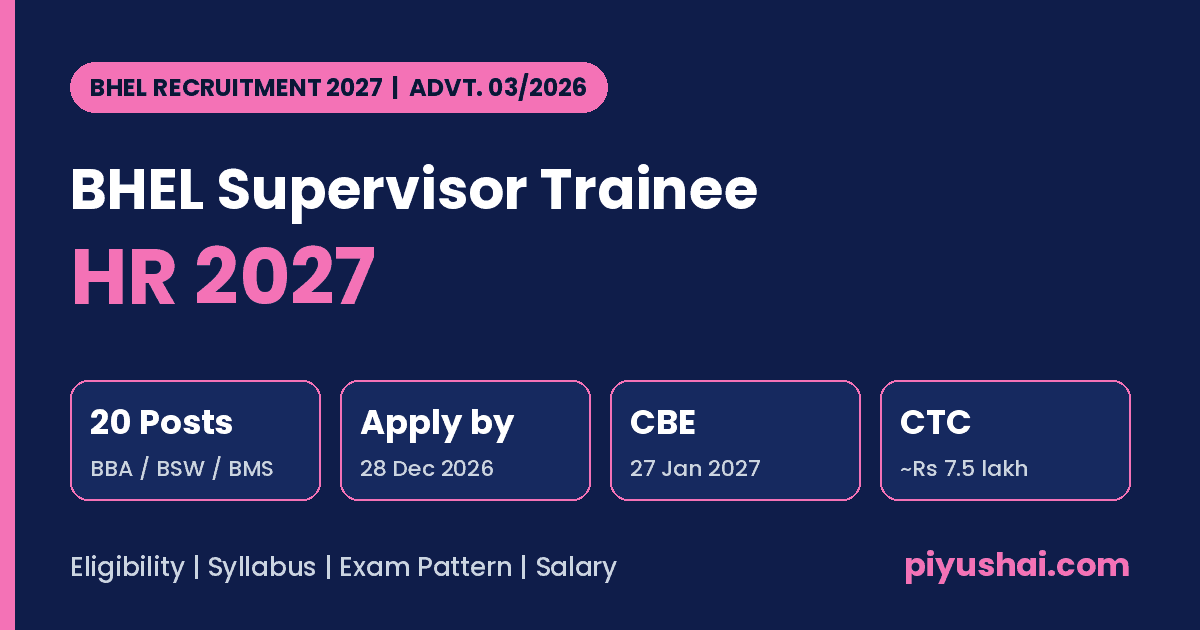
BHEL Supervisor Trainee (HR) Recruitment 2027 (Advt. 03/2026): 20 posts. Full-time regular Bachelor's degree in Business Administration, Social Work, Business Management, BBS or BMS. Upper age 27 years. Apply 25 November to 28 December 2026; CBE on 27 January 2027 (no interview). Basic pay Rs 32,000 in training, CTC about Rs 7.5 lakh. Vacancy, exam pattern, syllabus and prep plan.
Learn Daily, Wherever You Are
Free lectures, exam updates, PYQ discussions, and job alerts — delivered through our YouTube channel and Telegram communities.

[…] BHEL ET Mechanical PYQs: paper analysis and weightage […]
[…] BHEL ET Mechanical PYQs: paper analysis and weightage […]
[…] BHEL ET Mechanical PYQs: paper analysis and weightage […]