
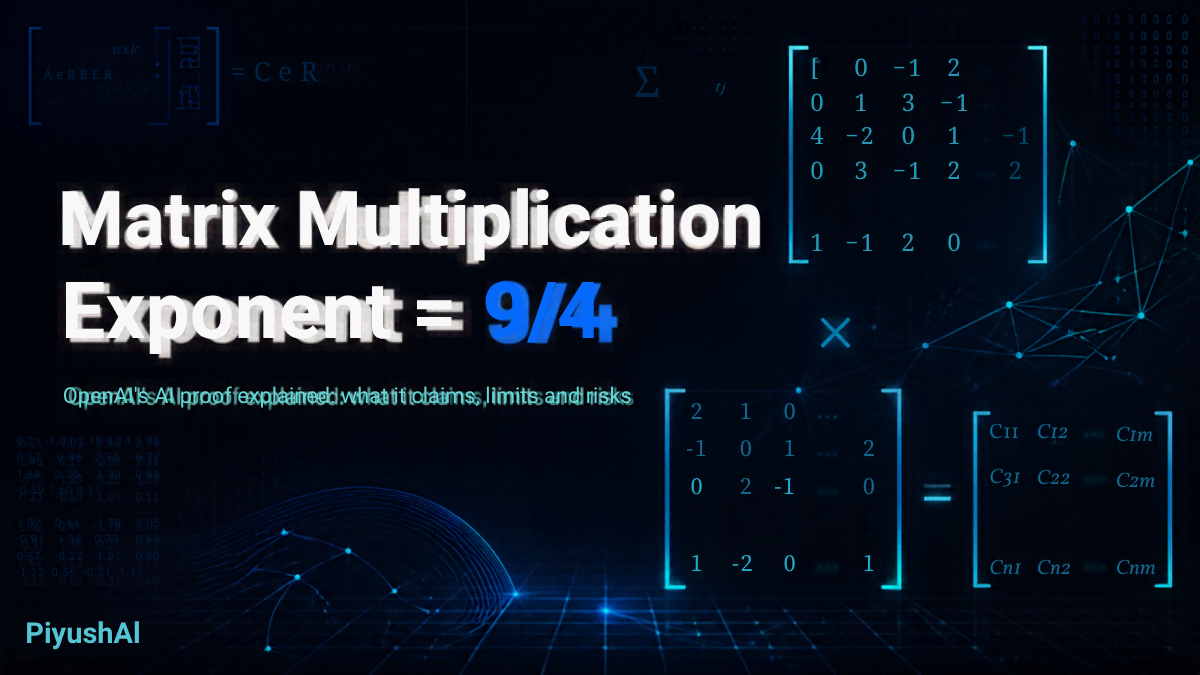
Last updated: 26 November 2026
Every computer science student meets matrix multiplication twice: once as the simple triple loop that takes about n³ steps, and again in the Algorithms course as Strassen’s trick that beats n³. Behind that classroom example sits one of the oldest open questions in theoretical computer science: what is the smallest possible exponent ω (omega) such that two n × n matrices can be multiplied in roughly nω operations? For more than 50 years, most researchers suspected the answer might be 2.
On 24 November 2026, OpenAI posted a 111-page preprint titled “The matrix multiplication exponent is nine fourths”. It claims that the matrix multiplication exponent is exactly 9/4 = 2.25 over every field. The upper bound of 9/4 was already published by OpenAI in October and has since been re-proved by independent human researchers. What is new, and what has the theory community talking, is a matching lower bound: a claim that no arithmetic circuit can ever do better. The repository says the work was produced by an unnamed internal OpenAI model.
If it holds up, this is one of the biggest results in algorithm theory in decades, and it overturns the popular “ω = 2” conjecture. But it has not been peer reviewed, only part of it is machine-checked, and it changes nothing about how fast your NumPy code runs tomorrow. In this post I explain what is actually claimed, how the argument works at a high level, what has and has not been verified, and why I think every GATE CS and GATE DA aspirant should understand this story.
Quick summary
- The claim: Over every field, the exponent of square matrix multiplication is ω = 9/4. For every n ≥ 2, any formal arithmetic circuit multiplying two n × n matrices needs at least ⌈n9/4/2⌉ multiplication or division gates, even if additions are free.
- What was already known: OpenAI’s preprint dated 2 October 2026 gave the upper bound ω ≤ 9/4 over the complex numbers. Human researchers (Houxi Lü; Amanov, van den Berg and Zuiddam; an LMU Munich team) extended it to every field, and Rafael Pass gave a constructive proof.
- What is new: The matching lower bound, posted on 24 November 2026 (indexed on alphaXiv on 25 November).
- Who made it: The openai/math repository says its manuscripts come from “an unnamed internal OpenAI model”. No human author is listed on the paper.
- Verification: A Lean formalisation covers the division-free version of the result. The full theorem, which also allows division gates, is not machine-checked, and there is no peer review yet.
- Practical impact: None in the short term. This is about asymptotic gate counts in an idealised model, not about GPUs, BLAS libraries or wall-clock time.
What is the matrix multiplication exponent, in plain language?
To multiply two n × n matrices the schoolbook way, you compute n² entries, each a dot product of length n. That is n³ multiplications. In 1969, Volker Strassen showed that a 2 × 2 block product can be done with 7 multiplications instead of 8. Applied recursively, this gives about nlog₂7 ≈ n2.807 operations, the version you study in divide-and-conquer.
The exponent ω is defined as the smallest s (strictly, the infimum) such that matrix multiplication can be done with O(ns) scalar operations. Since the output alone has n² entries, ω can never be below 2. Researchers kept pushing the upper bound down: Coppersmith and Winograd’s work and the “laser method” brought it to about 2.376, and refinements up to 2024 brought it to about 2.371. Reports differ slightly on the exact pre-2026 record (figures such as 2.3713 and 2.371177 appear in coverage), but all agree it was close to 2.371.
The big open question was whether ω = 2, meaning matrix multiplication is almost as cheap as just writing down the answer. Many experts believed that. OpenAI’s claim says no: the true answer is 2.25.
The timeline: how we got here in two months
| Date (2026) | Event |
|---|---|
| 24 September | OpenAI preprints report ω below 2.258 over the complex numbers, and below 2.371055 over every field via “staggered extraction”. |
| 2 October | OpenAI preprint “An Upper Bound of 9/4 for the Matrix Multiplication Exponent” (some coverage, including Scott Aaronson’s blog, dates its public release to 6 October). |
| October | Houxi Lü extends a key step to arbitrary characteristic; Amanov, van den Berg and Zuiddam publish an exposition proving ω ≤ 9/4 over every field (arXiv 2610.30054). |
| 20 October | Rafael Pass posts a constructive, elementary proof of ω ≤ 9/4 with an explicit (but “galactic”) recursive algorithm (arXiv 2610.28627). |
| 6 November | An LMU Munich team (Doğan, Lysikov, Sakabe, Walter) posts a “tensor value” exposition of the 9/4 upper bound over every field (arXiv 2611.09716). |
| 24 November | OpenAI posts the matching lower bound, plus a companion paper on tensor geometry. alphaXiv lists it as submitted on 25 November. |
The important point: the upper half of the story (ω ≤ 9/4) has already been independently re-derived by human mathematicians. The lower half (ω ≥ 9/4) is brand new and, as of today, I could not find any named expert who has publicly confirmed checking it.
How the lower bound argument works (high level)
I have read the introduction of the preprint carefully, and the full proof is far beyond a blog post. But the structure is understandable:
- Turn algorithms into tensors. Matrix multiplication can be written as a 3-dimensional tensor Tn. The minimum number of multiplications in a bilinear algorithm is the rank of that tensor. Because Tn tensored with itself j times is Tnj, any saving at one size can be reused at all larger sizes. That is why the exponent is studied through “asymptotic rank”.
- Assume the opposite. The proof is by contradiction. Suppose some algorithm beat n9/4 by a fixed power of n.
- Use it to compress a different problem. The paper shows that such a fast algorithm would let you build impossibly small “tensor networks” (networks of tiny tensors with at most three wires per vertex) for an unrelated task: checking whether all words in several lists are distinct.
- Prove that compression is impossible. Separately, the paper proves a lower bound on the size of any such network for list distinctness. The two estimates clash, so the fast algorithm cannot exist.
- Where does 9/4 come from? The paper assigns geometric “prices” to tensor wires, like distances. Flat Euclidean geometry only gives a ratio of 2. Using a different, curved geometry (developed in the companion paper), a critical three-site configuration gives the ratio 9/4.
The paper also states two striking corollaries: the geometric border rank of Tn is at least n9/4, and a long-standing conjecture by Strassen on “tight” tensors (which would predict n²) is false for the matrix multiplication tensor. It even notes a direct conflict with an estimate in an earlier preprint by Zhi-Wei Sun: at n = 28, Sun’s proposed upper bound is 217 while the new lower bound is 218. One of the two must be wrong, which is exactly the kind of detail experts will now check.
See the numbers yourself
Here is a tiny Python script you can run to compare the multiplication counts. Note that the n9/4 column is a theoretical limit, not a real algorithm you can run.
def strassen_mults(n):
    # scalar multiplications for Strassen, n a power of 2
    return 1 if n == 1 else 7 * strassen_mults(n // 2)

for n in [16, 256, 1024]:
    print(n, n**3, strassen_mults(n), round(n**2.25))

# Output
# 16    4096        2401       512
# 256   16777216    5764801    262144
# 1024 1073741824 282475249 5931642| n | Schoolbook (n³) | Strassen (7log₂n) | n9/4 (claimed limit) |
|---|---|---|---|
| 16 | 4,096 | 2,401 | 512 |
| 256 | 16,777,216 | 5,764,801 | 262,144 |
| 1,024 | 1,073,741,824 | 282,475,249 | 5,931,642 |
The gap looks huge, but remember: algorithms that approach n2.37 or n2.25 hide enormous constants and only win for astronomically large matrices. Pass himself describes his explicit 9/4 algorithm as “galactic”.
What has been verified, and what has not
This is the most important section for anyone who wants to repeat the headline.
- Lean covers a narrower model. According to OpenAI’s own formalisation scope note, the Lean proof establishes ω = 9/4 for division-free programs (additions, subtractions and multiplications) computing formal polynomial identities. The paper’s main theorem also allows division gates. That extra step is not machine-checked.
- The scope note and the paper differ on one detail. The Lean scope states the dual exponent α = 1/2 in the division-free model, while the paper only proves 1/2 ≤ α ≤ 2/3 for general circuits. Not a contradiction, but a sign that the formal and informal results are not identical.
- OpenAI itself is cautious. The repository README says “Some of the unformalized results could have issues” and describes the manuscripts as raw research data rather than polished papers. It also says OpenAI defers to the mathematics community on credit and precedence.
- No peer review yet. AI Weekly, Mad Robot and an independent dev.to review all note the result is unreviewed. The dev.to author, who checked the claim’s scope but not the mathematics, rates it “needs review”.
- Past corrections. Two outlets report that OpenAI earlier withdrew three manuscripts from the same repository after a sign error. Nothing suggests this paper has such a problem, but it is a reminder that “AI-generated and partly formalised” is not the same as “established”.
Reactions so far are excited rather than evaluative. OpenAI researcher Sébastien Bubeck wrote that it is “the kind of result that I never thought I would see in my lifetime” (as quoted by SteamDB). Latent Space summed it up as “The lower bound is the biggest news.” Scott Aaronson, a leading complexity theorist, celebrated the claim on his blog on 25 November and highlighted a companion OpenAI claim about the Fourier transform, but did not say he had checked the proof. One report says no mathematician had commented publicly as of 25 November, while another cites Aaronson’s post; the difference seems to be about what counts as expert review.
Limits: what this result does not say
- It is about a specific model. The bound counts nonscalar multiplication and division gates in formal arithmetic circuits. It says nothing directly about bit-level tricks in the Word RAM model, which is the model behind many real algorithm analyses. Readers on Aaronson’s blog have already asked whether Word RAM algorithms could sidestep it; the paper makes no claim there.
- No faster code. As AI Weekly put it, the “near-term impact on GPU workloads is zero”. Deep learning frameworks use highly tuned O(n³) kernels (and sometimes Strassen-like variants) because constants, memory movement and numerical stability matter far more at practical sizes.
- No new algorithm in this paper. The 24 November preprint is purely a lower bound. The 9/4 algorithms come from the earlier October work and are impractical.
- Attribution is unclear. The paper lists “OpenAI” as author. How much human guidance shaped the problem selection, writing or checking is not documented for this specific paper. The README says results on average used about three hours of ChatGPT Pro thinking compute, from roughly 4,000 problems posed to the model.
Risks and the bigger picture
There are no privacy or legal issues for students here, but there are real risks for the research ecosystem:
- A verification bottleneck. OpenAI’s repository now lists 730 manuscripts in 375 families, with about 42% of top-line results formalised in Lean. Human experts cannot read 111-page proofs as fast as models produce them. Latent Space’s headline, “Math Proofs Are Landing Faster Than We Can Read Them”, captures the problem.
- Hype outrunning evidence. Social media headlines like “matrix multiplication is solved” skip the model of computation and the unformalised division step. If an error is later found, public trust in both AI and mathematics takes a hit.
- Credit and careers. Who gets credit when a model proves a theorem and humans re-derive or extend it? Young researchers, including those in India, now face a field where AI can generate candidate results at scale.
On the positive side, this is also a powerful example of humans and AI working together well: the October upper bound was quickly checked, simplified and generalised by independent mathematicians, which is exactly how science should absorb a surprising claim.
Why this matters for Indian students and educators
I wrote earlier about OpenAI’s claimed disproof of the Exponential Time Hypothesis. Together, these stories show that core topics in your syllabus are now front-page news. Here is how this result connects to what you study:
- GATE CS Algorithms: asymptotic notation, recurrences and the master theorem (Strassen’s T(n) = 7T(n/2) + O(n²) is a classic), divide and conquer, and the difference between upper bounds and lower bounds. This news is a perfect illustration of why “we have no faster algorithm” is not the same as “no faster algorithm exists”.
- GATE DA Linear Algebra: matrix products, rank and the idea of decomposing an object into simpler pieces. Tensor rank is the natural next step after matrix rank and SVD.
- Theory of Computation and complexity: models of computation matter. A bound in arithmetic circuits is not automatically a bound for Turing machines or Word RAM.
- Machine learning systems: every transformer layer is mostly matrix multiplication. Understanding why asymptotic theory and GPU practice diverge is a valuable interview-level insight for ML engineering roles.
For careers, this is a signal that theoretical computer science and formal verification are becoming more relevant, not less. Strong theory groups at institutions such as IISc, the IITs, CMI, IMSc and TIFR work on algorithms and complexity, and skills in proof assistants like Lean are increasingly valued in AI research labs. For teachers, it is a great classroom discussion: put Strassen’s recurrence on the board, then ask students what it would mean to prove that nobody can ever do better.
Frequently asked questions
Has OpenAI proved that matrix multiplication takes n2.25 time?
It claims that, in the model of formal arithmetic circuits, the exponent is exactly 9/4 over every field. The upper bound is widely accepted. The lower bound is new, unreviewed, and only partly machine-checked (the division-free case).
Will my Python or PyTorch matrix code become faster?
No. The algorithms that reach exponents near 2.25 are galactic, with constants so large they never help at practical sizes. Libraries will keep using tuned cubic-time kernels.
Does this disprove the ω = 2 conjecture?
If the lower bound is correct, yes, in the arithmetic circuit model. That is why researchers are calling it surprising. Until experts finish checking it, treat it as a strong claim rather than settled fact.
Which AI model produced the proof?
OpenAI says only that it is an unnamed, unreleased internal model. The paper names no individual human authors.
Is this asked in GATE?
The research result itself will not be. But Strassen’s algorithm, its recurrence, and the reasoning about upper and lower bounds are standard GATE CS material, and matrix operations are central to GATE DA Linear Algebra.
What should I read to go deeper?
Start with Strassen’s algorithm in CLRS, then read the introduction of the OpenAI preprint (the first five pages are readable) and the Pass paper, which gives an elementary construction for the upper bound.
The bottom line
OpenAI’s claim that the matrix multiplication exponent is exactly 9/4 is a genuinely historic announcement if it survives scrutiny: it would settle a question open since Strassen’s 1969 paper and refute the widely held belief that ω = 2. The upper bound has already been independently confirmed; the lower bound has not yet been. My advice to students is simple: be excited, but be precise. Know the model of computation, know what Lean has and has not checked, and know that a theorem about gate counts does not make your code faster. That habit of careful reading is exactly what will matter most as AI starts producing mathematics faster than humans can check it.
Sources and further reading
- OpenAI preprint: The matrix multiplication exponent is nine fourths (PDF)
- OpenAI preprint README and Lean links
- openai/math repository README (how results were produced)
- Lean formalisation scope for the exponent results
- alphaXiv listing of the preprint
- Rafael Pass: a constructive and elementary proof of ω ≤ 9/4 (arXiv)
- Doğan, Lysikov, Sakabe, Walter: Tensor value and the 9/4 bound (arXiv)
- Scott Aaronson, Shtetl-Optimized, 25 November 2026
- Latent Space: Math proofs are landing faster than we can read them
- dev.to: what has been checked in the 9/4 claim
- AI Weekly: OpenAI claims the exponent is exactly 9/4
- Mad Robot: OpenAI claims proof the exponent is 9/4
- SteamDB AI: reactions including Bubeck’s comment
Written by Piyush Wairale (M.Tech, IIT Madras), founder of PiyushAI Edtech. This is a fast-moving research story; figures and verification status are as reported on or before 26 November 2026.

Recent Post

OpenAI says an autonomous AI pipeline found 948 Linux kernel vulnerabilities, each a local privilege escalation with a working exploit and candidate patch, for about $1.2 million. Here is how the pipeline works, what the numbers really mean, the risks, and why it matters for Indian students.
GATE CSE 2027 Computer Networks guide: official syllabus, approx. 8 to 9 marks weightage, layering, switching, error detection, MAC and Ethernet, distance vector and link state routing, IPv4, CIDR, NAT, fragmentation, TCP flow and congestion control, DNS and HTTP, solved numericals and the GATE CSE 2027 Test Series.
GATE CSE 2027 DBMS guide: official syllabus, approx. 7 to 8 marks weightage, ER model, relational algebra, tuple calculus, SQL, functional dependencies, normal forms, B and B+ trees, transactions and concurrency control, solved problems and the GATE CSE 2027 Test Series.
GATE CSE 2027 Operating System guide: official syllabus, approx. 9 to 10 marks weightage, processes, threads, fork, CPU scheduling, semaphores, deadlock, paging, virtual memory, page replacement and file systems, solved numericals and the GATE CSE 2027 Test Series.

GATE CSE 2027 Compiler Design guide: official syllabus, approx. 4 to 6 marks weightage, lexical analysis, LL and LR parsing, syntax-directed translation, runtime environments, intermediate code, liveness and constant propagation, solved problems and the GATE CSE 2027 Test Series.
GATE CSE 2027 Theory of Computation guide: official syllabus, approx. 8 marks weightage, regular expressions, DFA/NFA, CFGs, PDAs, pumping lemma, closure properties, Turing machines and undecidability, solved problems and the GATE CSE 2027 Test Series.
Learn Daily, Wherever You Are
Free lectures, exam updates, PYQ discussions, and job alerts — delivered through our YouTube channel and Telegram communities.