
Quick Summary: Financial Accounting is a foundation-level course in the IIT Madras BS in Management & Data Science. It teaches the language of business — how transactions become journals, ledgers and financial statements. Master the accounting equation early and the rest follows logically. This guide maps the syllabus and how to study it.
📋 Table of Contents
Where this course fits
Financial Accounting underpins the later finance and analytics courses in the degree. It is highly logical and rule-based, which makes it very scoring once the fundamentals click — and useful far beyond the classroom for anyone who runs a business or reads company results.
Syllabus — topic by topic
- Accounting principles & concepts — the accounting equation, double-entry
- Journal entries — recording transactions
- Ledgers & posting — organising accounts
- Trial balance — checking the books
- Final accounts — trading, profit & loss, and balance sheet
- Adjustments — depreciation, accruals and prepayments
Exact week-wise content is on the official student portal; the above is the reliable topic map.
What to focus on
Journal entries, ledgers and the trial balance are the core mechanics — practise them until they are automatic. Final accounts and adjustments (especially depreciation) are where marks are won or lost, so drill full problems, not just concepts.
Common mistakes
❌ Learning theory but not practising full problems.
❌ Ignoring adjustment entries like depreciation.
❌ Not reconciling the trial balance when it does not tally.
Frequently Asked Questions (FAQs)
Is Financial Accounting hard without a commerce background?
No. It is rule-based and logical. Once you internalise the accounting equation and debit/credit rules, it becomes one of the more predictable, scoring courses.
How much practice does it need?
Regular problem-solving is essential. Accounting is learned by doing entries, not by reading about them.
Get a structured start on the foundation level and qualifier.
Related foundation guides: Principles of Economics · Business Statistics · Management Thought & Practice. See the full program guide and all IITM BS guides.
Recent Post
A guide to Supply Chain Analytics in the IIT Madras BS in Management & Data Science diploma level — demand forecasting, inventory optimisation, logistics and network design, with a study plan, by Piyush Wairale (IIT Madras).
A guide to Financial Analytics in the IIT Madras BS in Management & Data Science diploma level — financial statement analysis, ratios, forecasting, risk and valuation with data, plus a study plan, by Piyush Wairale (IIT Madras).
A guide to HR Analytics in the IIT Madras BS in Management & Data Science diploma level — workforce metrics, attrition and recruitment analytics, performance data and people analytics, with a study plan, by Piyush Wairale (IIT Madras).
A guide to Marketing Analytics in the IIT Madras BS in Management & Data Science diploma level — segmentation, customer lifetime value, market response models and campaign measurement, with a study plan, by Piyush Wairale (IIT Madras).
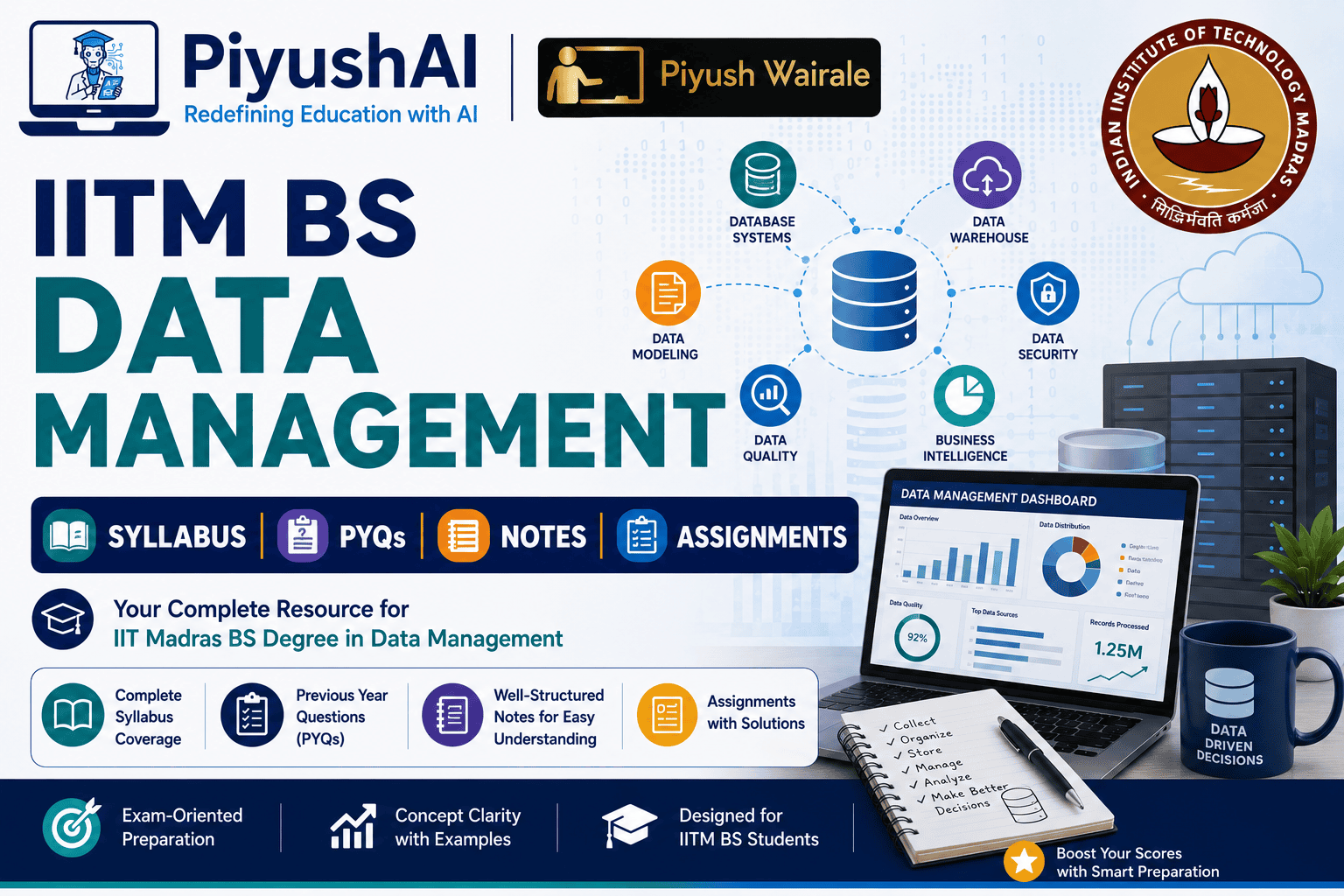
A guide to Data Management in the IIT Madras BS in Management & Data Science diploma level — databases, SQL, data modelling and organising data for analysis, with a study plan, by Piyush Wairale (IIT Madras).
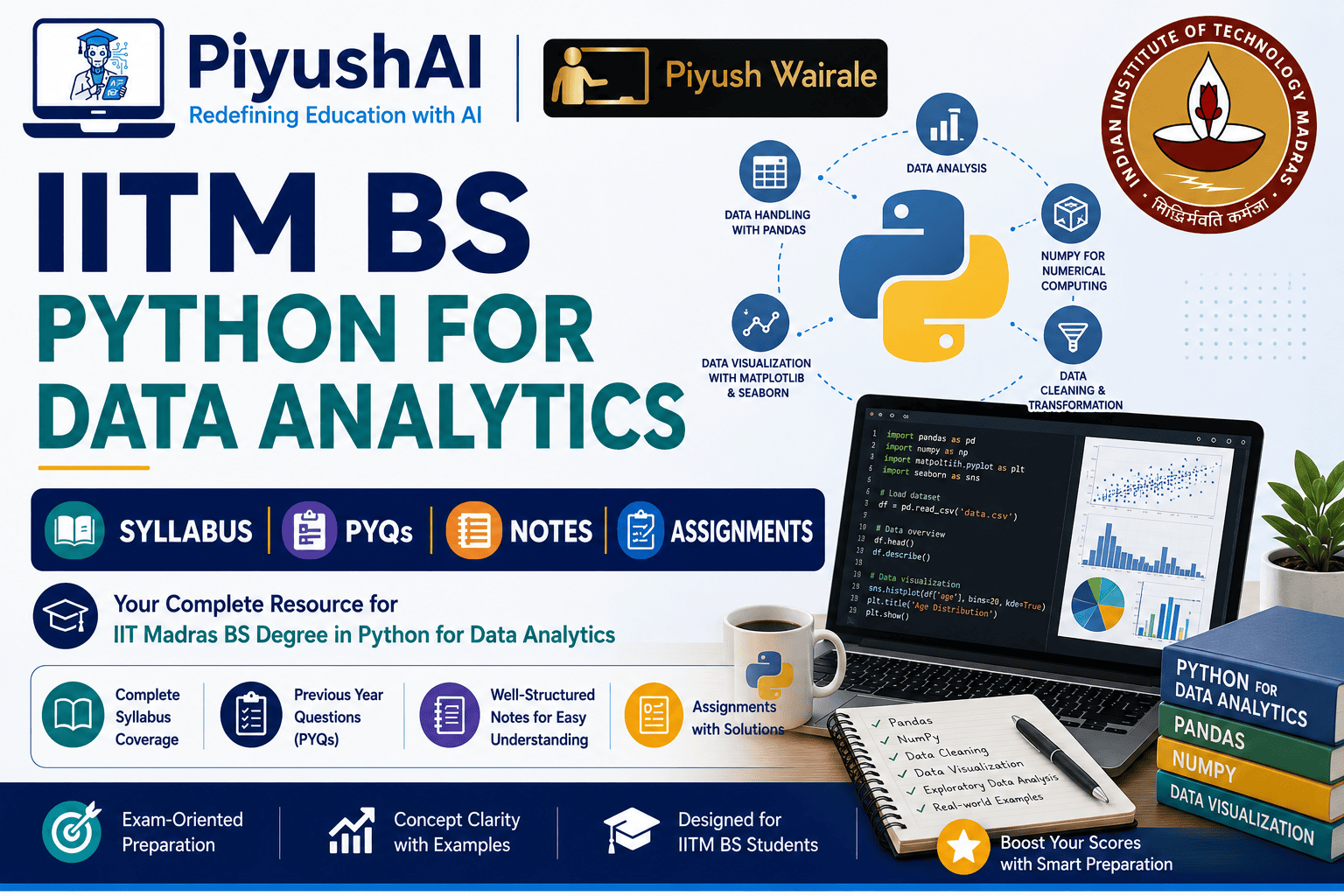
A guide to Python for Data Analytics in the IIT Madras BS in Management & Data Science diploma level — Python basics, pandas, NumPy, data cleaning and visualisation, with a study plan, by Piyush Wairale (IIT Madras).
Learn Daily, Wherever You Are
Free lectures, exam updates, PYQ discussions, and job alerts — delivered through our YouTube channel and Telegram communities.


[…] decisions — analysing statements, forecasting, and assessing risk and value. It builds on Financial Accounting and your analytics toolkit. This guide maps the […]