
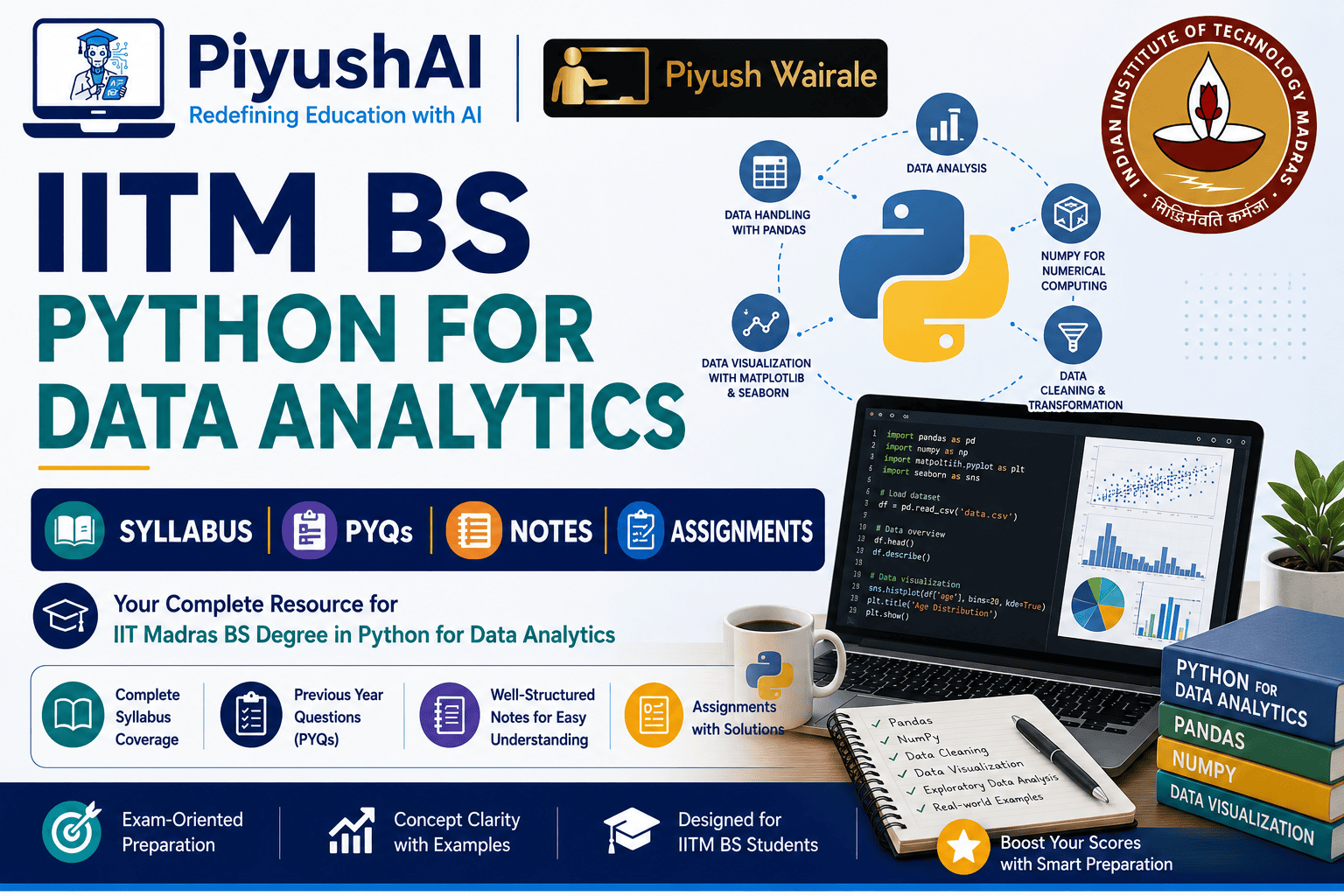
Quick Summary: Python for Data Analytics is the engine of the diploma level in the IIT Madras BS in Management & Data Science. You go from zero coding to cleaning, analysing and visualising real datasets with pandas and NumPy. Get comfortable here and every other analytics course becomes easier. This guide maps the syllabus and how to study it.
📋 Table of Contents
Where this course fits
This is usually the first serious programming course in the degree, and it underpins Marketing, HR, Financial and Supply Chain analytics. Your Computational Thinking foundation pays off here — the algorithmic thinking you built now turns into real code.
Syllabus — topic by topic
- Python basics — variables, data types, operators, control flow
- Data structures — lists, dictionaries, tuples, sets
- Functions & modules — reusable, organised code
- NumPy — arrays and vectorised computation
- pandas — DataFrames, filtering, grouping, joining
- Data cleaning & visualisation — handling missing data, plots
Exact week-wise content is on the official student portal; the above is the reliable topic map.
What to focus on
pandas is the highest-return skill — DataFrame filtering, grouping and joining show up in every downstream analytics course and in interviews. Build fluency with real datasets rather than toy examples, and keep a personal snippet library of operations you use often.
Common mistakes
❌ Skipping pandas practice — it is the most-used skill later.
❌ Copy-pasting solutions without understanding them.
❌ Ignoring data-cleaning steps that real datasets demand.
Frequently Asked Questions (FAQs)
Do I need prior coding experience?
No. The course starts from Python basics, and Computational Thinking from the foundation level prepares you well.
How much practice is enough?
Daily hands-on coding beats occasional long sessions. Aim for consistent practice on real datasets.
Build the base for the diploma — start by clearing the qualifier.
Related diploma guides: Data Management · Marketing Analytics · diploma level overview. See the full program guide and all IITM BS guides.
Recent Post
A guide to Supply Chain Analytics in the IIT Madras BS in Management & Data Science diploma level — demand forecasting, inventory optimisation, logistics and network design, with a study plan, by Piyush Wairale (IIT Madras).
A guide to Financial Analytics in the IIT Madras BS in Management & Data Science diploma level — financial statement analysis, ratios, forecasting, risk and valuation with data, plus a study plan, by Piyush Wairale (IIT Madras).
A guide to HR Analytics in the IIT Madras BS in Management & Data Science diploma level — workforce metrics, attrition and recruitment analytics, performance data and people analytics, with a study plan, by Piyush Wairale (IIT Madras).
A guide to Marketing Analytics in the IIT Madras BS in Management & Data Science diploma level — segmentation, customer lifetime value, market response models and campaign measurement, with a study plan, by Piyush Wairale (IIT Madras).
A guide to Data Management in the IIT Madras BS in Management & Data Science diploma level — databases, SQL, data modelling and organising data for analysis, with a study plan, by Piyush Wairale (IIT Madras).
A complete overview of the Diploma level in the IIT Madras BS in Management & Data Science — the Data Analytics for Business courses, the management courses, the two projects, credits and fees, by Piyush Wairale (IIT Madras).
Learn Daily, Wherever You Are
Free lectures, exam updates, PYQ discussions, and job alerts — delivered through our YouTube channel and Telegram communities.

[…] how data is stored, structured and queried — databases, SQL and data modelling. Together with Python, it is the practical backbone of the analytics track. This guide maps the syllabus and how to study […]
[…] and measuring what actually works. It combines the business thinking from the foundation with the Python and statistics you have built. This guide maps the […]
[…] Analytics takes the same statistical and Python toolkit and points it at the workforce. As companies get serious about data-driven people […]
[…] — how much to stock, where to store it, and how to move it. It builds on your statistics and Python skills and complements Operations Management in the diploma […]
[…] Python for Data Analytics — the programming engine of the whole track […]
[…] Python for Data Analytics […]