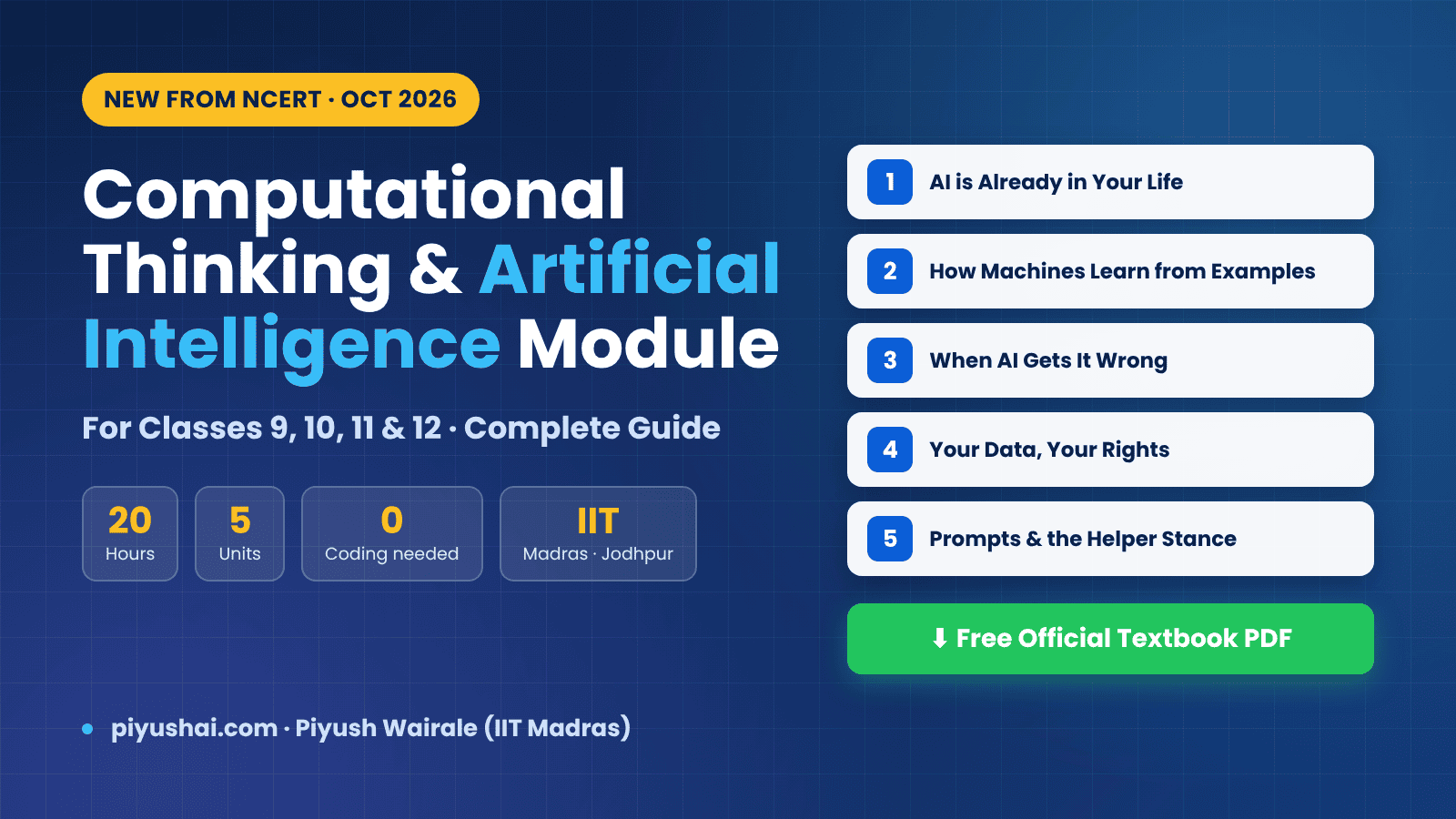
NCERT has released “An Introductory Module on Computational Thinking and Artificial Intelligence for the Secondary Stage (Grades 9 to 12)”, a 20-hour, five-unit module that brings AI literacy to every senior secondary classroom in India. It assumes no prior knowledge of AI, needs no coding, and can be taught fully even in a school with no computers or internet. NCERT announced the module through a press release on Friday, 23 October 2026, and the full 108-page textbook (code UN514) is available as a free PDF on the NCERT website.
This guide explains what the module contains, unit by unit, how the 20 hours are planned, how students are assessed, and what it means for students, teachers, parents and schools. You can download the official NCERT textbook from the button below.
Official NCERT Textbook (Free PDF)
An Introductory Module on Computational Thinking and Artificial Intelligence, Grades 9 to 12 (UN514), First Edition, October 2026, 108 pages
⬇ Download Official NCERT Textbook (PDF)Hosted on ncert.nic.in. File size is about 36 MB.
NCERT CT and AI module at a glance
| Full title | An Introductory Module on Computational Thinking and Artificial Intelligence for the Secondary Stage (Grades 9 to 12) |
| Publisher | National Council of Educational Research and Training (NCERT) |
| Book code / ISBN | UN514 / 978-93-5729-286-3 |
| Edition | First Edition, October 2026 (Ashwina 1948) |
| For | Classes 9, 10, 11 and 12 (a common foundation that can be taught in any of the four grades) |
| Duration | 20 class hours (suggested plan) |
| Structure | 5 units + glossary, 108 pages |
| Prerequisites | None. No prior AI knowledge, no coding, no maths beyond school level |
| Developed by | Faculty from IIT Madras, IIT Jodhpur and CIET, NCERT |
| Policy alignment | NEP 2020 and NCF-SE 2023 |
| Assessment | Formative, through a running portfolio called the Curious Notebook |
| Delivery modes | Full (device per student or pair), Teacher-Demo (one shared screen), Unplugged (paper and discussion) |
Why NCERT introduced this module
In the foreword, NCERT Director Dinesh Prasad Saklani points out that AI is already part of how students search for information, translate between languages, receive recommendations, make digital payments, create media and learn. At the same time, AI systems can produce outputs that are “incomplete, inaccurate, unfair, or inappropriate”. The module is meant to help students understand AI “without being either overwhelmed by it or uncritically admiring of its output”.
The stated goal is clear: the module “does not aim to turn every student into an AI engineer. It aims to help every student become a careful, confident, and responsible user and evaluator of AI systems.” The foreword closes with the principle that runs through the whole book: technology can extend human capability, but “judgement, creativity, responsibility, and ownership of learning remain with the learner.”
The Letter to the Students puts it even more simply: “This is not a module to be memorised. It is a set of habits to be practised.”
What students will be able to do
By the end of the module, NCERT expects every student to be able to:
- Recognise AI in daily life and tell it apart from ordinary automation.
- Explain in plain terms how a machine learns from examples.
- Check whether an AI output can be trusted.
- Understand and protect their own data.
- Use AI tools as a helper rather than a replacement for their own thinking.
NCERT describes these as “five aspects of one habit: thinking clearly and carefully about the machines we increasingly rely on.”
The five units: unit map
The five units build on one another and are meant to be taught in order. Each unit pairs a central question with a computational thinking habit and ends with one piece of work for the student’s portfolio.
| Unit | Central question | CT habit | Portfolio output |
|---|---|---|---|
| 1. AI is Already in Your Life | Where do we meet AI? | Pattern recognition | AI Diary |
| 2. How Machines Learn from Examples | How does learning from data work? | Abstraction, data thinking | Train-and-Break log |
| 3. When AI Gets It Wrong | How do we check confidence? | Evaluation | Verification checklist / Hallucination Hunt |
| 4. Your Data, Your Rights, Your Responsibility | What should we share or protect? | Decomposition | Privacy Policy Dissection |
| 5. Working with Modern AI Tools: Prompts and the Helper Stance | How do we use AI well? | Algorithmic thinking, reflection | Prompt Library |
Unit 1: AI is Already in Your Life
Unit 1 opens with everyday pattern recognition: spotting a friend across a crowded canteen, a third umpire checking for a faint edge, recognising a singer from three notes. Rather than giving a boxed definition of AI to memorise, it walks students through a day in their own lives and asks where AI or automated machines appear.
- 1.1 You are Already a Pattern-spotter!
- 1.2 What AI is, and What it is Not
- 1.3 Where You Meet AI Every Day
- 1.4 AI in India
- 1.5 What AI is Good at, and What it Struggles with
- 1.6 Your turn: starting your AI Diary
The key skill here is telling real AI apart from older rule-based systems that often get called AI. Indian examples are used throughout: Bhashini for Indian-language translation, Aadhaar face authentication and UPI transaction-safety checks that briefly hold unusual transfers. Classroom activities include an AI Scavenger Hunt and an “AI or Not?” card sort, and students start their AI Diary.
Unit 2: How Machines Learn from Examples
Unit 2 is the longest unit and the conceptual core of the module. It builds a parallel between how a student learns and how a learning system learns, and then shows exactly where that parallel breaks.
- 2.1 How You Learn (with a “Meet a Scientist” box on Donald Hebb and the idea that “cells that fire together, wire together”)
- 2.2 Rules versus Learning from Examples
- 2.3 What both systems need: examples, features, labels and categories
- 2.4 What Kinds of Data: Training, Validation, Test, Live
- 2.5 Why Training Data Matters (bias from uneven data)
- 2.6 Categories are human constructs, with consequences
- 2.7 Where the Parallel Breaks: Recognising is not Understanding
- 2.8 Three Ways Machines Learn from Examples: supervised, unsupervised and reinforcement learning
- 2.9 Train and Break: Your First AI Experiment
The highlight is the Train-and-Break experiment. Students train a simple image classifier on everyday objects such as a pen, an eraser or a water bottle (using a tool like Teachable Machine, a teacher demo, or an unplugged paper version), and then deliberately try to make it fail. As the module says, analysing what went wrong often reveals more than looking only at what worked. Notably, the module tells students to train on objects, never on faces, classmates or ID cards.
Unit 3: When AI Gets It Wrong
Unit 3 tackles a problem students and machines share: being confident but wrong. It covers why models fail (including a medical-screening example of false negatives), deepfakes and synthetic media, and the human biases that affect how we read AI output, such as confirmation bias, anchoring and authority overtrust.
- 3.1 Confident but Wrong: A Problem You and Machines Share
- 3.2 Why models fail
- 3.3 Deepfakes and Synthetic Media
- 3.4 Where Your Own Thinking Enters
- 3.5 Verification Habits: The Five Checks
- 3.6 What Good Evaluation Means
- 3.7 Your Careful-use Checklist
The Five Checks: NCERT’s verification method
The single most useful idea in the module is a five-step habit students apply before trusting any AI output that matters, whether it is a chatbot paragraph, a translation, a photo or a video.
| Check | What the student asks |
|---|---|
| 1. Source | Where did this output come from? Which tool, when, and was it copied, edited or forwarded on the way? |
| 2. Claim type | Is this easy to check, hard to check, or essentially unverifiable? Unverifiable claims are treated as opinion, not fact. |
| 3. Compare | If the AI cited a source, does that source really say this? For important claims, do at least two independent sources agree? |
| 4. Pause | Before forwarding, sharing or submitting: am I confident enough to put my name to it? |
| 5. Confidence | If I pass it on, do I say honestly how sure I am? |
Students then run a Hallucination Hunt in a subject they know well, catching an AI tool making things up, and a “Spot the Manipulation” gallery walk on deepfakes. The unit also gives the official reporting route for harmful content: the National Cyber Crime Reporting Portal at cybercrime.gov.in and the helpline 1930.
Unit 4: Your Data, Your Rights, Your Responsibility
Unit 4 brings data privacy down to the level of a student’s own phone. It explains consent in plain language and introduces India’s Digital Personal Data Protection (DPDP) Act, 2023 and the DPDP Rules, 2025, including the terms Data Principal (you) and Data Fiduciary (the company that decides how your data is used).
- 4.1 Not All Data is the Same
- 4.2 Consent, in Plain Language
- 4.3 What not to upload into an AI tool
- 4.4 Fairness, inclusion, accessibility
- 4.5 AI in Your Learning: What It Does For You, What It Does to You
- 4.6 If something goes wrong
Students learn four kinds of data: identifying (name, face, Aadhaar, phone number), behavioural (what you click, skip and reply to), sensitive (health, financial, biometric) and inferred (conclusions a system draws about you, often the most valuable to a company).
The unit gives a clear list of things never to upload into an AI tool:
- Aadhaar number, PAN or full bank details
- Passwords or one-time passwords (OTPs)
- Photos of ID documents
- Other people’s personal information
- Confidential work or school documents
- Medical details, especially about minors
- Anything you would not want shared publicly
The portfolio task is a Privacy Policy Dissection, where each student reads and breaks down the privacy policy of an app they actually use.
Unit 5: Working with Modern AI Tools: Prompts and the Helper Stance
Unit 5 is the capstone, where the earlier habits are put to use with real AI tools. It covers four habits for better prompts:
- Say what you actually want. “Write something about Diwali” versus a specific 200-word welcome note for parents.
- Give context. The tool cannot guess your audience or situation.
- Show, don’t just tell. A sample sentence works better than “formal but warm”.
- Ask for the shape of the output. Length, structure and point of view.
The central idea is the Helper, Not Replacement stance. Used as a helper, you write the first draft and the tool suggests improvements you accept, reject or modify, so the thinking stays yours. Used as a replacement, the tool writes everything and you learn almost nothing. Students build a personal Prompt Library, peer-review each other’s prompts and finish by reflecting on the whole module.
The 20-hour teaching plan
The Note for the Teacher suggests the following 20-hour plan. Core activities are teacher-guided and part of the 20 hours; enrichment activities are optional extensions.
| Hours | Unit | Core activities |
|---|---|---|
| 1 to 3 | Unit 1 | AI Scavenger Hunt, “AI or Not?” sorting, Indian AI systems, launch and workshop of the AI Diary |
| 4 to 8 | Unit 2 | Rules vs learning, features and labels, training/validation/test/live data, bias, three ways machines learn, Train-and-Break setup and run |
| 9 to 13 | Unit 3 | Confident but wrong, deepfakes gallery walk, Five Checks checklist, teacher-led and student-led Hallucination Hunt |
| 14 to 16 | Unit 4 | Kinds of data, consent and the DPDP Act, Privacy Policy Dissection, fairness and accessibility, what to do if something goes wrong |
| 17 to 19 | Unit 5 | Better prompts, helper stance, Prompt Library, peer review of prompts, reflection |
| 20 | Closing | Each student presents one of their five Curious Notebook artefacts |
Three activity modes: built for every classroom
Every hands-on activity in the module comes in three forms, all of which teach the same lesson:
- Full: a device for each student or pair.
- Teacher-Demo: one shared screen or projector.
- Unplugged: paper, everyday objects and discussion, with no tools at all.
NCERT states that a class with no devices and limited internet can still complete the core of the module in full, and advises teachers to “change the mode, not to leave out the unit.” This is a significant design decision for India, where access to devices and connectivity varies widely between schools.
Assessment: the Curious Notebook
There is no memorisation-based exam built into the module. Instead, assessment lives in a running portfolio called the Curious Notebook, which collects the five unit outputs: the AI Diary, the Train-and-Break log, the verification checklist or Hallucination Hunt, the Privacy Policy Dissection and the Prompt Library.
The notebook is meant for formative assessment and is “a working record and not a fair copy”. Crossings-out, revised answers and a first guess that turned out wrong are treated as valuable evidence, and students should not be marked down for them. Any exercise book or stapled sheets will do. Each unit also ends with a three-part assignment: Quick Checks, Apply It, and an optional Stretch Question.
Recurring features inside the textbook
- To begin: Words You’ll Meet
- To do: Try This, Pause and Discuss, Curious Notebook task
- To connect with India: AI in India, Meet a Scientist
- To think carefully: Myth/Reality, Computational Thinking Lens, Inclusivity Lens
- To go deeper: Stretch activities
- To stay safe: A Note on Care
Students also follow a few fictional classmates from Bhopal, Visakhapatnam, Bhubaneswar, Kohima and Surat, each noticing AI in a different way, which keeps the examples rooted in Indian life.
Who developed the module
Module Development Team: Prof. Mayank Vatsa (IIT Jodhpur), Prof. Mitesh M. Khapra (IIT Madras), Rajesh D (CIET, NCERT), Tarun Choubisa (Programme Office, NSTC), Pranita Gopal (CIET, NCERT), and research associates Anubhooti Jain, Chiranjeev and Muskan Dosi (IIT Jodhpur).
Reviewers: Dr Shekhar C. Mande (former Director General, CSIR), Anurag Behar (CEO, Azim Premji Foundation and member, NCF Oversight Committee) and Prof. Abhay Kumar (CIET, NCERT).
How this connects with the CBSE CT and AI curriculum for Classes 3 to 8
From the 2026–27 session, CBSE schools already teach Computational Thinking and AI in Classes 3 to 8, with about 50 hours a year in Classes 3 to 5 and 100 hours a year in Classes 6 to 8. The new NCERT module extends the same thread into the secondary stage. Many of its ideas, such as pattern recognition, data types, bias, the three ways machines learn and responsible use, are deliberate continuations of what students meet in the middle stage, now taken further with deepfakes, the DPDP Act, verification and prompting.
For the middle-stage syllabus, see our CBSE AI curriculum 2026–27 overview and the Class 8 CT and AI syllabus guide.
What this means for students, teachers, parents and schools
For students
You do not need to know coding. You need curiosity and the willingness to check before you trust. The Five Checks and the helper stance will be useful in every subject, in board exam preparation and well beyond school. Start your Curious Notebook early; it is meant to show how your thinking changed, not to look perfect.
For teachers
NCERT is explicit that you do not need to be an AI expert. What the module asks is that you model curiosity and say “let us check that together”. Most class time belongs to activities and discussion, so ask students to read sections before class. Some topics, such as deepfakes and online harm, can be sensitive; the teacher note asks you to pause, protect the student and involve a trusted adult or school authority rather than turn it into a classroom discussion.
For parents
The safety habits in the module are worth reinforcing at home: keep Aadhaar, PAN, passwords and OTPs out of AI tools, verify before forwarding, and tell a trusted adult if something feels wrong. The module is not about avoiding AI; it is about using it with confidence and care.
For schools
The module fits into 20 hours and works without a computer lab, so implementation is mainly a question of timetabling and teacher preparation. The biggest risk is teaching it as a lecture series of definitions, which defeats the purpose. Schools that want help preparing teachers can look at our CT and AI teacher training and the PiyushAI School Lab, or take the school AI readiness self-check.
Frequently asked questions
What is the NCERT Computational Thinking and AI module for Classes 9 to 12?
It is a 20-hour introductory module published by NCERT in October 2026 that teaches students in Grades 9 to 12 how AI works, how to check AI outputs, how to protect their data and how to use AI tools responsibly. It has five units and assumes no prior knowledge of AI.
Where can I download the NCERT CT and AI module PDF?
The official PDF is free on the NCERT website at ncert.nic.in/pdf/An_Introductory_Module_AI_CT_UN514.pdf. Use the download button on this page.
How many hours and units does the module have?
Five units taught over a suggested 20 class hours: AI is Already in Your Life; How Machines Learn from Examples; When AI Gets It Wrong; Your Data, Your Rights, Your Responsibility; and Working with Modern AI Tools: Prompts and the Helper Stance.
Do students need coding or a computer lab?
No. Coding is not required, and every activity has an Unplugged version using paper and discussion, so schools without devices or internet can complete the core of the module.
Who developed the module?
A team led by Prof. Mayank Vatsa (IIT Jodhpur) and Prof. Mitesh M. Khapra (IIT Madras) along with faculty from CIET, NCERT, and reviewed by experts including Dr Shekhar C. Mande and Anurag Behar.
How are students assessed in this module?
Through formative assessment based on the Curious Notebook, a portfolio that collects five artefacts: the AI Diary, Train-and-Break log, verification checklist or Hallucination Hunt, Privacy Policy Dissection and Prompt Library. Each unit also ends with Quick Checks, Apply It and an optional Stretch Question.
What are the Five Checks in the NCERT AI module?
Source, Claim type, Compare, Pause and Confidence: a five-step habit for deciding whether an AI output can be trusted before you rely on it or pass it on.
Is the module mandatory for all schools?
NCERT’s announcement and the textbook do not set out a mandatory rollout schedule. The module is designed as a common foundation that can be taught in any of Grades 9 to 12. Schools should watch for any circular from CBSE or their state board on how it will be adopted.
Get the complete NCERT CT and AI module for Grades 9 to 12
⬇ Download Official NCERT Textbook (PDF)PiyushAI provides CT and AI resources for schools, teacher training and the PiyushAI School Lab. Founded by Piyush Wairale (M.Tech, IIT Madras).
Related: CBSE AI curriculum 2026–27 · AI literacy for schools · Ethical AI
Sources: NCERT, An Introductory Module on Computational Thinking and Artificial Intelligence for the Secondary Stage (Grades 9 to 12), First Edition, October 2026 (ncert.nic.in); India Today; The Tribune; Free Press Journal.
Recent Post
A complete five-hour teaching guide for Chapter 4 of CBSE Class 6 AI: digital footprints, privacy, passwords, online safety and ethical use of technology. Includes period plans, six diagrams, three unplugged activities, a worksheet with answer key, misconceptions, a rubric and India-specific reporting channels for schools.
CBSE Class 6 AI Chapter 3 gives five hours to simple pattern recognition and decision making. This guide covers what the syllabus asks, six diagrams you can copy to a blackboard, a period-by-period plan, three unplugged activities, a worksheet with answers, misconceptions, a rubric and interdisciplinary project ideas.
Chapter 2 of the CBSE Class 6 AI syllabus covers basic data concepts in five hours: the four data types, and organising and representing data using tables and charts. This guide gives a period plan, six diagrams, unplugged activities, a worksheet with answer key, misconceptions, a rubric and interdisciplinary project ideas.
A complete five-hour teaching guide for Chapter 1 of the Class 6 CBSE AI syllabus: what AI is, how it differs from automation, human versus machine intelligence, and the three types of learning taught purely by analogy. Includes six classroom diagrams, unplugged activities, a worksheet with answers, and a rubric.
The CBSE Class 8 CT & AI syllabus for 2026–27 — the computational thinking chapters plus four AI chapters built around the AI Project Lifecycle, data and fairness, and responsible AI. Every AI chapter carries an explicit ethical focus. Includes the 40/20/40 hours split and assessment guidance.
The CBSE Class 7 CT & AI syllabus for 2026–27 — the computational thinking chapters plus the four AI chapters covering Data Science, Computer Vision and NLP, classification, regression and clustering, and AI bias awareness. The year the curriculum gets real.
Learn Daily, Wherever You Are
Free lectures, exam updates, PYQ discussions, and job alerts — delivered through our YouTube channel and Telegram communities.