
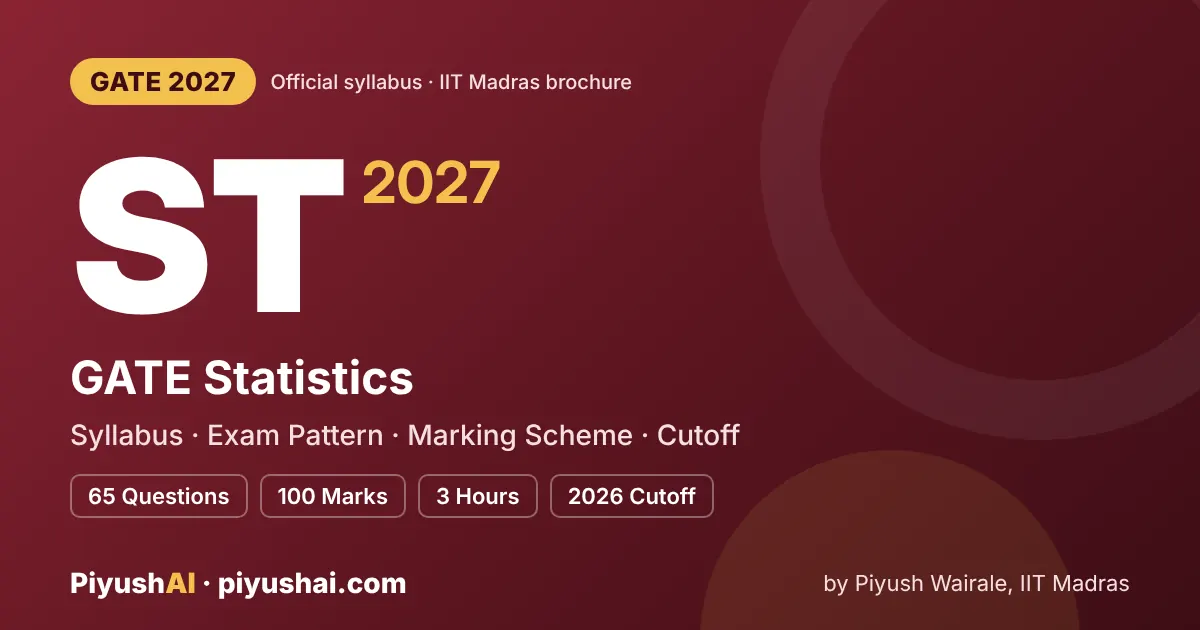
GATE ST 2027 syllabus, quick answer: GATE ST 2027 has 65 questions for 100 marks in 3 hours: General Aptitude carries 15 marks and the Statistics syllabus carries 85 marks. There is no separate Engineering Mathematics section. The exam is a Computer Based Test conducted by IIT Madras on 6 to 21 February 2027. MCQs carry negative marking (1/3 or 2/3); MSQ and NAT questions do not. Below is the complete, official GATE ST 2027 syllabus with the section-wise structure, GATE 2026 cutoffs and a preparation plan.
📋 Table of Contents
- GATE ST 2027 overview
- Exam pattern and marks distribution
- Question types and marking scheme
- GATE ST 2027 syllabus (official)
- General Aptitude syllabus
- GATE 2026 cutoff and statistics
- Allowed second papers
- Important dates and eligibility
- Preparation strategy
- What a GATE ST score gets you
- GATE ST course, notes and test series
- FAQs
GATE Statistics (ST) 2027: Overview
GATE Statistics (ST) is the paper for students heading into M.Tech, PhD and research programmes in statistics, data science and quantitative fields. Its syllabus is at M.Sc. level: calculus, matrix theory, probability, distributions, stochastic processes, estimation, hypothesis testing, non-parametric methods, multivariate analysis and regression.
Who usually takes this paper: M.Sc. Statistics/Mathematics students and graduates, and B.Sc. Statistics and Mathematics students in the third year or higher.
| Particular | Details |
|---|---|
| Exam name | GATE 2027: Statistics |
| Paper code | ST |
| Organising institute | IIT Madras |
| Mode | Computer Based Test (CBT), English only |
| Exam dates | 6, 7, 13, 14, 20 and 21 February 2027 (two sessions a day) |
| Duration | 3 hours (4 hours with compensatory time for eligible PwD candidates) |
| Questions / marks | 65 questions / 100 marks |
| Question types | MCQ, MSQ, NAT |
| Calculator | On-screen virtual scientific calculator only |
| Result date | 19 March 2027 |
| Score validity | 3 years |
| Official website | gate2027.iitm.ac.in |
GATE ST 2027 Exam Pattern and Marks Distribution
GATE ST 2027 has 65 questions for 100 marks in 3 hours: General Aptitude carries 15 marks and the Statistics syllabus carries 85 marks. There is no separate Engineering Mathematics section.
| Section | Questions | Marks | Notes |
|---|---|---|---|
| General Aptitude (GA) | 10 | 15 | 5 × 1 mark + 5 × 2 marks |
| Statistics (subject) | 55 | 85 | No separate Engineering Mathematics section |
| Total | 65 | 100 | 3 hours, CBT |
Question Types and Marking Scheme
| Question type | What it is | Marks | Negative marking |
|---|---|---|---|
| MCQ | Four options, exactly one correct | 1 or 2 | −1/3 for a 1-mark MCQ, −2/3 for a 2-mark MCQ |
| MSQ | Four options, one or more correct; full marks only for the exact correct combination | 1 or 2 | None (and no partial marks) |
| NAT | Numerical answer typed on a virtual keypad (integer or decimal) | 1 or 2 | None (and no partial marks) |
GATE questions test four abilities: Recall, Comprehension, Application, and Analysis and Synthesis. For NAT answers, round off only at the final step, to the number of decimal places asked in the question.
GATE ST 2027 Syllabus (Official, IIT Madras)
The GATE 2027 syllabus has been revised for most papers, so use this version rather than older lists. Here is the section-wise summary of the GATE ST 2027 syllabus, followed by the complete official topic list as published in Appendix D of the GATE 2027 Information Brochure.
| # | Section |
|---|---|
| 1 | Calculus |
| 2 | Matrix Theory |
| 3 | Probability |
| 4 | Standard Univariate Distributions |
| 5 | Joint Distributions |
| 6 | Convergence of Random Variables |
| 7 | Stochastic Processes |
| 8 | Estimation |
| 9 | Testing of Hypotheses |
| 10 | Non-parametric Statistics |
| 11 | Multivariate Analysis |
| 12 | Regression Analysis |
Complete GATE ST 2027 syllabus: topic-wise
Section 1: Calculus
Finite, countable and uncountable sets; Sequences of real numbers, convergence of sequences, bounded sequences, monotonic sequences, Cauchy criterion for convergence; Series of real numbers, convergence, tests of convergence, alternating series, absolute and conditional convergence; Power series and radius of convergence; Functions of a real variable: Limit, continuity, monotone functions, uniform continuity, differentiability, Rolle’s theorem, mean value theorems, Taylor’s theorem, L’Hospital rules, maxima and minima, Riemann integration and its properties, improper integrals;
Functions of several real variables: Limit, continuity, partial derivatives, directional derivatives, gradient, Taylor’s theorem, total derivative, maxima and minima, saddle point, method of Lagrange multipliers, double and triple integrals and their applications.
Section 2: Matrix Theory
Subspaces of ℝ𝑛 and ℂ𝑛, span, linear independence, basis and dimension, row space and column space of a matrix, rank and nullity, row reduced echelon form, trace and determinant, inverse of a matrix, systems of linear equations; Inner products in ℝ𝑛 and ℂ𝑛, Gram-Schmidt orthonormalization; Eigen values and eigen vectors, characteristic polynomial, Cayley-Hamilton theorem, symmetric, skew-symmetric, Hermitian, skew-Hermitian, orthogonal, unitary matrices and their eigen values, change of basis matrix, equivalence and similarity, diagonalizability, positive definite and positive semi-definite matrices and their properties, quadratic forms, singular value decomposition.
Section 3: Probability
Axiomatic definition of probability, properties of probability function, conditional probability, Bayes’ theorem, independence of events; Random variables and their distributions, cumulative distribution function, probability mass function, probability density function and their properties, expectation, variance, properties of expectation and variance, moments and moment generating function, probability generating function, quantiles, distribution of functions of a random variable, Chebyshev, Markov and Jensen inequalities.
Section 4: Standard Univariate Distributions
Bernoulli, binomial, geometric, negative binomial, hypergeometric, discrete uniform, Poisson, continuous uniform, exponential, double exponential, gamma, beta distributions of first and second kinds, Weibull, normal, Cauchy.
Section 5: Joint Distributions
Jointly distributed random variables and their distribution functions, probability mass function, probability density function and their properties, marginal and conditional distributions, conditional expectation and moments, product moments, simple correlation coefficient, joint moment generating function, independence of random variables, functions of random vector and their distributions, distributions of order statistics, joint and marginal distributions of order statistics; multinomial distribution, bivariate normal distribution, sampling distributions: central chi-square, central 𝑡, and central 𝐹 distributions.
Section 6: Convergence of Random Variables
Convergence in distribution, convergence in probability, convergence almost surely, convergence in 𝑟 − 𝑡ℎ mean and their inter-relations, Slutsky’s lemma, Borel-Cantelli lemma; weak and strong laws of large numbers; central limit theorem for i.i.d. random variables.
Section 7: Stochastic Processes
Markov chains with finite and countable state space, classification of states, limiting behaviour of n-step transition probabilities, stationary distribution, Poisson process, birth-and-death process, pure-birth process, pure-death process, Brownian motion and its basic properties.
Section 8: Estimation
Sufficiency, minimal sufficiency, factorization theorem, completeness, completeness of exponential families, ancillary statistic, Basu’s theorem and its applications, unbiased estimation, uniformly minimum variance unbiased estimation, Rao-Blackwell theorem, Lehmann-Scheffe theorem, Cramer-Rao inequality, consistent estimators, method of moments estimators, method of maximum likelihood estimators and their properties;
Interval estimation: pivotal quantities and confidence intervals based on them, coverage probability.
Section 9: Testing of Hypotheses
Neyman-Pearson lemma, most powerful tests, monotone likelihood ratio (MLR) property, uniformly most powerful tests, uniformly most powerful tests for families having MLR property, uniformly most powerful unbiased tests, uniformly most powerful unbiased tests for exponential families, likelihood ratio tests, large sample tests.
Section 10: Non-parametric Statistics
Empirical distribution function and its properties, goodness of fit tests, chi-square test, Kolmogorov-Smirnov test, run tests, sign test, Wilcoxon signed rank test, Mann-Whitney U-test, Kruskal-Wallis test, rank correlation coefficients of Spearman and Kendall.
Section 11: Multivariate Analysis
Multivariate normal distribution: properties, conditional and marginal distributions, maximum likelihood estimation of mean vector and dispersion matrix, Hotelling’s 𝑇2 test, Wishart distribution and its basic properties, multiple and partial correlation coefficients and their basic properties.
Section 12: Regression Analysis
Simple and multiple linear regression, 𝑅2 and adjusted 𝑅2 and their applications, distributions of quadratic forms of random vectors: Fisher-Cochran theorem, Gauss-Markov theorem, tests for regression coefficients, confidence intervals.
General Aptitude (GA) Syllabus: 15 Marks, Common to All Papers
| Area | Topics |
|---|---|
| Verbal Aptitude | Basic English grammar, vocabulary (words, idioms, phrases in context), reading comprehension, narrative sequencing |
| Quantitative Aptitude | Data interpretation (graphs, charts, maps, tables), ratios, percentages, powers, exponents, logarithms, permutations and combinations, series, mensuration and geometry, elementary statistics and probability |
| Analytical Aptitude | Deduction and induction, analogy, numerical relations and reasoning |
| Spatial Aptitude | Translation, rotation, scaling, mirroring, assembling and grouping, paper folding, cutting and patterns in 2D and 3D |
GATE ST 2026 Cutoff, Qualifying Marks and Statistics
These are the official GATE 2026 figures for Statistics from the GATE 2026 Statistical and Performance Report (IIT Guwahati). They are the best guide to what to expect in GATE ST 2027. Qualifying marks are out of 100; the qualifying GATE score for the general category is always 350.
| Paper | Registered | Appeared | Qualified | Qualified % |
|---|---|---|---|---|
| Statistics (ST) | 3,333 | 2,087 | 414 | 19.8% |
| Paper | GEN | OBC-NCL / EWS | SC / ST / PwD |
|---|---|---|---|
| Statistics (ST) | 30.4 | 27.3 | 20.2 |
| Paper | Highest marks | Mean of top 0.1% (or top 10) | Average marks | Std. deviation |
|---|---|---|---|---|
| Statistics (ST) | 94 | 69.07 | 19.41 | 11.02 |
What this means for you: in GATE 2026 the average ST candidate scored 19.41 marks, while the top 0.1% averaged 69.07. Crossing the general qualifying mark of 30.4 puts you in the top 20% of candidates, but admissions to top IITs and PSU interview calls usually need a score far above the qualifying line.
How the qualifying marks and GATE score are calculated
For each paper, the general-category qualifying mark is max(25, min(40, μ + σ)), where μ and σ are the mean and standard deviation of the marks of all candidates who appeared. OBC-NCL/EWS qualifying marks are 90% and SC/ST/PwD qualifying marks are about two-thirds of the general value.
Your GATE score (out of 1000) is computed as Score = 350 + 550 × (M − Mq) / (M̄t − Mq), where M is your marks (normalised marks for multi-session papers), Mq is the general qualifying mark and M̄t is the mean marks of the top 0.1% or top 10 candidates, whichever is larger. A score of 350 corresponds to the qualifying mark and 900 to the top-candidate average.
Which Papers Can Be Combined with GATE ST 2027?
You may appear in one or two GATE papers. As per the tentative list in the GATE 2027 brochure, the second paper allowed with ST as the primary paper is: Computer Science and Information Technology (CS), Data Science and Artificial Intelligence (DA), Mathematics (MA), Humanities and Social Sciences (XH). The fee for two papers is twice that of one paper.
GATE 2027 Important Dates, Fee and Eligibility
| Event | Date |
|---|---|
| Registration (regular period) | 2 to 27 September 2026 (closed) |
| Extended period with late fee | Up to 12 October 2026 (closed) |
| Special window (late fee) | 15 October 2026, 10:30 AM to 16 October 2026, 10:29 AM (closed) |
| Exam city notification | 4 January 2027 |
| Admit card | To be announced on GOAPS |
| GATE 2027 exam | 6, 7, 13, 14, 20 and 21 February 2027 |
| Result | 19 March 2027 |
Application fee per paper (regular period): ₹1,000 for female, SC, ST and PwD candidates and ₹2,000 for all others; ₹1,500 and ₹2,500 respectively in the extended period and special window.
Eligibility: candidates in the third or higher year of any undergraduate degree, or who have completed a government-approved degree in Engineering, Technology, Architecture, Science, Commerce, Arts or Humanities, are eligible. M.B.B.S./B.D.S./B.V.Sc. students from the fifth semester and M.Sc./M.A./MCA students from the first year are also eligible. There is no age limit. All dates are as per the brochure and subject to change, so always confirm on the official website.
GATE ST 2027 Preparation Strategy
- Probability, standard distributions and joint distributions are the base for everything. Solve many problems on transformations and conditional expectations.
- Estimation and Testing of Hypotheses are the most important inference sections: sufficiency, MVUE, Cramer-Rao, MLE, Neyman-Pearson and likelihood ratio tests.
- Regression Analysis and Multivariate Analysis are matrix-heavy, so keep Matrix Theory sharp.
- Convergence of random variables, stochastic processes and non-parametric statistics are compact sections that are easy to cover well.
- In 2026 the general qualifying mark was 30.4 and the topper scored 94. Breadth and speed matter.
- Solve previous GATE papers (2007 to 2026 are available on the official website) section by section, then as timed full-length papers.
- Practise every numerical with the GATE virtual calculator, since no physical calculator is allowed.
- From December, take one full mock a week in the real interface and analyse every mistake, especially negatively marked MCQs.
What Can You Do with a GATE ST 2027 Score?
GATE ST scores are used for M.Tech (including data science and computer science programmes that accept ST), PhD admissions and research fellowships in statistics and allied areas.
Under MoE guidelines, admitting institutes give at least 70% weightage to GATE performance for M.Tech admissions with scholarship. Qualifying GATE does not by itself guarantee admission, a scholarship or a job; each institute and employer applies its own criteria.
GATE ST 2027 Course, Notes and Test Series
Get structured guidance for GATE Statistics from Piyush Wairale (IIT Madras) on www.piyushwairale.com. Start with the section that is common to every paper, then build your subject preparation:
Best GATE Aptitude Test Series 2027
General Aptitude is 15 of your 100 marks in GATE ST. Topic-wise tests, full GA mocks in the real interface and solved PYQs from 2010 to 2026.
GATE Engineering Mathematics courses
Linear Algebra, Calculus and Probability and Statistics taught for GATE, for the core mathematics in your syllabus.
All GATE courses, notes and test series
Browse every GATE course, notes package and test series in the PiyushAI store.
Writing two papers in GATE 2027?
Adding GATE DA as your second paper?
DA is an allowed second paper with ST. Get the complete GATE DA 2027 course and test series.
GATE 2027 courses, notes and test series by Piyush Wairale (IIT Madras)
Free lessons on YouTube (@piyushwairaleiitm)
GATE ST 2027: Frequently Asked Questions
What is the GATE ST 2027 exam pattern?
GATE ST 2027 has 65 questions for 100 marks in 3 hours: General Aptitude carries 15 marks and the Statistics syllabus carries 85 marks. There is no separate Engineering Mathematics section. Questions are MCQ, MSQ and NAT, and each carries 1 or 2 marks.
Is there negative marking in GATE ST 2027?
Yes, but only for MCQs. A wrong 1-mark MCQ costs 1/3 mark and a wrong 2-mark MCQ costs 2/3 mark. MSQ and NAT questions have no negative marking, and there is no partial marking for any question.
What was the GATE ST 2026 cutoff?
The GATE 2026 qualifying marks out of 100 were Statistics (ST): 30.4 (GEN), 27.3 (OBC-NCL/EWS), 20.2 (SC/ST/PwD).
When is the GATE ST 2027 exam?
GATE 2027 will be held on 6, 7, 13, 14, 20 and 21 February 2027 in forenoon (9:30 AM to 12:30 PM) and afternoon (2:30 PM to 5:30 PM) sessions. The paper-wise schedule will be published on the official website, and results are scheduled for 19 March 2027.
Which IIT is conducting GATE 2027?
IIT Madras is the organising institute for GATE 2027. The official website is gate2027.iitm.ac.in.
Which papers can be combined with GATE Statistics 2027?
Statistics (ST) can be combined with CS, DA, MA or XH.
Is GATE ST useful for data science careers?
Yes. The ST syllabus covers probability, inference, regression and multivariate analysis, the mathematical foundations of data science. ST can also be paired with DA in GATE 2027.
How long is the GATE ST 2027 score valid?
The GATE 2027 score is valid for three years from the date the results are announced.
Sources: GATE 2027 Information Brochure, IIT Madras (gate2027.iitm.ac.in); GATE 2026 Statistical and Performance Report, IIT Guwahati. Last updated 27 October 2026.
More GATE 2027 guides: GATE 2027 syllabus and exam pattern for all 30 papers | GATE General Aptitude 2027 | GATE AE 2027 | GATE AG 2027 | GATE AR 2027 | GATE BM 2027 | GATE BT 2027 | GATE CE 2027 | GATE CH 2027 | GATE CS 2027 | GATE CY 2027 | GATE DA 2027 | GATE EC 2027 | GATE EE 2027 | GATE ES 2027 | GATE EY 2027 | GATE GE 2027 | GATE GG 2027 | GATE IN 2027 | GATE MA 2027 | GATE ME 2027 | GATE MN 2027 | GATE MT 2027 | GATE NM 2027 | GATE PE 2027 | GATE PH 2027 | GATE PI 2027 | GATE RA 2027 | GATE XE 2027 | GATE XH 2027 | GATE XL 2027

Recent Post
GATE PE 2027 Petroleum Engineering syllabus, exam pattern, marks distribution, 2026 cutoff and prep tips, based on the official IIT Madras brochure.
GATE ES 2027 Environmental Science and Engineering syllabus, exam pattern, marking scheme, 2026 cutoff and prep tips from the IIT Madras brochure.

GATE RA 2027 Robotics and Automation syllabus, exam pattern, marks distribution, 2026 cutoff and prep tips, based on the official IIT Madras brochure.
GATE MA 2027 Mathematics syllabus, exam pattern, marks distribution, 2026 cutoff and prep tips, based on the official IIT Madras brochure.

GATE MT 2027 Metallurgical Engineering syllabus, exam pattern, marks distribution, 2026 cutoff and prep tips, based on the official IIT Madras brochure.

GATE NM 2027 Naval Architecture and Marine Engineering syllabus, exam pattern, marking scheme, 2026 cutoff and prep tips from the IIT Madras brochure.
Learn Daily, Wherever You Are
Free lectures, exam updates, PYQ discussions, and job alerts — delivered through our YouTube channel and Telegram communities.