
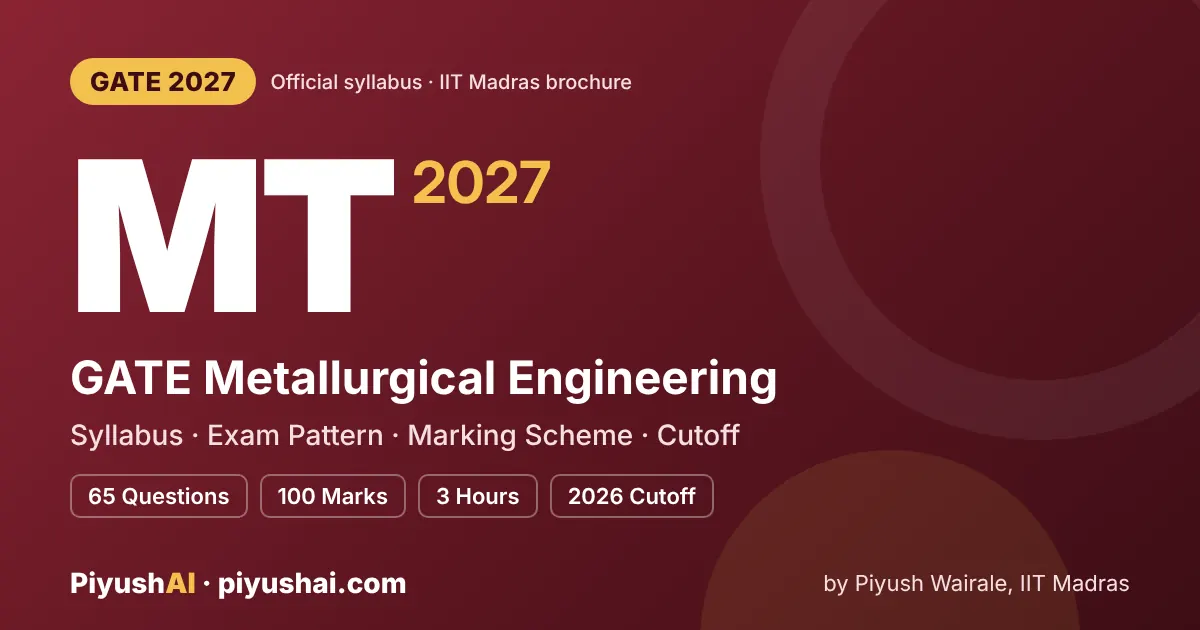
Quick answer: GATE MT 2027 has 65 questions for 100 marks in 3 hours: General Aptitude carries 15 marks, Engineering Mathematics 13 marks and core Metallurgical Engineering subjects 72 marks. The exam is a Computer Based Test conducted by IIT Madras on 6 to 21 February 2027. MCQs carry negative marking (1/3 or 2/3); MSQ and NAT questions do not. Below is the complete, official GATE MT 2027 syllabus with the section-wise structure, GATE 2026 cutoffs and a preparation plan.
📋 Table of Contents
- GATE MT 2027 overview
- Exam pattern and marks distribution
- Question types and marking scheme
- GATE MT 2027 syllabus (official)
- General Aptitude syllabus
- GATE 2026 cutoff and statistics
- Allowed second papers
- Important dates and eligibility
- Preparation strategy
- What a GATE MT score gets you
- GATE MT course, notes and test series
- FAQs
GATE Metallurgical Engineering (MT) 2027: Overview
GATE Metallurgical Engineering (MT) is the paper for materials and metallurgy students targeting M.Tech, PhD and steel or materials-sector roles. Its syllabus covers thermodynamics, transport phenomena, mineral processing and extractive metallurgy, physical metallurgy, mechanical behaviour, manufacturing and non-metallic materials.
Who usually takes this paper: B.E./B.Tech. Metallurgical, Materials and allied programme students and graduates, and IIM (Indian Institute of Metals) candidates.
| Particular | Details |
|---|---|
| Exam name | GATE 2027: Metallurgical Engineering |
| Paper code | MT |
| Organising institute | IIT Madras |
| Mode | Computer Based Test (CBT), English only |
| Exam dates | 6, 7, 13, 14, 20 and 21 February 2027 (two sessions a day) |
| Duration | 3 hours (4 hours with compensatory time for eligible PwD candidates) |
| Questions / marks | 65 questions / 100 marks |
| Question types | MCQ, MSQ, NAT |
| Calculator | On-screen virtual scientific calculator only |
| Result date | 19 March 2027 |
| Score validity | 3 years |
| Official website | gate2027.iitm.ac.in |
GATE MT 2027 Exam Pattern and Marks Distribution
GATE MT 2027 has 65 questions for 100 marks in 3 hours: General Aptitude carries 15 marks, Engineering Mathematics 13 marks and core Metallurgical Engineering subjects 72 marks.
| Section | Questions | Marks | Notes |
|---|---|---|---|
| General Aptitude (GA) | 10 | 15 | 5 × 1 mark + 5 × 2 marks |
| Engineering Mathematics | Part of 55 | 13 | Paper-specific maths questions |
| Metallurgical Engineering (core subject) | Part of 55 | 72 | Mix of 1-mark and 2-mark questions |
| Total | 65 | 100 | 3 hours, CBT |
Question Types and Marking Scheme
| Question type | What it is | Marks | Negative marking |
|---|---|---|---|
| MCQ | Four options, exactly one correct | 1 or 2 | −1/3 for a 1-mark MCQ, −2/3 for a 2-mark MCQ |
| MSQ | Four options, one or more correct; full marks only for the exact correct combination | 1 or 2 | None (and no partial marks) |
| NAT | Numerical answer typed on a virtual keypad (integer or decimal) | 1 or 2 | None (and no partial marks) |
GATE questions test four abilities: Recall, Comprehension, Application, and Analysis and Synthesis. For NAT answers, round off only at the final step, to the number of decimal places asked in the question.
GATE MT 2027 Syllabus (Official, IIT Madras)
The GATE 2027 syllabus has been revised for most papers, so use this version rather than older lists. Here is the section-wise summary of the GATE MT 2027 syllabus, followed by the complete official topic list as published in Appendix D of the GATE 2027 Information Brochure.
| # | Section |
|---|---|
| 1 | Engineering Mathematics |
| 2 | Metallurgical Thermodynamics |
| 3 | Transport Phenomena and Rate Processes |
| 4 | Mineral Processing and Extractive Metallurgy |
| 5 | Physical Metallurgy |
| 6 | Mechanical Behaviour of Materials |
| 7 | Manufacturing Processes |
| 8 | Materials Science and Non-Metallic Materials |
Complete GATE MT 2027 syllabus: topic-wise
Section 1: Engineering Mathematics
Linear Algebra: Matrices and determinants; systems of linear equations; eigenvalues and eigenvectors.
Calculus: Limit, continuity and differentiability; partial derivatives; maxima and minima; sequences and series; test for convergence; Fourier series.
Vector Calculus: Gradient, divergence and curl; line, surface and volume integrals; Gauss theorem.
Differential Equations: Linear and non-linear first order ODEs; higher order linear ODEs with constant coefficients; Cauchy’s and Euler’s equations; PDEs – one dimensional heat and wave equations.
Probability and Statistics: Definitions of probability; conditional probability; mean, median, mode and standard deviation; random variables; Poisson, normal and binomial distributions; analysis of experimental data; linear least squares method.
Numerical Methods: Roots of linear and non-linear algebraic equations of single variable (bisection, secant, Newton- Raphson methods); numerical integration (trapezoidal rule) and differentiation (Taylor series expansion).
Section 2: Metallurgical Thermodynamics
Laws of Thermodynamics: First law – energy conservation, Second law – entropy; enthalpy, Gibbs and Helmholtz free energy; Maxwell’s relations; chemical potential; applications to metallurgical systems; solutions, ideal and regular solutions; Gibbs phase rule, phase equilibria, binary phase diagram and lever rule; free-energy vs. composition diagrams; equilibrium constant, activity, Ellingham and phase stability diagrams.
Electrochemistry: Single electrode potential; electrochemical cells; Nernst equation; potential-pH diagrams.
Section 3: Transport Phenomena and Rate Processes
Momentum Transfer: Concept of viscosity; shell balances; Bernoulli’s equation; mechanical energy balance equation; flow past plane surfaces and through pipes.
Heat transfer: Conduction – Fourier’s Law, 1-D steady state conduction; convection; heat transfer coefficient and correlations; radiation; Stefan-Boltzmann Law; Kirchhoff’s Law.
Mass Transfer: Diffusion and Fick’s laws, mass transfer coefficients and correlations.
Dimensional Analysis: Significance of dimensionless numbers and their applications.
Basic Laws of Chemical Kinetics: First order reactions; reaction rate constant; Arrhenius relation; heterogeneous reactions; oxidation kinetics.
Electrochemical Kinetics: Polarization.
Section 4: Mineral Processing and Extractive Metallurgy
Comminution; Size classification; Flotation, Gravity, magnetic and electrostatic separation methods of mineral beneficiation.
Principles of pyro, hydro and electro metallurgy; unit processes for extraction of non-ferrous metals – aluminium, copper, titanium, zinc, and associated heat and material balance.
Ironmaking: Thermodynamics of blast furnace ironmaking; heat and material balance in blast furnace; production of sinter, pellets, metallurgical coke and testing, alternative routes of iron making (rotary kiln, MIDREX, COREX).
Primary Steel Making: Structure and properties of slags; thermodynamics and kinetics of steelmaking; basic oxygen furnace and electric arc furnace steel making.
Secondary Steel Making: Ladle process – deoxidation, degassing, argon stirring, desulphurization, inclusion shape control; basics of stainless steel manufacturing.
Continuous Casting: Basics of continuous casting, casting defects, thin slab casting.
Section 5: Physical Metallurgy
Materials Characterisation: X-ray Diffraction-Bragg’s law; optical microscopy; imaging and spectroscopy in SEM.
Crystal Imperfections: Point, line and surface defects; coherent, semi-coherent and incoherent interfaces.
Diffusion in Solids: Atomic models for interstitial and substitutional diffusion; volume, surface and grain boundary diffusion, Kirkendall effect; uphill diffusion.
Phase Transformation: Driving force; homogeneous and heterogeneous nucleation; growth kinetics; solidification in isomorphous, eutectic and peritectic systems; cast structures and macrosegregation; dendritic solidification and constitutional supercooling; coring and microsegregation.
Solid-state Transformations: Precipitation; eutectoid transformation, diffusionless transformations; precipitate coarsening, Gibbs-Thomson effect; glass transition in ceramics and polymers.
Principles of heat treatment: Heat treatment of steels; time-temperature-transformation (TTT) and continuous cooling transformation (CCT) diagrams; surface hardening; recovery, recrystallization and grain growth; heat treatment of cast irons and aluminium alloys.
Corrosion: Basic forms of corrosion and its prevention.
Section 6: Mechanical Behaviour of Materials
Elasticity; strain tensor and stress tensor; representation by Mohr’s circle; uniaxial tensile testing and stress-strain curves for metals, ceramics, and polymers; Tresca and von Mises yield criteria; plastic deformation by slip and twinning.
Dislocation Theory: Edge, screw and mixed dislocations; sources and multiplication of dislocations; stress fields around dislocations; partial dislocations; dislocation interactions and reactions.
Strengthening Mechanisms: Work/strain hardening, strengthening due to grain boundaries, solid solution, precipitation and dispersion.
Fracture behaviour: Griffith theory; linear elastic fracture mechanics; fracture toughness; fractography; ductile to brittle transition; toughening mechanisms in ceramics.
Fatigue: Low and high cycle fatigue; crack growth.
High Temperature deformation: Mechanisms of high temperature deformation and failure; creep and stress rupture, stress exponent and activation energy.
Section 7: Manufacturing Processes
Metal Casting: Mould design involving feeding, gating and risering, casting practices, casting defects.
Hot, Warm and Cold Working of Metals: Metal forming – fundamentals of metal forming processes of rolling, forging, extrusion, wire drawing and sheet metal forming; defects in forming.
Metal Joining: Principles of soldering, brazing and welding; welding metallurgy, defects in welded joints in steels and aluminium alloys.
Powder Metallurgy: Production of powders, compaction and sintering.
Non-destructive Testing (NDT): Dye-penetrant, ultrasonic, radiography, eddy current, acoustic emission and magnetic particle inspection methods.
Section 8: Materials Science and Non-Metallic Materials
Classification of engineering materials; chemical bonding- ionic, covalent, metallic and secondary bonding in materials; Structure of metals and alloys, ionic and covalent bonded solids and polymers.
Polymers: Molecular weight; thermoplastics and thermosets; copolymers; crystallinity of polymers.
Ceramics: Radius ratio and electroneutrality rules for determining crystal structure; Schottky and Frenkel defects, non-stoichiometric defects.
Composites: Types of reinforcements and matrices; enhancement in modulus and strength; isostrain and isostress loading conditions.
Electronic Properties: Band gap; Fermi energy; conductors, semiconductors and insulators.
Magnetic properties: Magnetization and B-H curves, principles of ferro-, ferri-, antiferro-, para- and dia-magnetism.
General Aptitude (GA) Syllabus: 15 Marks, Common to All Papers
| Area | Topics |
|---|---|
| Verbal Aptitude | Basic English grammar, vocabulary (words, idioms, phrases in context), reading comprehension, narrative sequencing |
| Quantitative Aptitude | Data interpretation (graphs, charts, maps, tables), ratios, percentages, powers, exponents, logarithms, permutations and combinations, series, mensuration and geometry, elementary statistics and probability |
| Analytical Aptitude | Deduction and induction, analogy, numerical relations and reasoning |
| Spatial Aptitude | Translation, rotation, scaling, mirroring, assembling and grouping, paper folding, cutting and patterns in 2D and 3D |
GATE MT 2026 Cutoff, Qualifying Marks and Statistics
These are the official GATE 2026 figures for Metallurgical Engineering from the GATE 2026 Statistical and Performance Report (IIT Guwahati). They are the best guide to what to expect in GATE MT 2027. Qualifying marks are out of 100; the qualifying GATE score for the general category is always 350.
| Paper | Registered | Appeared | Qualified | Qualified % |
|---|---|---|---|---|
| Metallurgical Engineering (MT) | 4,794 | 3,908 | 1,228 | 31.4% |
| Paper | GEN | OBC-NCL / EWS | SC / ST / PwD |
|---|---|---|---|
| Metallurgical Engineering (MT) | 40 | 36 | 26.6 |
| Paper | Highest marks | Mean of top 0.1% (or top 10) | Average marks | Std. deviation |
|---|---|---|---|---|
| Metallurgical Engineering (MT) | 100 | 86.67 | 27.92 | 17.05 |
What this means for you: in GATE 2026 the average MT candidate scored 27.92 marks, while the top 0.1% averaged 86.67. Crossing the general qualifying mark of 40 puts you in the top 31% of candidates, but admissions to top IITs and PSU interview calls usually need a score far above the qualifying line.
How the qualifying marks and GATE score are calculated
For each paper, the general-category qualifying mark is max(25, min(40, μ + σ)), where μ and σ are the mean and standard deviation of the marks of all candidates who appeared. OBC-NCL/EWS qualifying marks are 90% and SC/ST/PwD qualifying marks are about two-thirds of the general value.
Your GATE score (out of 1000) is computed as Score = 350 + 550 × (M − Mq) / (M̄t − Mq), where M is your marks (normalised marks for multi-session papers), Mq is the general qualifying mark and M̄t is the mean marks of the top 0.1% or top 10 candidates, whichever is larger. A score of 350 corresponds to the qualifying mark and 900 to the top-candidate average.
Which Papers Can Be Combined with GATE MT 2027?
You may appear in one or two GATE papers. As per the tentative list in the GATE 2027 brochure, the second paper allowed with MT as the primary paper is: Engineering Sciences (XE). The fee for two papers is twice that of one paper.
GATE 2027 Important Dates, Fee and Eligibility
| Event | Date |
|---|---|
| Registration (regular period) | 2 to 27 September 2026 (closed) |
| Extended period with late fee | Up to 12 October 2026 (closed) |
| Special window (late fee) | 15 October 2026, 10:30 AM to 16 October 2026, 10:29 AM (closed) |
| Exam city notification | 4 January 2027 |
| Admit card | To be announced on GOAPS |
| GATE 2027 exam | 6, 7, 13, 14, 20 and 21 February 2027 |
| Result | 19 March 2027 |
Application fee per paper (regular period): ₹1,000 for female, SC, ST and PwD candidates and ₹2,000 for all others; ₹1,500 and ₹2,500 respectively in the extended period and special window.
Eligibility: candidates in the third or higher year of any undergraduate degree, or who have completed a government-approved degree in Engineering, Technology, Architecture, Science, Commerce, Arts or Humanities, are eligible. M.B.B.S./B.D.S./B.V.Sc. students from the fifth semester and M.Sc./M.A./MCA students from the first year are also eligible. There is no age limit. All dates are as per the brochure and subject to change, so always confirm on the official website.
GATE MT 2027 Preparation Strategy
- Physical Metallurgy and Mechanical Behaviour of Materials are the largest, most conceptual sections: phase diagrams, diffusion, heat treatment, dislocations, fracture, fatigue and creep.
- Metallurgical Thermodynamics and Transport Phenomena are numerical. Ellingham diagrams, solution thermodynamics and heat and mass transfer problems repeat often.
- Extractive Metallurgy and Mineral Processing reward flowchart-style notes on iron and steel making and non-ferrous extraction.
- Manufacturing Processes and Non-Metallic Materials add steady marks from casting, forming, welding, ceramics and polymers.
- MT is high-scoring: in 2026 a candidate scored 100 and the general qualifying mark hit the 40-mark ceiling, so you need a very high score for a top rank.
- Solve previous GATE papers (2007 to 2026 are available on the official website) section by section, then as timed full-length papers.
- Practise every numerical with the GATE virtual calculator, since no physical calculator is allowed.
- From December, take one full mock a week in the real interface and analyse every mistake, especially negatively marked MCQs.
What Can You Do with a GATE MT 2027 Score?
GATE MT scores are used for M.Tech/PhD admissions and by steel and materials PSUs such as SAIL and RINL, which appear in the GATE brochure’s list of recruiters.
Under MoE guidelines, admitting institutes give at least 70% weightage to GATE performance for M.Tech admissions with scholarship. Qualifying GATE does not by itself guarantee admission, a scholarship or a job; each institute and employer applies its own criteria.
GATE MT 2027 Course, Notes and Test Series
Get structured guidance for GATE Metallurgical Engineering from Piyush Wairale (IIT Madras) on www.piyushwairale.com. Start with the section that is common to every paper, then build your subject preparation:
Best GATE Aptitude Test Series 2027
General Aptitude is 15 of your 100 marks in GATE MT. Topic-wise tests, full GA mocks in the real interface and solved PYQs from 2010 to 2026.
GATE Engineering Mathematics courses
Linear Algebra, Calculus and Probability and Statistics taught for GATE, for the 13-mark Engineering Mathematics section.
All GATE courses, notes and test series
Browse every GATE course, notes package and test series in the PiyushAI store.
Engineering Mathematics courses: Linear Algebra · Calculus · Probability and Statistics
GATE 2027 courses, notes and test series by Piyush Wairale (IIT Madras)
Free lessons on YouTube (@piyushwairaleiitm)
GATE MT 2027: Frequently Asked Questions
What is the GATE MT 2027 exam pattern?
GATE MT 2027 has 65 questions for 100 marks in 3 hours: General Aptitude carries 15 marks, Engineering Mathematics 13 marks and core Metallurgical Engineering subjects 72 marks. Questions are MCQ, MSQ and NAT, and each carries 1 or 2 marks.
Is there negative marking in GATE MT 2027?
Yes, but only for MCQs. A wrong 1-mark MCQ costs 1/3 mark and a wrong 2-mark MCQ costs 2/3 mark. MSQ and NAT questions have no negative marking, and there is no partial marking for any question.
What was the GATE MT 2026 cutoff?
The GATE 2026 qualifying marks out of 100 were Metallurgical Engineering (MT): 40 (GEN), 36 (OBC-NCL/EWS), 26.6 (SC/ST/PwD).
When is the GATE MT 2027 exam?
GATE 2027 will be held on 6, 7, 13, 14, 20 and 21 February 2027 in forenoon (9:30 AM to 12:30 PM) and afternoon (2:30 PM to 5:30 PM) sessions. The paper-wise schedule will be published on the official website, and results are scheduled for 19 March 2027.
Which IIT is conducting GATE 2027?
IIT Madras is the organising institute for GATE 2027. The official website is gate2027.iitm.ac.in.
Which second paper is allowed with GATE MT 2027?
Metallurgical Engineering (MT) can be combined only with Engineering Sciences (XE).
What was the highest score in GATE MT 2026?
According to the GATE 2026 Statistical Report, the maximum marks in Metallurgical Engineering were 100 out of 100.
How long is the GATE MT 2027 score valid?
The GATE 2027 score is valid for three years from the date the results are announced.
Sources: GATE 2027 Information Brochure, IIT Madras (gate2027.iitm.ac.in); GATE 2026 Statistical and Performance Report, IIT Guwahati. Last updated 27 October 2026.
More GATE 2027 guides: GATE 2027 syllabus and exam pattern for all 30 papers | GATE General Aptitude 2027 | GATE AE 2027 | GATE AG 2027 | GATE AR 2027 | GATE BM 2027 | GATE BT 2027 | GATE CE 2027 | GATE CH 2027 | GATE CS 2027 | GATE CY 2027 | GATE DA 2027 | GATE EC 2027 | GATE EE 2027 | GATE ES 2027 | GATE EY 2027 | GATE GE 2027 | GATE GG 2027 | GATE IN 2027 | GATE MA 2027 | GATE ME 2027 | GATE MN 2027 | GATE NM 2027 | GATE PE 2027 | GATE PH 2027 | GATE PI 2027 | GATE RA 2027 | GATE ST 2027 | GATE XE 2027 | GATE XH 2027 | GATE XL 2027
Recent Post
GATE PE 2027 Petroleum Engineering syllabus, exam pattern, marks distribution, 2026 cutoff and prep tips, based on the official IIT Madras brochure.
GATE ES 2027 Environmental Science and Engineering syllabus, exam pattern, marking scheme, 2026 cutoff and prep tips from the IIT Madras brochure.
GATE RA 2027 Robotics and Automation syllabus, exam pattern, marks distribution, 2026 cutoff and prep tips, based on the official IIT Madras brochure.
GATE MA 2027 Mathematics syllabus, exam pattern, marks distribution, 2026 cutoff and prep tips, based on the official IIT Madras brochure.
GATE NM 2027 Naval Architecture and Marine Engineering syllabus, exam pattern, marking scheme, 2026 cutoff and prep tips from the IIT Madras brochure.
GATE PH 2027 Physics syllabus, exam pattern, marks distribution, 2026 cutoff and prep tips, based on the official IIT Madras brochure.
Learn Daily, Wherever You Are
Free lectures, exam updates, PYQ discussions, and job alerts — delivered through our YouTube channel and Telegram communities.