
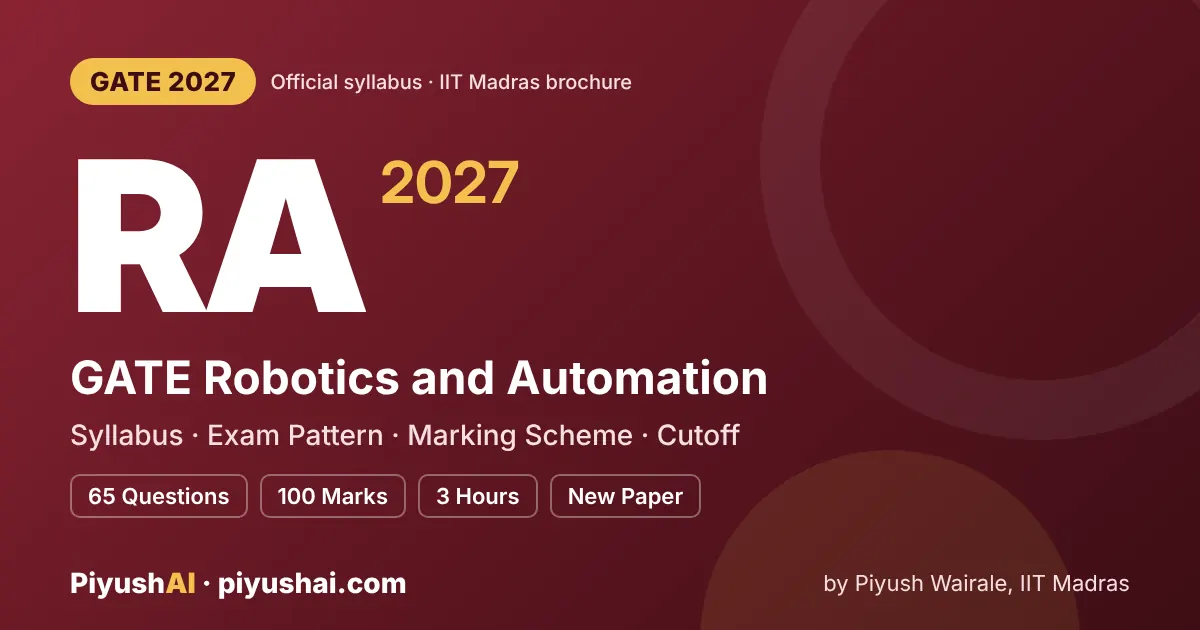
Quick answer: GATE RA 2027 has 65 questions for 100 marks: General Aptitude (15 marks), a common Part A (60 marks) and either Part B1 Electrical or Part B2 Mechanical (25 marks), chosen during the exam. The exam is a Computer Based Test conducted by IIT Madras on 6 to 21 February 2027. MCQs carry negative marking (1/3 or 2/3); MSQ and NAT questions do not. Below is the complete, official GATE RA 2027 syllabus with the section-wise structure, GATE 2026 cutoffs and a preparation plan.
📋 Table of Contents
- GATE RA 2027 overview
- Exam pattern and marks distribution
- Question types and marking scheme
- GATE RA 2027 syllabus (official)
- General Aptitude syllabus
- GATE 2026 cutoff and statistics
- Allowed second papers
- Important dates and eligibility
- Preparation strategy
- What a GATE RA score gets you
- GATE RA course, notes and test series
- FAQs
GATE Robotics and Automation (RA) 2027: Overview
GATE Robotics and Automation (RA) is the newest GATE paper, introduced in GATE 2027. It has a common Part A (60 marks) covering engineering mathematics, mechatronics and the principles of robotics and automation, plus a Part B (25 marks) where you choose either B1 Electrical or B2 Mechanical during the exam. It is designed for M.Tech programmes in robotics, mechatronics and automation.
Who usually takes this paper: Students and graduates of Mechanical, Electrical, Electronics, Instrumentation, Mechatronics, Robotics and Computer Science who want to specialise in robotics.
| Particular | Details |
|---|---|
| Exam name | GATE 2027: Robotics and Automation |
| Paper code | RA |
| Organising institute | IIT Madras |
| Mode | Computer Based Test (CBT), English only |
| Exam dates | 6, 7, 13, 14, 20 and 21 February 2027 (two sessions a day) |
| Duration | 3 hours (4 hours with compensatory time for eligible PwD candidates) |
| Questions / marks | 65 questions / 100 marks |
| Question types | MCQ, MSQ, NAT |
| Calculator | On-screen virtual scientific calculator only |
| Result date | 19 March 2027 |
| Score validity | 3 years |
| Official website | gate2027.iitm.ac.in |
GATE RA 2027 Exam Pattern and Marks Distribution
GATE RA 2027 has 65 questions for 100 marks: General Aptitude (15 marks), a common Part A (60 marks) and either Part B1 Electrical or Part B2 Mechanical (25 marks), chosen during the exam.
| Section | Questions | Marks | Notes |
|---|---|---|---|
| General Aptitude (GA) | 10 | 15 | 5 × 1 mark + 5 × 2 marks |
| Part A (common, compulsory) | 39 | 60 | 18 × 1 mark + 21 × 2 marks |
| Part B1 (Electrical) or Part B2 (Mechanical) | 16 | 25 | 7 × 1 mark + 9 × 2 marks; choose B1 or B2 during the exam |
| Total | 65 | 100 | 3 hours, CBT |
Question Types and Marking Scheme
| Question type | What it is | Marks | Negative marking |
|---|---|---|---|
| MCQ | Four options, exactly one correct | 1 or 2 | −1/3 for a 1-mark MCQ, −2/3 for a 2-mark MCQ |
| MSQ | Four options, one or more correct; full marks only for the exact correct combination | 1 or 2 | None (and no partial marks) |
| NAT | Numerical answer typed on a virtual keypad (integer or decimal) | 1 or 2 | None (and no partial marks) |
GATE questions test four abilities: Recall, Comprehension, Application, and Analysis and Synthesis. For NAT answers, round off only at the final step, to the number of decimal places asked in the question.
GATE RA 2027 Syllabus (Official, IIT Madras)
The GATE 2027 syllabus has been revised for most papers, so use this version rather than older lists. Here is the section-wise summary of the GATE RA 2027 syllabus, followed by the complete official topic list as published in Appendix D of the GATE 2027 Information Brochure.
| Part | Section |
|---|---|
| Part A: Common Section | Engineering Mathematics |
| Part A: Common Section | Basics of Mechatronics |
| Part A: Common Section | Principles of Robotics and Automation |
| Part B1: Electrical Engineering | Analog Circuits and Embedded Systems |
| Part B1: Electrical Engineering | Signals and Systems |
| Part B1: Electrical Engineering | Control Systems |
| Part B2: Mechanical Engineering | Mechanics of Materials |
| Part B2: Mechanical Engineering | Kinematics and Dynamics |
| Part B2: Mechanical Engineering | Machine Design and Computer Integrated Manufacturing |
Complete GATE RA 2027 syllabus: topic-wise
Part A: Common Section
Section A.1: Engineering Mathematics
Linear Algebra: Matrices- transpose, determinant, rank, eigenvalues and eigenvectors, trace, adjoint, solutions to system of linear equations.
Calculus: Functions of a single variable, limit, continuity, and differentiability, mean value theorems, indeterminate forms; evaluation of definite and improper integrals; double and triple integrals; partial derivatives, total derivative, Taylor series (in one and two variables), maxima and minima; gradient, divergence and curl, vector identities.
Differential Equations: First-order equations (linear and nonlinear); higher-order linear differential equations with constant coefficients; Euler-Cauchy equation; initial and boundary value problems; Laplace transforms; solutions of heat, wave, and Laplace’s equations; Fourier series.
Probability and Statistics: Axioms of probability, conditional probability, mean, median, mode, standard deviation, random variables, expectation, binomial, Poisson, and normal distributions; hypothesis testing, Probability Density Function (PDF), Cumulative Distribution Function (CDF).
Numerical Methods: Solutions of linear and non-linear algebraic equations; integration by trapezoidal and Simpson’s rules; finite differences, explicit single and multi-step methods for differential equations.
Section A.2: Basics of Mechatronics
Network Elements: Ideal voltage and current sources, dependent sources, R, L, C, M elements; Network solution methods: Kirchoff’s laws (KCL, KVL), Node and Mesh analysis; Network Theorems: Thevenin’s, Norton’s Superposition and Maximum Power Transfer theorem; Transient response of DC and AC networks, sinusoidal steady-state analysis, resonance, two-port networks, balanced three-phase circuits, complex power and power factor in AC circuits.
Digital Circuits: Boolean algebra, combinational (multiplexers, encoders, decoders), and sequential circuits (flip-flops, counters).
Sensors: Resistive, capacitive, inductive, piezoelectric, Hall effect sensors and associated signal conditioning circuits; transducers for industrial instrumentation- displacement (linear and angular), velocity, acceleration, force, torque, pressure.
Actuators: Principles of operation, performance, torque-speed characteristics of hydraulic and pneumatic actuators, DC motors, stepper motors, and servo motors.
Engineering Mechanics: Free-body diagrams and equilibrium; friction and its applications- rolling friction, belt-pulley; trusses and frames; kinematics and dynamics of rigid bodies in plane motion.
Programming: Flowcharts and pseudo code; Programming in Python: data types, operators, expressions, conditional statements (if, elif, else, case) looping statements (while, for), loop control statements (break and continue), functions, arrays, dictionary, strings, recursion.
Data Structures: Stack, queue, linked list, binary search tree, binary heap, graph.
Section A.3: Principles of Robotics and Automation
Robotic classification- serial and parallel manipulators, geometrical configuration, Links and joints, Coordinate systems and degrees-of-freedom; Rotation matrices in 2D and 3D; homogeneous transformations, forward kinematics. Robot applications- point-to-point and continuous path control, types of end-effectors, robot accuracy and repeatability.
Computer Integrated Manufacturing- Automation in Manufacturing, Programmable Logic Controllers (PLCs) in manufacturing, Automated material handling systems, Automated storage and retrieval systems, Automated identification, detection and capture systems; computer numerical control; Basics of single and multi-axis positioning systems; Basics of concurrent design and manufacturing planning for automation.
Part B1: Electrical Engineering
Section B1.1: Analog Circuits and Embedded Systems
Analog filters – low-pass, high-pass, band-pass and band-reject; Amplifiers: biasing, equivalent circuit and frequency response, feedback amplifiers, operational amplifiers- characteristics and applications; oscillators; Voltage Controlled Oscillators and timers, Schmitt triggers, sample and hold circuits, Analog-to-Digital (A/D) and Digital-to-Analog (D/A) converters; Switched Mode Power Supplies (SMPS).
Microprocessor and microcontroller applications, components of microcontrollers (CPU, memory, I/O ports, timers), interrupt handling; memory and input-output interfacing; basics of data acquisition systems.
Section B1.2: Signals and Systems
Representation of continuous and discrete time signals, shifting and scaling properties, linear time-invariant and causal systems, Fourier series representation of continuous and discrete time periodic signals, Shannon’s sampling theorem, Definitions and properties of Fourier Transform, Laplace Transform and Z transform; R.M.S. value, average value calculation.
Section B1.3: Control Systems
Mathematical modeling and representation of systems, feedback principle, transfer function, Block diagrams and Signal flow graphs, Transient and Steady‐state analysis of linear time-invariant systems, Stability analysis using Routh-Hurwitz and Nyquist criteria, Bode plots, Root Loci, Lag, Lead and Lead‐Lag compensators; P, PI and PID controllers.
Part B2: Mechanical Engineering
Section B2.1: Mechanics of Materials
Stress and strain, elastic constants, Poisson’s ratio; Mohr’s circle for plane stress and plane strain; thin cylinders; shear force and bending moment diagrams; bending and shear stresses; concept of shear centre; deflection of beams; torsion of circular shafts; Euler’s theory of columns; Castigliano’s theorems; thermal stresses; strain gauges and rosettes; testing of materials with universal testing machine; testing of hardness and impact strength.
Section B2.2: Kinematics and Dynamics
Displacement, velocity, and acceleration analysis of plane mechanisms; dynamic analysis of linkages; gears and gear trains; balancing of reciprocating and rotating masses; gyroscope, Vibrations- free and forced vibration of single degree of freedom systems, the effect of damping, vibration isolation; resonance; critical speeds of shafts.
Section B2.3: Machine Design and Computer Integrated Manufacturing
Design for static and dynamic loading; failure theories; fatigue strength and the S-N diagram; principles of the design of machine elements such as bolted, riveted and welded joints; shafts, rolling and sliding contact bearings, brakes and clutches, springs. Basic concepts of Computer Aided Design (CAD)/Computer Aided Manufacturing (CAM) and their integration tools; additive manufacturing.
General Aptitude (GA) Syllabus: 15 Marks, Common to All Papers
| Area | Topics |
|---|---|
| Verbal Aptitude | Basic English grammar, vocabulary (words, idioms, phrases in context), reading comprehension, narrative sequencing |
| Quantitative Aptitude | Data interpretation (graphs, charts, maps, tables), ratios, percentages, powers, exponents, logarithms, permutations and combinations, series, mensuration and geometry, elementary statistics and probability |
| Analytical Aptitude | Deduction and induction, analogy, numerical relations and reasoning |
| Spatial Aptitude | Translation, rotation, scaling, mirroring, assembling and grouping, paper folding, cutting and patterns in 2D and 3D |
GATE RA 2026 Cutoff, Qualifying Marks and Statistics
Robotics and Automation is a new paper in GATE 2027, so there is no previous-year RA cutoff. For reference, the closest papers in GATE 2026 had these general-category qualifying marks: Mechanical Engineering 25.2, Electrical Engineering 27.7, Electronics and Communication 26.4, Instrumentation 39.8 and Data Science and AI 26.4 (out of 100). Qualifying marks are computed fresh each year with the formula below.
| Related paper (GATE 2026) | Appeared | Qualified | Qualifying marks (GEN / OBC-NCL-EWS / SC-ST-PwD) |
|---|---|---|---|
| Mechanical Engineering (ME) | 59,612 | 10,970 | 25.2 / 22.6 / 16.7 |
| Electrical Engineering (EE) | 65,801 | 13,726 | 27.7 / 24.9 / 18.4 |
| Electronics and Communication Engineering (EC) | 95,752 | 17,392 | 26.4 / 23.7 / 17.5 |
| Instrumentation Engineering (IN) | 12,424 | 2,823 | 39.8 / 35.8 / 26.5 |
| Data Science and Artificial Intelligence (DA) | 69,242 | 12,849 | 26.4 / 23.7 / 17.5 |
How the qualifying marks and GATE score are calculated
For each paper, the general-category qualifying mark is max(25, min(40, μ + σ)), where μ and σ are the mean and standard deviation of the marks of all candidates who appeared. OBC-NCL/EWS qualifying marks are 90% and SC/ST/PwD qualifying marks are about two-thirds of the general value.
Your GATE score (out of 1000) is computed as Score = 350 + 550 × (M − Mq) / (M̄t − Mq), where M is your marks (normalised marks for multi-session papers), Mq is the general qualifying mark and M̄t is the mean marks of the top 0.1% or top 10 candidates, whichever is larger. A score of 350 corresponds to the qualifying mark and 900 to the top-candidate average.
Which Papers Can Be Combined with GATE RA 2027?
You may appear in one or two GATE papers. As per the tentative list in the GATE 2027 brochure, the second paper allowed with RA as the primary paper is: Electrical Engineering (EE), Mechanical Engineering (ME), Data Science and Artificial Intelligence (DA), Computer Science and Information Technology (CS), Electronics and Communication Engineering (EC), Instrumentation Engineering (IN). The fee for two papers is twice that of one paper.
GATE 2027 Important Dates, Fee and Eligibility
| Event | Date |
|---|---|
| Registration (regular period) | 2 to 27 September 2026 (closed) |
| Extended period with late fee | Up to 12 October 2026 (closed) |
| Special window (late fee) | 15 October 2026, 10:30 AM to 16 October 2026, 10:29 AM (closed) |
| Exam city notification | 4 January 2027 |
| Admit card | To be announced on GOAPS |
| GATE 2027 exam | 6, 7, 13, 14, 20 and 21 February 2027 |
| Result | 19 March 2027 |
Application fee per paper (regular period): ₹1,000 for female, SC, ST and PwD candidates and ₹2,000 for all others; ₹1,500 and ₹2,500 respectively in the extended period and special window.
Eligibility: candidates in the third or higher year of any undergraduate degree, or who have completed a government-approved degree in Engineering, Technology, Architecture, Science, Commerce, Arts or Humanities, are eligible. M.B.B.S./B.D.S./B.V.Sc. students from the fifth semester and M.Sc./M.A./MCA students from the first year are also eligible. There is no age limit. All dates are as per the brochure and subject to change, so always confirm on the official website.
GATE RA 2027 Preparation Strategy
- Part A is worth 60 of the 85 subject marks. Engineering Mathematics, Basics of Mechatronics and Principles of Robotics and Automation must be your top priority.
- Part A is broad: network theory, digital circuits, sensors, actuators, engineering mechanics, Python programming and data structures, plus rotation matrices, homogeneous transformations and forward kinematics. Cover all of it, since nothing here is optional.
- Choose B1 (Electrical: analog circuits and embedded systems, signals and systems, control) or B2 (Mechanical: mechanics of materials, kinematics and dynamics, machine design and CIM) based on your degree, but you can switch in the exam.
- Since 2027 is the first RA paper, there are no RA PYQs. Use related PYQs from ME, EE, EC and IN, and take RA-specific mock tests.
- Section-wise scores and ranks will not be given for RA; you receive one RA score.
- Solve previous GATE papers (2007 to 2026 are available on the official website) section by section, then as timed full-length papers.
- Practise every numerical with the GATE virtual calculator, since no physical calculator is allowed.
- From December, take one full mock a week in the real interface and analyse every mistake, especially negatively marked MCQs.
What Can You Do with a GATE RA 2027 Score?
GATE RA scores will be used for M.Tech/PhD admissions in robotics, mechatronics and automation at IITs and other institutes. As a new paper, check each recruiter’s notification for whether RA is accepted.
Under MoE guidelines, admitting institutes give at least 70% weightage to GATE performance for M.Tech admissions with scholarship. Qualifying GATE does not by itself guarantee admission, a scholarship or a job; each institute and employer applies its own criteria.
GATE RA 2027 Course, Notes and Test Series
RA is new in GATE 2027, so there are no previous papers to practise from. PiyushAI has built a complete GATE RA course, subject notes, numerical workbooks and a dedicated RA test series, taught by Piyush Wairale (IIT Madras), on www.piyushwairale.com.
GATE Robotics and Automation (RA) Complete Course: Part A
Bundle of 10 subject courses covering the full common Part A syllabus.
Principles of Robotics and Automation for GATE RA
Robot configurations, DOF, transformations and automation with notes.
Sensors and Actuators for GATE RA
Sensors, signal conditioning and actuators for Part A.
All GATE RA courses, notes and workbooks
Every RA subject course, notes and practice workbook.
Best GATE Aptitude Test Series 2027
Secure the 15 General Aptitude marks with topic tests and full GA mocks.
Engineering Mathematics for GATE RA
Linear Algebra, Calculus and Probability and Statistics courses for the Part A maths section.
GATE 2027 courses, notes and test series by Piyush Wairale (IIT Madras)
Free lessons on YouTube (@piyushwairaleiitm)
GATE RA 2027: Frequently Asked Questions
What is the GATE RA 2027 exam pattern?
GATE RA 2027 has 65 questions for 100 marks: General Aptitude (15 marks), a common Part A (60 marks) and either Part B1 Electrical or Part B2 Mechanical (25 marks), chosen during the exam. Questions are MCQ, MSQ and NAT, and each carries 1 or 2 marks.
Is there negative marking in GATE RA 2027?
Yes, but only for MCQs. A wrong 1-mark MCQ costs 1/3 mark and a wrong 2-mark MCQ costs 2/3 mark. MSQ and NAT questions have no negative marking, and there is no partial marking for any question.
What is the GATE RA cutoff?
There is no previous cutoff because Robotics and Automation is new in GATE 2027. The qualifying mark will be calculated as max(25, min(40, mean + standard deviation)) of all RA candidates’ marks.
When is the GATE RA 2027 exam?
GATE 2027 will be held on 6, 7, 13, 14, 20 and 21 February 2027 in forenoon (9:30 AM to 12:30 PM) and afternoon (2:30 PM to 5:30 PM) sessions. The paper-wise schedule will be published on the official website, and results are scheduled for 19 March 2027.
Which IIT is conducting GATE 2027?
IIT Madras is the organising institute for GATE 2027. The official website is gate2027.iitm.ac.in.
Is Robotics and Automation a new GATE paper?
Yes. The GATE 2027 Information Brochure introduces Robotics and Automation (RA) as a new test paper for 2027.
Which papers can be combined with GATE RA 2027?
Robotics and Automation (RA) can be combined with EE, ME, DA, CS, EC or IN.
How long is the GATE RA 2027 score valid?
The GATE 2027 score is valid for three years from the date the results are announced.
Sources: GATE 2027 Information Brochure, IIT Madras (gate2027.iitm.ac.in); GATE 2026 Statistical and Performance Report, IIT Guwahati. Last updated 27 October 2026.
More GATE 2027 guides: GATE 2027 syllabus and exam pattern for all 30 papers | GATE General Aptitude 2027 | GATE AE 2027 | GATE AG 2027 | GATE AR 2027 | GATE BM 2027 | GATE BT 2027 | GATE CE 2027 | GATE CH 2027 | GATE CS 2027 | GATE CY 2027 | GATE DA 2027 | GATE EC 2027 | GATE EE 2027 | GATE ES 2027 | GATE EY 2027 | GATE GE 2027 | GATE GG 2027 | GATE IN 2027 | GATE MA 2027 | GATE ME 2027 | GATE MN 2027 | GATE MT 2027 | GATE NM 2027 | GATE PE 2027 | GATE PH 2027 | GATE PI 2027 | GATE ST 2027 | GATE XE 2027 | GATE XH 2027 | GATE XL 2027
Recent Post
GATE PE 2027 Petroleum Engineering syllabus, exam pattern, marks distribution, 2026 cutoff and prep tips, based on the official IIT Madras brochure.
GATE ES 2027 Environmental Science and Engineering syllabus, exam pattern, marking scheme, 2026 cutoff and prep tips from the IIT Madras brochure.
GATE MA 2027 Mathematics syllabus, exam pattern, marks distribution, 2026 cutoff and prep tips, based on the official IIT Madras brochure.
GATE MT 2027 Metallurgical Engineering syllabus, exam pattern, marks distribution, 2026 cutoff and prep tips, based on the official IIT Madras brochure.
GATE NM 2027 Naval Architecture and Marine Engineering syllabus, exam pattern, marking scheme, 2026 cutoff and prep tips from the IIT Madras brochure.

GATE PH 2027 Physics syllabus, exam pattern, marks distribution, 2026 cutoff and prep tips, based on the official IIT Madras brochure.
Learn Daily, Wherever You Are
Free lectures, exam updates, PYQ discussions, and job alerts — delivered through our YouTube channel and Telegram communities.

[…] and Marine Engineering (NM), Production and Industrial Engineering (PI), Engineering Sciences (XE), Robotics and Automation (RA), Computer Science and Information Technology (CS). The fee for two papers is twice that of one […]