
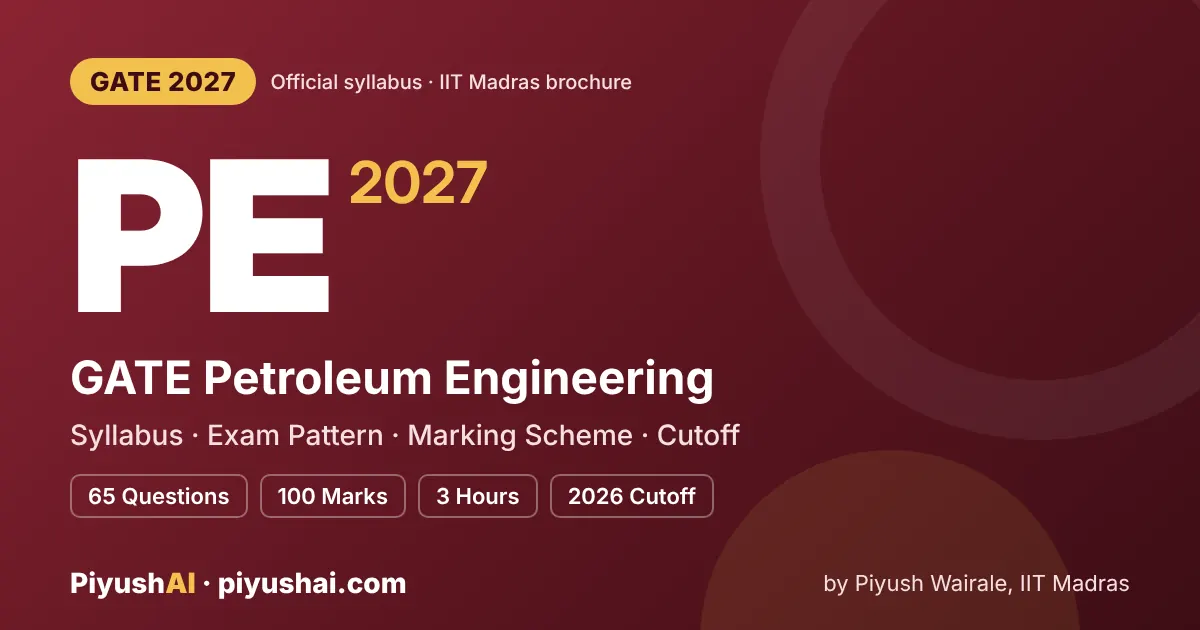
Quick answer: GATE PE 2027 has 65 questions for 100 marks in 3 hours: General Aptitude carries 15 marks, Engineering Mathematics 13 marks and core Petroleum Engineering subjects 72 marks. The exam is a Computer Based Test conducted by IIT Madras on 6 to 21 February 2027. MCQs carry negative marking (1/3 or 2/3); MSQ and NAT questions do not. Below is the complete, official GATE PE 2027 syllabus with the section-wise structure, GATE 2026 cutoffs and a preparation plan.
📋 Table of Contents
- GATE PE 2027 overview
- Exam pattern and marks distribution
- Question types and marking scheme
- GATE PE 2027 syllabus (official)
- General Aptitude syllabus
- GATE 2026 cutoff and statistics
- Allowed second papers
- Important dates and eligibility
- Preparation strategy
- What a GATE PE score gets you
- GATE PE course, notes and test series
- FAQs
GATE Petroleum Engineering (PE) 2027: Overview
GATE Petroleum Engineering (PE) is the specialist paper for upstream oil and gas. It is the route to M.Tech and PhD programmes in petroleum engineering and has relevance for oil and gas recruitment. The syllabus covers exploration, drilling, reservoir engineering, production, offshore operations, formation evaluation, well testing, HSE, EOR and latest trends.
Who usually takes this paper: B.E./B.Tech. Petroleum Engineering, Chemical Engineering and Applied Petroleum Engineering students and graduates.
| Particular | Details |
|---|---|
| Exam name | GATE 2027: Petroleum Engineering |
| Paper code | PE |
| Organising institute | IIT Madras |
| Mode | Computer Based Test (CBT), English only |
| Exam dates | 6, 7, 13, 14, 20 and 21 February 2027 (two sessions a day) |
| Duration | 3 hours (4 hours with compensatory time for eligible PwD candidates) |
| Questions / marks | 65 questions / 100 marks |
| Question types | MCQ, MSQ, NAT |
| Calculator | On-screen virtual scientific calculator only |
| Result date | 19 March 2027 |
| Score validity | 3 years |
| Official website | gate2027.iitm.ac.in |
GATE PE 2027 Exam Pattern and Marks Distribution
GATE PE 2027 has 65 questions for 100 marks in 3 hours: General Aptitude carries 15 marks, Engineering Mathematics 13 marks and core Petroleum Engineering subjects 72 marks.
| Section | Questions | Marks | Notes |
|---|---|---|---|
| General Aptitude (GA) | 10 | 15 | 5 × 1 mark + 5 × 2 marks |
| Engineering Mathematics | Part of 55 | 13 | Paper-specific maths questions |
| Petroleum Engineering (core subject) | Part of 55 | 72 | Mix of 1-mark and 2-mark questions |
| Total | 65 | 100 | 3 hours, CBT |
Question Types and Marking Scheme
| Question type | What it is | Marks | Negative marking |
|---|---|---|---|
| MCQ | Four options, exactly one correct | 1 or 2 | −1/3 for a 1-mark MCQ, −2/3 for a 2-mark MCQ |
| MSQ | Four options, one or more correct; full marks only for the exact correct combination | 1 or 2 | None (and no partial marks) |
| NAT | Numerical answer typed on a virtual keypad (integer or decimal) | 1 or 2 | None (and no partial marks) |
GATE questions test four abilities: Recall, Comprehension, Application, and Analysis and Synthesis. For NAT answers, round off only at the final step, to the number of decimal places asked in the question.
GATE PE 2027 Syllabus (Official, IIT Madras)
The GATE 2027 syllabus has been revised for most papers, so use this version rather than older lists. Here is the section-wise summary of the GATE PE 2027 syllabus, followed by the complete official topic list as published in Appendix D of the GATE 2027 Information Brochure.
| # | Section |
|---|---|
| 1 | Engineering Mathematics |
| 2 | Petroleum Exploration |
| 3 | Oil and Gas Well Drilling Technology |
| 4 | Reservoir Engineering |
| 5 | Petroleum Production Operations |
| 6 | Offshore Drilling and Production Practices |
| 7 | Petroleum Formation Evaluation |
| 8 | Oil and Gas Well Testing |
| 9 | Health Safety and Environment in Petroleum Industry |
| 10 | Enhanced Oil Recovery Techniques |
| 11 | Latest Trends in Petroleum Engineering |
Complete GATE PE 2027 syllabus: topic-wise
Section 1: Engineering Mathematics
Linear Algebra: Matrix algebra; Systems of linear equations; Eigenvalues and eigenvectors.
Calculus: Functions of single variable; Limit, continuity and differentiability; Taylor series; Mean value theorems; Evaluation of definite and improper integrals; Partial derivative, Total derivative; Maxima and minima; Gradient, divergence and curl; Vector identities; Directional derivatives; Line, surface and volume integrals; Stokes, Gauss and Green’s theorems.
Differential Equations: First order equations: linear and nonlinear; Higher order linear differential equations with constant coefficients; Cauchy’s and Euler’s equations; Initial and boundary value problems; Laplace transform; Solution of one-dimensional diffusivity equation and Laplace equation.
Complex Variables: Complex number; Polar form of complex number; Triangle inequality.
Probability and Statistics: Definitions of probability and sampling theorems; Conditional probability; Mean, median, mode and standard deviation; Random variables; Poisson, normal and binomial distributions; Linear regression analysis.
Numerical Methods: Numerical solutions of linear and non-linear algebraic equations; Integration by trapezoidal and Simpson’s rule; Single and multi-step methods for numerical solution of differential equations.
Section 2: Petroleum Exploration
Classification and description of some common rocks with special reference to clastic and non-clastic reservoir rocks; Origin, migration and accumulation of petroleum; Petroleum exploration methods; Petroleum resource classification and evaluation.
Section 3: Oil and Gas Well Drilling Technology
Well planning; Drilling methods; Drilling rigs; Rig operating systems; Drilling fluids, function and properties; Drilling fluid maintenance equipment; Oil and gas well cementing operations; Drill bit types and their applications; Drill string and casing string function, operation, selection and design; Drilling problems, their control and remedies; Directional drilling tools; Directional survey; Application of horizontal, multilateral, extended reach; Slim wells; Intelligent drilling and completion techniques: image assisted drilling, managed pressure drilling, underbalanced drilling.
Section 4: Reservoir Engineering
Petrophysical properties of reservoir rocks; Coring and core analysis; Reservoir fluid properties; Phase behaviour of a hydrocarbon system; Single phase and multiphase flow through porous media; Water and gas coning; Reservoir pressure measurement; Reservoir drives, drive mechanisms and recovery factors; Theory of material balance; Reserve estimation and techniques; Field development and reservoir management; Reservoir geomechanics: Stress analysis and fracturing; Basics of reservoir simulation: mathematical models, finite difference discretization, Cartesian and radial grid systems, black oil reservoir simulation, history matching.
Section 5: Petroleum Production Operations
Well equipment; Well completion techniques; Well production problems and mitigation; Well servicing and Workover operations; Workover and completion fluids; Formation damage; Well stimulation techniques; Artificial lift techniques; Field processing of oil and gas; Storage and transportation of petroleum and petroleum products; Metering and measurements of oil and gas; Production system analysis and optimization including inflow performance, tubing performance, and nodal analysis; Production testing; Multiphase flow in tubing and flow-lines; Flow assurance: Problems and remedies; Pressure vessels, storage tanks, shell and tube heat exchangers, pumps and compressors.
Section 6: Offshore Drilling and Production Practices
Offshore oil and gas operations and ocean environment; Buoyancy and stability; Offshore fixed platforms, Offshore mobile units, station keeping methods like mooring and dynamic positioning system; Offshore drilling from fixed platform, jack-up, ships and semi submersibles; Use of conductors, risers and umbilicals; Offshore well completion; Deep water applications of subsea technology; Offshore production: Oil processing platforms, water injection platforms, storage, Single Point Mooring (SPM) and Single Buoy Mooring (SBM), transportation and utilities; Deep water drilling and production system.
Section 7: Petroleum Formation Evaluation
Petrophysical evaluation of sub-surface formations: principles, applications, advantages and disadvantages of Spontaneous Potential (SP), resistivity, radioactive, acoustic logs, gamma ray logs and types of tools used; Logging While Drilling (LWD); Evaluation of Cement Bond Long (CBL)/ Variable Density Log (VDL), Ultrasonic Imager Tool (USIT), Segmented Frequency Tool (SFT), Repeat Formation Tester (RFT); Production logging tools, principles, limitations and applications; Special types of logging tools; Casing inspection tools: principles, applications and limitations; Formations micro scanner (FMS), Nuclear Magnetic Resonance (NMR) logging principles; Standard log interpretation methods; Cross-plotting methods.
Section 8: Oil and Gas Well Testing
Diffusivity equation and its solutions; Radius of investigation; Principle of superposition; Horner’s approximation; Drill stem testing; Pressure transient tests: drawdown and build up-test analysis; Pressure derivative analysis; Wellbore effects; Multilayer reservoirs; Injection well testing; Multiple well testing; Interference testing; Pulse testing; Well-test analysis by use of type curves; Gas well testing; Inflow testing.
Section 9: Health Safety and Environment in Petroleum Industry
Health hazards in Petroleum Industry: toxicity, physiological, asphyxiation, respiratory and skin effect of petroleum hydrocarbons, sour gases; Safety System: manual and automatic shutdown system, blow down systems; Gas detection system; Fire detection and suppression systems; Personal protection system and measures; Health, Safety and Environment (HSE) policies; Disaster and crisis management in petroleum industry; Environment: Environment concepts, impact on ecosystem, air, water and soil; The impact of drilling and production operations on environment; Environmental transport of petroleum wastes; Offshore environmental studies; Offshore oil-spill and oil-spill control; Environmental regulations and compliance.
Section 10: Enhanced Oil Recovery Techniques
Basic principles and mechanism of Enhanced Oil Recovery (EOR); Screening of EOR processes; Concept of pattern flooding, recovery efficiency, permeability heterogeneity; Macroscopic and microscopic displacement efficiency; EOR methods: chemical flooding, miscible flooding, thermal recoveries (steam stimulation, hot water and steam flooding, in-situ combustion), microbial EOR, low salinity water flooding.
Section 11: Latest Trends in Petroleum Engineering
Coal bed methane, shale gas, oil shale, gas hydrate, heavy oil, physical and chemical trapping of CO 2 in underground reservoirs.
General Aptitude (GA) Syllabus: 15 Marks, Common to All Papers
| Area | Topics |
|---|---|
| Verbal Aptitude | Basic English grammar, vocabulary (words, idioms, phrases in context), reading comprehension, narrative sequencing |
| Quantitative Aptitude | Data interpretation (graphs, charts, maps, tables), ratios, percentages, powers, exponents, logarithms, permutations and combinations, series, mensuration and geometry, elementary statistics and probability |
| Analytical Aptitude | Deduction and induction, analogy, numerical relations and reasoning |
| Spatial Aptitude | Translation, rotation, scaling, mirroring, assembling and grouping, paper folding, cutting and patterns in 2D and 3D |
GATE PE 2026 Cutoff, Qualifying Marks and Statistics
These are the official GATE 2026 figures for Petroleum Engineering from the GATE 2026 Statistical and Performance Report (IIT Guwahati). They are the best guide to what to expect in GATE PE 2027. Qualifying marks are out of 100; the qualifying GATE score for the general category is always 350.
| Paper | Registered | Appeared | Qualified | Qualified % |
|---|---|---|---|---|
| Petroleum Engineering (PE) | 1,428 | 1,137 | 317 | 27.9% |
| Paper | GEN | OBC-NCL / EWS | SC / ST / PwD |
|---|---|---|---|
| Petroleum Engineering (PE) | 40 | 36 | 26.6 |
| Paper | Highest marks | Mean of top 0.1% (or top 10) | Average marks | Std. deviation |
|---|---|---|---|---|
| Petroleum Engineering (PE) | 69 | 66.67 | 27.52 | 14.29 |
What this means for you: in GATE 2026 the average PE candidate scored 27.52 marks, while the top 0.1% averaged 66.67. Crossing the general qualifying mark of 40 puts you in the top 28% of candidates, but admissions to top IITs and PSU interview calls usually need a score far above the qualifying line.
How the qualifying marks and GATE score are calculated
For each paper, the general-category qualifying mark is max(25, min(40, μ + σ)), where μ and σ are the mean and standard deviation of the marks of all candidates who appeared. OBC-NCL/EWS qualifying marks are 90% and SC/ST/PwD qualifying marks are about two-thirds of the general value.
Your GATE score (out of 1000) is computed as Score = 350 + 550 × (M − Mq) / (M̄t − Mq), where M is your marks (normalised marks for multi-session papers), Mq is the general qualifying mark and M̄t is the mean marks of the top 0.1% or top 10 candidates, whichever is larger. A score of 350 corresponds to the qualifying mark and 900 to the top-candidate average.
Which Papers Can Be Combined with GATE PE 2027?
You may appear in one or two GATE papers. As per the tentative list in the GATE 2027 brochure, the second paper allowed with PE as the primary paper is: Chemical Engineering (CH). The fee for two papers is twice that of one paper.
GATE 2027 Important Dates, Fee and Eligibility
| Event | Date |
|---|---|
| Registration (regular period) | 2 to 27 September 2026 (closed) |
| Extended period with late fee | Up to 12 October 2026 (closed) |
| Special window (late fee) | 15 October 2026, 10:30 AM to 16 October 2026, 10:29 AM (closed) |
| Exam city notification | 4 January 2027 |
| Admit card | To be announced on GOAPS |
| GATE 2027 exam | 6, 7, 13, 14, 20 and 21 February 2027 |
| Result | 19 March 2027 |
Application fee per paper (regular period): ₹1,000 for female, SC, ST and PwD candidates and ₹2,000 for all others; ₹1,500 and ₹2,500 respectively in the extended period and special window.
Eligibility: candidates in the third or higher year of any undergraduate degree, or who have completed a government-approved degree in Engineering, Technology, Architecture, Science, Commerce, Arts or Humanities, are eligible. M.B.B.S./B.D.S./B.V.Sc. students from the fifth semester and M.Sc./M.A./MCA students from the first year are also eligible. There is no age limit. All dates are as per the brochure and subject to change, so always confirm on the official website.
GATE PE 2027 Preparation Strategy
- Reservoir Engineering and Drilling Technology are the most important sections: material balance, Darcy flow, drilling fluids, hydraulics and well control.
- Production Operations and Well Testing are numerical. IPR curves, artificial lift, pressure transient analysis and decline curves repeat often.
- Formation Evaluation (well logging) needs clear knowledge of SP, resistivity, radioactive and acoustic logs, and the tools used in cased and open holes.
- HSE, EOR and Latest Trends (coal bed methane, shale gas, gas hydrates and CO2 trapping) are quick recall marks if revised close to the exam.
- PE had a 40-mark general qualifying mark (the ceiling) in 2026 and a mean of 27.52, so expect stiff competition among a small pool.
- Solve previous GATE papers (2007 to 2026 are available on the official website) section by section, then as timed full-length papers.
- Practise every numerical with the GATE virtual calculator, since no physical calculator is allowed.
- From December, take one full mock a week in the real interface and analyse every mistake, especially negatively marked MCQs.
What Can You Do with a GATE PE 2027 Score?
GATE PE scores are used for M.Tech/PhD admissions and by oil and gas companies such as ONGC, which appears in the GATE brochure list of PSUs that have used GATE scores.
Under MoE guidelines, admitting institutes give at least 70% weightage to GATE performance for M.Tech admissions with scholarship. Qualifying GATE does not by itself guarantee admission, a scholarship or a job; each institute and employer applies its own criteria.
GATE PE 2027 Course, Notes and Test Series
Get structured guidance for GATE Petroleum Engineering from Piyush Wairale (IIT Madras) on www.piyushwairale.com. Start with the section that is common to every paper, then build your subject preparation:
Best GATE Aptitude Test Series 2027
General Aptitude is 15 of your 100 marks in GATE PE. Topic-wise tests, full GA mocks in the real interface and solved PYQs from 2010 to 2026.
GATE Engineering Mathematics courses
Linear Algebra, Calculus and Probability and Statistics taught for GATE, for the 13-mark Engineering Mathematics section.
All GATE courses, notes and test series
Browse every GATE course, notes package and test series in the PiyushAI store.
Engineering Mathematics courses: Linear Algebra · Calculus · Probability and Statistics
GATE 2027 courses, notes and test series by Piyush Wairale (IIT Madras)
Free lessons on YouTube (@piyushwairaleiitm)
GATE PE 2027: Frequently Asked Questions
What is the GATE PE 2027 exam pattern?
GATE PE 2027 has 65 questions for 100 marks in 3 hours: General Aptitude carries 15 marks, Engineering Mathematics 13 marks and core Petroleum Engineering subjects 72 marks. Questions are MCQ, MSQ and NAT, and each carries 1 or 2 marks.
Is there negative marking in GATE PE 2027?
Yes, but only for MCQs. A wrong 1-mark MCQ costs 1/3 mark and a wrong 2-mark MCQ costs 2/3 mark. MSQ and NAT questions have no negative marking, and there is no partial marking for any question.
What was the GATE PE 2026 cutoff?
The GATE 2026 qualifying marks out of 100 were Petroleum Engineering (PE): 40 (GEN), 36 (OBC-NCL/EWS), 26.6 (SC/ST/PwD).
When is the GATE PE 2027 exam?
GATE 2027 will be held on 6, 7, 13, 14, 20 and 21 February 2027 in forenoon (9:30 AM to 12:30 PM) and afternoon (2:30 PM to 5:30 PM) sessions. The paper-wise schedule will be published on the official website, and results are scheduled for 19 March 2027.
Which IIT is conducting GATE 2027?
IIT Madras is the organising institute for GATE 2027. The official website is gate2027.iitm.ac.in.
Which second paper is allowed with GATE PE 2027?
Petroleum Engineering (PE) can be combined only with Chemical Engineering (CH).
Why was the GATE PE 2026 qualifying mark 40?
Qualifying marks are max(25, min(40, mean + SD)). In 2026 PE had a mean of 27.52 and SD of 14.29, so mean plus SD exceeded 40 and the cap of 40 applied.
How long is the GATE PE 2027 score valid?
The GATE 2027 score is valid for three years from the date the results are announced.
Sources: GATE 2027 Information Brochure, IIT Madras (gate2027.iitm.ac.in); GATE 2026 Statistical and Performance Report, IIT Guwahati. Last updated 27 October 2026.
More GATE 2027 guides: GATE 2027 syllabus and exam pattern for all 30 papers | GATE General Aptitude 2027 | GATE AE 2027 | GATE AG 2027 | GATE AR 2027 | GATE BM 2027 | GATE BT 2027 | GATE CE 2027 | GATE CH 2027 | GATE CS 2027 | GATE CY 2027 | GATE DA 2027 | GATE EC 2027 | GATE EE 2027 | GATE ES 2027 | GATE EY 2027 | GATE GE 2027 | GATE GG 2027 | GATE IN 2027 | GATE MA 2027 | GATE ME 2027 | GATE MN 2027 | GATE MT 2027 | GATE NM 2027 | GATE PH 2027 | GATE PI 2027 | GATE RA 2027 | GATE ST 2027 | GATE XE 2027 | GATE XH 2027 | GATE XL 2027
Recent Post

GATE ES 2027 Environmental Science and Engineering syllabus, exam pattern, marking scheme, 2026 cutoff and prep tips from the IIT Madras brochure.

GATE RA 2027 Robotics and Automation syllabus, exam pattern, marks distribution, 2026 cutoff and prep tips, based on the official IIT Madras brochure.

GATE MA 2027 Mathematics syllabus, exam pattern, marks distribution, 2026 cutoff and prep tips, based on the official IIT Madras brochure.

GATE MT 2027 Metallurgical Engineering syllabus, exam pattern, marks distribution, 2026 cutoff and prep tips, based on the official IIT Madras brochure.
GATE NM 2027 Naval Architecture and Marine Engineering syllabus, exam pattern, marking scheme, 2026 cutoff and prep tips from the IIT Madras brochure.

GATE PH 2027 Physics syllabus, exam pattern, marks distribution, 2026 cutoff and prep tips, based on the official IIT Madras brochure.
Learn Daily, Wherever You Are
Free lectures, exam updates, PYQ discussions, and job alerts — delivered through our YouTube channel and Telegram communities.

[…] GG 2027 | GATE IN 2027 | GATE MA 2027 | GATE ME 2027 | GATE MN 2027 | GATE MT 2027 | GATE NM 2027 | GATE PE 2027 | GATE PH 2027 | GATE RA 2027 | GATE ST 2027 | GATE XE 2027 | GATE XH 2027 | GATE XL […]