Last updated: 1 November 2026
For most of October 2026, an open-source project from the University of Hong Kong was quietly adding a hundred or so GitHub stars a day. Then, in the last week of the month, it exploded. DeepTutor, built by the Data Intelligence Lab at HKU (HKUDS), jumped from about 143 new stars on 25 October to over 2,100 on 28 October, when it reached number one on GitHub’s overall trending list, according to the tracker Trendshift. As of today it sits at roughly 53,000 stars.
DeepTutor is not another chatbot wrapper. It is a self-hostable, Apache-2.0 licensed “AI tutor” platform that reads your own notes and textbooks, builds quizzes and learning paths from them, remembers what you have studied, and lets you plug in almost any AI model, including free local ones. For a country like India, where crores of students prepare for GATE, JEE, university exams and competitive tests largely on their own, that pitch is very attractive.
I have been asked by several students and teachers whether DeepTutor is worth their time. In this post I explain what it is in plain language, how it works under the hood, how to install it the official way, what the research paper really shows (and does not show), the privacy and safety questions, and why I think it matters for Indian learners and educators.
Quick summary
- What it is: An open-source, agent-based personalised tutoring platform with a web app and a command-line interface, from HKU’s Data Intelligence Lab (HKUDS).
- Licence and price: Apache-2.0, free to use and modify. You pay only for the AI model you connect, or nothing if you run a local model.
- Origin: Officially released on 29 December 2025. A research preprint followed on arXiv on 10 April 2026.
- Why it is trending now: It hit #1 on GitHub trending on 28 October 2026 after a run of feature-heavy releases (the latest stable version I could confirm is v1.6.15, dated 19 October 2026).
- Core idea: Ground the AI in your own study material, then add a long-term, inspectable memory of you as a learner.
- Reality check: The research results come from the authors’ own benchmark using a simulated AI student, not real classrooms. There is no independent evidence yet that it improves marks or long-term retention.
What is DeepTutor, in plain language?
Think of a normal chatbot like a very knowledgeable stranger. You ask a question, it answers, and next week it remembers nothing about you or your syllabus. DeepTutor tries to behave more like a personal tutor who has read your textbooks, knows which topics you struggle with, and plans your next study session accordingly.
You upload your material (PDFs, EPUB books, lecture notes, even YouTube or Bilibili lecture links), and DeepTutor turns it into a searchable knowledge base. You can then chat with it, ask it to solve a problem step by step with citations back to your material, generate quizzes at a chosen difficulty, follow a “Mastery Path” where you must show understanding before moving on, or produce an audio overview to listen to on the bus. Everything runs on your own computer or server, and you choose which AI model powers it.
The project’s own README describes its goal as “Lifelong Personalized Tutoring”. The team also says there is no paid online version of the product, which matters because look-alike sites often appear around popular projects.
How DeepTutor works
Under the hood, DeepTutor combines three ideas that every CS and data science student should recognise.
1. Retrieval-augmented generation (RAG)
Large language models make things up when they do not know an answer. RAG reduces that by first searching your documents for relevant passages and then asking the model to answer using those passages. DeepTutor lets you pick the retrieval engine behind each knowledge base, including LlamaIndex, LightRAG, GraphRAG (which builds a knowledge graph of concepts and their links), PageIndex, an Obsidian vault, or offline Kiwix archives such as a downloaded copy of Wikipedia.
2. A single agent loop with tools
Since its April 2026 rewrite, DeepTutor uses one “agent” that decides which tool to use for each step: search your knowledge base, search the web, run code in a sandbox, generate a diagram, or build a quiz. It can also consult other coding agents such as Claude Code or Codex mid-conversation, and it supports MCP (Model Context Protocol) servers, the open standard for giving AI agents extra tools.
3. A three-layer learner memory
This is the part that makes it a tutor rather than a search engine. DeepTutor keeps raw traces of your sessions, periodic summaries of them, and a higher-level synthesis of what you know and where you struggle. Crucially, the memory is stored as files you can open, edit and trace back to the original sessions, so you can see why the tutor believes you are weak in, say, eigenvalues.
The research paper calls this a “hybrid personalisation engine”: static grounding in curriculum material keeps answers accurate, while dynamic memory adapts them to the individual learner. The authors’ ablation tests found that removing either part hurt performance, and removing both hurt most.
What DeepTutor can do
The feature list is long and growing almost weekly. The main pieces as of the October 2026 releases:
| Feature | What it does | Useful for |
|---|---|---|
| Chat and Solve | Step-by-step answers with citations back to your own documents | Doubt clearing, numericals |
| Quiz and question bank | Generates practice questions at a chosen difficulty and tracks attempts | Exam revision, daily practice |
| Mastery Path and Courses | Structured learning paths with checkpoints before moving on | Covering a full syllabus |
| Immersive Reading | Read PDFs, EPUBs and lecture videos with transcript search and timestamp-linked tutoring | NPTEL-style video lectures, textbooks |
| Deep Research | Multi-step research across your knowledge base and the web | Projects, seminars, literature reviews |
| Co-Writer and Book | Markdown drafting with AI edits, and auto-compiled “living books” from your sources | Notes, assignments, teaching material |
| Partners | Persistent companion agents that can also reply on chat apps such as Slack, Discord or WeChat | Reminders and quick questions on the go |
| Learner and guardian accounts | Multi-user setup with isolated workspaces, added in v1.6.3 (September 2026) | Schools, coaching centres, families |
On the model side, DeepTutor supports any OpenAI-compatible API, the Anthropic and Gemini formats, NVIDIA NIM and several aggregators, plus local servers such as Ollama, LM Studio, llama.cpp and vLLM. The interface and reply language can be switched among more than a dozen languages; check the settings for the Indian languages you need, since reply quality in them depends largely on the model you connect.
How to try it (official method)
Install only from the official repository github.com/HKUDS/DeepTutor, the deeptutor package on PyPI, or the official Docker image. Searching GitHub for “DeepTutor” also returns many forks and copies under other accounts; stick to the HKUDS original.
The README’s PyPI route needs Python 3.11 to 3.14 and Node.js 20 or newer:
# Create a folder for your DeepTutor data
mkdir -p my-deeptutor && cd my-deeptutor

# Install or upgrade to the latest stable release
pip install -U deeptutor

# Guided setup: choose your model provider and keys
deeptutor init

# Start the web app, then open http://127.0.0.1:3782
deeptutor start
If you prefer Docker, the README gives this one-liner, which keeps your data in a named volume:
docker run --rm --name deeptutor \
  -p 127.0.0.1:3782:3782 \
  -v deeptutor-data:/app/data \
  ghcr.io/hkuds/deeptutor:latest
A few practical tips from reading the docs and release notes:
- Zero API cost: Point DeepTutor at a local model through Ollama or LM Studio. Expect slower and weaker answers on a typical student laptop than with a large cloud model.
- Version churn: The project ships very frequently, and some releases contain breaking changes (v1.6.3 changed URL paths, v1.6.5 removed an older code tool). The official docs site also refers to a forthcoming 1.7.0 install command, so read the release notes before upgrading.
- Hardware: One independent review noted a reported deployment in August 2026 that used more than 14 GB of memory before a process crashed. Start small and keep an eye on RAM.
What the research shows, and its limits
The accompanying preprint, “DeepTutor: Towards Agentic Personalized Tutoring” by Bingxi Zhao, Chao Huang and colleagues, introduces a benchmark called TutorBench. According to coverage of the paper, it contains 30 knowledge bases across five university disciplines, 90 student profiles and 270 tasks. The headline claims:
- An average 10.8% improvement on personalised tutoring metrics over a simpler baseline.
- A 29.4% average gain in general agentic reasoning across five backbone models (individual gains reported between roughly 26% and 32% Pass@1).
- Agreement between human judges and the AI judge of r = 0.82, based on 45 sessions.
These are interesting numbers, but they need careful reading:
- The students were simulated. TutorBench uses an LLM playing the role of a student and another model as judge. The authors themselves acknowledge that real learners were not tested.
- No long-term learning evidence. The paper does not measure whether weeks of use improve retention, transfer or exam scores. That requires longitudinal studies with real students.
- Self-reported and not peer reviewed. It is an arXiv preprint (third version dated 9 July 2026), and I could not find an independent replication.
- Uneven citations. A review on the remio blog pointed out that some retrieval engines, such as the local LightRAG pipeline, return synthesised answers without the underlying chunks, so provenance is not equally strong everywhere.
- Stars are not outcomes. The same review summed it up neatly: “The educational verdict is not yet available.”
My own reading: DeepTutor is a well-engineered, transparent architecture for document-grounded, memory-aware tutoring. It is not yet proof that AI tutors make students learn better. Treat it as a powerful study tool that still needs your judgement, not as an authority.
Risks, safety and privacy (including the India angle)
This section is general information, not legal advice.
- Where does your data go? The app runs locally, but if you connect a cloud model, your questions and the retrieved passages from your documents are sent to that provider under its data policy. For full privacy, use a local model.
- Agent tools add attack surface. DeepTutor can run code, browse the web and import community “skills”. The team has fixed real security issues along the way, for example a notebook path-traversal bug in v1.6.11 and sandbox isolation between user accounts in v1.6.5, and shell execution has been disabled by default since v1.4.1. Keep it updated, do not expose it to the open internet without authentication, and review any skill before importing it.
- Memory can store mistakes. A persistent memory that wrongly concludes you “know” a topic can steer you away from revision you need. Check and edit the memory files occasionally.
- Children’s data in India. Schools or edtech companies that deploy DeepTutor for minors should note India’s Digital Personal Data Protection Act, 2023. The DPDP Rules notified in November 2025 require verifiable consent from a parent or guardian before processing a child’s personal data, with most obligations phased in over about 18 months. A self-hosted setup still makes the school or company responsible for how that data is handled.
- Academic integrity. A tool that solves problems step by step can just as easily be used to copy assignments. Teachers should design tasks that test understanding, not just final answers.
Why this matters for Indian students and educators
India’s learning reality is self-study at scale: lakhs of GATE aspirants, IIT Madras BS learners and university students working through NPTEL lectures, standard textbooks and previous year papers, often without a personal mentor. A free, self-hostable tutor that works from your material, not generic internet text, fits that reality better than most commercial chatbots.
For students, I see three good uses:
- Syllabus-grounded revision: Load your GATE DA notes on Probability and Statistics, Linear Algebra or Machine Learning, then generate topic-wise quizzes and let the Mastery Path track weak areas.
- Video lectures: Add NPTEL or other YouTube lectures to Reading and ask questions that are tied to timestamps.
- Learning the technology itself: Reading DeepTutor’s code is a practical lesson in RAG, vector search, knowledge graphs, agent design and FastAPI plus Next.js engineering. These map directly to GATE DA topics such as Database Management and Warehousing, Machine Learning and AI, and to data science and AI engineering roles that Indian companies are hiring for.
For teachers and coaching centres, the learner and guardian accounts and question bank make it possible to run a private, branded study assistant on a single server, with course material that stays under your control. Cybersecurity learners can also treat it as a case study: an AI system with code execution, file parsing, OAuth sign-in and multi-user isolation is exactly the kind of software that needs threat modelling, and its public release notes show real vulnerabilities being found and fixed.
My advice as an educator: use it to practise, not to outsource thinking. The value of a tutor is that it makes you attempt the problem first.
Frequently asked questions
Is DeepTutor free?
Yes. The software is open source under the Apache-2.0 licence. If you connect a paid cloud model, you pay that provider for usage; with a local model through Ollama or LM Studio there is no API cost.
Who made DeepTutor?
The Data Intelligence Lab at the University of Hong Kong (HKUDS), the same group behind projects such as LightRAG and nanobot. The research paper lists Bingxi Zhao, Jiahao Zhang, Xubin Ren, Zirui Guo, Tianzhe Chu, Yi Ma and Chao Huang as authors.
Can I use it without a powerful GPU?
Yes, if you connect a cloud model, because the heavy computation then happens on the provider’s servers. Running a capable local model needs a decent GPU or a lot of RAM, and quality will drop on small models.
Does it work for Indian exams like GATE or JEE?
It is not built for any specific exam, but it works with whatever material you give it. The quality depends on your notes and the model you choose. Always verify answers to numericals against trusted sources.
Is my data safe?
Data is stored on your machine or server. Anything sent to a cloud model leaves your machine. Use a local model, keep the software updated, and do not expose the web interface publicly without proper authentication.
Has it been proven to improve learning?
Not yet. The published results use simulated students on the authors’ own benchmark. Independent studies with real learners are still needed.
The bottom line
DeepTutor is one of the most complete open-source attempts so far to turn large language models into a genuine personal tutor: grounded in your own material, aware of your learning history and transparent about what it remembers. Its jump to the top of GitHub trending shows how much demand there is for that idea. The honest caveat is that its research evidence is early and self-reported, and its rapid release cycle means rough edges. For Indian students and teachers willing to experiment, it is well worth trying, ideally with a local model and a healthy dose of scepticism about any answer it gives.
Sources and further reading
- DeepTutor official repository (HKUDS/DeepTutor)
- DeepTutor official documentation site
- arXiv: DeepTutor: Towards Agentic Personalized Tutoring
- DeepTutor release notes
- Trendshift: HKUDS/DeepTutor trending stats
- remio: DeepTutor is trending, but its real test starts after the GitHub rush
- XiaoHu.AI: HKUDS open-sources AI tutor DeepTutor
- CoddyKit: GitHub Trending October 2026
- agents-radar: AI open source trends, 31 October 2026
- Takshashila Institution: MeitY notifies DPDP Rules 2025
Written by Piyush Wairale (M.Tech, IIT Madras), founder of PiyushAI Edtech. Star counts, versions and features change quickly; figures are as reported on or before 1 November 2026.
Recent Post
Gemini 4 Carbon is Google DeepMind's new frontier model, ranked first on the Artificial Analysis Intelligence Index v5.0 but released only to vetted cyber defenders for now. Here is what it is, how it works, benchmarks, pricing, limits, safety and what it means for Indian students.
Mistral Large 4, nicknamed "Le Chonk", is Mistral AI's 1 trillion parameter open-weight model, released on 29 October 2026 and pitched for coding agents and cyber defence. Here is what it is, how it works, what it costs to run, what independent tests found, and what it means for Indian students.
DeepSeek Super-agent is an open-source, MIT-licensed coding agent prototype released on 31 October 2026 that works inside one GitHub repository and replies with pull requests. Here is what DeepSeek Super-agent is, how it works, its permission model, the full-access security caveat, and what it means for Indian students.
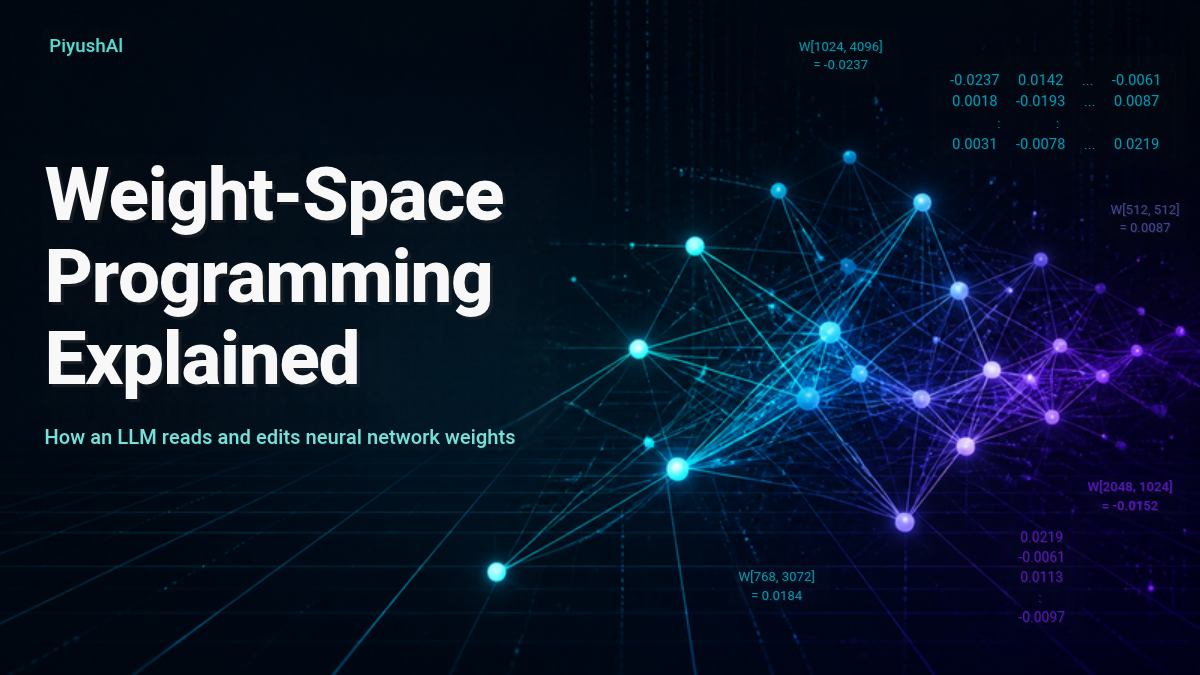
Weight-Space Programming is a new MIT CSAIL research idea in which GPT-6 Astra reads and edits another neural network's weights without training, lifting Qwen3.5-0.8B's MATH-500 score from 7.9% to 48.1%. Here is how it works, what critics say, the safety questions, and what it means for Indian students.
GPT-6.1 Terra is OpenAI's new mid-tier model for computer use, visual reasoning and everyday coding, at half its predecessor's API price. Here is what it is, how it works, how to try it, what independent benchmarks found, its Critical cyber rating, and what it means for Indian students.
An hour-by-hour plan for teaching NCERT's 20-hour Computational Thinking and AI module to Classes 9 to 12, based on the official Note for the Teacher. Covers the three activity modes, core and enrichment activities for every hour, Curious Notebook assessment, handling sensitive topics, and practical tips for schools with no computer lab.
Learn Daily, Wherever You Are
Free lectures, exam updates, PYQ discussions, and job alerts — delivered through our YouTube channel and Telegram communities.