
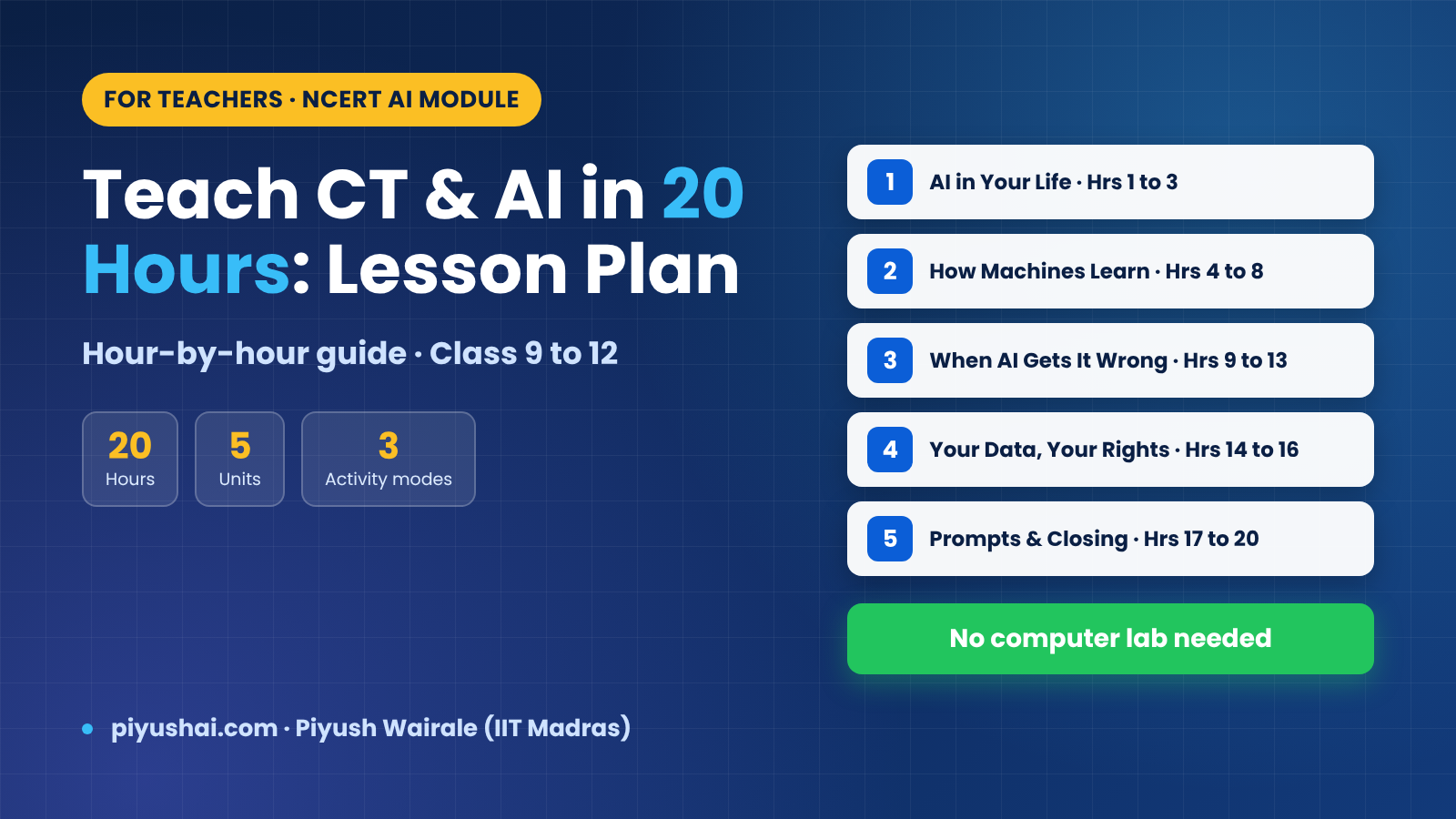
NCERT’s Computational Thinking and AI module for Classes 9 to 12 is designed to be taught in 20 class hours, and teachers do not need to be AI experts to teach it well. This guide turns the official Note for the Teacher into a practical, hour-by-hour plan, with tips on running activities without a computer lab, assessing through the Curious Notebook, and handling sensitive topics.
For an overview of what the module contains, read our complete guide to the NCERT CT and AI module.
The Note for the Teacher is on pages ix to xii of the official NCERT textbook
⬇ Download Official NCERT Textbook (PDF)The teaching approach NCERT asks for
NCERT deliberately chose not to give students a boxed definition of AI to memorise. Instead, the module walks students through a day in their own lives and lets the ideas surface. The organising thread is a parallel: the student learns from examples, and so does a learning system; the student can be confident and wrong, and so can a machine.
Three practical consequences for teachers:
- You do not need all the answers. The note asks teachers to be “curious alongside your students, willing to say ‘let us check that together'”.
- Get things wrong on purpose. In many activities, the most valuable move is to make a mistake deliberately and let the class catch it.
- Talk more than tell. Most class time belongs to the activity and discussion. Ask students to read the sections before class.
Choosing an activity mode
| Mode | What you need | When to use it |
|---|---|---|
| Full | A device per student or pair, reliable internet | Computer lab or tablet classrooms |
| Teacher-Demo | One shared screen or projector | Smart classrooms with one device |
| Unplugged | Paper, everyday objects, discussion | No devices or no internet |
All three teach the same lesson, and a class with no internet can complete the core module in full. NCERT’s rule is simple: change the mode, do not leave out the unit. Many schools will mix modes, for example running Train and Break unplugged first and then as a teacher demo.
The 20-hour plan, hour by hour
The units must be taught in order, because each builds on the habit formed in the one before. Each session follows the same shape: a short introduction, the activity, the discussion that grows out of it. Each unit closes with students adding its piece to the Curious Notebook.
Unit 1: AI is Already in Your Life (Hours 1 to 3)
| Hour | Sections | Core activities | Enrichment |
|---|---|---|---|
| 1 | 1.1 to 1.3 | AI Scavenger Hunt; “AI or Not?” sorting | AI in India case-card discussion |
| 2 | 1.4 to 1.6 | Indian systems with AI or pattern-matching parts (Bhashini, Aadhaar authentication, UPI safety checks); pattern-recognition reflection; launch My AI Diary | Begin the AI Diary in class |
| 3 | AI Diary workshop | Students start diaries; teacher walks through one or two entries with the group | Compare entries; discuss surprises |
Tip: in “AI or Not?”, include a few items that look smart but are simple automation (an alarm clock, a timer-based street light, an automatic door). The debate over these is where students learn the distinction.
Unit 2: How Machines Learn from Examples (Hours 4 to 8)
| Hour | Sections | Core activities | Enrichment |
|---|---|---|---|
| 4 | Bridge + 2.1 to 2.2 | “How You Learn” bridge; rules vs learning from examples | Link to Class 9 and 10 Biology on neurons |
| 5 | 2.3 to 2.4 | Patterns, features, labels, categories; training, validation, test and live data | None |
| 6 | 2.5 to 2.6 | Bias from uneven training data; categories as human constructs | Messy Data Audit on a sample dataset |
| 7 | 2.7 to 2.9 (prep) | Where the parallel breaks; three ways machines learn; plan Train and Break | Plan how to break the classifier |
| 8 | 2.9 (run) | Run Train and Break (full, demo or unplugged), then try to break it | “What Changed?” retrain with different data |
Hour 8 is the most important practical hour of the module. Our step-by-step guide is here: Train and Break: NCERT’s first AI experiment.
Unit 3: When AI Gets It Wrong (Hours 9 to 13)
| Hour | Sections | Core activities | Enrichment |
|---|---|---|---|
| 9 | 3.1 to 3.2 | Confident but wrong; why models fail; medical-screening example | None |
| 10 | 3.3 | Deepfakes and synthetic media; “Spot the Manipulation” gallery walk | None |
| 11 | 3.4 to 3.5 | Reader biases; build a personal verification checklist using the Five Checks | None |
| 12 | 3.6 to 3.7 (demo) | What good evaluation means; teacher runs one Hallucination Hunt on the projector | None |
| 13 | 3.6 to 3.7 (student-led) | Each student runs a Hallucination Hunt in a domain they know well | Error Journal: one surprising AI mistake from the week |
See our full explainer: the Five Checks, hallucinations and deepfakes.
Unit 4: Your Data, Your Rights, Your Responsibility (Hours 14 to 16)
| Hour | Sections | Core activities | Enrichment |
|---|---|---|---|
| 14 | 4.1 to 4.2 | Four kinds of data; consent and the DPDP Act, 2023 | None |
| 15 | 4.3 to 4.4 | Privacy Policy Dissection of an app each student uses; fairness, inclusion and accessibility | “Safe or Unsafe to Upload?” scenario sort |
| 16 | 4.5 to 4.6 | AI in your learning: helper, not replacement; what to do if something goes wrong | Class discussion: where can a complaint go? |
Tip: for the Privacy Policy Dissection, let students pick apps they actually use. A shared checklist helps: what data does it collect, who is it shared with, how long is it kept, and how can I delete it?
Unit 5 and closing: Working with Modern AI Tools (Hours 17 to 20)
| Hour | Sections | Core activities | Enrichment |
|---|---|---|---|
| 17 | 5.1 to 5.3 | Asking better questions; helper stance; build a Prompt Library (worked example, then student tasks) | None |
| 18 | 5.3 (peer review) | Students review each other’s prompts in pairs and improve them together | Prompt Improvement Ladder |
| 19 | 5.4 + closing | Reflecting on what you made; Curious Notebook sharing and review | Full-module reflection |
| 20 | Closing session | Each student presents one of their five Curious Notebook artefacts; class discusses what they noticed | Cohort reflection on habits to carry forward |
Unit 5 is the capstone the module builds towards. The four prompt habits to teach are: say what you actually want, give context, show with examples rather than adjectives, and ask for the shape of the output.
Assessment: running the Curious Notebook
The Curious Notebook is a running portfolio and the natural home of assessment. It collects five artefacts:
- AI Diary (Unit 1)
- Train-and-Break log (Unit 2)
- Verification checklist / Hallucination Hunt (Unit 3)
- Privacy Policy Dissection (Unit 4)
- Prompt Library (Unit 5)
NCERT’s guidance on using it is specific and worth following closely:
- It is a working record, not a fair copy. Crossings-out, revisions and wrong first guesses are valuable evidence. Do not mark students down for them.
- Look through notebooks from time to time and leave a short comment rather than collecting them for correction.
- Any exercise book or stapled sheets will do, so no student is disadvantaged.
- Questions you set should ask students to apply an idea, judge a case or explain a decision in their own words, never to recall a definition.
Each unit also ends with a three-part assignment. Quick Checks confirm students followed the unit. Apply It carries an idea into a new situation, and works better after one worked example on the board than after more explanation. The Stretch Question is genuinely optional and should not be set for the whole class. When a student is stuck, ask what they noticed rather than giving the answer.
Handling sensitive topics
Deepfakes, data misuse and online harm can surface difficult experiences. If a discussion moves in that direction, or a student is in distress, NCERT asks teachers not to turn it into a classroom spectacle: pause, protect the student, involve a trusted adult or school authority, and follow the reporting pathways in the module (the National Cyber Crime Reporting Portal at cybercrime.gov.in and the helpline 1930).
Common mistakes to avoid
- Turning it into a lecture of definitions. Every question in the module is answered from observation and reasoning, not recall.
- Skipping the unplugged activities because they look simple. They carry the core lessons, and they work in every classroom.
- Making Train and Break succeed. The narrow training set and the failure are the point.
- Collecting notebooks once at the end. A notebook started in the final week documents nothing.
- Dropping Unit 5 for lack of devices. Run it as a teacher demo; prompts can be written and peer-reviewed on paper.
- Using faces or personal data in activities. NCERT is clear: everyday objects only.
Fitting 20 hours into the school timetable
NCERT designs the module as a common foundation that can be taught in any of Grades 9 to 12, and does not fix a rollout schedule. Some practical options for schools:
- One period a week: about 20 weeks, roughly one academic term.
- Two periods a week: about 10 weeks, leaving room for enrichment activities.
- Intensive block: a focused one-week workshop, best for Class 11 at the start of the year.
Whichever pattern you choose, keep the unit order, and leave space between Hours 12 and 13 so students can run their Hallucination Hunt properly.
Frequently asked questions
How many hours does the NCERT CT and AI module take to teach?
NCERT suggests 20 class hours: 3 for Unit 1, 5 for Unit 2, 5 for Unit 3, 3 for Unit 4, and 4 for Unit 5 and the closing session.
Do teachers need AI or coding knowledge to teach it?
No. NCERT states that teachers do not need to be AI experts. They need to be curious alongside students and model careful habits such as checking claims together.
Can the module be taught without a computer lab?
Yes. Every hands-on activity has Full, Teacher-Demo and Unplugged versions, and a class with no internet can complete the core module in full.
How are students assessed?
Formatively, through the Curious Notebook portfolio of five unit artefacts, plus end-of-unit assignments with Quick Checks, Apply It and an optional Stretch question.
Can the units be taught in a different order?
NCERT recommends teaching them in order, because each unit builds on the habit formed in the previous one, and Unit 5 is the capstone.
Want help preparing your teachers? PiyushAI runs CT and AI teacher training and the PiyushAI School Lab for schools, led by Piyush Wairale (M.Tech, IIT Madras). Check where your school stands with the school AI readiness self-check.
More on the NCERT CT and AI module: Complete module guide + PDF · Unit 2: Train and Break · Unit 3: The Five Checks
Source: NCERT, An Introductory Module on Computational Thinking and Artificial Intelligence for the Secondary Stage (Grades 9 to 12), Note for the Teacher, First Edition, October 2026 (ncert.nic.in).
Recent Post
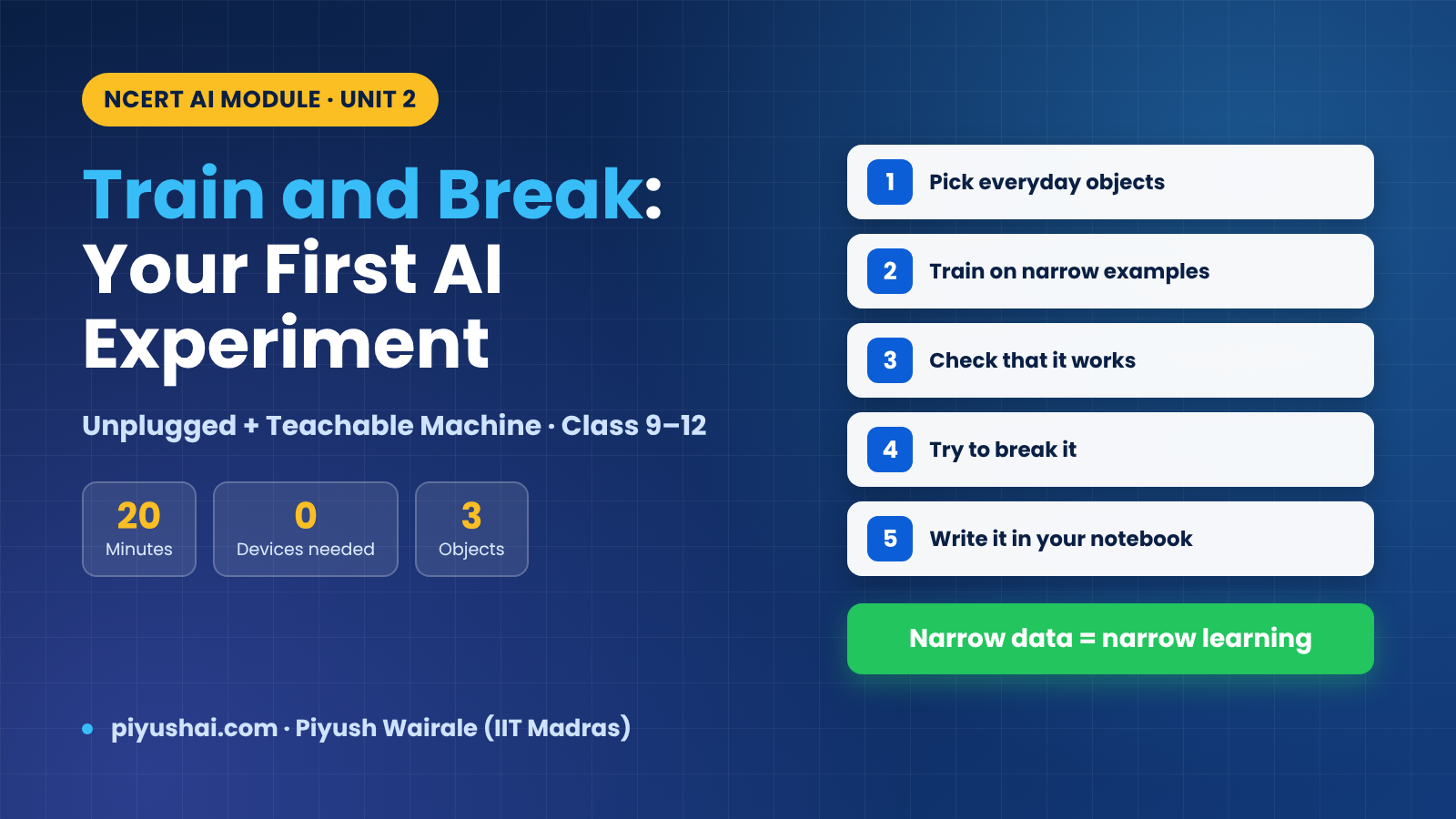
Train and Break is the main hands-on activity in Unit 2 of NCERT's Computational Thinking and AI module for Classes 9 to 12. Here is how to run it step by step, both as the unplugged Human Classifier and on a free image-classifier tool, plus the concepts it teaches (training, validation, test and live data, overfitting) and the Curious Notebook write-up.
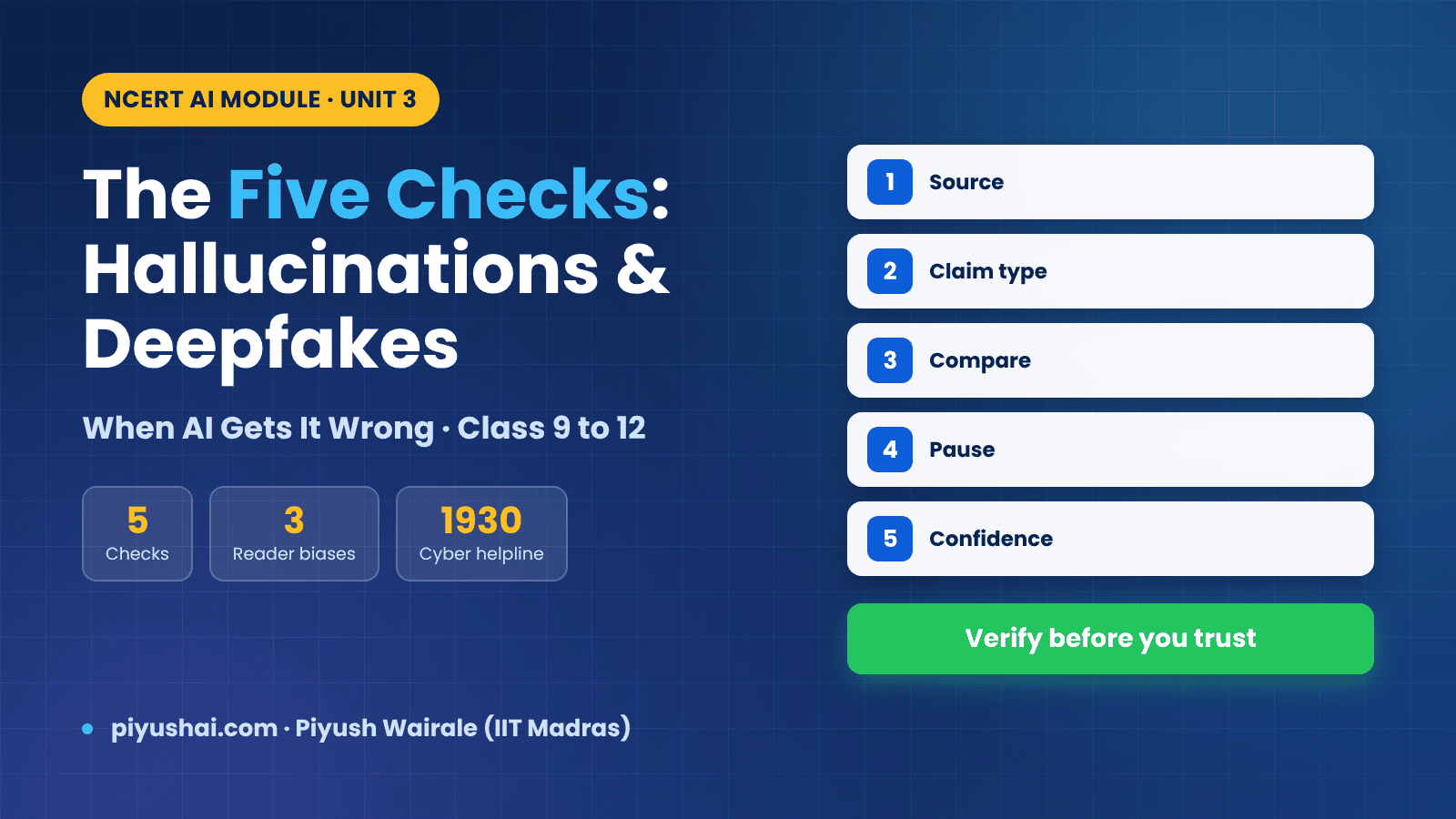
Unit 3 of NCERT's Computational Thinking and AI module, "When AI Gets It Wrong", teaches Class 9 to 12 students why AI is confidently wrong, how deepfakes work, the three reader biases, and the Five Checks: Source, Claim type, Compare, Pause and Confidence. Full explainer with the Hallucination Hunt activity and answers to the unit's key questions.
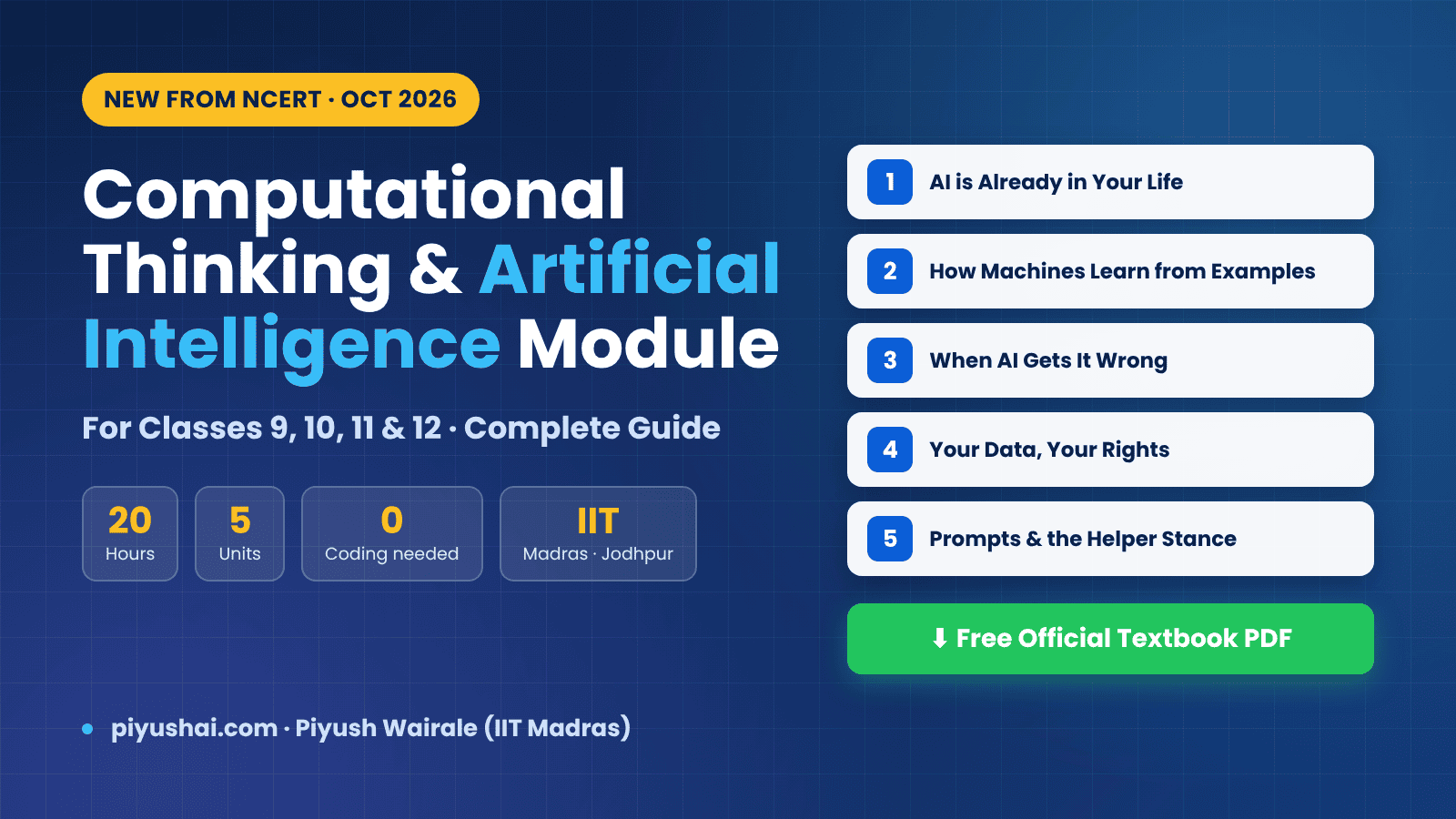
NCERT has released a 20-hour, five-unit Computational Thinking and AI module for Classes 9 to 12, developed with IIT Madras and IIT Jodhpur. Here is the complete unit-wise breakdown, the 20-hour plan, the Five Checks, the Curious Notebook assessment, and the official NCERT textbook PDF download.
A complete five-hour teaching guide for Chapter 4 of CBSE Class 6 AI: digital footprints, privacy, passwords, online safety and ethical use of technology. Includes period plans, six diagrams, three unplugged activities, a worksheet with answer key, misconceptions, a rubric and India-specific reporting channels for schools.
CBSE Class 6 AI Chapter 3 gives five hours to simple pattern recognition and decision making. This guide covers what the syllabus asks, six diagrams you can copy to a blackboard, a period-by-period plan, three unplugged activities, a worksheet with answers, misconceptions, a rubric and interdisciplinary project ideas.
Chapter 2 of the CBSE Class 6 AI syllabus covers basic data concepts in five hours: the four data types, and organising and representing data using tables and charts. This guide gives a period plan, six diagrams, unplugged activities, a worksheet with answer key, misconceptions, a rubric and interdisciplinary project ideas.
Learn Daily, Wherever You Are
Free lectures, exam updates, PYQ discussions, and job alerts — delivered through our YouTube channel and Telegram communities.