
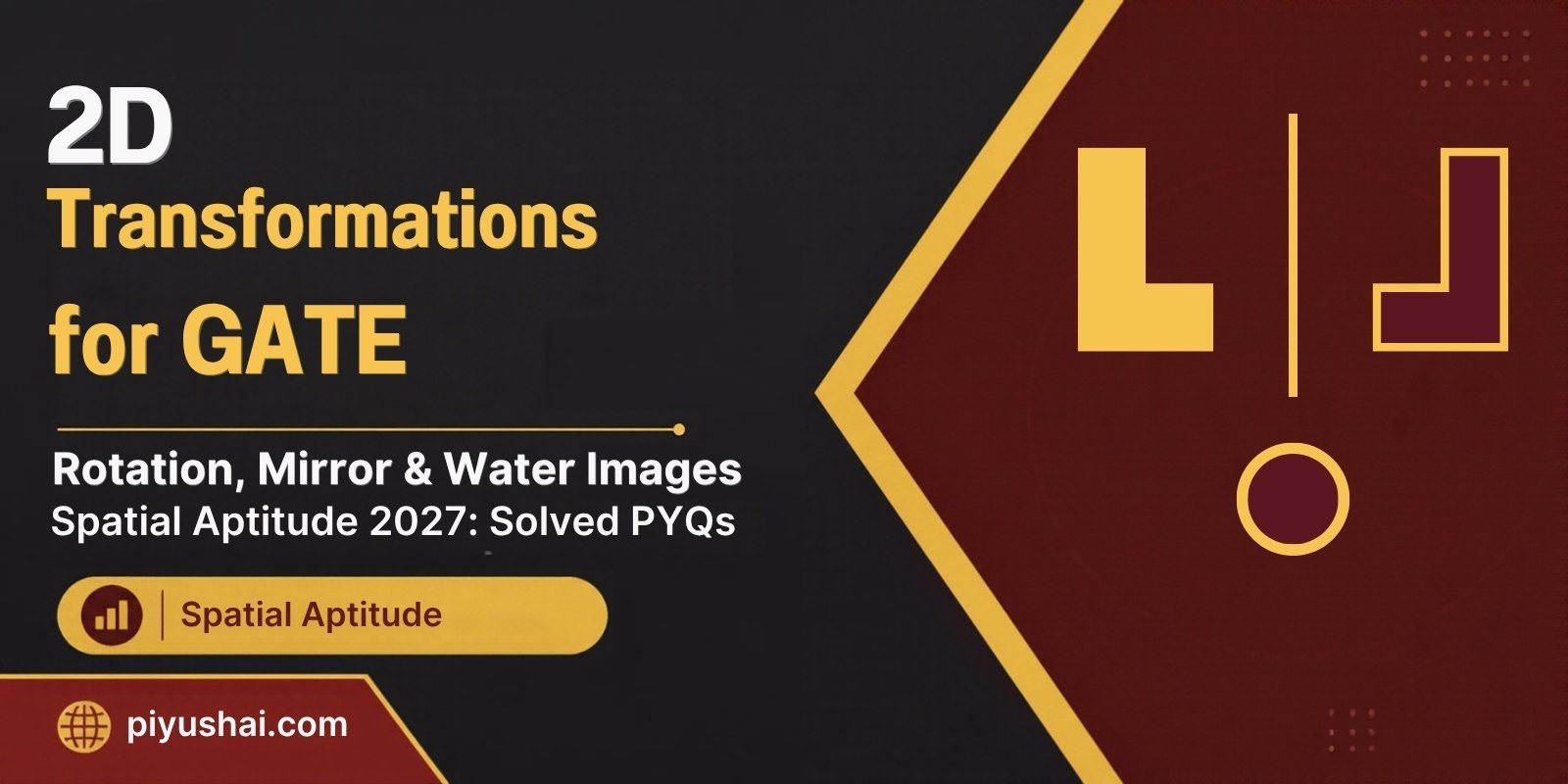
Quick Summary: 2D transformations (translation, rotation, scaling, mirror images and water images) open the Spatial Aptitude part of GATE General Aptitude 2027 and give 1 to 2 questions (1 to 3 marks) in every paper (DA, RA, CS, ME, EE, CE, EC). These questions are pictures, not words: a figure is shown and you must pick the option that is its rotated, reflected or scaled version. This guide gives you the corner-tracking method for rotations, the two reflection rules (mirror = left-right flip, water = top-bottom flip), the symmetric letters and digits worth memorising, the clock mirror formula, the “180° rotation = mirror + water” identity, a three-step elimination routine for shape-matching MCQs, 8 solved questions, four diagrams, a 5-question practice set and a one-page rule sheet.
📋 Table of Contents
- Why this topic matters in GATE GA
- What the official GA syllabus says
- Translation, rotation and scaling of shapes
- Reflection: mirror images and water images
- Combined transformations
- Shape-matching MCQs and the elimination routine
- Shortcuts and traps
- Solved PYQs and GATE-style questions
- Practice set
- One-page rule sheet
- Common mistakes
- FAQs
Why this topic matters in GATE GA
Spatial Aptitude entered the GATE General Aptitude syllabus with the 2021 revision, and since then almost every paper has carried at least one figure-based question. The simplest of them is a 2D transformation: a shape is drawn, and the four options show it rotated, reflected or scaled. You are asked which option is a rotation, which is the mirror image, or which one cannot be produced from the original at all. There is nothing to calculate, which is exactly why students treat it casually and then lose a 2-mark question in forty seconds.
My students who struggle here all make the same error: they try to “see” the answer in one glance. The reliable way is slower by ten seconds and right every time. Mark one distinctive corner, track where it must go, and check whether the shape’s handedness has flipped. Once you know that a rotation can never produce a mirror image, half the options in any question vanish.
Here is roughly how much the topic has contributed. Candidates targeting 15/15 in GA should treat these as guaranteed marks.
| Year | Marks from this topic (approximate, across papers) | Typical question type |
|---|---|---|
| 2019 | 0 to 1 | Occasional mirror image of a word or figure |
| 2020 | 0 to 1 | Rotated figure in a pattern question |
| 2021 | 1 to 3 | Spatial Aptitude introduced: rotation of a composite figure |
| 2022 | 1 to 3 | Mirror image of a figure, odd one out among rotations |
| 2023 | 1 to 2 | Figure rotated and reflected, pick the matching option |
| 2024 | 1 to 3 | Combined rotation and mirror, shaded-cell pattern |
| 2025 | 1 to 2 | Which option cannot be obtained by rotation |
| 2026 | 1 to 3 | Scaled and rotated figure, water image of a pattern |
What the official GA syllabus says
This post covers the first four words of that list: translation, rotation, scaling and mirroring, all in two dimensions. The GA section in every paper has 10 questions for 15 marks (5 questions of 1 mark and 5 of 2 marks), set as MCQ, MSQ or NAT, with negative marking of 1/3 and 2/3 mark on wrong 1-mark and 2-mark MCQs only. The previous post covered Puzzles, Seating Arrangement, Blood Relations and Direction Sense, and the next post moves into three dimensions with Cubes, Dice, Nets, Assembling and Grouping. The complete syllabus and weightage are in the GATE General Aptitude 2027 hub.
Translation, rotation and scaling of shapes
Three of the four basic transformations keep the shape “the same” in a strict sense, and you should know exactly what each one preserves:
- Translation slides the figure without turning it. Every point moves by the same amount in the same direction. Lengths, angles, orientation and handedness all stay. GATE uses translation only as a distractor: an option that is the original figure shifted to a different place is still the original figure.
- Scaling multiplies every length by the same factor k. Angles stay, so the new figure is similar to the old one; the perimeter becomes k times and the area k2 times. A shape stretched in one direction only (a square becoming a rectangle) is not scaling in the GATE sense, and such an option is wrong whenever the question says “scaled”.
- Rotation turns the figure about a point by an angle. Lengths, angles and handedness stay; only the orientation changes. Clockwise is the direction of clock hands. Three facts: 90° clockwise applied three times is 270° clockwise, which is the same as 90° anticlockwise; 180° is the same whichever way you turn; and 360° brings the figure back.
The method for any rotation question is corner tracking. Choose one distinctive feature (a corner, a dot, a notch), note which side of the figure it sits on, and move it with the clock rule: under a 90° clockwise turn, top goes to right, right to bottom, bottom to left, left to top (12 to 3 to 6 to 9 on a clock face). Under 90° anticlockwise, top goes to left. A corner in the top-left therefore lands at top-right after 90° clockwise, bottom-right after 180° and bottom-left after 270°. If you prefer coordinates with the centre as origin: 90° clockwise sends (x, y) to (y, −x), 90° anticlockwise sends (x, y) to (−y, x), and 180° sends (x, y) to (−x, −y).
Solution: 270° clockwise is 90° anticlockwise. Under 90° anticlockwise, top goes to left and right goes to top, so the top-right quarter becomes the top-left quarter. The arrow’s direction turns with the tile: “up” rotated 90° anticlockwise is “left”.
Answer: Top-left quarter, pointing left.
Reflection: mirror images and water images
A reflection flips the figure over a line. GATE uses two named cases, and the only difference between them is the direction of the line:
- Mirror image: the mirror stands beside the object, so the mirror line is vertical. Left and right swap; top and bottom stay where they are. For a word, the order of the letters reverses and each letter is flipped left-right.
- Water image: the water surface lies below the object, so the line is horizontal. Top and bottom swap; left and right stay. For a word, the order of the letters does not change, but each letter is flipped top-bottom.
Some letters and digits survive a reflection unchanged, and a GATE question on words is really a question on which letters survive:
| Transformation | Capital letters that look the same | Digits that look the same |
|---|---|---|
| Mirror image (vertical line) | A H I M O T U V W X Y | 0 8 (and 1 in a plain font) |
| Water image (horizontal line) | B C D E H I K O X | 0 3 8 |
| 180° rotation | H I N O S X Z | 0 1 8 (and 6 becomes 9, 9 becomes 6) |
Notice that H, I, O and X appear in every row: a letter symmetric about both a vertical and a horizontal line is automatically unchanged by 180° rotation, which is the identity we meet in the next section.
Clock mirror rule. A mirror reflects the clock face about the 12 to 6 line, so every hand’s clockwise angle becomes an anticlockwise angle of the same size. The reflected time is therefore 12:00 minus the actual time, which is easiest to compute as 11:60 minus the time. For 4:20 the mirror shows 11:60 − 4:20 = 7:40; for 2:35 it shows 9:25. If the time lies between 11:00 and 1:00, subtract from 23:60 instead (12:30 becomes 11:30). A water image reflects about the 3 to 9 line; the hour hand lands at 6:00 minus the time, but the minute hand generally does not land on a consistent reading, so GATE asks mirror images of clocks, not water images.
Solution: A water image keeps the letter order and flips each letter top-bottom, so the word is unchanged only if every letter is water-symmetric (B C D E H I K O X). BOOK uses B, O, O, K, all in the list. MATH contains M, A and T, which flip; FLIP contains F, L and P; WAVE contains W, A and V.
Answer: (A) BOOK.
Combined transformations
GATE’s 2-mark questions chain two transformations: “the figure is reflected in a mirror and then rotated by 90° clockwise”. Doing both by hand is slow and error-prone. Three identities do the work instead:
- Mirror + water = 180° rotation. A mirror sends (x, y) to (−x, y); water sends (x, y) to (x, −y). One after the other gives (−x, −y), which is exactly a half-turn about the centre. The order does not matter. So whenever a question asks for the water image of a mirror image, simply turn the figure upside down.
- Rotations add. 90° clockwise followed by 180° is 270° clockwise, which is 90° anticlockwise. Add clockwise angles, subtract anticlockwise ones, and reduce modulo 360°.
- Reflections count in pairs. Any even number of reflections (with any rotations mixed in) is equivalent to a single rotation, so handedness is preserved. Any odd number of reflections flips handedness, and the result can never be matched by rotating the original. This single fact decides most “which option cannot be obtained” questions.
A useful consequence of identity 1: a water image equals a 180° rotation followed by a mirror image, and a mirror image equals a 180° rotation followed by a water image. If you find mirror images easier to draw than water images (most people do), rotate the figure upside down first and then mirror it.
Solution: Replace the 180° rotation by mirror + water. The sequence becomes mirror, mirror, water. Two mirror reflections in the same line cancel, leaving a single water reflection.
Answer: (B) Water image.
Shape-matching MCQs and the elimination routine
The standard GATE figure is a composite: a polygon with one notch, a square grid with two or three shaded cells, or a circle with a few marks inside it. Four options follow, and the stem asks one of three things: which option is the figure rotated, which option is its mirror image, or which option is not obtainable by rotation. In the last form, the three wrong options are rotations and the odd one is a reflection. My routine takes three steps, and most questions end at step 2:
- Count. Count sides, shaded cells, dots, and anything else countable. Rotation and reflection never change a count. An option with a different count is out immediately. Scaling changes sizes but not counts either.
- Locate the distinctive feature. Pick the most unusual feature (the notch, the lone dot, the shaded corner) and describe its position relative to a second feature: “the dot sits two cells away from the shaded corner along the longest side”. Check the same description in each option.
- Check handedness. Walk around the boundary from the distinctive feature towards the longest side and note whether you are moving clockwise or anticlockwise. In a rotated copy you move the same way; in a reflected copy you move the opposite way. This is the chirality test, and it is the only way to distinguish a rotation from a reflection for an asymmetric shape.
Solution: Walking down the stem from the top, the foot of the original turns right. Rotation keeps that turn (the diagram above shows all four rotations). A piece whose foot turns left is the mirror image, which no rotation produces.
Answer: The option with the foot on the left; it is a reflection, not a rotation.
Shortcuts and traps
❌ Applying 90° anticlockwise when the question says clockwise; “top goes to right” is clockwise.
❌ Treating a mirror image as a rotation because the shape “looks similar”.
❌ Reversing the letter order in a water image of a word; the order stays.
❌ Using 11:60 minus time for a time between 11:00 and 1:00 and getting a negative hour; use 23:60.
❌ Assuming scaling changes angles; it changes only lengths (and area by the square of the factor).
❌ Deciding by instinct instead of checking a marked corner and the handedness.
Solved previous-year and GATE-style questions
GATE has carried figure-based transformation questions since Spatial Aptitude was added in 2021; the questions below are built on that pattern, with the figure described in words or drawn where it matters. Many more, with the original figures, are solved in the PiyushAI Aptitude Test Series with video explanations.
Solution: Mirror time = 11:60 − 3:40 = 8:20. Check: at 3:40 the minute hand points to 8 and the hour hand sits two-thirds of the way from 3 to 4; reflected about the 12 to 6 line, the minute hand points to 4 (20 minutes) and the hour hand sits two-thirds of the way from 9 to 8, which is consistent with 8:20.
Answer: (A) 8:20.
Solution: Mirror-symmetric capitals are A H I M O T U V W X Y. Go letter by letter: M (yes), A (yes), T (yes), H (yes), E (no), M (yes), A (yes), T (yes), I (yes), C (no), S (no).
Answer: 8 letters.
Solution: 90° anticlockwise sends (x, y) to (−y, x): (3, 1) becomes (−1, 3). A vertical mirror changes the sign of x: (−1, 3) becomes (1, 3).
Answer: (1, 3), in the upper right, three units up and one unit right of the centre.
Solution: Step 1, counts: every option has six sides, one notch and one dot, so nothing is eliminated. Step 2, feature: in the original, go clockwise around the boundary from the dot’s corner (top-right): the very next corner is the notch (bottom-right). Step 3, handedness: in (A) the dot is at the top-left and, going clockwise, the next corner (top-right) is again the notch, so (A) is a rotation (270° clockwise). In (B) the dot is top-left but the notch is bottom-left: going clockwise you pass two corners before reaching it, and it is the next corner only if you go anticlockwise. The sense is reversed, so (B) is a mirror image. (C) is the water image and (D) is a mirror image turned by 90°; both reverse the sense as well.
Answer: (A).
Solution: Letters unchanged by a half-turn are H I N O S X Z. E and B are water-symmetric but not rotation-symmetric (E turned upside down is still E, but a 180° turn also flips it left-right, giving a reversed E). F has no symmetry at all. N has a diagonal stroke that returns to itself under a half-turn.
Answer: (A) N.
Solution: Mirror followed by water is a 180° rotation. The statement says the 180° rotation returns the figure to itself, which is (C). It does not require either line symmetry: the letter N has no line of symmetry yet satisfies the condition, which also rules out (D).
Answer: (C).
Solution: Scaling by k multiplies lengths (and hence the perimeter) by k = 1.5 and the area by k2 = 2.25; angles do not change, so the triangles are similar. Rotation changes nothing but orientation. Statement (B) uses the area factor for the perimeter.
Answer: (B).
Solution: Two reflections in perpendicular lines make a 180° rotation, so the final image is DECIDE turned upside down: the letter order reverses to E D I C E D and each letter is rotated by 180°. Of these, I is unchanged, while D, E and C turn into their 180°-rotated forms (which are the same as their mirror images, because each is water-symmetric). So the image reads like the mirror image of EDICED.
Answer: EDICED with D, E and C reversed left-right (the 180° rotation of DECIDE).
Watch: Mission GATE 2027 Aptitude Test Series, Score 15/15 (PYQ Analysis)
In this session I walk through how the 15-mark General Aptitude section is set for every GATE branch, analyse previous-year questions, and show exactly how the Best GATE Aptitude Test Series 2027 is structured to get you to 15/15.
★ PiyushAI Test Series
Best GATE Aptitude Test Series 2027
General Aptitude is 15 marks in every GATE paper and the easiest 15 marks to lose to silly mistakes. The PiyushAI Aptitude Test Series by Piyush Wairale (IIT Madras) gives you topic-wise tests on exactly this chapter, full-length GA mocks in the real GATE interface, detailed video and text solutions, and All-India rank analysis.
Practice set
Attempt these in 8 minutes before opening the key.
- A clock shows 7:15. Its mirror image shows: (A) 5:45 (B) 4:45 (C) 4:15 (D) 5:15
- A square card has a dot in its bottom-left corner. The card is rotated 90° anticlockwise about its centre. The dot is now in the: (A) top-left corner (B) top-right corner (C) bottom-right corner (D) bottom-left corner
- Which of the following letters looks the same in a vertical mirror? (A) B (B) N (C) T (D) S
- A figure is mirrored, then water-imaged, then rotated 90° clockwise. The combined effect equals a single rotation of: (A) 90° clockwise (B) 90° anticlockwise (C) 180° (D) 0°
- Which of the following two-digit numbers changes when rotated by 180° in its plane? (A) 69 (B) 96 (C) 88 (D) 68
Show answer key
- (B). 11:60 − 7:15 = 4:45.
- (C). 90° anticlockwise: bottom goes to right, left goes to bottom, so bottom-left becomes bottom-right.
- (C). T is in the mirror-symmetric list A H I M O T U V W X Y; B, N and S are not.
- (B). Mirror + water = 180°; adding 90° clockwise gives 270° clockwise, which is 90° anticlockwise.
- (D). A 180° turn reverses the digit order and turns each digit: 6 and 9 swap, 8 stays. 69 becomes 69, 96 becomes 96, 88 stays 88, but 68 becomes 89.
One-page rule sheet
2. Rotation keeps lengths, angles and handedness; 90° clockwise three times = 270° clockwise = 90° anticlockwise; 360° = no change.
3. Corner tracking, 90° clockwise: top to right, right to bottom, bottom to left, left to top. Anticlockwise: top to left.
4. Coordinates about the centre: 90° CW (x, y) to (y, −x); 90° ACW (x, y) to (−y, x); 180° (x, y) to (−x, −y).
5. Mirror image: vertical line, left-right swap. Words: reverse the order, flip each letter.
6. Water image: horizontal line, top-bottom swap. Words: same order, flip each letter.
7. Mirror-symmetric letters: A H I M O T U V W X Y. Water-symmetric: B C D E H I K O X. Water-symmetric digits: 0 3 8.
8. Unchanged by 180°: H I N O S X Z and 0 1 8; 6 and 9 swap.
9. Clock mirror: 11:60 minus the time (23:60 minus the time between 11:00 and 1:00).
10. Mirror + water (either order) = 180° rotation. Water = 180° then mirror.
11. Even number of reflections = a rotation (handedness kept); odd number = a reflection (handedness flipped). A rotation can never match a mirror image of an asymmetric shape.
12. Elimination routine: count features, locate the distinctive feature, check handedness by walking the boundary.
Common mistakes
❌ Rotating the wrong way; clockwise means top goes to right.
❌ Picking a mirror image as “the rotated figure” because it has the same outline.
❌ Reversing the order of letters in a water image.
❌ Treating a stretched figure as a scaled figure.
❌ Chaining two transformations by hand instead of replacing mirror + water with 180°.
❌ Answering by glance without marking a corner and checking handedness.
FAQs
How many 2D transformation questions appear in GATE GA?
Usually 1 question, occasionally 2, drawn from the whole Spatial Aptitude area (2D transformations, mirror images, paper folding, cubes). Expect 1 to 3 marks a year from the spatial cluster across papers.
What is the difference between a mirror image and a water image?
A mirror image is a reflection in a vertical line, so left and right swap. A water image is a reflection in a horizontal line, so top and bottom swap. Doing both one after the other is the same as rotating the figure by 180°.
How do I find the mirror image of a clock time quickly?
Subtract the time from 11:60. For 4:20 the mirror shows 7:40. If the time is between 11:00 and 1:00, subtract from 23:60 instead.
Is the PiyushAI Aptitude Test Series enough for GA?
Yes. The Best GATE Aptitude Test Series 2027 has dedicated tests on 2D transformations, mirror and water images and the rest of Spatial Aptitude, tests on every other GA chapter, full-length GA mocks in the GATE interface, solved PYQs from 2010 to 2026 and All-India rank analysis. With the free guides on this site it covers the whole GA section.
Can a rotation ever produce the mirror image of a figure?
Only if the figure has a line of symmetry. For an asymmetric figure such as the letter F or an L-shaped piece, no rotation in the plane produces its mirror image, because rotation preserves handedness and reflection reverses it. This is the test that separates “rotated” options from “reflected” options.
Stop losing easy marks. Practise this topic under exam pressure.
Previous in series: Puzzles, Seating Arrangement, Blood Relations & Direction Sense for GATE Aptitude 2027 | Next in series: 3D Visualisation for GATE Spatial Aptitude 2027: Cubes, Dice, Nets, Assembling & Grouping
Related guides: GATE General Aptitude 2027 hub | All GATE General Aptitude articles | GATE DA Syllabus 2027 | GATE RA Syllabus 2027

Recent Post
GATE PE 2027 Petroleum Engineering syllabus, exam pattern, marks distribution, 2026 cutoff and prep tips, based on the official IIT Madras brochure.
GATE ES 2027 Environmental Science and Engineering syllabus, exam pattern, marking scheme, 2026 cutoff and prep tips from the IIT Madras brochure.
GATE RA 2027 Robotics and Automation syllabus, exam pattern, marks distribution, 2026 cutoff and prep tips, based on the official IIT Madras brochure.
GATE MA 2027 Mathematics syllabus, exam pattern, marks distribution, 2026 cutoff and prep tips, based on the official IIT Madras brochure.
GATE MT 2027 Metallurgical Engineering syllabus, exam pattern, marks distribution, 2026 cutoff and prep tips, based on the official IIT Madras brochure.
GATE NM 2027 Naval Architecture and Marine Engineering syllabus, exam pattern, marking scheme, 2026 cutoff and prep tips from the IIT Madras brochure.
Learn Daily, Wherever You Are
Free lectures, exam updates, PYQ discussions, and job alerts — delivered through our YouTube channel and Telegram communities.