
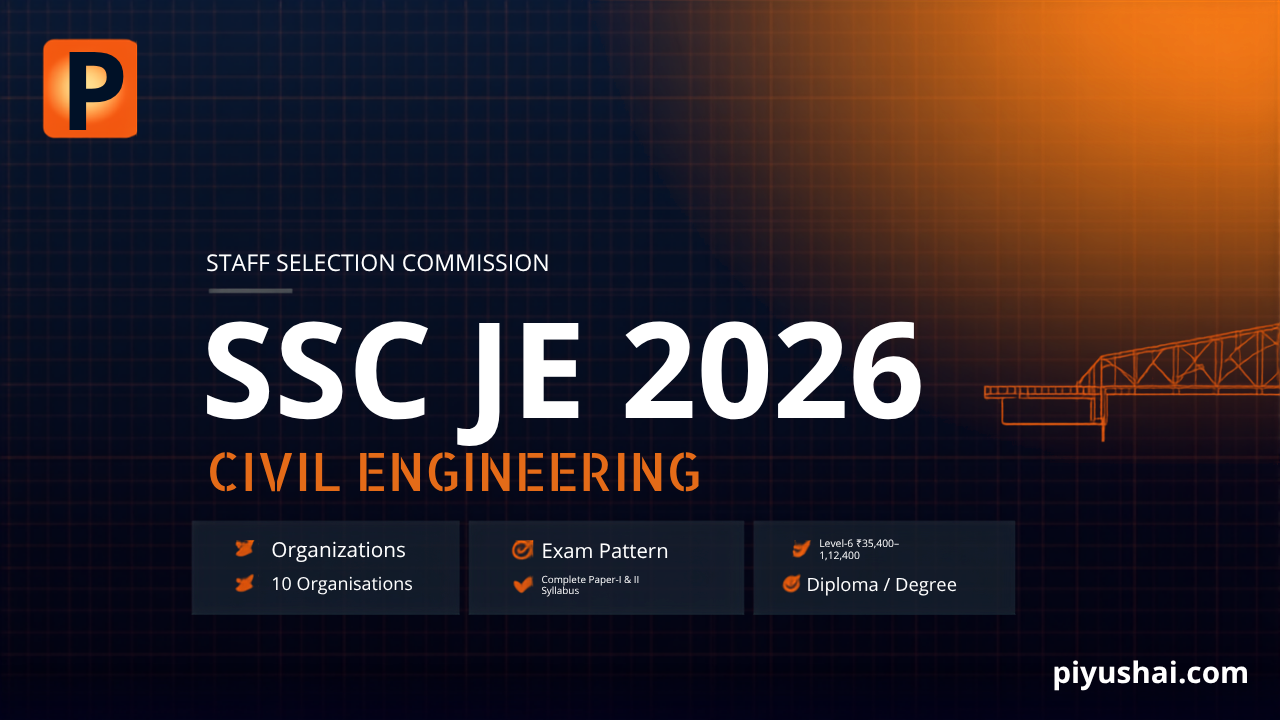
The Staff Selection Commission has released the Junior Engineer Examination, 2026 notification (F. No. HQ-C-3019/1/2026-C-3) on 02.09.2026. Out of a tentative 1748 vacancies, the largest share goes to Junior Engineer (Civil), which is recruited by almost every participating organisation — CPWD, MES, BRO, Central Water Commission, NTRO, Brahmaputra Board, Farakka Barrage Project, Directorate General of Lighthouses & Lightships and the Ministry of Fisheries.
This page covers everything a Civil Engineering candidate needs: eligibility, age limit, organisation-wise qualifications, application dates and fee, exam pattern and the complete Paper-I and Paper-II Civil & Structural Engineering syllabus exactly as notified.
SSC JE Civil 2026 — Overview
| Examination | SSC Junior Engineer (JE) Examination, 2026 |
| Conducting Body | Staff Selection Commission (SSC), Department of Personnel & Training |
| Post | Junior Engineer (Civil) — JE(C) |
| Notification No. | F. No. HQ-C-3019/1/2026-C-3, dated 02.09.2026 |
| Total Vacancies (all posts) | 1748 (tentative) |
| Post Classification | Group ‘B’ (Non-Gazetted) |
| Pay Scale | Level-6 of 7th CPC Pay Matrix — Rs. 35,400 to Rs. 1,12,400 |
| Selection Stages | Paper-I (CBE, qualifying) → Paper-II (CBE, merit) → Document Verification |
| Application Mode | Online at ssc.gov.in or the mySSC mobile app |
| Helpline | 1800 309 3063 (toll-free) |
SSC JE 2026 Important Dates
| Event | Date |
|---|---|
| Online application opens | 02.09.2026 |
| Last date to submit online application | 22.09.2026 (23:00 hrs) |
| Last date for online fee payment | 23.09.2026 (23:00 hrs) |
| Application Correction Window | 28.09.2026 to 30.09.2026 (23:00 hrs) |
| Paper-I (Computer Based Exam) | October / November 2026 (tentative) |
| Paper-II (Computer Based Exam) | December 2026 (tentative) |
Organisations Recruiting Junior Engineer (Civil)
Educational qualification for JE (Civil) differs slightly across departments. Some accept only a 3-year diploma, some require a degree, and a few accept a diploma plus 2 years of work experience.
| Organisation | Essential Qualification for JE (Civil) | Age Limit |
|---|---|---|
| Border Roads Organisation (BRO) | Degree in Civil Engineering; OR 3-year Diploma in Civil Engineering + 2 years’ experience in Planning / Execution / Maintenance of civil engineering works | Up to 30 years |
| Brahmaputra Board, Ministry of Jal Shakti | 3-year Diploma in Civil Engineering from a recognised University/Institution | Up to 30 years |
| Central Water Commission (CWC) | Bachelor’s Degree or Diploma in Civil Engineering | Up to 30 years |
| Central Public Works Department (CPWD) | Diploma in Civil Engineering | Up to 32 years |
| Central Water and Power Research Station (CWPRS) | Diploma in Civil Engineering from a recognised Institute | Up to 30 years |
| Farakka Barrage Project, Ministry of Jal Shakti | Diploma in Civil Engineering | Up to 30 years |
| Military Engineer Services (MES) | Degree in Civil Engineering; OR 3-year Diploma in Civil Engineering + 2 years’ experience | Up to 30 years |
| National Technical Research Organisation (NTRO) | Diploma in Civil Engineering | Up to 30 years |
| Directorate General of Lighthouses & Lightships | Degree in Civil Engineering; OR Diploma in Civil Engineering with 3 years’ experience; OR equivalent qualification | Up to 32 years |
| Ministry of Fisheries, Animal Husbandry and Dairying | Degree or 3-year Diploma in Civil Engineering | Up to 30 years |
Important: Where experience is required, it must be acquired after completing the essential educational qualification. Internship, training or research experience obtained during the course of the qualification is not counted.
Age Limit and Age Relaxation
The crucial date for age reckoning is 01.08.2026.
| Age Limit for the Post | Date of Birth Must Be |
|---|---|
| Up to 30 years | Not earlier than 02.08.1996 and not later than 01.08.2008 |
| Up to 32 years | Not earlier than 02.08.1994 and not later than 01.08.2008 |
| Code | Category | Relaxation Beyond Upper Age Limit |
|---|---|---|
| 01 | SC / ST | 5 years |
| 02 | OBC | 3 years |
| 03 | PwBD (Unreserved / EWS) | 10 years |
| 04 | PwBD (OBC) | 13 years |
| 05 | PwBD (SC / ST) | 15 years |
| 06 | Ex-Servicemen (ESM) | 3 years after deduction of military service from actual age |
| 08 | Defence personnel disabled in operations (UR/EWS/OBC) | 3 years |
| 09 | Defence personnel disabled in operations (SC/ST) | 8 years |
Note: there is no vacancy reservation for Ex-Servicemen in this examination since JE posts are Group ‘B’, but ESM age relaxation is admissible.
Application Fee
- Fee payable: Rs. 100/-
- Exempted: All women candidates, SC, ST, PwBD and Ex-Servicemen
- Payment only through BHIM UPI, Net Banking, or Visa / MasterCard / Maestro / RuPay debit card
- Correction charges: Rs. 200 for the first correction, Rs. 500 for the second
- Fee once paid is non-refundable and non-adjustable
SSC JE Civil 2026 Exam Pattern
Paper-I (Computer Based Examination) — Qualifying
| Subject | Questions | Marks | Duration |
|---|---|---|---|
| General Intelligence & Reasoning | 50 | 50 | 2 Hours (2 hours 40 minutes for eligible scribe candidates) |
| General Awareness | 50 | 50 | |
| Part-A: General Engineering (Civil & Structural) | 100 | 100 | |
| Total | 200 | 200 |
Paper-II (Computer Based Examination) — Merit Deciding
| Subject | Questions | Marks | Duration |
|---|---|---|---|
| Part-A: General Engineering (Civil & Structural) | 100 | 300 | 2 Hours (2 hours 40 minutes for eligible scribe candidates) |
Key Exam Rules
- Both papers are objective type, multiple choice, in Hindi and English only.
- Negative marking: 0.25 marks per wrong answer in Paper-I; 1 mark per wrong answer in Paper-II.
- Paper-I is only qualifying. Shortlisting for Paper-II is based on normalised Paper-I marks; only normalised Paper-II scores decide the final merit.
- Minimum qualifying marks: UR – 30%, OBC/EWS – 25%, all other categories – 20%.
- The IS 456:2000 Code of Practice table and Steam Table are available on the candidate console under the “Useful Data” option.
- A scientific calculator is available on screen for the entire duration. No physical calculator or table is permitted in the exam lab.
- The subject/stream opted in the application form cannot be changed under any circumstances.
SSC JE Civil 2026 Syllabus — Paper-I
1. General Intelligence & Reasoning
Questions of both verbal and non-verbal type covering analogies, similarities, differences, space visualization, problem-solving, analysis, judgment, decision-making, visual memory, discrimination, observation, relationship concepts, arithmetical reasoning, verbal and figure classification, arithmetical number series, and the ability to deal with abstract ideas and symbols and their relationships, arithmetical computations and other analytical functions.
2. General Awareness
Questions testing general awareness of the environment and its application to society; current events; matters of everyday observation and experience in their scientific aspect. Questions relating to India and its neighbouring countries, especially History, Culture, Geography, Economic Scene, General Polity and Scientific Research. Questions will not require special study of any discipline.
3. Part-A: General Engineering (Civil & Structural) — Paper-I
The Paper-I engineering section is a topic-level list; questions are set at approximately Diploma in Engineering level.
- Engineering Mechanics
- Solid Mechanics
- Structural Analysis
- Construction Materials and Management
- Estimating, Costing and Valuation
- Concrete Structures
- Steel Structures
- Surveying
- Soil Mechanics (Geotechnical Engineering)
- Fluid Mechanics and Hydraulics
- Hydrology and Irrigation Engineering
- Environmental Engineering
- Transportation (Traffic) Engineering
SSC JE Civil 2026 Syllabus — Paper-II (Detailed)
Paper-II expands the same subjects into a detailed, topic-wise syllabus. This is the section that decides your final merit, so study it closely.
Engineering Mechanics
System of forces, free-body diagrams, equilibrium equations; Internal forces in structures; Friction and its applications; Centre of mass, Moment of Inertia.
Solid Mechanics
Bending moment and shear force in statically determinate beams; Simple stress and strain relationships; Simple bending theory, flexural and shear stresses, Uniform torsion, buckling of column, combined and direct bending stresses.
Structural Analysis
Introduction to statically determinate and indeterminate structures; Method of superposition; Analysis of trusses, arches, beams, cables and frames; Slope deflection and moment distribution method; Influence lines.
Construction Materials and Management
Construction materials: Bricks, Stones, Timber, Steel, Cement, Aggregates, Plastics, Polymers, Glass, Concrete, concrete mix design, testing of concrete.
Construction Management: Types of construction projects; Project planning and network analysis – PERT and CPM.
Estimating, Costing and Valuation
Fundamentals of estimating, Cost Estimates for works, Rate Analysis, Valuation, Detailed Estimates.
Concrete Structures
Working stress and Limit State design concepts; Design of beams, slabs, columns; Foundation and Retaining Walls; Bond and development length.
Steel Structures
Working stress and Limit state design concepts; Bolted connections, Welds, Design of tension members, compression members and beams; Concept of plastic analysis – beams and frames.
Surveying
Principles of surveying; Errors and their adjustment; Maps – scale, coordinate system; Distance and angle measurement: Chain and Compass survey, Plane table surveying, Levelling and trigonometric levelling; Traversing and triangulation survey; Total station; Tacheometric surveying, Theodolite Surveying, Advanced surveying equipment.
Soil Mechanics
Three-phase system and phase relationships, index properties; Unified and Indian standard soil classification system; Permeability – one dimensional flow, Seepage through soils – two dimensional flow, flow nets, uplift pressure, piping, capillarity, seepage force; Principle of effective stress and quicksand condition; Compaction of soils; One-dimensional consolidation, time rate of consolidation; Shear Strength, Mohr’s circle, effective and total shear strength parameters, Stress-Strain characteristics of clays and sand.
Fluid Mechanics
Properties of fluids, fluid statics; Continuity, momentum and energy equations and their applications; Laminar and turbulent flow; Flow in pipes, pipe networks; Concept of lift and drag.
Hydraulics
Forces on immersed bodies; Flow measurement in channels and pipes; Channel Hydraulics – Energy-depth relationships, specific energy, critical flow, hydraulic jump, uniform flow.
Hydrology
Hydrologic cycle, precipitation, evaporation, evapo-transpiration, watershed, infiltration, unit hydrographs, hydrograph analysis, reservoir capacity, flood estimation and routing, groundwater hydrology – steady-state well hydraulics and aquifers; Application of Darcy’s Law.
Irrigation
Types of irrigation systems and methods; Crop water requirements – Duty, delta, evapo-transpiration; Gravity Dams and Spillways; Lined and unlined canals, cross drainage structures.
Water and Wastewater Quality and Treatment
Basics of water quality standards – Physical, chemical and biological parameters; Water quality index; Unit processes and operations; Water requirement; Water distribution system; Drinking water treatment. Sewerage system design, quantity of domestic wastewater, primary and secondary treatment; Effluent discharge standards; Sludge disposal; Reuse of treated sewage for different applications.
Air Pollution
Types of Pollutants, their sources and impacts, Air Pollution control, Air Quality Standards, Air Quality Index and limits.
Municipal Solid Wastes
Characteristics, generation, collection and transportation of solid wastes, engineered systems for solid waste management (reuse/recycle, energy recovery, treatment and disposal).
Transportation Infrastructure
Geometric design of highways – cross-sectional elements, sight distances, horizontal and vertical alignments. Geometric design of railway track – Speed and Cant.
Highway Pavements
Highway materials – desirable properties and tests; Desirable properties of bituminous paving mixes; Design factors for flexible and rigid pavements; Design of flexible and rigid pavement using IRC codes.
Traffic Engineering
Traffic studies on flow and speed, peak hour factor, accident study, fundamental relationships; Traffic signs; Signal design by Webster’s method; Types of intersections; Highway capacity.
Selection Process
- Paper-I (CBE) — qualifying in nature; normalised marks used only for shortlisting.
- Paper-II (CBE) — a separate merit list is drawn for JE (Civil), distinct from JE (Electrical & Mechanical), JE (Telecom) and Scientific Assistant in IMD.
- Post Preference — submitted through the online Option Form before the First Round of Tentative Allocation (FRTA). Candidates who do not submit preferences within the stipulated time will not be considered for any post.
- Document Verification — conducted by the User Department after the final result.
Tie-breaking order: marks in Part (i) of Paper-I → marks in Part (ii) of Paper-I → date of birth (older placed higher) → alphabetical order of names.
Special Note for BRO Aspirants (Civil)
- Only male candidates are eligible for Junior Engineer posts in Border Roads Organisation.
- BRO posts are not identified as suitable for PwBD candidates.
- A Physical Efficiency Test is mandatory: one mile run within 10 minutes, held at GREF Centre, Pune.
- Region-wise physical standards apply (e.g. West Plain Region: minimum height 162.5 cm, chest 76 cm unexpanded with 5 cm expansion, weight 50 kg).
- Once a post is allotted as per merit-cum-preference, it cannot be changed if you later fail these standards.
How to Apply
- Complete One-Time Registration (OTR) on the new SSC website ssc.gov.in. OTR generated on the old ssc.nic.in site will not work.
- Opt for Aadhaar-Based Authentication — this exempts you from carrying photographs and photo-ID at the exam venue and protects your form from rejection on photo/signature grounds.
- The application module captures a live photograph; pre-existing photos are rejected. No cap, mask or spectacles.
- Upload a scanned signature in JPEG (10–20 KB, about 6.0 cm × 2.0 cm).
- Choose three centre preferences within one region, in order of priority. Centre changes are not permitted later.
- Pay the fee (if applicable) by 23.09.2026 and take a printout of the submitted form.
Preparation Strategy for SSC JE Civil
- Paper-II is where the exam is won. With 300 marks and 1 mark negative per wrong answer, accuracy matters more than attempt count.
- High-yield subjects: RCC and Steel Structures, Soil Mechanics, Surveying, Estimating & Costing, and Fluid Mechanics/Hydraulics together account for the bulk of Paper-II.
- Learn to use the on-screen IS 456:2000 table during practice, not for the first time in the exam hall.
- Paper-I is qualifying — clear it comfortably but do not over-invest. 200 marks in 2 hours means roughly 36 seconds per question.
- Revise Estimating & Costing and Construction Management last; they are formula-and-definition heavy and fade quickly.
Frequently Asked Questions
Can a diploma holder apply for SSC JE Civil 2026?
Yes. Most organisations (CPWD, CWPRS, NTRO, Brahmaputra Board, Farakka Barrage) accept a 3-year Diploma in Civil Engineering. BRO and MES require a degree, or a diploma plus 2 years’ post-qualification experience.
Is there negative marking in SSC JE?
Yes — 0.25 marks in Paper-I and 1 full mark in Paper-II for each wrong answer.
Does Paper-I count towards the final merit?
No. Paper-I is purely qualifying. Only normalised Paper-II scores determine the final merit list.
Can I change my branch after applying?
No. The subject/stream opted at the time of filling the application form cannot be changed under any circumstances.
Are female candidates eligible?
Yes, for all organisations except Border Roads Organisation, where only male candidates are eligible.
Related SSC JE 2026 Guides
- SSC JE 2026 Notification — Complete Details (Master Guide)
- SSC JE Mechanical 2026 — Eligibility, Pattern & Syllabus
- SSC JE Electrical 2026 — Eligibility, Pattern & Syllabus
- SSC JE Telecom (DoT) 2026 — Eligibility, Pattern & Syllabus
- SSC Scientific Assistant in IMD 2026 — Eligibility, Pattern & Syllabus
Source: Notice of Junior Engineer Examination, 2026, Staff Selection Commission, uploaded on ssc.gov.in on 02.09.2026. Candidates must read the official notice before applying; in case of any dispute the English version of the official notice prevails.
Recent Post
Complete guide to Scientific Assistant in India Meteorological Department (IMD) 2026 through the SSC JE examination — B.Sc./B.E. eligibility, age limit, exam pattern and the full Part-D (CS & IT), Part-E (Electronics & Telecom) and Part-F (Physics) syllabus.
Complete guide to SSC Junior Engineer (Telecom) 2026 in the Department of Telecommunications — degree-level eligibility, age limit, dates, exam pattern and the full Part-G Telecommunication Engineering syllabus as per the official SSC notification dated 02.09.2026.
Complete guide to SSC Junior Engineer (Electrical) 2026 — recruiting organisations, eligibility, age limit, dates, Paper-I and Paper-II exam pattern and the full Part-B Electrical Engineering syllabus as per the official SSC notification dated 02.09.2026.
Complete guide to SSC Junior Engineer (Mechanical) 2026 — recruiting organisations, eligibility, age limit, dates, Paper-I and Paper-II exam pattern and the full Part-C Mechanical Engineering syllabus as per the official SSC notification dated 02.09.2026.
Learn Daily, Wherever You Are
Free lectures, exam updates, PYQ discussions, and job alerts — delivered through our YouTube channel and Telegram communities.