
Quick Summary: Computational Thinking (course code BSCS1001) is a 4-credit foundation course and a qualifier subject in the IIT Madras BS in Management & Data Science. Despite the name, it is not programming — it teaches you to break problems down and design step-by-step solutions using flowcharts and pseudocode. This guide maps the syllabus and how to prepare.
📋 Table of Contents
Where this course fits
Computational Thinking is the course applicants worry about most and need to worry about least. It is one of the four qualifier subjects, and it lays the mental foundation for the Python and analytics courses later in the degree — without asking you to write real code yet. If you can plan a recipe or give clear directions, you can do this.
Syllabus — topic by topic
- Variables & assignment — storing and updating values
- Conditionals & iteration — decisions and loops
- Flowcharts & pseudocode — expressing an algorithm clearly
- Procedures/functions — reusing steps
- Organising data — lists and tables (relational thinking)
- Core algorithms — searching, sorting and iterative problem solving
Exact week-wise content is on the official student portal; the above is the reliable topic map.
What to focus on
Iteration, conditionals and organising data into tables/lists are the heart of the course and reappear constantly. Practise converting a plain-English problem into a flowchart, then into pseudocode — that translation skill is what earns marks and what makes Python easy later.
Study plan
- Weeks 1–2: Variables, conditionals, loops — with hand-traced examples.
- Weeks 3–4: Flowcharts, pseudocode and procedures.
- Weeks 5–6: Organising data (lists/tables) and basic algorithms.
- Throughout: Do every graded assignment — it sets your qualifier eligibility.
Common mistakes
❌ Reading algorithms instead of tracing them step by step.
❌ Ignoring pseudocode conventions used in the assignments.
❌ Underestimating it because the name sounds technical.
Frequently Asked Questions (FAQs)
Do I need to know a programming language?
No. Computational Thinking uses flowcharts and pseudocode, not a real programming language. It prepares you to learn Python later with ease.
Is it the hardest qualifier subject?
Most learners find it very manageable once they realise it is about clear step-by-step thinking, not coding. Regular tracing practice makes it one of the more scoring subjects.
Want guided classes & practice for Computational Thinking and the qualifier?
Related: Mathematics for Data Science I · Statistics for Data Science I · the Qualifier Exam explained. See the full program guide and all IITM BS guides.
Recent Post
A guide to Supply Chain Analytics in the IIT Madras BS in Management & Data Science diploma level — demand forecasting, inventory optimisation, logistics and network design, with a study plan, by Piyush Wairale (IIT Madras).
A guide to Financial Analytics in the IIT Madras BS in Management & Data Science diploma level — financial statement analysis, ratios, forecasting, risk and valuation with data, plus a study plan, by Piyush Wairale (IIT Madras).
A guide to HR Analytics in the IIT Madras BS in Management & Data Science diploma level — workforce metrics, attrition and recruitment analytics, performance data and people analytics, with a study plan, by Piyush Wairale (IIT Madras).
A guide to Marketing Analytics in the IIT Madras BS in Management & Data Science diploma level — segmentation, customer lifetime value, market response models and campaign measurement, with a study plan, by Piyush Wairale (IIT Madras).
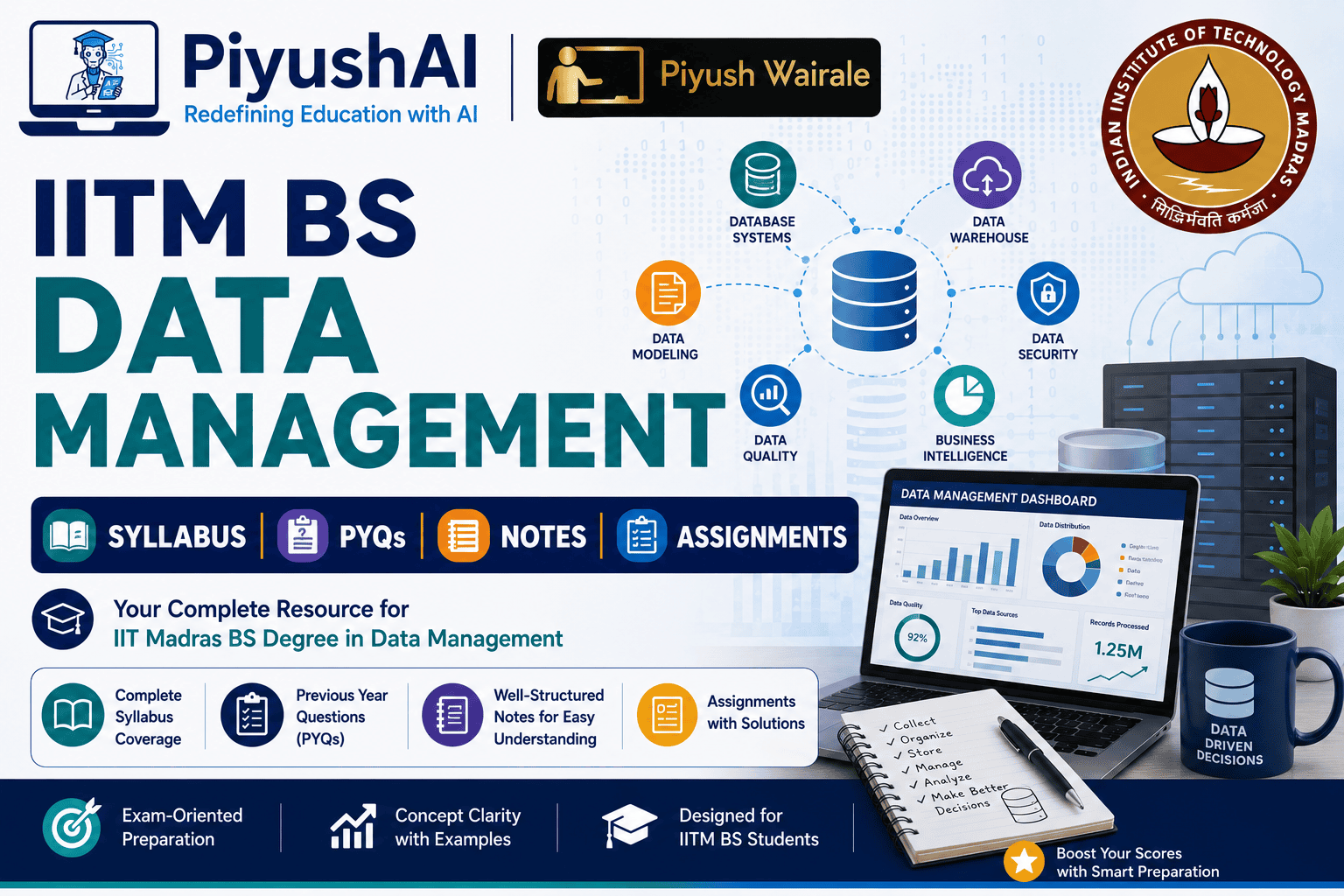
A guide to Data Management in the IIT Madras BS in Management & Data Science diploma level — databases, SQL, data modelling and organising data for analysis, with a study plan, by Piyush Wairale (IIT Madras).
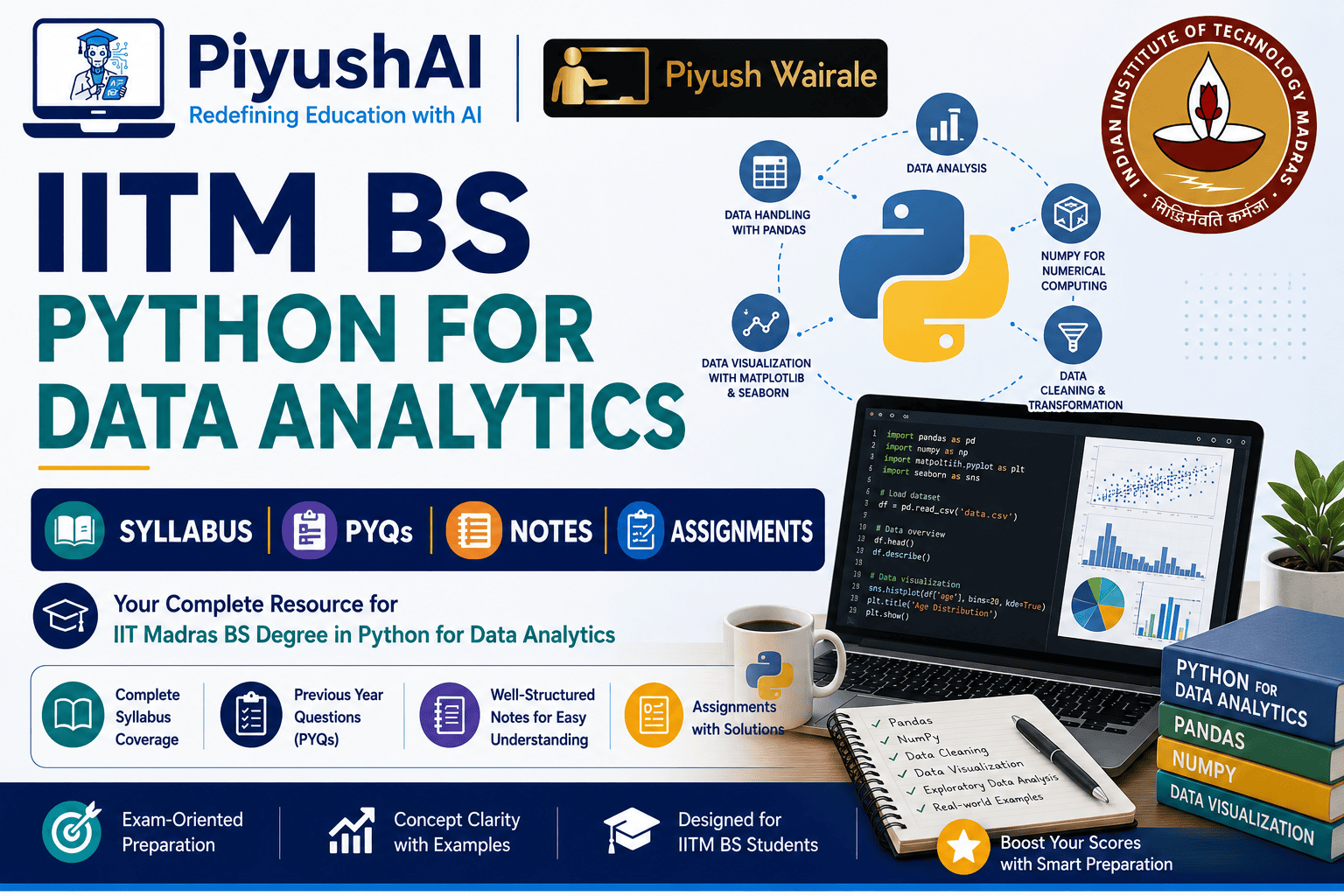
A guide to Python for Data Analytics in the IIT Madras BS in Management & Data Science diploma level — Python basics, pandas, NumPy, data cleaning and visualisation, with a study plan, by Piyush Wairale (IIT Madras).
Learn Daily, Wherever You Are
Free lectures, exam updates, PYQ discussions, and job alerts — delivered through our YouTube channel and Telegram communities.


[…] course in the degree, and it underpins Marketing, HR, Financial and Supply Chain analytics. Your Computational Thinking foundation pays off here — the algorithmic thinking you built now turns into real […]
[…] Computational Thinking […]
[…] Computational Thinking […]