
Quick Summary: Statistics for Data Science I (course code BSMA1002) is a 4-credit foundation course and a qualifier subject in the IIT Madras BS in Management & Data Science. It builds the core of data literacy — describing data, spotting relationships, and the basics of probability. This guide maps the syllabus, the focus areas and a study plan.
📋 Table of Contents
Where this course fits
Statistics I is one of the four qualifier courses and a full 12-week foundation course. It pairs naturally with Mathematics for Data Science I — maths gives you the tools, statistics gives you the reasoning about data. Because so much of the whole degree is analytics, a strong start here compounds later.
Syllabus — topic by topic
- Types of data — categorical vs numerical, scales of measurement
- Descriptive statistics — mean, median, mode; range, variance, standard deviation
- Data visualisation — bar charts, histograms, box plots and how to read them
- Association & correlation — how two variables move together
- Counting principles — permutations and combinations
- Probability basics — events, conditional probability, and intro to random variables
Exact week-wise content is on the official student portal; the above is the reliable topic map.
What to focus on
Descriptive statistics and probability basics carry the most weight and feed directly into later analytics courses. Counting (permutations and combinations) is small but very scoring if you practise it. Correlation is conceptually important — make sure you understand that correlation is not causation.
Study plan
- Weeks 1–2: Data types + descriptive statistics (central tendency, dispersion).
- Weeks 3–4: Visualisation and correlation.
- Weeks 5–6: Counting, then probability basics and random variables.
- Throughout: Submit every graded assignment — it sets your qualifier eligibility.
Common mistakes
❌ Treating probability as guesswork instead of learning the rules.
❌ Ignoring interpretation and only memorising formulas.
❌ Skipping the counting topic — it is easy marks.
Frequently Asked Questions (FAQs)
Do I need maths to handle Statistics I?
Only basic maths. The course teaches the statistical ideas from scratch; comfort with arithmetic and simple algebra is enough to start.
Is it heavy on probability?
Statistics I introduces probability at a foundational level. Deeper probability comes in later statistics courses, so focus here on the basics done well.
Want guided classes & practice for Statistics I and the qualifier?
Related: Mathematics for Data Science I · Computational Thinking · the Qualifier Exam explained. See the full program guide and all IITM BS guides.
Recent Post
A guide to Supply Chain Analytics in the IIT Madras BS in Management & Data Science diploma level — demand forecasting, inventory optimisation, logistics and network design, with a study plan, by Piyush Wairale (IIT Madras).
A guide to Financial Analytics in the IIT Madras BS in Management & Data Science diploma level — financial statement analysis, ratios, forecasting, risk and valuation with data, plus a study plan, by Piyush Wairale (IIT Madras).
A guide to HR Analytics in the IIT Madras BS in Management & Data Science diploma level — workforce metrics, attrition and recruitment analytics, performance data and people analytics, with a study plan, by Piyush Wairale (IIT Madras).
A guide to Marketing Analytics in the IIT Madras BS in Management & Data Science diploma level — segmentation, customer lifetime value, market response models and campaign measurement, with a study plan, by Piyush Wairale (IIT Madras).
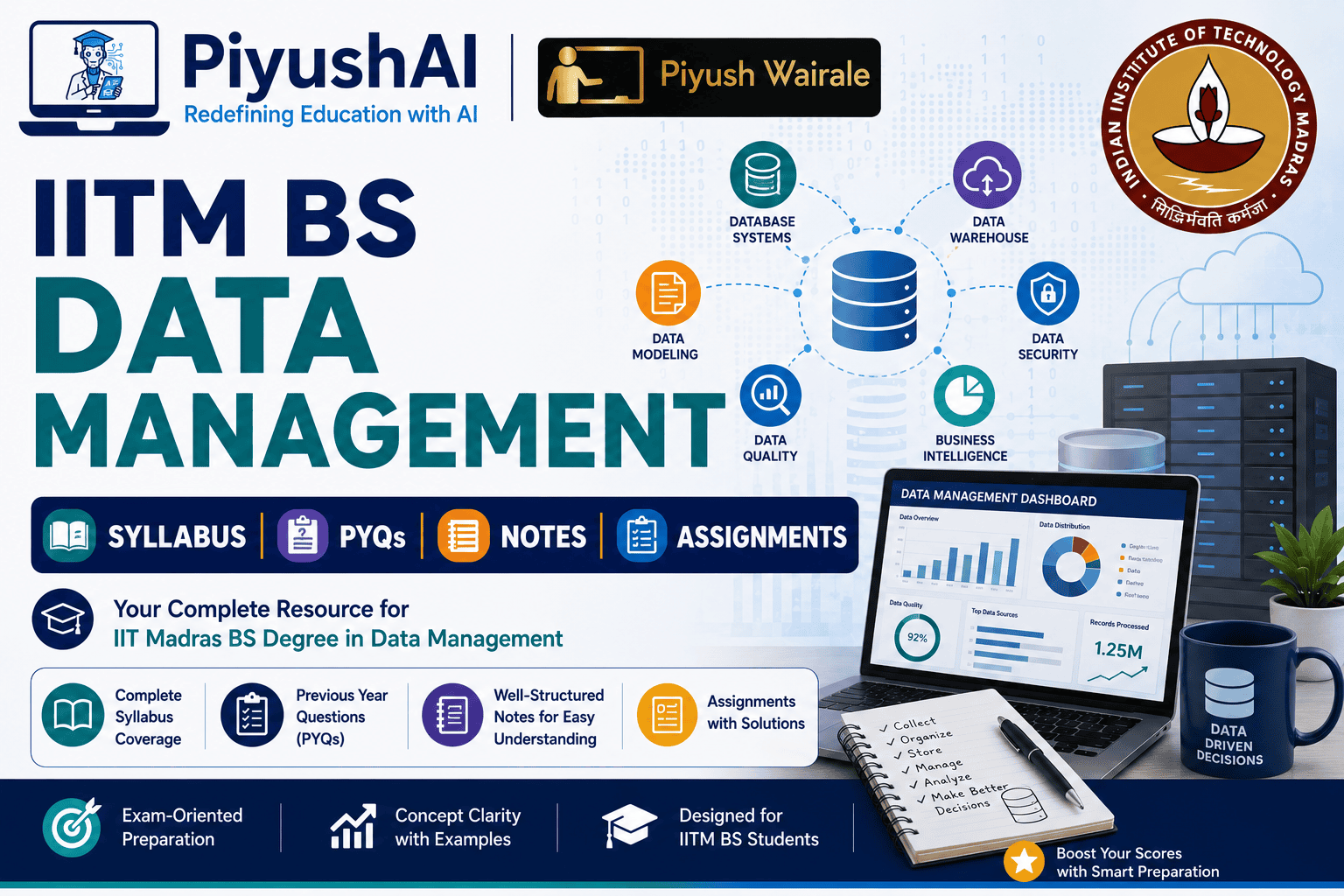
A guide to Data Management in the IIT Madras BS in Management & Data Science diploma level — databases, SQL, data modelling and organising data for analysis, with a study plan, by Piyush Wairale (IIT Madras).
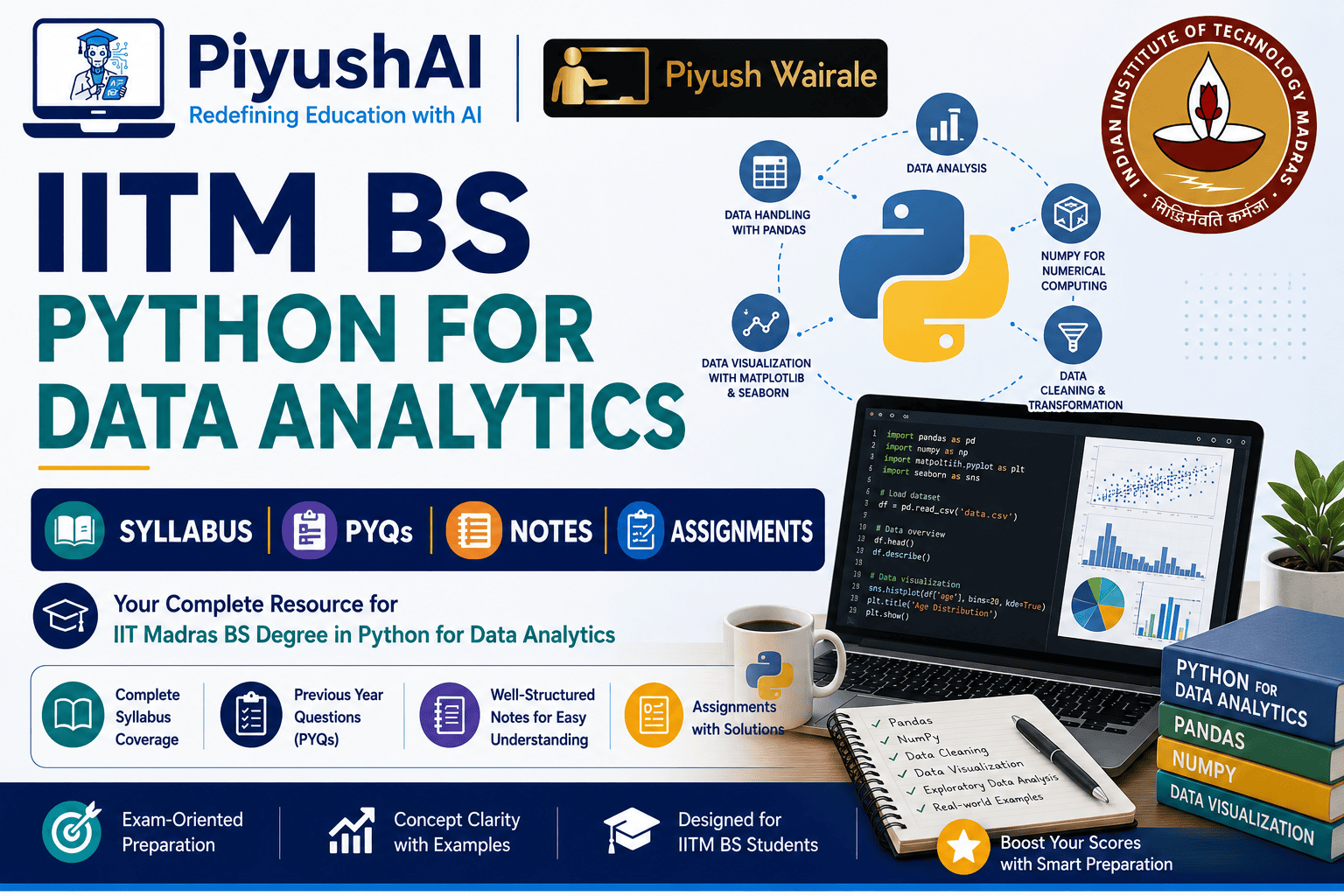
A guide to Python for Data Analytics in the IIT Madras BS in Management & Data Science diploma level — Python basics, pandas, NumPy, data cleaning and visualisation, with a study plan, by Piyush Wairale (IIT Madras).
Learn Daily, Wherever You Are
Free lectures, exam updates, PYQ discussions, and job alerts — delivered through our YouTube channel and Telegram communities.


[…] tools to business problems — distributions, correlation, regression and index numbers. It bridges Statistics for Data Science I and the analytics courses of the diploma level. This guide maps the syllabus and how to study […]
[…] Statistics for Data Science I · Computational Thinking · the Qualifier Exam explained. See the full program guide and all IITM […]
[…] your PYQ practice to each qualifier subject: numerical drilling for Maths I and Statistics I; hand-traced algorithm problems for Computational Thinking; and timed comprehension plus grammar […]