
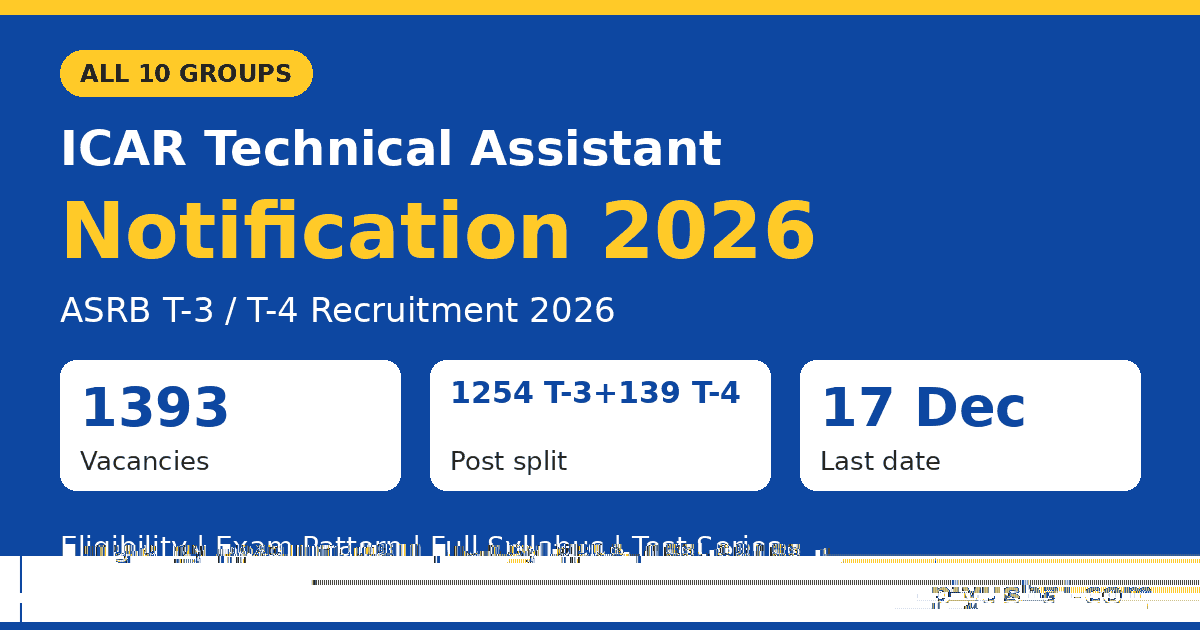
ICAR Technical Assistant Electronics and Instrumentation 2026 notification is out. The Agricultural Scientists Recruitment Board (ASRB) has released the Centralized Combined Examination 2026 notification (11 November 2026) for 1393 posts of Technical Assistant (T-3) in ICAR institutes and Senior Technical Assistant (T-4) in Krishi Vigyan Kendras. This page is the complete guide for the Workshop Staff (Electronics & Instrumentation Engineering) functional group: vacancies, eligibility, exam pattern and the full Mains syllabus exactly as notified by ICAR.
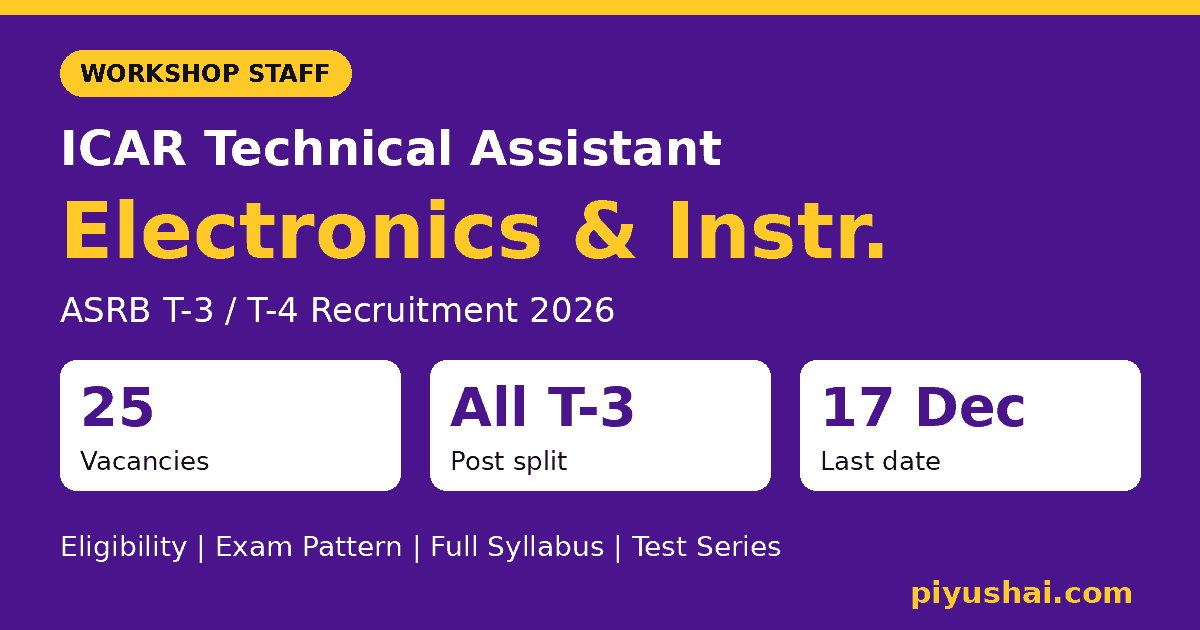
There are 25 Technical Assistant (T-3) Workshop Staff (Electronics & Instrumentation Engineering) posts in ICAR institutes. Electronics and E&I diploma or degree holders can apply. The syllabus is the most modern of all groups, with dedicated units on IoT, AI/ML and Industry 4.0.
Quick answer: ICAR Technical Assistant Electronics and Instrumentation 2026
- Total posts: 25 (all T-3)
- Qualification: B.Tech / B.E. / Three-year Diploma in Electronics Engineering / Electronics & Instrumentation Engineering from a recognised University.
- Age: 21 to 30 years as on 17.12.2026 (relaxation for SC/ST/OBC/PwBD/ESM)
- Apply: 18.11.2026 to 17.12.2026 at asrb.gov.in
- Selection: Prelims (qualifying) + Mains (300 marks); no interview
- Pay: T-3 Level 5 (₹29,200 to ₹92,300)
Overview
| Recruiting Body | Agricultural Scientists Recruitment Board (ASRB), DARE, New Delhi |
| Employer | Indian Council of Agricultural Research (ICAR): institutes (T-3) and KVKs (T-4) |
| Exam Name | Centralized Combined Examination 2026 for TA (T-3) and STA (T-4) |
| Functional Group | Workshop Staff (Electronics & Instrumentation Engineering) |
| Vacancies in this group | 25 (all T-3) |
| Total vacancies (all groups) | 1393 (1254 T-3 + 139 T-4) |
| Notification No. | F. No. 2(2)/2025-Exam, dated 11.11.2026 |
| Exam Mode | Computer Based Test (Prelims and Mains) |
| Official Website | asrb.gov.in |
Important Dates
| Event | Date |
|---|---|
| Notification date | 11 November 2026 |
| Online application starts | 18 November 2026 |
| Last date to apply online | 17 December 2026 (11:59 PM) |
| Last date for fee payment (Bharatkosh) | 17 December 2026 (11:59 PM) |
| Application correction window | 18 to 20 December 2026 |
| Preliminary Exam (CBT) | February 2027 (exact date to be announced) |
| Mains Exam (CBT) | To be announced |
All dates are as per the ASRB notification and are subject to change. Admission certificates are released about one week before the exam on asrb.gov.in only.
ICAR Technical Assistant Electronics and Instrumentation 2026 Vacancies
Technical Assistant (T-3), ICAR Institutes
| Post | UR | OBC | SC | ST | EWS | Total | PwBD | ESM |
|---|---|---|---|---|---|---|---|---|
| Workshop Staff (Electronics & Instrumentation Engineering) | 10 | 6 | 4 | 2 | 3 | 25 | 0 | 1 |
There are no T-4 (KVK) posts for this functional group in 2026; all posts are T-3 in ICAR institutes.
PwBD and Ex-Servicemen (ESM) vacancies are horizontal and included within the category totals. Vacancies are tentative.
ICAR Technical Assistant Electronics and Instrumentation 2026 Eligibility
Educational Qualification
B.Tech / B.E. / Three-year Diploma in Electronics Engineering / Electronics & Instrumentation Engineering from a recognised University.
The degree/diploma must be completed on or before 17.12.2026 from a recognised Indian university/institution (or an equivalent foreign qualification recognised by the Government of India). Candidates must be citizens of India (or Nepal/Bhutan/eligible categories with a certificate of eligibility).
Age Limit and Relaxation
Minimum 21 years and maximum 30 years as on the closing date, 17.12.2026 (indicatively, date of birth between 18.12.1995 and 17.12.2005).
| Category | Upper Age Relaxation |
|---|---|
| SC / ST | 5 years |
| OBC (Non-Creamy Layer) | 3 years |
| PwBD | 10 years (cumulative with SC/ST/OBC relaxation) |
| Ex-Servicemen | 3 years after deducting military service from actual age |
| ICAR in-service technical employees (UR) | Upper limit 40 years, plus category relaxation |
| RAs / SRFs in ICAR projects | Period actually engaged, up to 16 years 3 months |
| Disabled Defence Services Personnel | As per Government of India instructions |
Application Fee
| Category | T-3 only | T-4 only | T-3 + T-4 |
|---|---|---|---|
| Unreserved (UR) | ₹300 | ₹300 | ₹600 |
| EWS / OBC | ₹150 | ₹150 | ₹300 |
| SC / ST / PwBD / Women / Transgender / Ex-Servicemen | Nil | Nil | Nil |
The fee is paid only through Bharatkosh (bharatkosh.gov.in): Quick Payment, Ministry: Agriculture, Purpose: Examination/Certificate fee for ARS/NET/SMS/STO/FAO/AO, PAO 000001, DDO 216968 (Add. ASRB, Chayan Bhavan). Upload the payment receipt in the application form. Paying on Bharatkosh without submitting the form does not count, and the fee is non-refundable.
Exam Pattern
Selection is through two Computer Based Tests. There is no interview: final merit is based on Mains marks only.
Stage 1: Preliminary Exam (Qualifying)
| Section | Subject | Questions | Marks |
|---|---|---|---|
| 1 | General Knowledge | 25 | 25 |
| 2 | General English | 25 | 25 |
| 3 | Quantitative Aptitude | 25 | 25 |
| 4 | General Agriculture | 25 | 25 |
| Total (1 hour) | 100 | 100 |
- Negative marking: 0.25 mark per wrong answer.
- Minimum qualifying marks: UR 30%, EWS/OBC 25%, SC/ST/PwBD 20%.
- Candidates are shortlisted for Mains in the ratio 1:15 of the vacancies, functional group-wise (category-wise).
- Questions are bilingual (Hindi and English), except the General English section.
Stage 2: Mains Exam (Merit)
| Questions | 100 objective MCQs on the functional group’s domain subjects |
| Marks | 300 (3 marks per question) |
| Duration | 2 hours |
| Negative marking | 1 mark per wrong answer (one-third) |
| Minimum qualifying marks | UR 30%, EWS/OBC 25%, SC/ST/PwBD 20% |
| Normalisation | Applied wherever the CBT runs in multiple sessions |
Tie-breaking order: (a) higher Prelims marks, then (b) higher marks in Section 3, Quantitative Aptitude of Prelims, then (c) older candidate ranked higher.
Preparing for ICAR Electronics and Instrumentation? Practise with Piyush Wairale’s Test Series
Analog electronics, digital electronics, linear ICs, measurements and microcontrollers form the backbone of this paper. Practise them with our SSC JE Electronics & Telecommunication and BEL PE Electronics test series and notes.
Special offer: use coupon code ASRB50 to get 50% OFF on the ICAR ASRB Technical Assistant Test Series & Notes.
ICAR ASRB Technical Assistant Test Series & Notes (50% OFF) →SSC JE 2026 Test Series & Notes: Electronics & Telecommunication →BEL PE Electronics Test Series & Notes →Best GATE Aptitude Test Series (Quantitative Aptitude practice) →
Curated by Piyush Wairale (M.Tech, IIT Madras), former instructor in the IIT Madras BS programme, who has taught 20,000+ students. Browse all test series on piyushwairale.com.
Preliminary Exam Syllabus (Common for All Groups)
1. General Knowledge (25 marks)
General awareness of the environment and its application to society, current events, everyday science, and questions on India and its neighbouring countries, especially History, Culture, Geography, Economic Science, General Policy and Scientific Research.
2. General English (25 marks)
Ability to understand correct English, basic comprehension and writing ability (grammar, vocabulary, error spotting, sentence improvement, reading comprehension).
3. Quantitative Aptitude (25 marks)
Computation of whole numbers, decimals, fractions and relationships between numbers; Percentage; Ratio and Proportion; Square roots; Averages; Interest; Profit and Loss; Discount; Partnership Business; Mixture and Alligation; Time and Distance; Time and Work; basic algebraic identities of school algebra and elementary surds; graphs of linear equations; triangle and its centres; congruence and similarity of triangles; circle, chords, tangents, angles subtended by chords, common tangents; quadrilaterals, regular polygons; right prism, right circular cone and cylinder, sphere, hemisphere, rectangular parallelepiped, regular right pyramid; trigonometric ratios, degree and radian measure, standard identities, complementary angles, heights and distances; histogram, frequency polygon, bar diagram and pie chart.
4. General Agriculture (25 marks)
Agro-ecosystems and crops; Animal and fisheries basics; Farm machinery, post-harvest and agri-economics; Institutions and extension; Regulations in agriculture; International organisations. The topic-wise General Agriculture list is in our master guide.
ICAR Technical Assistant Electronics and Instrumentation 2026 Mains Syllabus (Paper-II)
The Mains paper (300 marks) tests domain knowledge of the Workshop Staff (Electronics & Instrumentation Engineering) group. ICAR has not notified unit-wise weightage, so cover every unit below.
1. Engineering Mathematics
Matrix theory, eigenvalues and eigenvectors, linear equations; numerical methods; calculus, partial derivatives, maxima and minima; line, surface and volume integrals; Fourier series; differential equations and boundary value problems; complex variables, Taylor and Laurent series, residue theorem; probability and statistics, sampling theorem, random variables, normal and Poisson distributions, correlation and regression.
2. Electrical Engineering, Network Theorems and Machines
Ohm’s law, Kirchhoff’s laws, ideal voltage and current sources and conversions; node voltage and mesh current analysis, Cramer’s rule, reciprocity theorem, superposition, Thevenin and Norton theorems, maximum power transfer, series resonance, Q-factor; motors and generators; alternator, induction motor, synchronous motor.
3. Electronics
Resistors, capacitors and inductors and their specifications; conductors, semiconductors and insulators; PN junction, biasing; Zener, varactor and tunnel diodes; rectifiers and filters; clippers and clampers; PNP and NPN transistors, UJT, FET, photodiode, phototransistor, LED, LCD. Amplifiers: h-parameter models of CE, CB and CC; RC-coupled and transformer-coupled amplifiers; Darlington and cascode; class A and class B push-pull; complementary power amplifiers; heat sinks; oscillators (RC phase shift, Hartley, Colpitts); bootstrap and current sweep circuits; load lines and operating point; direct-coupled and differential amplifiers; positive and negative feedback.
4. Digital Electronics
Number systems, postulates, De Morgan’s theorems, Boolean simplification, K-maps up to 3 variables; TTL and CMOS NAND; logic gates; half, full, serial and parallel adders, 2’s complement subtractor; tristate buffer; RS, T, D and master-slave JK flip-flops; encoders, decoders, 4×1 multiplexer, 1×4 demultiplexer; synchronous and asynchronous counters, decade, ripple, binary and up-down counters; registers and universal shift register; RAM, ROM, EEPROM, UVPROM, flash ROM.
5. Process Instrumentation
Transducers for displacement (LVDT, potentiometer, inductive, capacitive, RVDT); angular velocity, tacho-generators, photoelectric tachometer; temperature (thermometers, RTD, thermocouple, thermistor, pyrometers); pressure (elastic elements, strain gauge, piezoelectric, dead weight tester, capacitive, McLeod gauge); flow (head-type meters, rotameter, electromagnetic, anemometers, ultrasonic, thermal); level (resistive, capacitive, gamma ray, ultrasonic); force and torque (load cells, proving ring, hydraulic, pneumatic, piezoelectric); density and viscosity (capillary, falling ball, rotational viscometers); humidity (hair hygrometer); nuclear instrumentation (GM counter, ionisation chamber, scintillation counter); smart sensors (proximity, IR, motion, accelerometer, gyroscope). Instrumentation in power, petrochemical, iron and steel, paper and pulp, cement and textile industries.
6. Control Engineering
Open- and closed-loop control; process variables and characteristics; ON-OFF, P, I, D and PID control and tuning; flapper-nozzle; pneumatic, electro-pneumatic and hydraulic actuators; P-to-I and I-to-P converters; solenoid valves; stepper motor actuators; control valves (sliding stem, single-seat plug, rotary, butterfly); cascade, ratio, feed-forward and adaptive control; line diagrams, letter codes and standards.
7. Linear IC Applications
IC classification (SSI, MSI, LSI, WSI); op-amp characteristics; summer, integrator, differentiator, inverter, voltage follower, V-to-I and I-to-V converters; op-amp LPF and HPF; square and triangular wave generators; monostable and astable multivibrators; Wien bridge oscillator; Schmitt trigger; counter-type and successive approximation ADCs; R-2R ladder and weighted resistor DACs; 555 timer applications; 78XX regulated supply; PLL LM565.
8. Microcontrollers and PLCs
8051 architecture, instruction set and programming; interfacing 8255, 8251 and 8257; applications. PLC architecture, instruction set and ladder diagrams; basic concepts of SCADA, DCS, DAS, robots and CNC.
9. Electronic Measuring Instruments
PMMC movement; ammeter, voltmeter and ohmmeter; range extension; rectifier-type meters; moving iron instruments; FET-input and differential voltmeters; Wheatstone, Maxwell and Schering bridges; megger. Digital multimeter, LCR meter, ramp-type and successive-approximation DVMs, digital frequency meter. CRO: CRT, time base, deflection sensitivity, triggered sweep, applications, storage, digital and dual-trace oscilloscopes.
10. Analytical and Biomedical Instrumentation
Electromagnetic spectrum, Beer-Lambert law, monochromators, sources and detectors, UV/visible/IR spectrophotometers, flame photometer, spectrofluorometer, interferometer, refractometer, polarimeter, gas analysers, mass spectrometer, liquid and gas chromatography, autoanalyser. Bioelectric potentials, electrodes, ECG, EEG, EMG; blood pressure measurement; electromagnetic and ultrasonic blood flow meters; pacemakers, defibrillators, dialysis; X-ray, CT and MRI.
11. IoT in Instrumentation
IoT architecture: sensors, actuators, protocols (MQTT, CoAP, HTTP); integrating sensors with Arduino, Raspberry Pi and ESP32; applications in agriculture, healthcare, industrial automation and environmental monitoring; cloud data acquisition (ThingSpeak, Blynk); case study of IoT-based temperature, humidity or pressure monitoring.
12. AI and Machine Learning in Instrumentation
AI/ML for instrumentation and automation; data acquisition and preprocessing for ML; supervised vs unsupervised learning; predictive maintenance, anomaly detection, quality control; case study of ML-based signal classification or image-based inspection.
13. Cyber-Physical Systems and Industry 4.0
Concepts of CPS; smart factories and intelligent process control; role of PLC, SCADA and IoT in CPS; real-time analytics and edge computing; automation communication standards (OPC-UA, Modbus TCP).
ICAR Technical Assistant Electronics and Instrumentation 2026 Preparation Strategy
- Core scoring area: Process Instrumentation (transducers), Electronic Measurements, Analog and Digital Electronics and Linear ICs. These are classic diploma-level objective questions.
- Build a transducer table: measured quantity, principle, range, advantage and typical use. It answers a large share of Process Instrumentation questions directly.
- The IoT, AI/ML and Industry 4.0 units are new in ICAR syllabi. Learn the protocols (MQTT, CoAP, OPC-UA, Modbus TCP), boards (Arduino, ESP32, Raspberry Pi) and ML metric basics.
- 8051 questions are predictable: memory map, SFRs, timers, addressing modes and instruction byte counts.
Posts Suitable for PwBD
Suitable categories of benchmark disability for this group: a) D, HH; b) OL, CP, LC, Dw, AAV; c) ASD (M), SLD, MI; d) MD involving (a) to (c). Functional requirements: Sitting, Standing, Walking, Bending, Lifting, Kneeling & Crouching, Pulling & Pushing, Manipulation with Fingers, Reading & Writing, Seeing, Communication.
How to Apply
- Visit asrb.gov.in between 18.11.2026 and 17.12.2026 and complete the One Time Registration (OTR).
- Choose your single functional group and opt for T-3, T-4 or both, with a preference order (final, cannot be changed).
- Select Prelims and Mains exam centres carefully; centre changes are not allowed.
- Upload photo (white background, .jpg, max 200 KB, without spectacles), signature (.jpg, max 100 KB), photo ID and certificates (.jpg, max 100 KB each).
- Pay the fee on Bharatkosh, upload the receipt and submit. Keep a copy of the completed form.
- Use the correction window (18 to 20 December 2026) if needed.
Start Your Test Series Today
Mains decides your rank and every wrong answer costs one-third of a question. Timed, exam-level mock tests are the fastest way to build accuracy before the CBT.
Special offer: use coupon code ASRB50 to get 50% OFF on the ICAR ASRB Technical Assistant Test Series & Notes.
ICAR ASRB Technical Assistant Test Series & Notes (50% OFF) →SSC JE 2026 Test Series & Notes: Electronics & Telecommunication →BEL PE Electronics Test Series & Notes →Best GATE Aptitude Test Series (Quantitative Aptitude practice) →
Curated by Piyush Wairale (M.Tech, IIT Madras), former instructor in the IIT Madras BS programme, who has taught 20,000+ students. Browse all test series on piyushwairale.com.
Frequently Asked Questions
Can an ECE (Electronics and Communication) diploma holder apply for ICAR E&I Workshop Staff?
The notification prescribes a B.Tech/B.E. or three-year Diploma in Electronics Engineering or Electronics & Instrumentation Engineering. Check that your diploma title matches; if in doubt, confirm with ASRB at t3t42026@asrb.gov.in before applying. Note that B.Tech/BE ECE graduates are explicitly eligible for the IT group.
How many Electronics & Instrumentation posts are there?
25 Technical Assistant (T-3) posts: UR 10, OBC 6, SC 4, ST 2, EWS 3, with 1 Ex-Serviceman vacancy.
What is the exam pattern for ICAR Technical Assistant Electronics and Instrumentation 2026?
A 1-hour qualifying Prelims of 100 marks (GK, English, Quantitative Aptitude and General Agriculture, 25 each, minus 0.25 per wrong answer), followed by a 2-hour Mains of 100 questions for 300 marks on the functional group syllabus, with 1 mark deducted per wrong answer. There is no interview.
What is the last date to apply for ASRB T-3/T-4 2026?
17 December 2026 (11:59 PM) for both the online application and fee payment. Applications open on 18 November 2026 at asrb.gov.in.
Can I apply for more than one functional group?
No. A candidate may apply for only one functional group/subgroup, even if eligible for more. Within it you can opt for T-3 only, T-4 only, or both, with a preference order that cannot be changed later.
What is the salary of ICAR Technical Assistant T-3 and Senior Technical Assistant T-4?
T-3 is at Pay Level 5 (₹29,200 to ₹92,300) of the 7th CPC Pay Matrix and T-4 is at Pay Level 6 (₹35,400 to ₹1,12,400), plus applicable allowances.
Other ICAR T-3 / T-4 2026 Functional Group Guides
- ASRB ICAR T-3/T-4 2026 Notification: Master Guide (all 10 groups)
- ICAR Technical Assistant Agriculture 2026 (772 posts)
- ICAR Technical Assistant Animal Science 2026 (124 posts)
- ICAR Technical Assistant Fisheries 2026 (97 posts)
- ICAR Technical Assistant Home Science 2026 (7 posts)
- ICAR Technical Assistant Civil Engineering 2026 (51 posts)
- ICAR Technical Assistant Agricultural Engineering 2026 (42 posts)
- ICAR Technical Assistant Electrical Engineering 2026 (35 posts)
- ICAR Technical Assistant Library Science 2026 (59 posts)
- ICAR Technical Assistant IT 2026 (181 posts)
Source: ASRB Notification F. No. 2(2)/2025-Exam dated 11.11.2026 and ICAR OM No. TS-19(6)/2024-Estt.IV (E-332924) dated 28.09.2026 (Scheme and Syllabus). Vacancies are tentative. Always read the official notification on asrb.gov.in before applying; in case of any discrepancy the English version on the ASRB website prevails.

Recent Post

ASRB ICAR Technical Assistant (T-3) and Senior Technical Assistant (T-4) 2026: 1393 vacancies across 10 functional groups, dates, eligibility, age limit, fee, Prelims and Mains pattern, syllabus and links to detailed group-wise guides.
With 772 posts (699 Technical Assistant T-3 in ICAR institutes and 73 Senior Technical Assistant T-4 in KVKs), the Agriculture functional group is the biggest slice of the ASRB Centralized Combined Examination 2026, accounting for more than half of all 1393 vacancies.
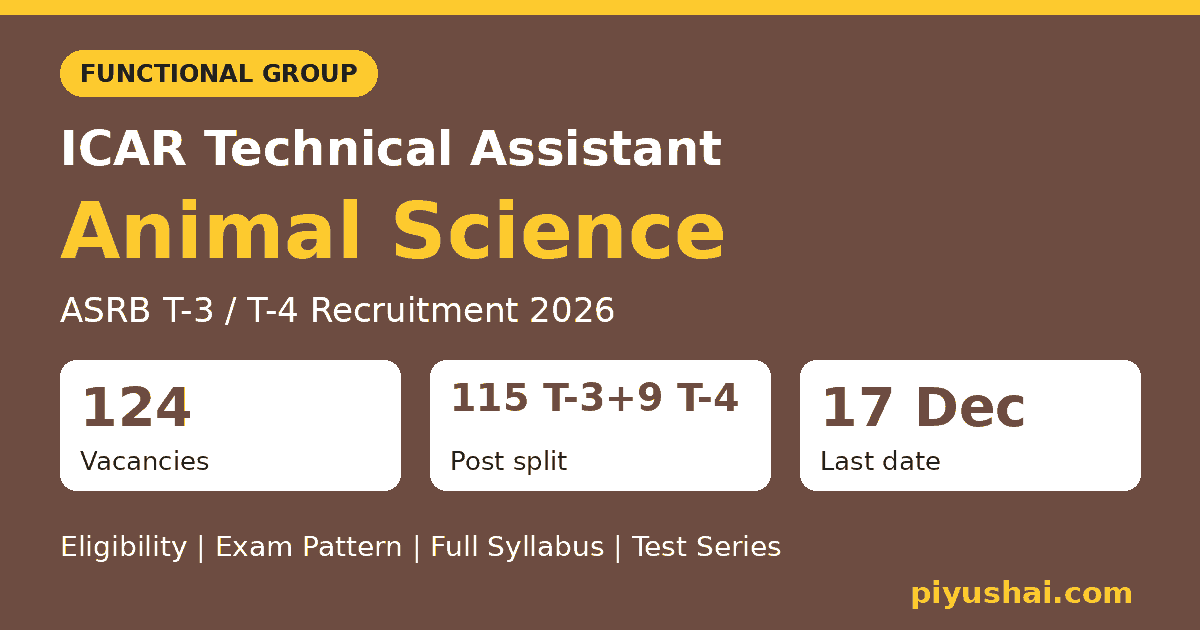
The Animal Science functional group offers 124 posts for veterinary graduates: 115 Technical Assistant (T-3) posts in ICAR institutes and 9 Senior Technical Assistant (T-4) posts in KVKs. Only B.V.Sc. & A.H. holders are eligible.
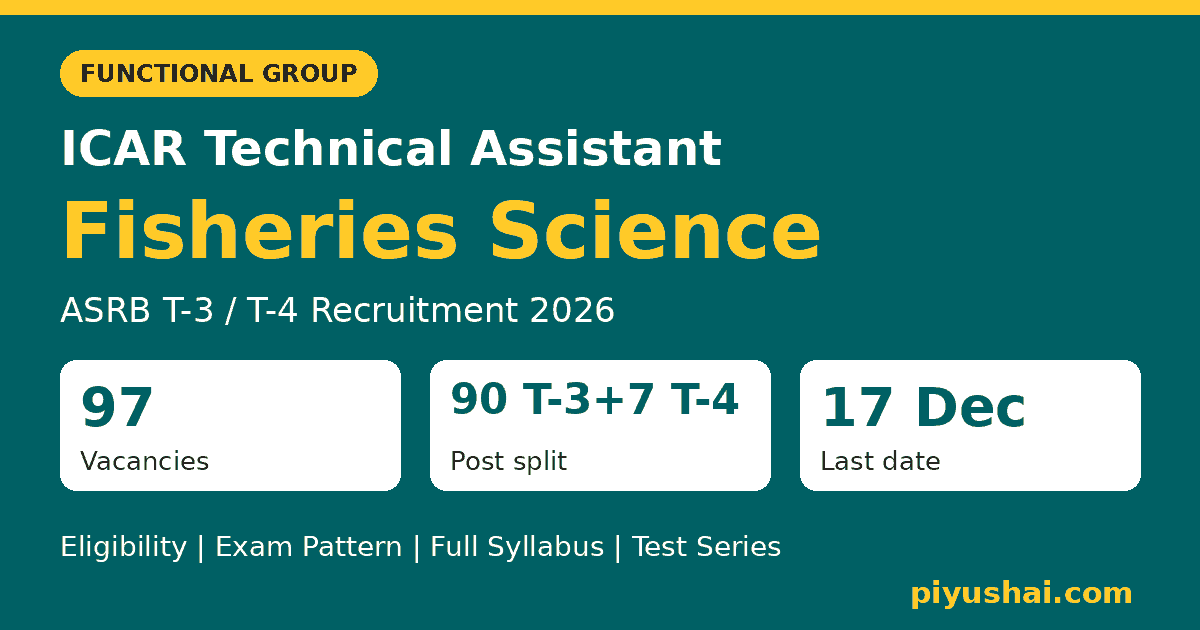
The Fisheries Science functional group has 97 posts: 90 Technical Assistant (T-3) posts in ICAR fisheries institutes and 7 Senior Technical Assistant (T-4) Laboratory Technician posts in KVKs. Only B.F.Sc. graduates are eligible.
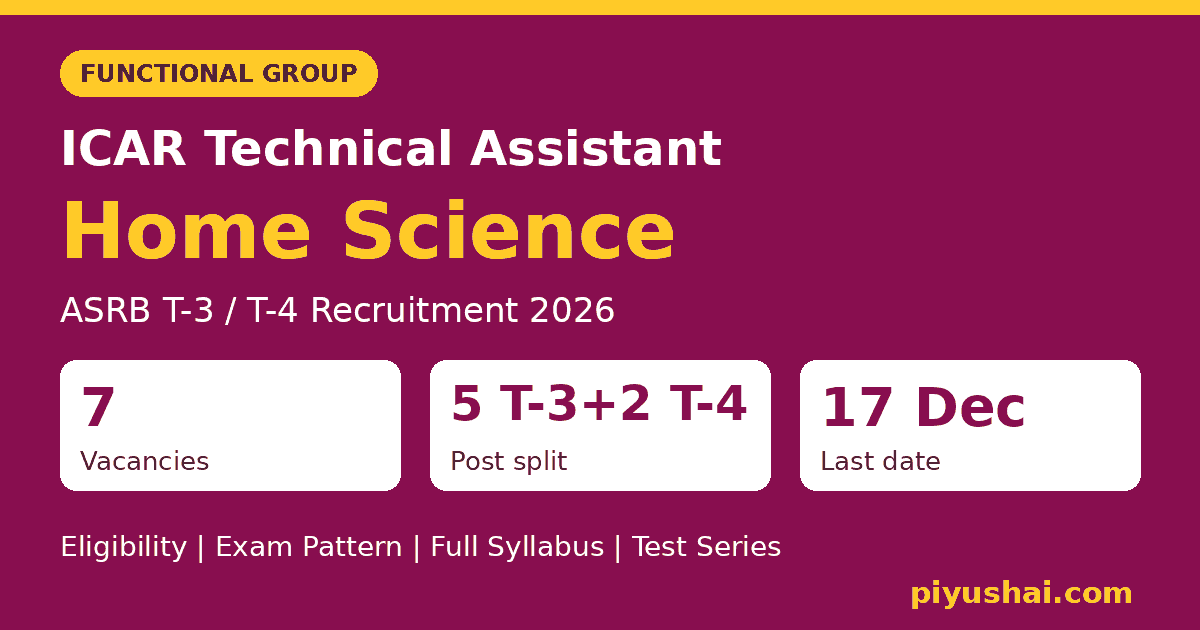
The Home Science / Community Science functional group is the smallest in ASRB T-3/T-4 2026 with just 7 posts (5 T-3 + 2 T-4). Home Science graduates are also eligible for the Agriculture group (772 posts), so compare both before applying.
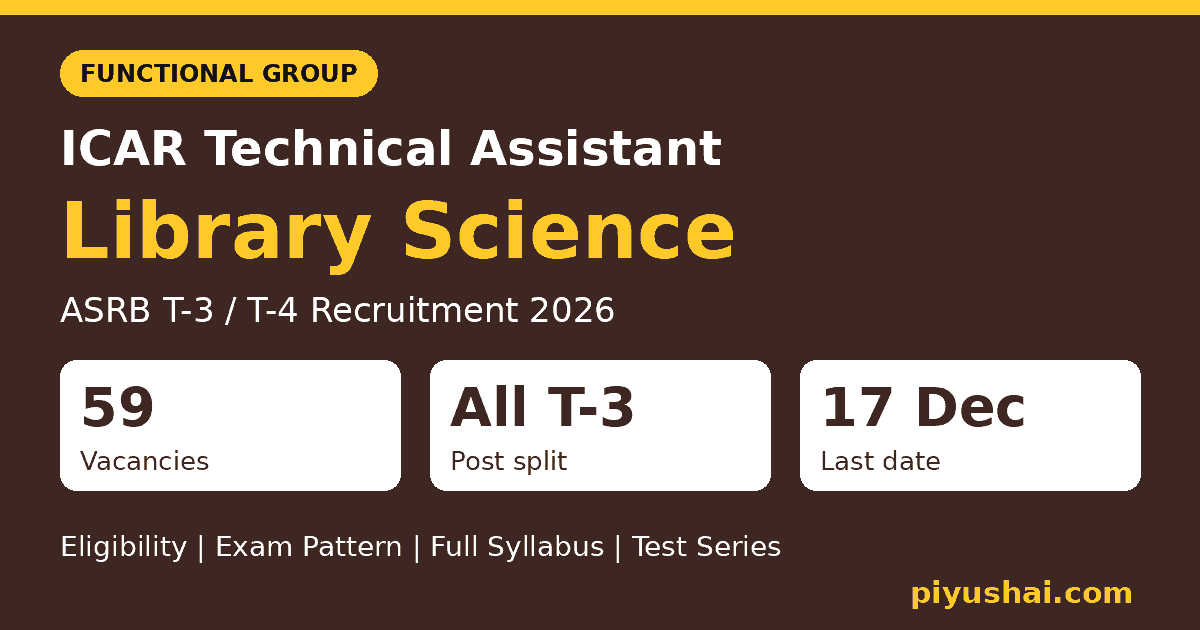
ICAR has 59 Technical Assistant (T-3) Library / Information Science / Documentation Staff posts in its institutes, one of the largest central government library recruitments of the year. A bachelor's degree in Library Science (B.Lib.I.Sc.) is the qualification, and there is no interview.
Learn Daily, Wherever You Are
Free lectures, exam updates, PYQ discussions, and job alerts — delivered through our YouTube channel and Telegram communities.