
ICAR Technical Assistant Fisheries 2026 notification is out. The Agricultural Scientists Recruitment Board (ASRB) has released the Centralized Combined Examination 2026 notification (11 November 2026) for 1393 posts of Technical Assistant (T-3) in ICAR institutes and Senior Technical Assistant (T-4) in Krishi Vigyan Kendras. This page is the complete guide for the Field Farm Technician & Laboratory Technician (Fisheries Science) functional group: vacancies, eligibility, exam pattern and the full Mains syllabus exactly as notified by ICAR.
The Fisheries Science functional group has 97 posts: 90 Technical Assistant (T-3) posts in ICAR fisheries institutes and 7 Senior Technical Assistant (T-4) Laboratory Technician posts in KVKs. Only B.F.Sc. graduates are eligible. Notably, the ST share here (15 of 90 T-3 posts) is unusually high compared with other groups.
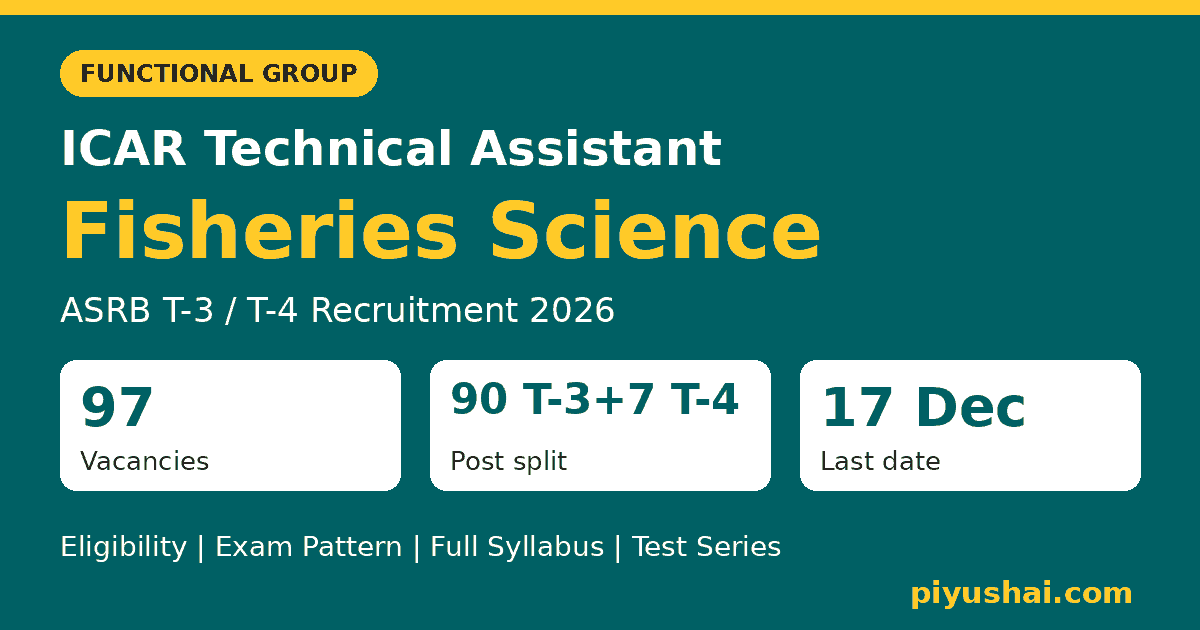
Quick answer: ICAR Technical Assistant Fisheries 2026
- Total posts: 97 (90 T-3 + 7 T-4)
- Qualification: B.F.Sc. (Bachelor of Fisheries Science).
- Age: 21 to 30 years as on 17.12.2026 (relaxation for SC/ST/OBC/PwBD/ESM)
- Apply: 18.11.2026 to 17.12.2026 at asrb.gov.in
- Selection: Prelims (qualifying) + Mains (300 marks); no interview
- Pay: T-3 Level 5 (₹29,200 to ₹92,300); T-4 Level 6 (₹35,400 to ₹1,12,400)
Overview
| Recruiting Body | Agricultural Scientists Recruitment Board (ASRB), DARE, New Delhi |
| Employer | Indian Council of Agricultural Research (ICAR): institutes (T-3) and KVKs (T-4) |
| Exam Name | Centralized Combined Examination 2026 for TA (T-3) and STA (T-4) |
| Functional Group | Field Farm Technician & Laboratory Technician (Fisheries Science) |
| Vacancies in this group | 97 (90 T-3 + 7 T-4) |
| Total vacancies (all groups) | 1393 (1254 T-3 + 139 T-4) |
| Notification No. | F. No. 2(2)/2025-Exam, dated 11.11.2026 |
| Exam Mode | Computer Based Test (Prelims and Mains) |
| Official Website | asrb.gov.in |
Important Dates
| Event | Date |
|---|---|
| Notification date | 11 November 2026 |
| Online application starts | 18 November 2026 |
| Last date to apply online | 17 December 2026 (11:59 PM) |
| Last date for fee payment (Bharatkosh) | 17 December 2026 (11:59 PM) |
| Application correction window | 18 to 20 December 2026 |
| Preliminary Exam (CBT) | February 2027 (exact date to be announced) |
| Mains Exam (CBT) | To be announced |
All dates are as per the ASRB notification and are subject to change. Admission certificates are released about one week before the exam on asrb.gov.in only.
ICAR Technical Assistant Fisheries 2026 Vacancies
Technical Assistant (T-3), ICAR Institutes
| Post | UR | OBC | SC | ST | EWS | Total | PwBD | ESM |
|---|---|---|---|---|---|---|---|---|
| Field Farm Technician (Fisheries) | 16 | 12 | 9 | 12 | 8 | 57 | 0 | 3 |
| Laboratory Technician (Fisheries) | 10 | 9 | 5 | 3 | 6 | 33 | 1 | 0 |
| Total T-3 Fisheries | 26 | 21 | 14 | 15 | 14 | 90 | 1 | 3 |
Senior Technical Assistant (T-4), KVKs
| Post | UR | OBC | SC | ST | EWS | Total | PwBD | ESM |
|---|---|---|---|---|---|---|---|---|
| Laboratory Technician (Fisheries) | 6 | 1 | 0 | 0 | 0 | 7 | 0 | 0 |
PwBD and Ex-Servicemen (ESM) vacancies are horizontal and included within the category totals. Vacancies are tentative.
ICAR Technical Assistant Fisheries 2026 Eligibility
Educational Qualification
B.F.Sc. (Bachelor of Fisheries Science).
The degree must be completed on or before 17.12.2026 from a recognised Indian university/institution (or an equivalent foreign qualification recognised by the Government of India). Candidates must be citizens of India (or Nepal/Bhutan/eligible categories with a certificate of eligibility).
Age Limit and Relaxation
Minimum 21 years and maximum 30 years as on the closing date, 17.12.2026 (indicatively, date of birth between 18.12.1995 and 17.12.2005).
| Category | Upper Age Relaxation |
|---|---|
| SC / ST | 5 years |
| OBC (Non-Creamy Layer) | 3 years |
| PwBD | 10 years (cumulative with SC/ST/OBC relaxation) |
| Ex-Servicemen | 3 years after deducting military service from actual age |
| ICAR in-service technical employees (UR) | Upper limit 40 years, plus category relaxation |
| RAs / SRFs in ICAR projects | Period actually engaged, up to 16 years 3 months |
| Disabled Defence Services Personnel | As per Government of India instructions |
Application Fee
| Category | T-3 only | T-4 only | T-3 + T-4 |
|---|---|---|---|
| Unreserved (UR) | ₹300 | ₹300 | ₹600 |
| EWS / OBC | ₹150 | ₹150 | ₹300 |
| SC / ST / PwBD / Women / Transgender / Ex-Servicemen | Nil | Nil | Nil |
The fee is paid only through Bharatkosh (bharatkosh.gov.in): Quick Payment, Ministry: Agriculture, Purpose: Examination/Certificate fee for ARS/NET/SMS/STO/FAO/AO, PAO 000001, DDO 216968 (Add. ASRB, Chayan Bhavan). Upload the payment receipt in the application form. Paying on Bharatkosh without submitting the form does not count, and the fee is non-refundable.
Exam Pattern
Selection is through two Computer Based Tests. There is no interview: final merit is based on Mains marks only.
Stage 1: Preliminary Exam (Qualifying)
| Section | Subject | Questions | Marks |
|---|---|---|---|
| 1 | General Knowledge | 25 | 25 |
| 2 | General English | 25 | 25 |
| 3 | Quantitative Aptitude | 25 | 25 |
| 4 | General Agriculture | 25 | 25 |
| Total (1 hour) | 100 | 100 |
- Negative marking: 0.25 mark per wrong answer.
- Minimum qualifying marks: UR 30%, EWS/OBC 25%, SC/ST/PwBD 20%.
- Candidates are shortlisted for Mains in the ratio 1:15 of the vacancies, functional group-wise (category-wise).
- Questions are bilingual (Hindi and English), except the General English section.
Stage 2: Mains Exam (Merit)
| Questions | 100 objective MCQs on the functional group’s domain subjects |
| Marks | 300 (3 marks per question) |
| Duration | 2 hours |
| Negative marking | 1 mark per wrong answer (one-third) |
| Minimum qualifying marks | UR 30%, EWS/OBC 25%, SC/ST/PwBD 20% |
| Normalisation | Applied wherever the CBT runs in multiple sessions |
Tie-breaking order: (a) higher Prelims marks, then (b) higher marks in Section 3, Quantitative Aptitude of Prelims, then (c) older candidate ranked higher.
Preparing for ICAR Fisheries? Practise with Piyush Wairale’s Test Series
There is no domain-specific Fisheries test series on our store yet, so build your Prelims edge with our Quantitative Aptitude practice. ASRB breaks Mains ties first on Prelims marks and then on Section 3 (Quantitative Aptitude) marks.
Special offer: use coupon code ASRB50 to get 50% OFF on the ICAR ASRB Technical Assistant Test Series & Notes.
ICAR ASRB Technical Assistant Test Series & Notes (50% OFF) →Best GATE Aptitude Test Series (Quantitative Aptitude practice) →All Test Series on piyushwairale.com →
Curated by Piyush Wairale (M.Tech, IIT Madras), former instructor in the IIT Madras BS programme, who has taught 20,000+ students. Browse all test series on piyushwairale.com.
Preliminary Exam Syllabus (Common for All Groups)
1. General Knowledge (25 marks)
General awareness of the environment and its application to society, current events, everyday science, and questions on India and its neighbouring countries, especially History, Culture, Geography, Economic Science, General Policy and Scientific Research.
2. General English (25 marks)
Ability to understand correct English, basic comprehension and writing ability (grammar, vocabulary, error spotting, sentence improvement, reading comprehension).
3. Quantitative Aptitude (25 marks)
Computation of whole numbers, decimals, fractions and relationships between numbers; Percentage; Ratio and Proportion; Square roots; Averages; Interest; Profit and Loss; Discount; Partnership Business; Mixture and Alligation; Time and Distance; Time and Work; basic algebraic identities of school algebra and elementary surds; graphs of linear equations; triangle and its centres; congruence and similarity of triangles; circle, chords, tangents, angles subtended by chords, common tangents; quadrilaterals, regular polygons; right prism, right circular cone and cylinder, sphere, hemisphere, rectangular parallelepiped, regular right pyramid; trigonometric ratios, degree and radian measure, standard identities, complementary angles, heights and distances; histogram, frequency polygon, bar diagram and pie chart.
4. General Agriculture (25 marks)
Agro-ecosystems and crops; Animal and fisheries basics; Farm machinery, post-harvest and agri-economics; Institutions and extension; Regulations in agriculture; International organisations. The topic-wise General Agriculture list is in our master guide.
ICAR Technical Assistant Fisheries 2026 Mains Syllabus (Paper-II)
The Mains paper (300 marks) tests domain knowledge of the Fisheries Science group. ICAR has not notified unit-wise weightage, so cover every unit below.
1. Aquaculture
Principles of aquaculture, aquaculture systems, major species farmed globally and in India, production trends, criteria for species selection. Freshwater culture of carps, catfishes, freshwater prawn, mussels, trout; brackishwater farming of shrimp, crab and finfishes; mariculture of finfishes, mussels, oysters and seaweeds. Cage aquaculture, integrated farming, sewage-fed farming, flow-through and recirculatory aquaculture systems (RAS), aquaponics. Pre- and post-stocking management (water quality, feed, fish health). Site selection and farm design.
2. Fish Breeding and Seed Production
Natural seed resources and collection. Sexual maturity, gonadal development and breeding seasons of cultivable finfish and shellfish. Broodstock development, induced breeding, hatchery management (freshwater, brackishwater, marine). Pituitary and synthetic hormones. Hatchery design. Indoor and outdoor nursery rearing, fingerling and juvenile production, seed transportation. Culture of micro-algae and live food organisms.
3. Ornamental Fish Farming and Aquarium Management
Ornamental fish trade in the world and India; indigenous ornamental fishes; broodstock, breeding and rearing of freshwater, brackishwater and marine ornamentals; trait improvement; hatchery and farm management; water quality; feeds; common diseases. Aquarium plants and propagation. Aquarium fabrication, setting up and maintenance; biological, mechanical and chemical filtration; filters, aerators, skimmers; biotope aquaria.
4. Fish Genetics and Biotechnology
Principles of fish genetics, chromosomes and genes, chromosomal aberrations, androgenesis, gynogenesis and polyploidy, hybridisation, cross-breeding, inbreeding, sex determination, monosex production, cryopreservation of gametes, population genetics, selective breeding, genetic engineering, genome editing.
5. Fish Nutrition and Feed Technology
Fundamentals of fish nutrition and growth; nutrient requirements of fish and shellfish; conventional and non-conventional feed ingredients; anti-nutritional factors; feed formulation, production and analysis; feed additives (binders, antioxidants, enzymes, pigments, growth promoters, stimulants); feed storage; larval feeds (microparticulate, micro-encapsulated); FCR, FER, PER, NPU, biological value; digestion and digestibility; feeding methods and devices.
6. Fish Disease Management
Fundamentals of microbiology; pathogens and their diagnosis; fish immunology; prevention and treatment of parasitic, bacterial, fungal and viral diseases; OIE-listed diseases; surveillance and reporting; quarantine and health certification; bioremediators, probiotics, immunomodulators; SPF, SPR and SPT stocks; GAP, HACCP and biosecurity; zoonoses; conventional, molecular and antibody-based diagnostics; rapid diagnostics; vaccines; nutritional deficiency diseases.
7. Inland Fisheries
Global inland fish production; inland open-water resources of India (rivers, estuaries, reservoirs, lakes, wetlands) and their potential; major riverine and estuarine systems; reservoir and lake fisheries; culture-based fisheries; floodplain fisheries; brackishwater lakes and lagoons; coldwater fisheries; fishing crafts and gears; fish biodiversity and conservation; sanctuaries and protected areas.
8. Marine Fisheries
Global marine production trends; India’s marine resources (EEZ, coastline, continental shelf and slope) and potential; marine production trends in India; classification of marine environments (pelagic, benthic, euphotic, aphotic); finfish, shellfish and seaweed resources; distribution of commercial species; traditional, motorised and mechanised fisheries; conservation and management; climate change impacts; GIS and remote sensing in capture fisheries.
9. Aquatic Ecology
Ecosystem structure and function; inland water types; lentic and lotic dynamics; origin of lakes; aquatic plants, seaweeds, seagrasses, mangroves and salt marshes; plankton classification and distribution; blooms and red tides; benthos, periphyton, nekton; primary productivity; nitrogen and phosphorus cycles; pollution and amelioration; food chains and webs; productivity factors.
10. Soil and Water Chemistry
Properties of freshwater and seawater; acids, bases, salts, pH and buffers; water quality parameters (temperature, transparency, turbidity, pH, conductivity, salinity, chlorinity, total solids, DO, free CO2, alkalinity, hardness, calcium, magnesium, ammonium, nitrate, phosphorus); soil physical properties, types and distribution; soil-water interactions; organic carbon, C:N ratio, soil fertility; determination methods; water and soil quality management for aquaculture.
11. Taxonomy of Finfishes and Shellfishes
Principles of taxonomy, nomenclature, types, classification; criteria for generic and specific identification; morphometric and meristic characters; major inland and marine taxa; commercially important crustaceans (prawns, shrimps, lobsters, crabs) and molluscs (bivalves, gastropods, cephalopods); karyotaxonomy and DNA barcoding; methods of fish preservation.
12. Fishery Biology
External and internal anatomy; oral region; digestive system; food and feeding habits; gut content analysis; reproductive biology (maturity stages, GSI, ponderal index, fecundity, sex ratio, spawning); eggs and larval stages; age and growth by direct and indirect methods; length-weight relationship; migration; tagging and marking.
13. Fishing Crafts and Gears
Traditional crafts; classification of crafts; boat-building materials; deck fittings; vessel maintenance; classification of gears (principal, subsidiary, auxiliary); natural and synthetic gear materials; netting materials; trawlers, gillnetters, liners and seiners; fish-finding devices (sonar, echo-sounder, net sonde); preservation of craft and gear materials.
14. Fish Processing, Products and By-products
Principles of processing and preservation; salting, curing, drying, smoking and fermentation; icing, chilling and freezing; canning; fish ham and sausage; ready-to-cook and ready-to-eat products, pickles, fish cake, finger, cutlet, wafer, soup powder; fish protein concentrate and hydrolysate; chitin and chitosan, fish maws and isinglass, collagen, gelatin, pearl essence, shark fin rays, beche-de-mer; packaging and storage; spoilage and quality standards; HACCP; nutraceuticals from seaweeds.
15. Fisheries Economics, Extension, Policy, Marketing and Trade
Basic economic terms; contribution of fisheries to the economy; production economics; fisheries extension and methodologies; co-operatives, NGOs, SHGs and FFPOs; co-management; central and state fisheries organisations; development schemes; fisheries policies; national and international agencies; market dynamics and channels; transportation and cold chains; export of fish and fishery products.
ICAR Technical Assistant Fisheries 2026 Preparation Strategy
- Aquaculture, Fish Breeding & Seed Production and Fish Nutrition are the core of the paper. Know the induced breeding hormones, doses and carp polyculture stocking ratios cold.
- Water quality parameters come with ideal ranges (DO, pH, alkalinity, hardness, ammonia). Keep a one-page table with optimal values for carp, shrimp and trout culture.
- Taxonomy and Fishery Biology are fact-heavy: scientific names of Indian major carps, exotic carps, commercial shrimps, lobsters, crabs and cephalopods are favourite one-liners.
- Expect current-affairs style questions on schemes (PMMSY, KCC for fishers), RAS, biofloc and aquaponics.
- Accuracy beats volume: each wrong answer costs 1 mark, which is one-third of a correct answer.
Posts Suitable for PwBD
Suitable categories of benchmark disability for this group: a) D, HH; b) OA, BA, OL, CP, LC, Dw, AAV; c) ASD (M), SLD, MI; d) MD involving (a) to (c). Functional requirements: Sitting, Standing, Walking, Bending, Manipulation with Fingers, Reading & Writing, Seeing, Communication.
How to Apply
- Visit asrb.gov.in between 18.11.2026 and 17.12.2026 and complete the One Time Registration (OTR).
- Choose your single functional group and opt for T-3, T-4 or both, with a preference order (final, cannot be changed).
- Select Prelims and Mains exam centres carefully; centre changes are not allowed.
- Upload photo (white background, .jpg, max 200 KB, without spectacles), signature (.jpg, max 100 KB), photo ID and certificates (.jpg, max 100 KB each).
- Pay the fee on Bharatkosh, upload the receipt and submit. Keep a copy of the completed form.
- Use the correction window (18 to 20 December 2026) if needed.
Start Your Test Series Today
Mains decides your rank and every wrong answer costs one-third of a question. Timed, exam-level mock tests are the fastest way to build accuracy before the CBT.
Special offer: use coupon code ASRB50 to get 50% OFF on the ICAR ASRB Technical Assistant Test Series & Notes.
ICAR ASRB Technical Assistant Test Series & Notes (50% OFF) →Best GATE Aptitude Test Series (Quantitative Aptitude practice) →All Test Series on piyushwairale.com →
Curated by Piyush Wairale (M.Tech, IIT Madras), former instructor in the IIT Madras BS programme, who has taught 20,000+ students. Browse all test series on piyushwairale.com.
Frequently Asked Questions
Who can apply for ICAR Technical Assistant Fisheries 2026?
Candidates holding a B.F.Sc. (Bachelor of Fisheries Science) degree on or before 17.12.2026, aged 21 to 30 years as on that date (with category relaxations).
Are there T-4 posts for Fisheries in KVKs?
Yes, 7 Senior Technical Assistant (T-4) Laboratory Technician (Fisheries) posts, in addition to 90 T-3 posts in ICAR institutes.
What is the exam pattern for ICAR Technical Assistant Fisheries 2026?
A 1-hour qualifying Prelims of 100 marks (GK, English, Quantitative Aptitude and General Agriculture, 25 each, minus 0.25 per wrong answer), followed by a 2-hour Mains of 100 questions for 300 marks on the functional group syllabus, with 1 mark deducted per wrong answer. There is no interview.
What is the last date to apply for ASRB T-3/T-4 2026?
17 December 2026 (11:59 PM) for both the online application and fee payment. Applications open on 18 November 2026 at asrb.gov.in.
Can I apply for more than one functional group?
No. A candidate may apply for only one functional group/subgroup, even if eligible for more. Within it you can opt for T-3 only, T-4 only, or both, with a preference order that cannot be changed later.
What is the salary of ICAR Technical Assistant T-3 and Senior Technical Assistant T-4?
T-3 is at Pay Level 5 (₹29,200 to ₹92,300) of the 7th CPC Pay Matrix and T-4 is at Pay Level 6 (₹35,400 to ₹1,12,400), plus applicable allowances.
Other ICAR T-3 / T-4 2026 Functional Group Guides
- ASRB ICAR T-3/T-4 2026 Notification: Master Guide (all 10 groups)
- ICAR Technical Assistant Agriculture 2026 (772 posts)
- ICAR Technical Assistant Animal Science 2026 (124 posts)
- ICAR Technical Assistant Home Science 2026 (7 posts)
- ICAR Technical Assistant Civil Engineering 2026 (51 posts)
- ICAR Technical Assistant Agricultural Engineering 2026 (42 posts)
- ICAR Technical Assistant Electrical Engineering 2026 (35 posts)
- ICAR Technical Assistant Electronics and Instrumentation 2026 (25 posts)
- ICAR Technical Assistant Library Science 2026 (59 posts)
- ICAR Technical Assistant IT 2026 (181 posts)
Source: ASRB Notification F. No. 2(2)/2025-Exam dated 11.11.2026 and ICAR OM No. TS-19(6)/2024-Estt.IV (E-332924) dated 28.09.2026 (Scheme and Syllabus). Vacancies are tentative. Always read the official notification on asrb.gov.in before applying; in case of any discrepancy the English version on the ASRB website prevails.

Recent Post

ASRB ICAR Technical Assistant (T-3) and Senior Technical Assistant (T-4) 2026: 1393 vacancies across 10 functional groups, dates, eligibility, age limit, fee, Prelims and Mains pattern, syllabus and links to detailed group-wise guides.
With 772 posts (699 Technical Assistant T-3 in ICAR institutes and 73 Senior Technical Assistant T-4 in KVKs), the Agriculture functional group is the biggest slice of the ASRB Centralized Combined Examination 2026, accounting for more than half of all 1393 vacancies.
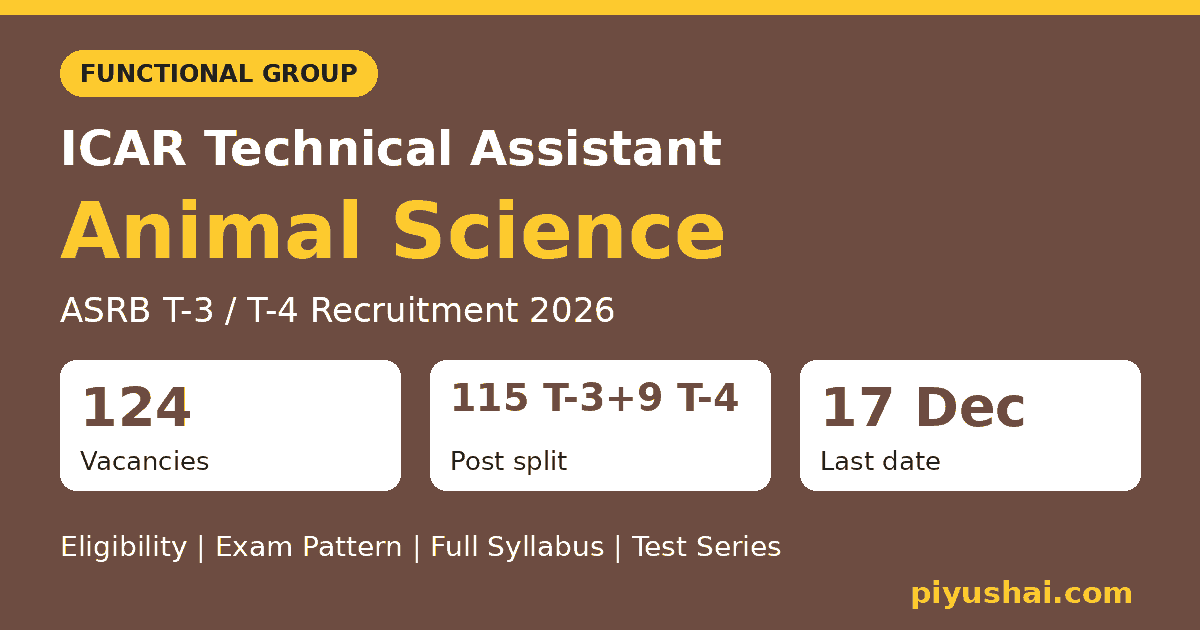
The Animal Science functional group offers 124 posts for veterinary graduates: 115 Technical Assistant (T-3) posts in ICAR institutes and 9 Senior Technical Assistant (T-4) posts in KVKs. Only B.V.Sc. & A.H. holders are eligible.
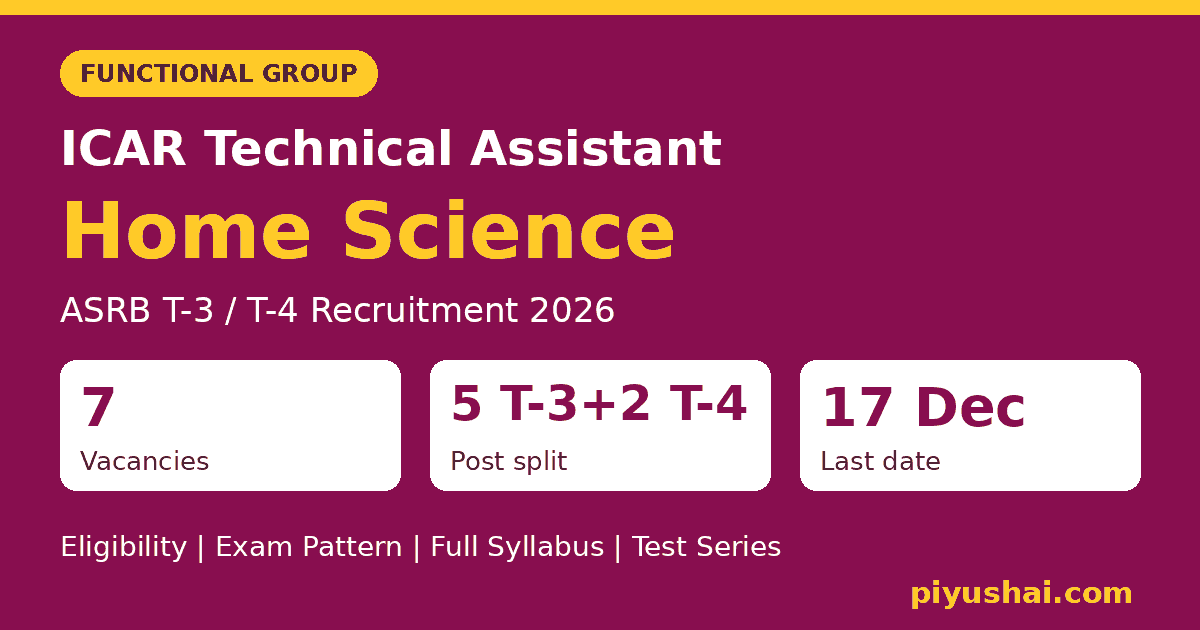
The Home Science / Community Science functional group is the smallest in ASRB T-3/T-4 2026 with just 7 posts (5 T-3 + 2 T-4). Home Science graduates are also eligible for the Agriculture group (772 posts), so compare both before applying.
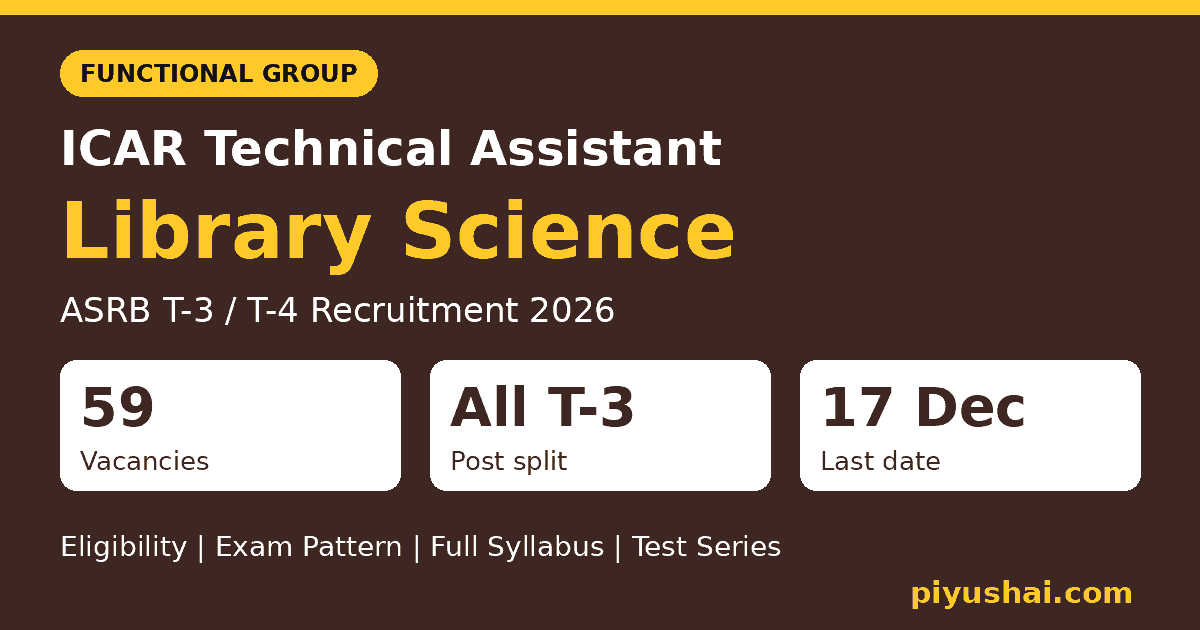
ICAR has 59 Technical Assistant (T-3) Library / Information Science / Documentation Staff posts in its institutes, one of the largest central government library recruitments of the year. A bachelor's degree in Library Science (B.Lib.I.Sc.) is the qualification, and there is no interview.
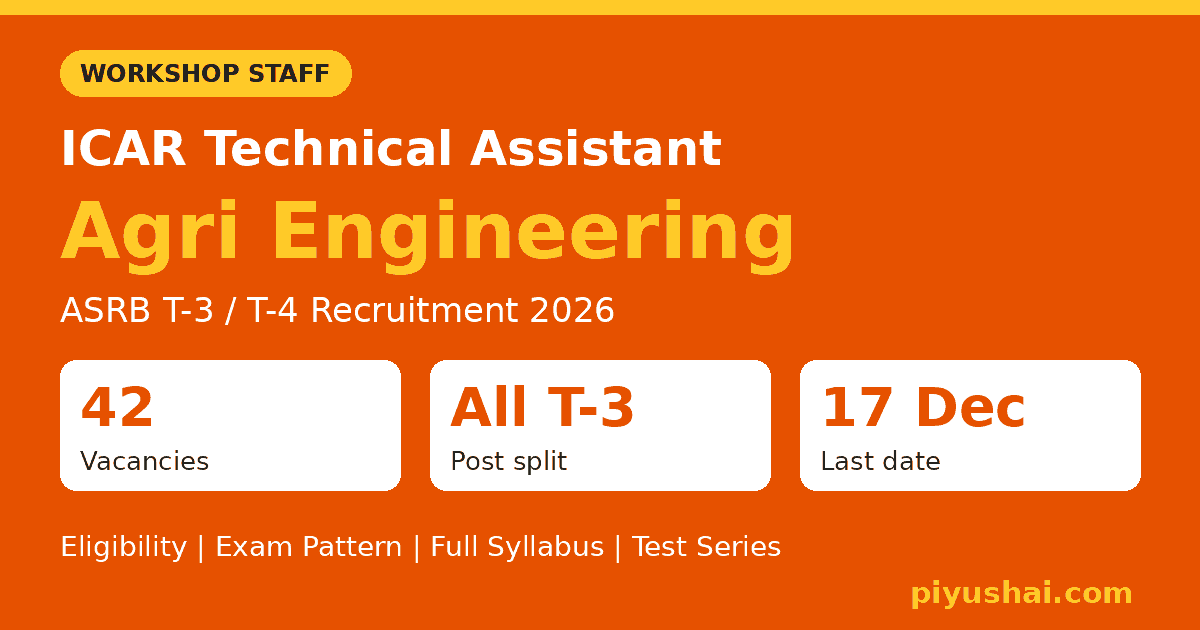
There are 42 Technical Assistant (T-3) Workshop Staff (Agricultural Engineering) posts in ICAR institutes. Mechanical Engineering, Textile Technology and Fibre Processing Engineering degree or diploma holders can also apply, alongside Agricultural Engineering graduates.

Learn Daily, Wherever You Are
Free lectures, exam updates, PYQ discussions, and job alerts — delivered through our YouTube channel and Telegram communities.

[…] ICAR Technical Assistant Fisheries 2026 (97 posts) […]
[…] Field Farm Technician & Laboratory Technician (Fisheries Science) […]
[…] ICAR Technical Assistant Fisheries 2026 (97 posts) […]
[…] ICAR Technical Assistant Fisheries 2026 (97 posts) […]