
ICAR Technical Assistant Civil Engineering 2026 notification is out. The Agricultural Scientists Recruitment Board (ASRB) has released the Centralized Combined Examination 2026 notification (11 November 2026) for 1393 posts of Technical Assistant (T-3) in ICAR institutes and Senior Technical Assistant (T-4) in Krishi Vigyan Kendras. This page is the complete guide for the Workshop Staff (Civil Engineering) functional group: vacancies, eligibility, exam pattern and the full Mains syllabus exactly as notified by ICAR.
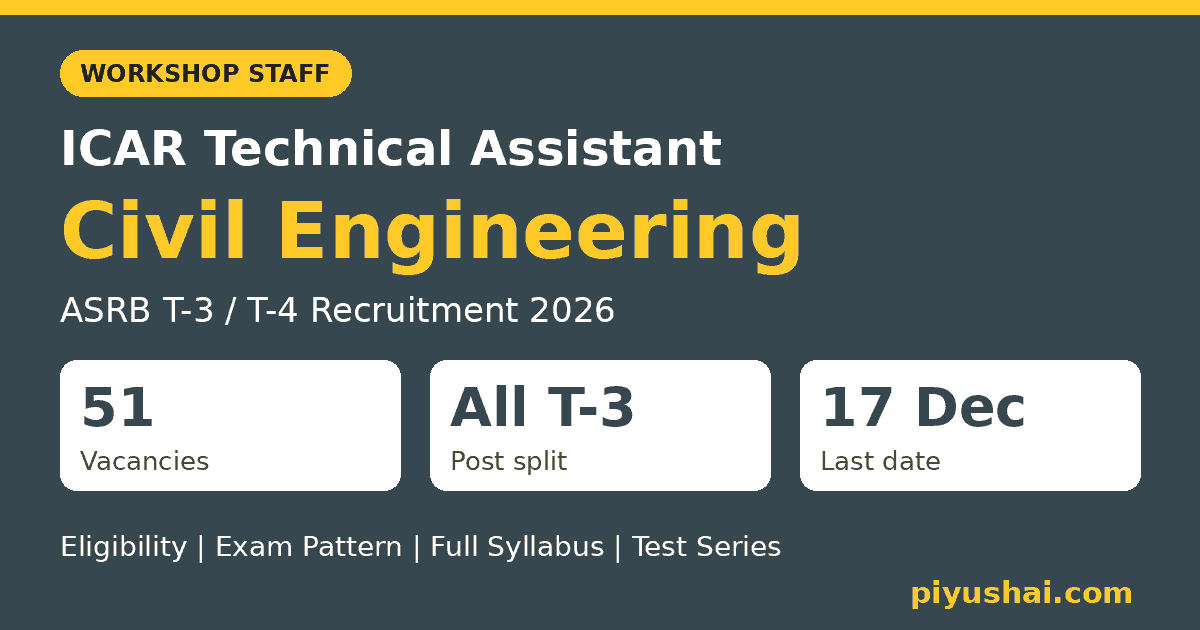
ICAR has 51 Technical Assistant (T-3) Workshop Staff (Civil Engineering) posts in this recruitment, all in ICAR institutes (no T-4 KVK posts for Civil). The big draw: a three-year Diploma in Civil Engineering is enough, and you get a Level-5 central government job with no interview.
Quick answer: ICAR Technical Assistant Civil Engineering 2026
- Total posts: 51 (51 T-3)
- Qualification: B.Tech / B.E. / Three-year Diploma in Civil Engineering from a recognised University/Institute.
- Age: 21 to 30 years as on 17.12.2026 (relaxation for SC/ST/OBC/PwBD/ESM)
- Apply: 18.11.2026 to 17.12.2026 at asrb.gov.in
- Selection: Prelims (qualifying) + Mains (300 marks); no interview
- Pay: T-3 Level 5 (₹29,200 to ₹92,300); T-4 Level 6 (₹35,400 to ₹1,12,400)
Overview
| Recruiting Body | Agricultural Scientists Recruitment Board (ASRB), DARE, New Delhi |
| Employer | Indian Council of Agricultural Research (ICAR): institutes (T-3) and KVKs (T-4) |
| Exam Name | Centralized Combined Examination 2026 for TA (T-3) and STA (T-4) |
| Functional Group | Workshop Staff (Civil Engineering) |
| Vacancies in this group | 51 (51 T-3) |
| Total vacancies (all groups) | 1393 (1254 T-3 + 139 T-4) |
| Notification No. | F. No. 2(2)/2025-Exam, dated 11.11.2026 |
| Exam Mode | Computer Based Test (Prelims and Mains) |
| Official Website | asrb.gov.in |
Important Dates
| Event | Date |
|---|---|
| Notification date | 11 November 2026 |
| Online application starts | 18 November 2026 |
| Last date to apply online | 17 December 2026 (11:59 PM) |
| Last date for fee payment (Bharatkosh) | 17 December 2026 (11:59 PM) |
| Application correction window | 18 to 20 December 2026 |
| Preliminary Exam (CBT) | February 2027 (exact date to be announced) |
| Mains Exam (CBT) | To be announced |
All dates are as per the ASRB notification and are subject to change. Admission certificates are released about one week before the exam on asrb.gov.in only.
ICAR Technical Assistant Civil Engineering 2026 Vacancies
Technical Assistant (T-3), ICAR Institutes
| Post | UR | OBC | SC | ST | EWS | Total | PwBD | ESM |
|---|---|---|---|---|---|---|---|---|
| Workshop Staff (Civil Engineering) | 33 | 11 | 1 | 0 | 6 | 51 | 1 | 4 |
There are no T-4 (KVK) posts for this functional group in 2026; all posts are T-3 in ICAR institutes.
PwBD and Ex-Servicemen (ESM) vacancies are horizontal and included within the category totals. Vacancies are tentative.
ICAR Technical Assistant Civil Engineering 2026 Eligibility
Educational Qualification
B.Tech / B.E. / Three-year Diploma in Civil Engineering from a recognised University/Institute.
The degree/diploma must be completed on or before 17.12.2026 from a recognised Indian university/institution (or an equivalent foreign qualification recognised by the Government of India). Candidates must be citizens of India (or Nepal/Bhutan/eligible categories with a certificate of eligibility).
Age Limit and Relaxation
Minimum 21 years and maximum 30 years as on the closing date, 17.12.2026 (indicatively, date of birth between 18.12.1995 and 17.12.2005).
| Category | Upper Age Relaxation |
|---|---|
| SC / ST | 5 years |
| OBC (Non-Creamy Layer) | 3 years |
| PwBD | 10 years (cumulative with SC/ST/OBC relaxation) |
| Ex-Servicemen | 3 years after deducting military service from actual age |
| ICAR in-service technical employees (UR) | Upper limit 40 years, plus category relaxation |
| RAs / SRFs in ICAR projects | Period actually engaged, up to 16 years 3 months |
| Disabled Defence Services Personnel | As per Government of India instructions |
Application Fee
| Category | T-3 only | T-4 only | T-3 + T-4 |
|---|---|---|---|
| Unreserved (UR) | ₹300 | ₹300 | ₹600 |
| EWS / OBC | ₹150 | ₹150 | ₹300 |
| SC / ST / PwBD / Women / Transgender / Ex-Servicemen | Nil | Nil | Nil |
The fee is paid only through Bharatkosh (bharatkosh.gov.in): Quick Payment, Ministry: Agriculture, Purpose: Examination/Certificate fee for ARS/NET/SMS/STO/FAO/AO, PAO 000001, DDO 216968 (Add. ASRB, Chayan Bhavan). Upload the payment receipt in the application form. Paying on Bharatkosh without submitting the form does not count, and the fee is non-refundable.
Exam Pattern
Selection is through two Computer Based Tests. There is no interview: final merit is based on Mains marks only.
Stage 1: Preliminary Exam (Qualifying)
| Section | Subject | Questions | Marks |
|---|---|---|---|
| 1 | General Knowledge | 25 | 25 |
| 2 | General English | 25 | 25 |
| 3 | Quantitative Aptitude | 25 | 25 |
| 4 | General Agriculture | 25 | 25 |
| Total (1 hour) | 100 | 100 |
- Negative marking: 0.25 mark per wrong answer.
- Minimum qualifying marks: UR 30%, EWS/OBC 25%, SC/ST/PwBD 20%.
- Candidates are shortlisted for Mains in the ratio 1:15 of the vacancies, functional group-wise (category-wise).
- Questions are bilingual (Hindi and English), except the General English section.
Stage 2: Mains Exam (Merit)
| Questions | 100 objective MCQs on the functional group’s domain subjects |
| Marks | 300 (3 marks per question) |
| Duration | 2 hours |
| Negative marking | 1 mark per wrong answer (one-third) |
| Minimum qualifying marks | UR 30%, EWS/OBC 25%, SC/ST/PwBD 20% |
| Normalisation | Applied wherever the CBT runs in multiple sessions |
Tie-breaking order: (a) higher Prelims marks, then (b) higher marks in Section 3, Quantitative Aptitude of Prelims, then (c) older candidate ranked higher.
Preparing for ICAR Civil Engineering? Practise with Piyush Wairale’s Test Series
The ICAR Civil Mains paper shares most of its core with SSC JE Civil: Building Materials, SOM, Structural Analysis, RCC and Steel, Geotech, Fluid Mechanics, Hydrology, Environmental, Surveying and Transportation. Our SSC JE Civil Test Series & Notes is the closest ready-made practice for this paper.
SSC JE 2026 Test Series & Notes: Civil Branch →Best GATE Aptitude Test Series (Quantitative Aptitude practice) →
Curated by Piyush Wairale (M.Tech, IIT Madras), former instructor in the IIT Madras BS programme, who has taught 20,000+ students. Browse all test series on piyushwairale.com.
Preliminary Exam Syllabus (Common for All Groups)
1. General Knowledge (25 marks)
General awareness of the environment and its application to society, current events, everyday science, and questions on India and its neighbouring countries, especially History, Culture, Geography, Economic Science, General Policy and Scientific Research.
2. General English (25 marks)
Ability to understand correct English, basic comprehension and writing ability (grammar, vocabulary, error spotting, sentence improvement, reading comprehension).
3. Quantitative Aptitude (25 marks)
Computation of whole numbers, decimals, fractions and relationships between numbers; Percentage; Ratio and Proportion; Square roots; Averages; Interest; Profit and Loss; Discount; Partnership Business; Mixture and Alligation; Time and Distance; Time and Work; basic algebraic identities of school algebra and elementary surds; graphs of linear equations; triangle and its centres; congruence and similarity of triangles; circle, chords, tangents, angles subtended by chords, common tangents; quadrilaterals, regular polygons; right prism, right circular cone and cylinder, sphere, hemisphere, rectangular parallelepiped, regular right pyramid; trigonometric ratios, degree and radian measure, standard identities, complementary angles, heights and distances; histogram, frequency polygon, bar diagram and pie chart.
4. General Agriculture (25 marks)
Agro-ecosystems and crops; Animal and fisheries basics; Farm machinery, post-harvest and agri-economics; Institutions and extension; Regulations in agriculture; International organisations. The topic-wise General Agriculture list is in our master guide.
ICAR Technical Assistant Civil Engineering 2026 Mains Syllabus (Paper-II)
The Mains paper (300 marks) tests domain knowledge of the Workshop Staff (Civil Engineering) group. ICAR has not notified unit-wise weightage, so cover every unit below.
1. Engineering Mathematics
Matrix theory, eigenvalues and eigenvectors, systems of linear equations; numerical methods for non-linear algebraic and differential equations; integral calculus, partial derivatives, maxima and minima; line, surface and volume integrals; Fourier series; linear, non-linear and partial differential equations, initial and boundary value problems; complex variables, Taylor and Laurent series, residue theorem; probability and statistics, sampling theorem, random variables, normal and Poisson distributions, correlation and regression.
2. Building Materials
Stone, lime, glass, plastics, steel, FRP, ceramics, aluminium, fly ash, admixtures, timber, bricks and aggregates: classification, properties and selection. Cement: types, composition, properties, uses, specifications and tests. Lime and cement mortars and concrete: properties and tests. Concrete mix design: proportioning of aggregates and methods of mix design.
3. Solid Mechanics
Elastic constants, stress, plane stress, strain, plane strain, Mohr’s circle of stress and strain, theories of failure, principal stresses, bending, shear and torsion.
4. Structural Analysis
Strength of materials basics, types of stresses and strains, bending moment and shear force, bending and shear stresses; analysis of determinate and indeterminate structures; trusses, beams, plane frames; rolling loads, influence lines, unit load method; free and forced vibrations of SDOF and MDOF systems; suspended cables; computer-aided design.
5. Design of Steel Structures
Working stress method, tension and compression members, beams and beam-column connections, built-up sections, girders, industrial roofs, principles of ultimate load design.
6. Design of Concrete and Masonry Structures
Limit state design for bending, shear, axial compression and combined forces; design of beams, slabs, lintels, foundations, retaining walls, tanks and staircases; prestressed concrete; earthquake-resistant design; masonry design.
7. Construction Practice, Planning and Management
Construction planning, equipment, site investigation and management; estimation with project management tools and network analysis; rate analysis; tendering and contract management; quality control, productivity, operation cost; land acquisition; labour safety and welfare.
8. Fluid Mechanics, Hydraulic Machines and Hydropower
Fluid properties, dimensional analysis and modelling, flow kinematics and measurement, flow nets, viscosity, boundary layer, drag and lift; open channel flow, flow controls, hydraulic jump, surges; pipe networks. Pumps, air vessels, hydraulic turbines (types and performance); power house classification and layout, storage, pondage.
9. Hydrology and Water Resources Engineering
Hydrological cycle, groundwater and well hydrology, stream gauging, river morphology, floods and droughts, reservoir capacity. Multipurpose uses of water, river basins, irrigation systems, water demand, storages and yields, waterlogging, canal and drainage design, gravity dams, falls, weirs, energy dissipators, barrages, cross-drainage works, headworks, canal construction and maintenance, river training, rainfall measurement.
10. Environmental Engineering
Water supply: sources, demand, quality standards, testing and treatment, rural, institutional and industrial supply, distribution networks. Wastewater: domestic sewage planning and design, collection and disposal, plumbing, sewerage layout, sludge management, reuse of treated effluent, industrial wastewater and ETPs. Solid waste management: sources, classification, planning, disposal and utilisation. Air and noise pollution and ecology.
11. Geotechnical and Foundation Engineering
Soil exploration, soil properties and classification, tests; permeability and seepage, compressibility, consolidation, shear strength, earth pressure theories, stress distribution; geosynthetics. Foundation types and selection, bearing capacity, settlement, shallow and deep foundation design and testing, slope stability, earthen embankments, dams, retaining structures, ground modification.
12. Surveying and Geology
Classification of surveys, instruments and measurement of distance, elevation and direction; field astronomy; GPS; map preparation; photogrammetry; remote sensing; survey layout for culverts, canals, bridges, roads, railways and buildings; setting out curves. Engineering geology and its applications.
13. Transportation Engineering
Highway planning, alignment and geometric design; traffic surveys and control; flexible and rigid pavement design. Tunnelling: alignment, construction methods, mucking, drainage, lighting, ventilation. Railways: planning, design, maintenance, track modernisation. Harbours: layout and planning. Airports: layout, planning and design.
14. Emerging Technologies and Digital Tools
BIM basics and applications; GIS for planning and monitoring agricultural infrastructure; drones and UAVs for surveying and construction monitoring; smart sensors and IoT for structural health monitoring; 3D printing in construction; AR/VR for training and safety; digital twins and automation in project management.
15. Sustainability and Green Infrastructure
Green building concepts and certifications (GRIHA, LEED); recycled and eco-friendly materials (fly ash bricks, GGBS); rainwater harvesting for campuses and farms; bioengineering for erosion control and slope stability; climate-resilient agricultural infrastructure; energy-efficient design and passive cooling.
16. Agricultural Structures and Rural Infrastructure (ICAR and KVK specific)
Design and layout of farm roads, godowns, rural housing and cattle sheds; grain storage structures (godowns, silos, CAP storage); farm ponds, check dams and recharge pits; polyhouse and greenhouse construction; site selection and development for KVKs and research stations; pre-fabricated structures for remote agri-infrastructure.
ICAR Technical Assistant Civil Engineering 2026 Preparation Strategy
- The Mains syllabus is essentially the SSC JE / GATE Civil core plus three ICAR-specific units. Your existing JE preparation transfers almost entirely.
- Do not skip the Agricultural Structures and Rural Infrastructure unit: farm ponds, check dams, silos, CAP storage and polyhouses are unique to this exam and easy to score.
- The new units on BIM, drones, IoT, GRIHA/LEED and digital twins are definition-level. One focused revision session can secure these marks.
- Engineering Mathematics is listed in full (complex variables, residue theorem). Diploma holders should not ignore it, but prioritise core civil subjects first.
- Only 51 seats with 33 UR: plan for a high Mains score, since about 765 candidates (1:15 ratio) will be shortlisted from Prelims.
Posts Suitable for PwBD
Suitable categories of benchmark disability for this group: a) D, HH; b) OA, OL, LC, Dw, AAV; c) SLD, MI; d) MD involving (a) to (c). Functional requirements: Sitting, Standing, Bending, Kneeling & Crouching, Manipulation with Fingers, Reading & Writing, Seeing, Communication.
How to Apply
- Visit asrb.gov.in between 18.11.2026 and 17.12.2026 and complete the One Time Registration (OTR).
- Choose your single functional group and opt for T-3, T-4 or both, with a preference order (final, cannot be changed).
- Select Prelims and Mains exam centres carefully; centre changes are not allowed.
- Upload photo (white background, .jpg, max 200 KB, without spectacles), signature (.jpg, max 100 KB), photo ID and certificates (.jpg, max 100 KB each).
- Pay the fee on Bharatkosh, upload the receipt and submit. Keep a copy of the completed form.
- Use the correction window (18 to 20 December 2026) if needed.
Start Your Test Series Today
Mains decides your rank and every wrong answer costs one-third of a question. Timed, exam-level mock tests are the fastest way to build accuracy before the CBT.
SSC JE 2026 Test Series & Notes: Civil Branch →Best GATE Aptitude Test Series (Quantitative Aptitude practice) →
Curated by Piyush Wairale (M.Tech, IIT Madras), former instructor in the IIT Madras BS programme, who has taught 20,000+ students. Browse all test series on piyushwairale.com.
Frequently Asked Questions
Can a Diploma holder apply for ICAR Technical Assistant Civil Engineering 2026?
Yes. A three-year Diploma in Civil Engineering from a recognised University/Institute is sufficient, as is a B.Tech/B.E. in Civil Engineering.
Are there any T-4 (KVK) posts for Civil Engineering?
No. All 51 Civil Engineering posts are Technical Assistant (T-3) posts in ICAR institutes at Pay Level 5.
What is the exam pattern for ICAR Technical Assistant Civil Engineering 2026?
A 1-hour qualifying Prelims of 100 marks (GK, English, Quantitative Aptitude and General Agriculture, 25 each, minus 0.25 per wrong answer), followed by a 2-hour Mains of 100 questions for 300 marks on the functional group syllabus, with 1 mark deducted per wrong answer. There is no interview.
What is the last date to apply for ASRB T-3/T-4 2026?
17 December 2026 (11:59 PM) for both the online application and fee payment. Applications open on 18 November 2026 at asrb.gov.in.
Can I apply for more than one functional group?
No. A candidate may apply for only one functional group/subgroup, even if eligible for more. Within it you can opt for T-3 only, T-4 only, or both, with a preference order that cannot be changed later.
What is the salary of ICAR Technical Assistant T-3 and Senior Technical Assistant T-4?
T-3 is at Pay Level 5 (₹29,200 to ₹92,300) of the 7th CPC Pay Matrix and T-4 is at Pay Level 6 (₹35,400 to ₹1,12,400), plus applicable allowances.
Other ICAR T-3 / T-4 2026 Functional Group Guides
- ASRB ICAR T-3/T-4 2026 Notification: Master Guide (all 10 groups)
- ICAR Technical Assistant Agriculture 2026 (772 posts)
- ICAR Technical Assistant Animal Science 2026 (124 posts)
- ICAR Technical Assistant Fisheries 2026 (97 posts)
- ICAR Technical Assistant Home Science 2026 (7 posts)
- ICAR Technical Assistant Agricultural Engineering 2026 (42 posts)
- ICAR Technical Assistant Electrical Engineering 2026 (35 posts)
- ICAR Technical Assistant Electronics and Instrumentation 2026 (25 posts)
- ICAR Technical Assistant Library Science 2026 (59 posts)
- ICAR Technical Assistant IT 2026 (181 posts)
Source: ASRB Notification F. No. 2(2)/2025-Exam dated 11.11.2026 and ICAR OM No. TS-19(6)/2024-Estt.IV (E-332924) dated 28.09.2026 (Scheme and Syllabus). Vacancies are tentative. Always read the official notification on asrb.gov.in before applying; in case of any discrepancy the English version on the ASRB website prevails.

Recent Post

ASRB ICAR Technical Assistant (T-3) and Senior Technical Assistant (T-4) 2026: 1393 vacancies across 10 functional groups, dates, eligibility, age limit, fee, Prelims and Mains pattern, syllabus and links to detailed group-wise guides.
With 772 posts (699 Technical Assistant T-3 in ICAR institutes and 73 Senior Technical Assistant T-4 in KVKs), the Agriculture functional group is the biggest slice of the ASRB Centralized Combined Examination 2026, accounting for more than half of all 1393 vacancies.
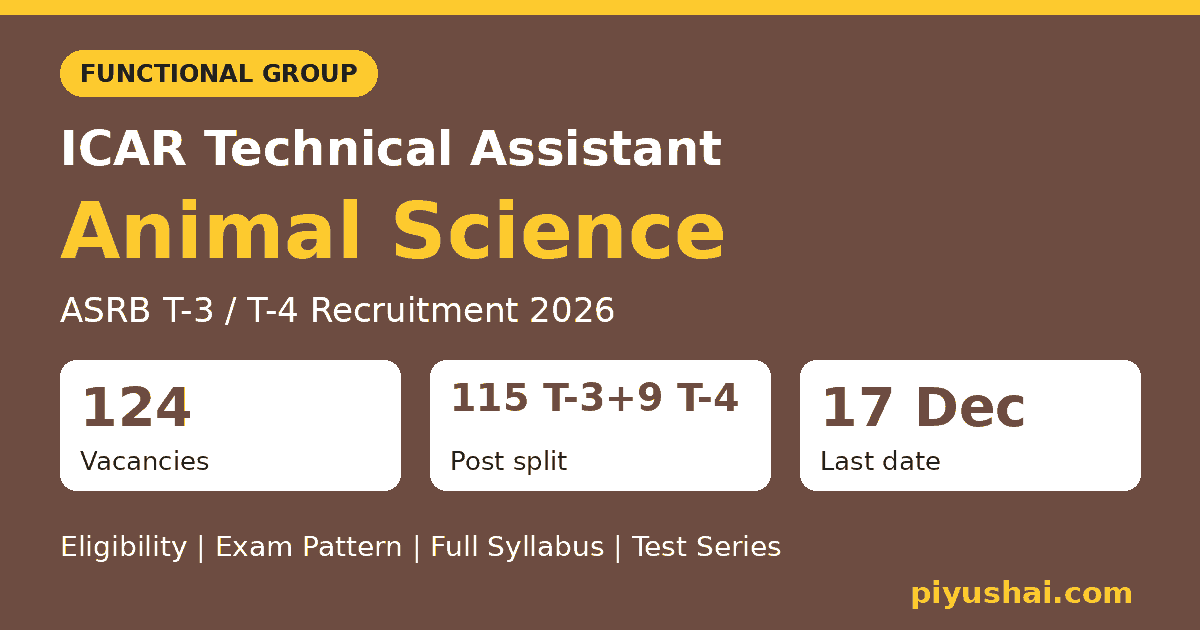
The Animal Science functional group offers 124 posts for veterinary graduates: 115 Technical Assistant (T-3) posts in ICAR institutes and 9 Senior Technical Assistant (T-4) posts in KVKs. Only B.V.Sc. & A.H. holders are eligible.
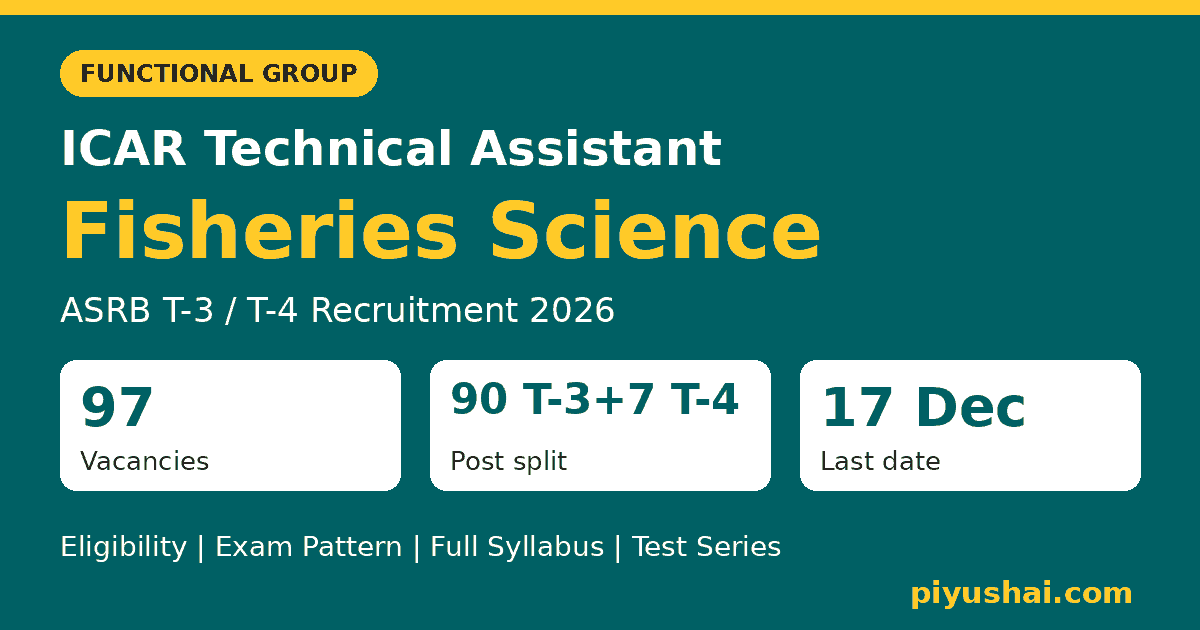
The Fisheries Science functional group has 97 posts: 90 Technical Assistant (T-3) posts in ICAR fisheries institutes and 7 Senior Technical Assistant (T-4) Laboratory Technician posts in KVKs. Only B.F.Sc. graduates are eligible.
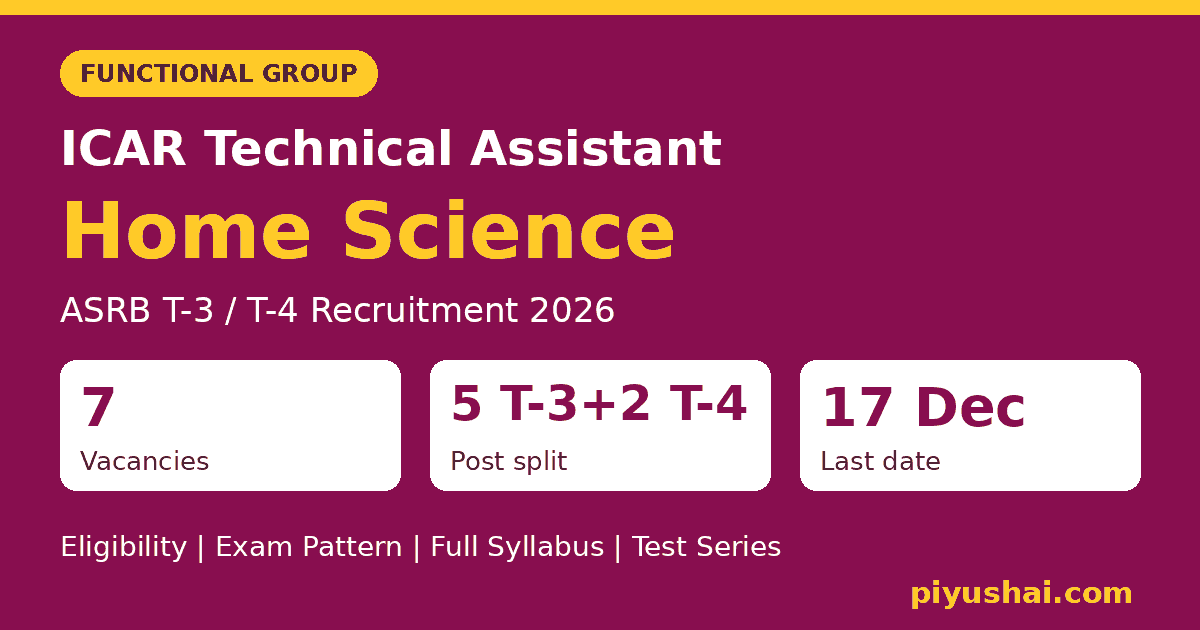
The Home Science / Community Science functional group is the smallest in ASRB T-3/T-4 2026 with just 7 posts (5 T-3 + 2 T-4). Home Science graduates are also eligible for the Agriculture group (772 posts), so compare both before applying.
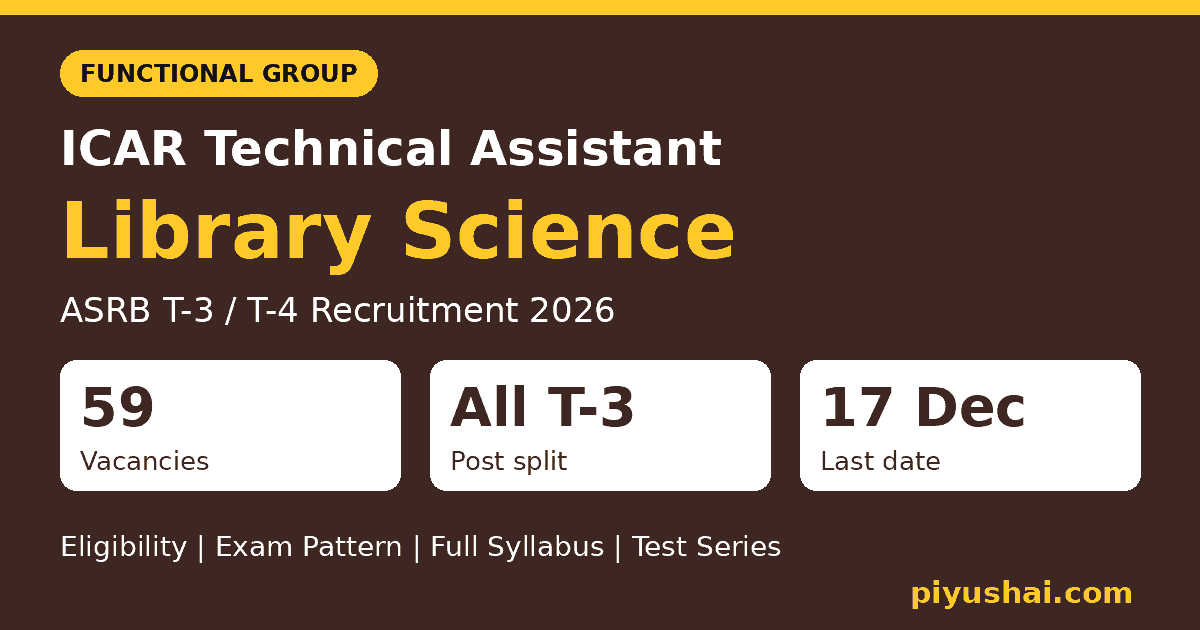
ICAR has 59 Technical Assistant (T-3) Library / Information Science / Documentation Staff posts in its institutes, one of the largest central government library recruitments of the year. A bachelor's degree in Library Science (B.Lib.I.Sc.) is the qualification, and there is no interview.
Learn Daily, Wherever You Are
Free lectures, exam updates, PYQ discussions, and job alerts — delivered through our YouTube channel and Telegram communities.

[…] ICAR Technical Assistant Civil Engineering 2026 (51 posts) […]
[…] ICAR Technical Assistant Civil Engineering 2026 (51 posts) […]
[…] ICAR Technical Assistant Civil Engineering 2026 (51 posts) […]
[…] ICAR Technical Assistant Civil Engineering 2026 (51 posts) […]
[…] ICAR Technical Assistant Civil Engineering 2026 (51 posts) […]