
ICAR Technical Assistant Animal Science 2026 notification is out. The Agricultural Scientists Recruitment Board (ASRB) has released the Centralized Combined Examination 2026 notification (11 November 2026) for 1393 posts of Technical Assistant (T-3) in ICAR institutes and Senior Technical Assistant (T-4) in Krishi Vigyan Kendras. This page is the complete guide for the Field Farm Technician & Laboratory Technician (Animal Science) functional group: vacancies, eligibility, exam pattern and the full Mains syllabus exactly as notified by ICAR.
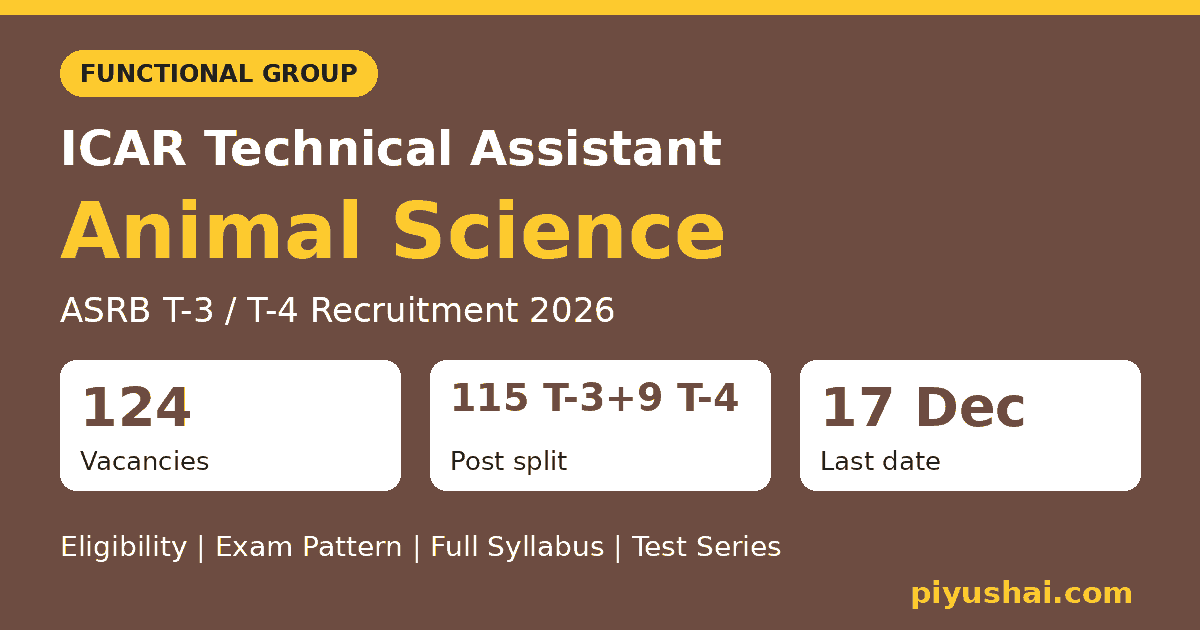
The Animal Science functional group offers 124 posts for veterinary graduates: 115 Technical Assistant (T-3) posts in ICAR institutes and 9 Senior Technical Assistant (T-4) posts in KVKs. Only B.V.Sc. & A.H. holders are eligible, so competition is limited to a focused pool of candidates.
Quick answer: ICAR Technical Assistant Animal Science 2026
- Total posts: 124 (115 T-3 + 9 T-4)
- Qualification: B.V.Sc. & A.H. (Bachelor of Veterinary Science & Animal Husbandry).
- Age: 21 to 30 years as on 17.12.2026 (relaxation for SC/ST/OBC/PwBD/ESM)
- Apply: 18.11.2026 to 17.12.2026 at asrb.gov.in
- Selection: Prelims (qualifying) + Mains (300 marks); no interview
- Pay: T-3 Level 5 (₹29,200 to ₹92,300); T-4 Level 6 (₹35,400 to ₹1,12,400)
Overview
| Recruiting Body | Agricultural Scientists Recruitment Board (ASRB), DARE, New Delhi |
| Employer | Indian Council of Agricultural Research (ICAR): institutes (T-3) and KVKs (T-4) |
| Exam Name | Centralized Combined Examination 2026 for TA (T-3) and STA (T-4) |
| Functional Group | Field Farm Technician & Laboratory Technician (Animal Science) |
| Vacancies in this group | 124 (115 T-3 + 9 T-4) |
| Total vacancies (all groups) | 1393 (1254 T-3 + 139 T-4) |
| Notification No. | F. No. 2(2)/2025-Exam, dated 11.11.2026 |
| Exam Mode | Computer Based Test (Prelims and Mains) |
| Official Website | asrb.gov.in |
Important Dates
| Event | Date |
|---|---|
| Notification date | 11 November 2026 |
| Online application starts | 18 November 2026 |
| Last date to apply online | 17 December 2026 (11:59 PM) |
| Last date for fee payment (Bharatkosh) | 17 December 2026 (11:59 PM) |
| Application correction window | 18 to 20 December 2026 |
| Preliminary Exam (CBT) | February 2027 (exact date to be announced) |
| Mains Exam (CBT) | To be announced |
All dates are as per the ASRB notification and are subject to change. Admission certificates are released about one week before the exam on asrb.gov.in only.
ICAR Technical Assistant Animal Science 2026 Vacancies
Technical Assistant (T-3), ICAR Institutes
| Post | UR | OBC | SC | ST | EWS | Total | PwBD | ESM |
|---|---|---|---|---|---|---|---|---|
| Field Farm Technician (Animal Science) | 23 | 11 | 9 | 3 | 4 | 50 | 1 | 3 |
| Laboratory Technician (Animal Science) | 27 | 20 | 7 | 3 | 8 | 65 | 2 | 5 |
| Total T-3 Animal Science | 50 | 31 | 16 | 6 | 12 | 115 | 3 | 8 |
Senior Technical Assistant (T-4), KVKs
| Post | UR | OBC | SC | ST | EWS | Total | PwBD | ESM |
|---|---|---|---|---|---|---|---|---|
| Field Farm Technician (Animal Science) | 1 | 0 | 0 | 0 | 0 | 1 | 0 | 0 |
| Laboratory Technician (Animal Science) | 2 | 3 | 2 | 0 | 1 | 8 | 0 | 0 |
| Total T-4 Animal Science | 3 | 3 | 2 | 0 | 1 | 9 | 0 | 0 |
PwBD and Ex-Servicemen (ESM) vacancies are horizontal and included within the category totals. Vacancies are tentative.
ICAR Technical Assistant Animal Science 2026 Eligibility
Educational Qualification
B.V.Sc. & A.H. (Bachelor of Veterinary Science & Animal Husbandry).
The degree must be completed on or before 17.12.2026 from a recognised Indian university/institution (or an equivalent foreign qualification recognised by the Government of India). Candidates must be citizens of India (or Nepal/Bhutan/eligible categories with a certificate of eligibility).
Age Limit and Relaxation
Minimum 21 years and maximum 30 years as on the closing date, 17.12.2026 (indicatively, date of birth between 18.12.1995 and 17.12.2005).
| Category | Upper Age Relaxation |
|---|---|
| SC / ST | 5 years |
| OBC (Non-Creamy Layer) | 3 years |
| PwBD | 10 years (cumulative with SC/ST/OBC relaxation) |
| Ex-Servicemen | 3 years after deducting military service from actual age |
| ICAR in-service technical employees (UR) | Upper limit 40 years, plus category relaxation |
| RAs / SRFs in ICAR projects | Period actually engaged, up to 16 years 3 months |
| Disabled Defence Services Personnel | As per Government of India instructions |
Application Fee
| Category | T-3 only | T-4 only | T-3 + T-4 |
|---|---|---|---|
| Unreserved (UR) | ₹300 | ₹300 | ₹600 |
| EWS / OBC | ₹150 | ₹150 | ₹300 |
| SC / ST / PwBD / Women / Transgender / Ex-Servicemen | Nil | Nil | Nil |
The fee is paid only through Bharatkosh (bharatkosh.gov.in): Quick Payment, Ministry: Agriculture, Purpose: Examination/Certificate fee for ARS/NET/SMS/STO/FAO/AO, PAO 000001, DDO 216968 (Add. ASRB, Chayan Bhavan). Upload the payment receipt in the application form. Paying on Bharatkosh without submitting the form does not count, and the fee is non-refundable.
Exam Pattern
Selection is through two Computer Based Tests. There is no interview: final merit is based on Mains marks only.
Stage 1: Preliminary Exam (Qualifying)
| Section | Subject | Questions | Marks |
|---|---|---|---|
| 1 | General Knowledge | 25 | 25 |
| 2 | General English | 25 | 25 |
| 3 | Quantitative Aptitude | 25 | 25 |
| 4 | General Agriculture | 25 | 25 |
| Total (1 hour) | 100 | 100 |
- Negative marking: 0.25 mark per wrong answer.
- Minimum qualifying marks: UR 30%, EWS/OBC 25%, SC/ST/PwBD 20%.
- Candidates are shortlisted for Mains in the ratio 1:15 of the vacancies, functional group-wise (category-wise).
- Questions are bilingual (Hindi and English), except the General English section.
Stage 2: Mains Exam (Merit)
| Questions | 100 objective MCQs on the functional group’s domain subjects |
| Marks | 300 (3 marks per question) |
| Duration | 2 hours |
| Negative marking | 1 mark per wrong answer (one-third) |
| Minimum qualifying marks | UR 30%, EWS/OBC 25%, SC/ST/PwBD 20% |
| Normalisation | Applied wherever the CBT runs in multiple sessions |
Tie-breaking order: (a) higher Prelims marks, then (b) higher marks in Section 3, Quantitative Aptitude of Prelims, then (c) older candidate ranked higher.
Preparing for ICAR Animal Science? Practise with Piyush Wairale’s Test Series
There is no domain-specific veterinary test series on our store yet, so build your Prelims edge with our Quantitative Aptitude practice. ASRB breaks Mains ties first on Prelims marks and then on Section 3 (Quantitative Aptitude) marks.
Special offer: use coupon code ASRB50 to get 50% OFF on the ICAR ASRB Technical Assistant Test Series & Notes.
ICAR ASRB Technical Assistant Test Series & Notes (50% OFF) →Best GATE Aptitude Test Series (Quantitative Aptitude practice) →All Test Series on piyushwairale.com →
Curated by Piyush Wairale (M.Tech, IIT Madras), former instructor in the IIT Madras BS programme, who has taught 20,000+ students. Browse all test series on piyushwairale.com.
Preliminary Exam Syllabus (Common for All Groups)
1. General Knowledge (25 marks)
General awareness of the environment and its application to society, current events, everyday science, and questions on India and its neighbouring countries, especially History, Culture, Geography, Economic Science, General Policy and Scientific Research.
2. General English (25 marks)
Ability to understand correct English, basic comprehension and writing ability (grammar, vocabulary, error spotting, sentence improvement, reading comprehension).
3. Quantitative Aptitude (25 marks)
Computation of whole numbers, decimals, fractions and relationships between numbers; Percentage; Ratio and Proportion; Square roots; Averages; Interest; Profit and Loss; Discount; Partnership Business; Mixture and Alligation; Time and Distance; Time and Work; basic algebraic identities of school algebra and elementary surds; graphs of linear equations; triangle and its centres; congruence and similarity of triangles; circle, chords, tangents, angles subtended by chords, common tangents; quadrilaterals, regular polygons; right prism, right circular cone and cylinder, sphere, hemisphere, rectangular parallelepiped, regular right pyramid; trigonometric ratios, degree and radian measure, standard identities, complementary angles, heights and distances; histogram, frequency polygon, bar diagram and pie chart.
4. General Agriculture (25 marks)
Agro-ecosystems and crops; Animal and fisheries basics; Farm machinery, post-harvest and agri-economics; Institutions and extension; Regulations in agriculture; International organisations. The topic-wise General Agriculture list is in our master guide.
ICAR Technical Assistant Animal Science 2026 Mains Syllabus (Paper-II)
The Mains paper (300 marks) tests domain knowledge of the Animal Science group. ICAR has not notified unit-wise weightage, so cover every unit below.
1. Animal Nutrition
Partitioning of food energy within the animal; direct and indirect calorimetry; carbon-nitrogen balance and comparative slaughter methods; systems for expressing energy value of foods in ruminants, pigs and poultry; energy requirements for maintenance, growth, pregnancy, lactation, egg, wool and meat production. Advances in protein nutrition, energy-protein inter-relationships, evaluation of protein quality, NPN compounds in ruminant diets, protein requirements. Major and trace minerals, toxic minerals, mineral interactions; fat- and water-soluble vitamins. Feed additives: methane inhibitors, probiotics, enzymes, antibiotics, hormones, oligosaccharides, antioxidants, emulsifiers, mould inhibitors, buffers; use and abuse of growth promoters. Conservation of fodders, storage of feeds, feed technology and processing, anti-nutritional and toxic factors, feed analysis and quality control, digestibility trials, predicting intake in grazing animals. Ruminant nutrition and balanced rations (calves, pregnant and work animals, breeding bulls, milch animals across the lactation cycle, goats, sheep). Swine nutrition (creep, starter, grower, finisher rations). Poultry nutrition and ration formulation for layers and broilers.
2. Animal Physiology
Physiology of blood and circulation, respiration, excretion; endocrine glands in health and disease. Blood constituents, haemoglobin synthesis, plasma proteins, coagulation, haemorrhagic disorders, anticoagulants, blood groups, blood volume, plasma expanders, buffer systems, biochemical tests in diagnosis. Physiology of heart, cardiac cycle, heart sounds, ECG, regulation of heart, blood pressure, arterial pulse, vasomotor regulation, shock, coronary and pulmonary circulation, blood-brain barrier, CSF, circulation in birds. Mechanism of respiration, gas transport, neural control, chemoreceptors, hypoxia, respiration in birds. Kidney structure and function, urine formation, renal acid-base regulation, renal failure, urinary secretion in chicken, sweat glands. Endocrine disorders, hormone synthesis and receptors. Prenatal and postnatal growth, growth curves, body composition, meat quality. Hormonal control of mammary development, milk secretion and ejection; reproductive and digestive organs. Environmental physiology, adaptation, animal behaviour, climatology, stress and production, climate change effects, stress amelioration and biomarkers.
3. Animal Reproduction
Semen quality, preservation and artificial insemination; components of semen, composition of spermatozoa, properties of ejaculated semen, factors affecting semen in vivo and in vitro; diluents, sperm concentration, transport of diluted semen; deep freezing techniques in cows, sheep, goats, swine and poultry; detection of oestrus and time of insemination; anoestrus and repeat breeding.
4. Livestock Production and Management
Commercial dairy farming: India vs advanced countries, mixed vs specialised dairying, economic dairy farming, starting a dairy farm, capital and land, organisation, herd recording, cost of milk production, pricing policy, personnel management, practical rations, year-round green fodder supply, feeding regimes for young stock, bulls, heifers and breeding animals, feeding records. Commercial meat, egg and wool production: rations for sheep, goats, pigs, rabbits and poultry, fodder supply, feeding regimes, capital and land requirements. Feeding and management during drought, flood and other natural calamities.
5. Genetics and Animal Breeding
History of animal genetics; mitosis and meiosis; Mendelian inheritance and deviations; gene expression; linkage and crossing-over; sex determination, sex-influenced and sex-limited traits; blood groups and polymorphism; chromosome aberrations; cytoplasmic inheritance; DNA, genetic code and protein synthesis; recombinant DNA technology; mutations; transgenesis. Population genetics: quantitative vs qualitative traits, Hardy-Weinberg law, gene and genotypic frequency, forces changing gene frequency, random drift, path coefficient, inbreeding and its coefficient, effective population size, breeding value, dominance and epistatic deviation, partitioning of variation, G x E interaction, repeatability, resemblance between relatives. Breeding systems: breeds of livestock and poultry, heritability, repeatability, genetic and phenotypic correlations, aids to selection, individual/pedigree/family selection, selection indices, genetic gain, correlated response, inbreeding, outbreeding, upgrading, cross-breeding, synthesis of breeds, combining ability, threshold characters, sire index.
6. Extension
Philosophy, objectives, concept and principles of extension; methods of educating farmers in rural conditions; generation, transfer and feedback of technology; constraints in technology transfer; animal husbandry programmes for rural development.
7. Anatomy, Pharmacology and Hygiene
Histology and histological techniques (paraffin embedding, H&E staining, freezing microtomy, bright-field and electron microscopy), cytology, tissues, comparative histology of organ systems. Embryology of vertebrates with reference to aves and domestic mammals: gametogenesis, fertilisation, germ layers, foetal membranes, placentation, teratology, twinning, organogenesis. Bovine regional anatomy including nerve blocks, epidural anaesthesia structures, lymph nodes and surface anatomy of visceral organs. Anatomy of fowl. Pharmacodynamics and pharmacokinetics, drugs acting on fluid balance and ANS, anaesthesia, autacoids, antimicrobials and chemotherapy, hormones in therapeutics, antiparasitic and antineoplastic chemotherapy, drug residues in edible tissues, toxicology (insecticides, plants, metals, zootoxins, mycotoxins). Veterinary hygiene: water, air and habitation, pollution assessment, climate and animal health, housing requirements, stress and productivity.
8. Animal Diseases
Etiology, epidemiology, pathogenesis, symptoms, post-mortem lesions, diagnosis and control of infectious diseases of cattle, sheep, goat, horses, pigs and poultry. Production diseases. Deficiency diseases. Non-specific conditions: impaction, bloat, diarrhoea, indigestion, dehydration, stroke, poisoning. Neurological disorders. Immunisation, herd immunity, disease-free zones, zero-disease concept, chemoprophylaxis. Local, regional and general anaesthesia; surgical interference in fractures, dislocation, hernia, choking, abomasal displacement, caesarean operation, rumenotomy, castration. Disease investigation techniques and animal health centres.
9. Veterinary Public Health
Zoonoses: classification, role of animals and birds in transmission, occupational zoonoses. Epidemiology: principles, terms, application in disease control, air-, water- and food-borne infections; OIE regulations, WTO, sanitary and phytosanitary measures. Veterinary jurisprudence: rules for animal quality and disease prevention, SPCA, veterolegal cases, certificates, sample collection for veterolegal investigation.
10. Milk and Milk Products Technology
Market milk: quality, testing and grading of raw milk, processing, packaging, storage, distribution, defects; pasteurised, standardised, toned, double-toned, sterilised, homogenised, reconstituted, recombined and flavoured milks; cultured milks, yoghurt, dahi, lassi, shrikhand; legal standards; sanitation of milk plant. Milk products: cream, butter, ghee, khoa, chhana, cheese, condensed, evaporated and dried milk, baby food, ice cream, kulfi; by-products (whey, buttermilk, lactose, casein); testing, grading and judging; BIS and Agmark specifications; quality control; costing of dairy products.
11. Meat Hygiene and Technology
Ante-mortem care, stunning, slaughter and dressing; abattoir requirements and design; meat inspection and carcass judgement and grading; hygienic handling, spoilage and control, post-slaughter changes, quality improvement, adulteration detection, regulatory provisions. Physical and chemical characteristics of meat, meat emulsions, curing, canning, irradiation, packaging. Slaughterhouse by-products and their utilisation. Poultry products technology, eggs and their preservation and marketing, legal and BIS standards. Rabbit and fur animal farming, wool grading.
ICAR Technical Assistant Animal Science 2026 Preparation Strategy
- This syllabus is close to a full B.V.Sc. curriculum. Prioritise Animal Nutrition, Animal Diseases, Livestock Production Management and Genetics & Breeding; these four carry the most question potential.
- Make a single disease master-sheet: causative agent, species affected, key lesion, diagnostic test and vaccine schedule. Infectious and zoonotic diseases appear across three different units.
- Population genetics numericals (Hardy-Weinberg, inbreeding coefficient, heritability, selection response) are easy marks if practised; keep the formulas on one page.
- Dairy and meat technology questions are mostly standards and definitions (BIS/Agmark/FSSAI fat and SNF limits, product compositions). Memorise the numbers.
- Lab Technician posts (65 in T-3) outnumber Field posts (50); both are filled from the same Mains merit list, so preference order in your form matters.
Posts Suitable for PwBD
Suitable categories of benchmark disability for this group: a) D, HH; b) OA, BA, OL, OAL, Dw, AAV; c) ASD (M), SLD, MI; d) MD involving (a) to (c). Functional requirements: Sitting, Standing, Walking, Manipulation with Fingers, Reading & Writing, Seeing.
How to Apply
- Visit asrb.gov.in between 18.11.2026 and 17.12.2026 and complete the One Time Registration (OTR).
- Choose your single functional group and opt for T-3, T-4 or both, with a preference order (final, cannot be changed).
- Select Prelims and Mains exam centres carefully; centre changes are not allowed.
- Upload photo (white background, .jpg, max 200 KB, without spectacles), signature (.jpg, max 100 KB), photo ID and certificates (.jpg, max 100 KB each).
- Pay the fee on Bharatkosh, upload the receipt and submit. Keep a copy of the completed form.
- Use the correction window (18 to 20 December 2026) if needed.
Start Your Test Series Today
Mains decides your rank and every wrong answer costs one-third of a question. Timed, exam-level mock tests are the fastest way to build accuracy before the CBT.
Special offer: use coupon code ASRB50 to get 50% OFF on the ICAR ASRB Technical Assistant Test Series & Notes.
ICAR ASRB Technical Assistant Test Series & Notes (50% OFF) →Best GATE Aptitude Test Series (Quantitative Aptitude practice) →All Test Series on piyushwairale.com →
Curated by Piyush Wairale (M.Tech, IIT Madras), former instructor in the IIT Madras BS programme, who has taught 20,000+ students. Browse all test series on piyushwairale.com.
Frequently Asked Questions
Who is eligible for ICAR Technical Assistant Animal Science 2026?
Only candidates with a B.V.Sc. & A.H. (Bachelor of Veterinary Science and Animal Husbandry) degree, completed on or before 17.12.2026, aged 21 to 30 years (with category relaxations).
How many Animal Science posts are there in ASRB T-3/T-4 2026?
124 in total: 115 T-3 posts (50 Field Farm Technician + 65 Laboratory Technician) and 9 T-4 posts in KVKs (1 Field Farm + 8 Laboratory).
What is the exam pattern for ICAR Technical Assistant Animal Science 2026?
A 1-hour qualifying Prelims of 100 marks (GK, English, Quantitative Aptitude and General Agriculture, 25 each, minus 0.25 per wrong answer), followed by a 2-hour Mains of 100 questions for 300 marks on the functional group syllabus, with 1 mark deducted per wrong answer. There is no interview.
What is the last date to apply for ASRB T-3/T-4 2026?
17 December 2026 (11:59 PM) for both the online application and fee payment. Applications open on 18 November 2026 at asrb.gov.in.
Can I apply for more than one functional group?
No. A candidate may apply for only one functional group/subgroup, even if eligible for more. Within it you can opt for T-3 only, T-4 only, or both, with a preference order that cannot be changed later.
What is the salary of ICAR Technical Assistant T-3 and Senior Technical Assistant T-4?
T-3 is at Pay Level 5 (₹29,200 to ₹92,300) of the 7th CPC Pay Matrix and T-4 is at Pay Level 6 (₹35,400 to ₹1,12,400), plus applicable allowances.
Other ICAR T-3 / T-4 2026 Functional Group Guides
- ASRB ICAR T-3/T-4 2026 Notification: Master Guide (all 10 groups)
- ICAR Technical Assistant Agriculture 2026 (772 posts)
- ICAR Technical Assistant Fisheries 2026 (97 posts)
- ICAR Technical Assistant Home Science 2026 (7 posts)
- ICAR Technical Assistant Civil Engineering 2026 (51 posts)
- ICAR Technical Assistant Agricultural Engineering 2026 (42 posts)
- ICAR Technical Assistant Electrical Engineering 2026 (35 posts)
- ICAR Technical Assistant Electronics and Instrumentation 2026 (25 posts)
- ICAR Technical Assistant Library Science 2026 (59 posts)
- ICAR Technical Assistant IT 2026 (181 posts)
Source: ASRB Notification F. No. 2(2)/2025-Exam dated 11.11.2026 and ICAR OM No. TS-19(6)/2024-Estt.IV (E-332924) dated 28.09.2026 (Scheme and Syllabus). Vacancies are tentative. Always read the official notification on asrb.gov.in before applying; in case of any discrepancy the English version on the ASRB website prevails.

Recent Post

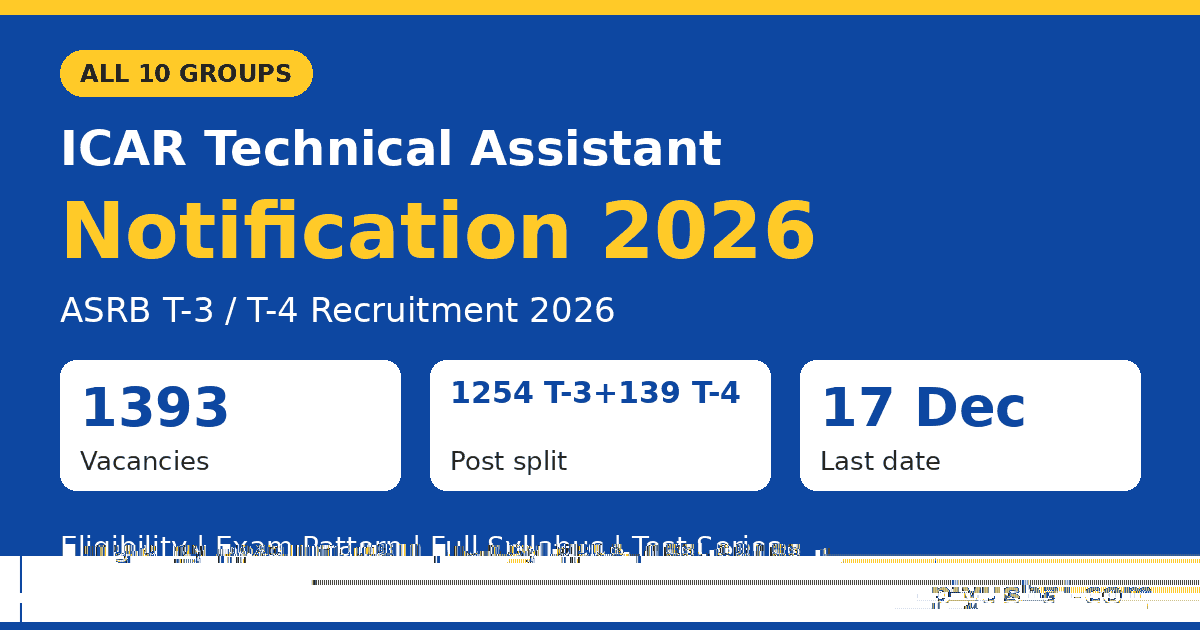
ASRB ICAR Technical Assistant (T-3) and Senior Technical Assistant (T-4) 2026: 1393 vacancies across 10 functional groups, dates, eligibility, age limit, fee, Prelims and Mains pattern, syllabus and links to detailed group-wise guides.
With 772 posts (699 Technical Assistant T-3 in ICAR institutes and 73 Senior Technical Assistant T-4 in KVKs), the Agriculture functional group is the biggest slice of the ASRB Centralized Combined Examination 2026, accounting for more than half of all 1393 vacancies.
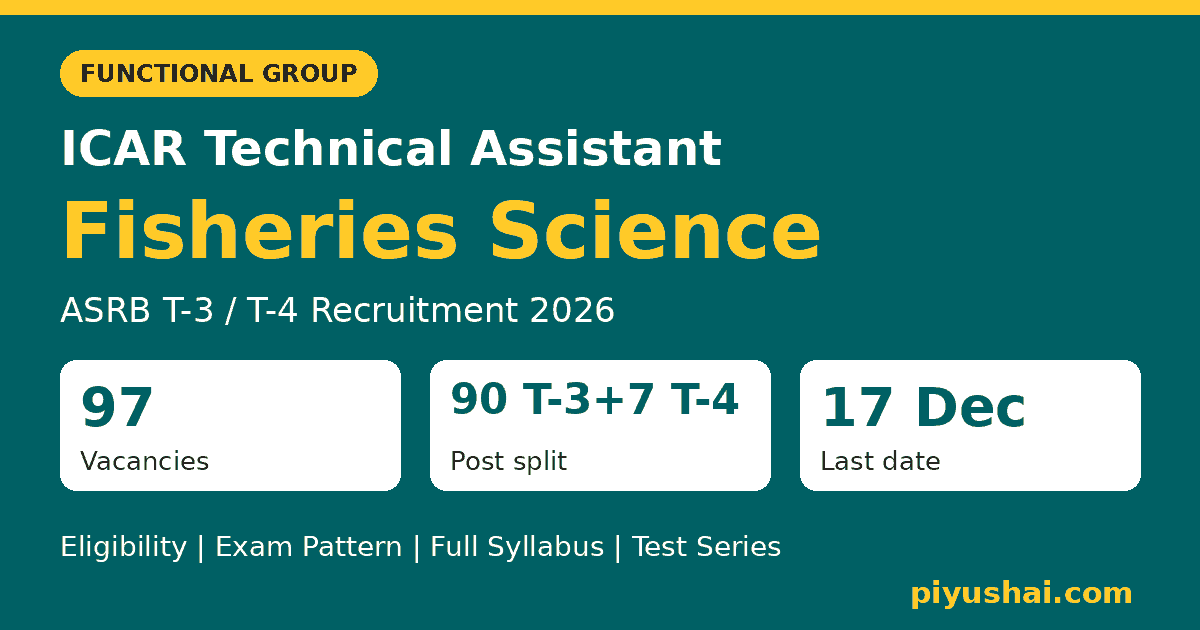
The Fisheries Science functional group has 97 posts: 90 Technical Assistant (T-3) posts in ICAR fisheries institutes and 7 Senior Technical Assistant (T-4) Laboratory Technician posts in KVKs. Only B.F.Sc. graduates are eligible.
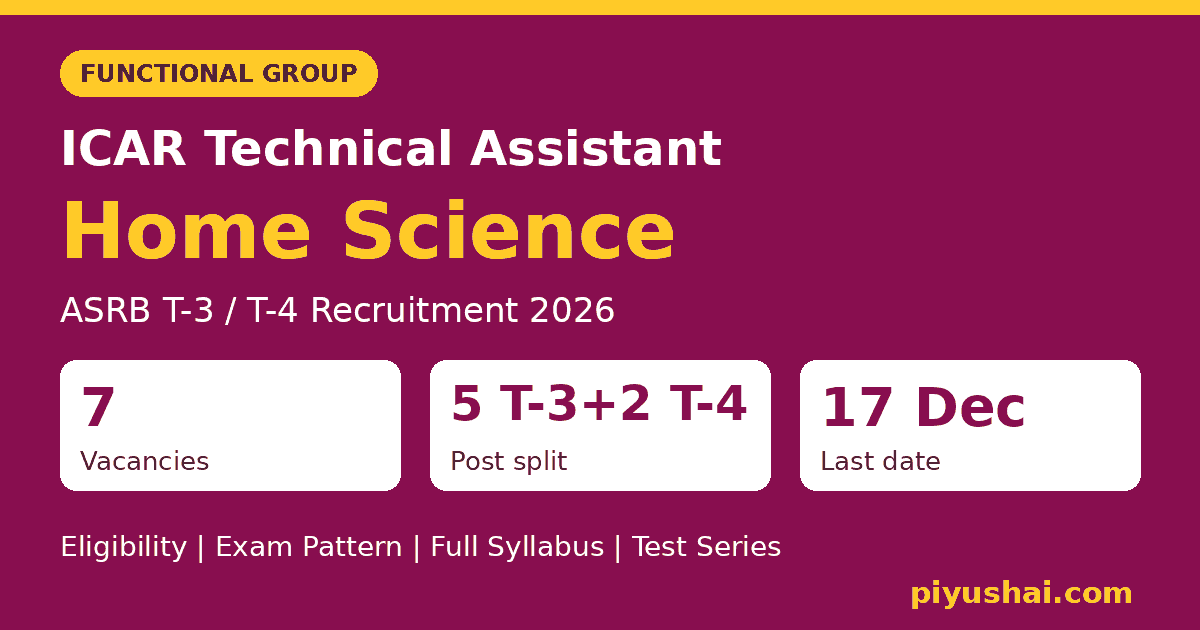
The Home Science / Community Science functional group is the smallest in ASRB T-3/T-4 2026 with just 7 posts (5 T-3 + 2 T-4). Home Science graduates are also eligible for the Agriculture group (772 posts), so compare both before applying.
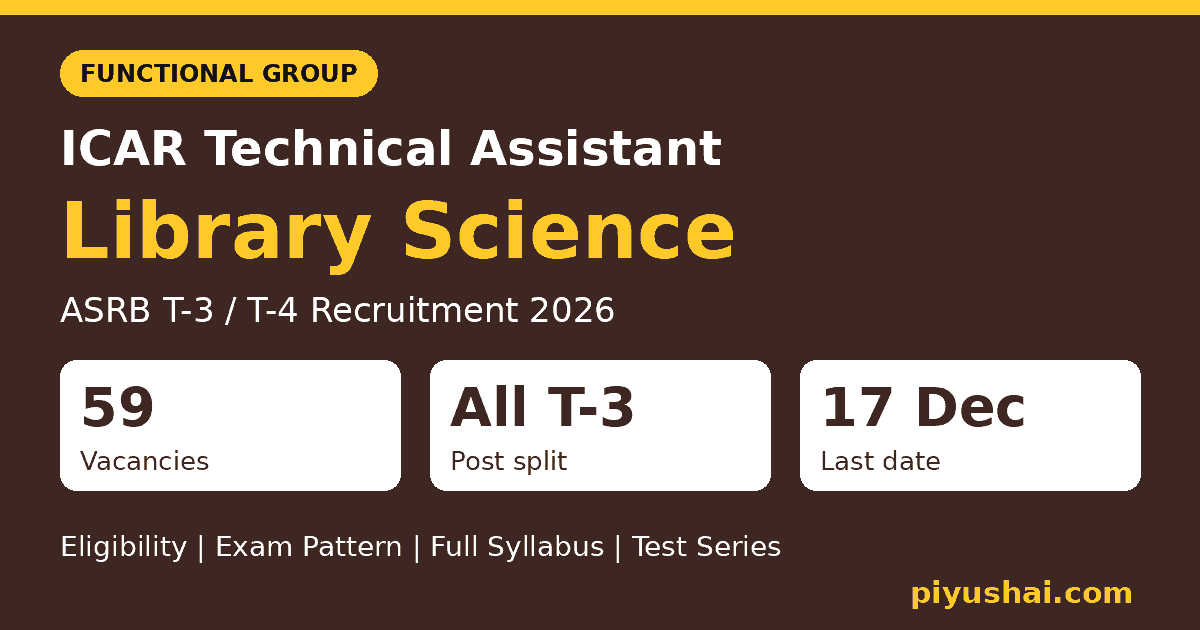
ICAR has 59 Technical Assistant (T-3) Library / Information Science / Documentation Staff posts in its institutes, one of the largest central government library recruitments of the year. A bachelor's degree in Library Science (B.Lib.I.Sc.) is the qualification, and there is no interview.
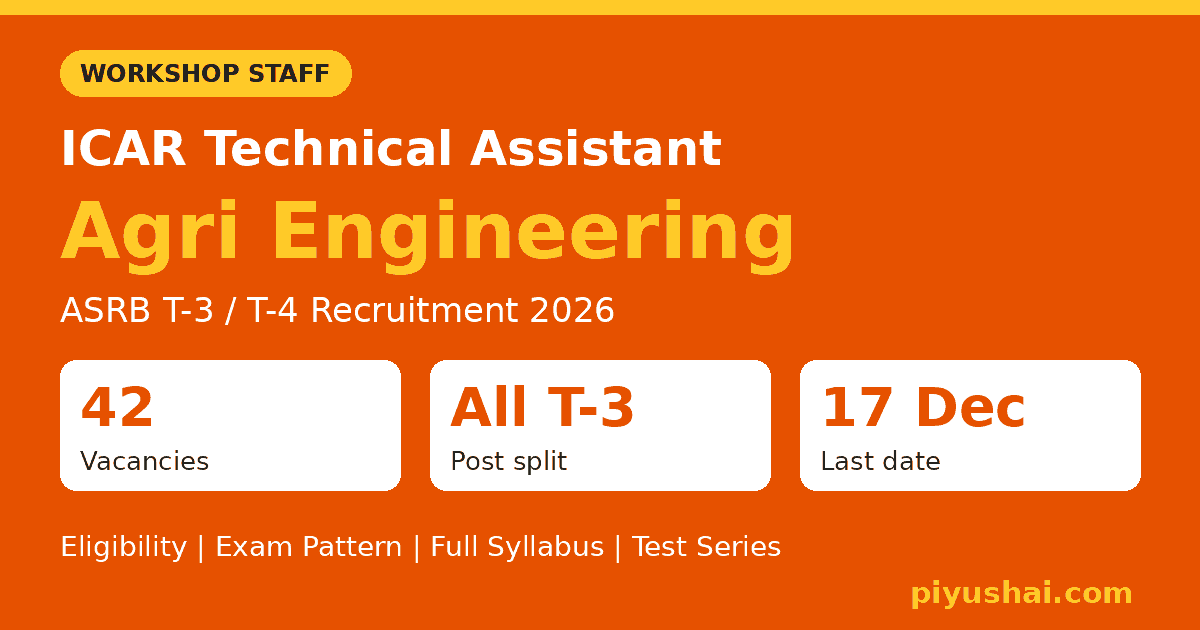
There are 42 Technical Assistant (T-3) Workshop Staff (Agricultural Engineering) posts in ICAR institutes. Mechanical Engineering, Textile Technology and Fibre Processing Engineering degree or diploma holders can also apply, alongside Agricultural Engineering graduates.

Learn Daily, Wherever You Are
Free lectures, exam updates, PYQ discussions, and job alerts — delivered through our YouTube channel and Telegram communities.

[…] ICAR Technical Assistant Animal Science 2026 (124 posts) […]
[…] Field Farm Technician & Laboratory Technician (Animal Science) […]
[…] ICAR Technical Assistant Animal Science 2026 (124 posts) […]