
Last updated: 15 November 2026
On 13 November 2026, llama.cpp, the open-source engine that quietly powers a large share of the “run AI on your own laptop” world, finally reached version 1.0.0. Its sister tensor library ggml hit 1.0.0 on the same day. After roughly three and a half years of numbered builds and fast, sometimes breaking, changes, the project now promises to follow semantic versioning so that apps built on top of it know when something will break.
That may sound like a boring housekeeping update, and some commentators have described it exactly that way. But llama.cpp is not a small hobby project any more. It has more than 130,000 GitHub stars, supports more than 150 model architecture variants, and sits underneath many of the local AI apps, desktop chat tools and edge deployments people use every day. When the foundation layer of an ecosystem declares itself stable, everything built above it gets a little more dependable.
In this post I explain what llama.cpp is in plain language, what actually changed in 1.0, including the new FP8 KV cache and the server security fixes, how to install it the official way, what the first independent tests found, and why I think every Indian student learning AI, data science or systems should spend a weekend running a model locally with it.
Quick summary
- What happened: llama.cpp v1.0.0 and ggml v1.0.0 were released on 13 November 2026 by the ggml-org team, which works at Hugging Face.
- What it is: A free, MIT-licensed C/C++ engine for running large language models (and some vision and speech models) on ordinary hardware: laptops, desktops, phones and servers, with or without a GPU.
- The big promise: From now on, breaking changes to the public C API will come with a major version bump (2.0, 3.0 and so on). New features, backends and model support go into minor versions; bug fixes go into patch versions.
- Cleanup: The release removes 35 deprecated functions plus a few other old options, renames one function and moves some multimodal code around.
- New features: An FP8 KV cache option, a host-memory cache for Mixture-of-Experts models, server security hardening, a speech endpoint and support for several new models.
- Reality check: The official announcement makes no speed or quality claims. Early independent testing found the FP8 cache halves cache memory in one test, but also hit a startup failure on Apple GPUs.
What is llama.cpp, in plain language?
A trained language model is essentially a very large file of numbers (weights) plus a recipe for doing arithmetic with them. To get a reply out of a model, some program has to load those numbers into memory and run billions of multiplications for every token it generates. That program is called an inference engine.
Big companies run their inference engines on racks of expensive data-centre GPUs. llama.cpp was created by Georgi Gerganov in March 2023 with a different goal: make inference fast enough on everyday hardware, written in plain C/C++ with as few dependencies as possible. Two ideas made this work:
- Quantisation: storing weights with fewer bits (for example 4 or 8 bits instead of 16), which shrinks a model so it fits in a laptop’s memory, with a modest loss in quality.
- The GGUF file format: a single-file package containing the quantised weights and the metadata needed to run them. If you have ever downloaded a model ending in
.gguffrom Hugging Face, you have used the llama.cpp ecosystem.
Underneath llama.cpp sits ggml, the tensor library that does the actual maths and talks to hardware through “backends” such as CUDA for NVIDIA GPUs, Metal for Apple Silicon, Vulkan, HIP for AMD, SYCL for Intel GPUs and plain CPU code. llama.cpp adds model loading, tokenisation, sampling, a command-line chat tool and an OpenAI-compatible HTTP server (llama-server) on top.
What “1.0” actually means: the stability promise
Until now, llama.cpp shipped as a stream of numbered builds (b-series releases), sometimes several a day. The library’s functions changed often, so anyone building an app on top of it had to watch closely and patch their code after upgrades. The official announcement on the Hugging Face blog puts the motivation simply: “having a flexible but stable API is paramount.”
The new rules, applying to ggml-org projects that use semantic versioning, are:
| Version part | When it changes | What it means for you |
|---|---|---|
| MAJOR (1.x.x to 2.0.0) | A breaking change to the public C API in the include folder |
Expect to change your code when upgrading |
| MINOR (1.0 to 1.1) | Backward-compatible features, backend updates, new model support or API additions | Upgrade should not break existing code |
| PATCH (1.0.0 to 1.0.1) | Bug fixes with no API change | Safe to upgrade |
The blog says both llama.cpp and ggml will signal API and ABI incompatibilities with major-version bumps. Two honest caveats from independent coverage are worth keeping in mind. First, the published table defines a breaking change only in terms of the public C API; it does not spell out what counts as an ABI break. Second, no deprecation period or support window is stated. As SuperPowerDaily argued, this is essentially a labelling policy, not a freeze on change: the real test is whether future breaking changes actually arrive with a major version bump.
The blog also lists the official distribution channels: prebuilt binaries on GitHub Releases, Docker images, Debian packages, Homebrew, conda-forge, MacPorts, Winget and an XCFramework for Apple platforms. Backends can now be compiled as separate dynamic libraries and loaded at runtime, which makes it easier for packagers to ship one build that adapts to the user’s hardware.
What changed in v1.0.0
According to the official release notes on GitHub, the main changes are:
API cleanup (the breaking parts)
- Removed
llama_set_warmup, 35 deprecated functions, and thedefrag_tholdsetting with its--defrag-tholdcommand-line flag. - Renamed
llama_set_embd_state_srctollama_set_ctx_state_src. - Moved the NextN/speculative-decoding API into the main
llama.hheader. - Removed
clip.hand consolidated multimodal code into themtmdlibrary. - ggml 1.0.0 similarly prunes its own deprecated API.
New capabilities
| Feature | What it does | Who benefits |
|---|---|---|
FP8 KV cache (-ctk f8_e4m3 -ctv f8_e4m3) |
Stores the attention key/value cache in 8-bit floating point, with optional static per-tensor scales | Anyone running long contexts on limited memory |
| MoE expert cache | Keeps Mixture-of-Experts weights in host (CPU) memory and caches frequently used experts, with new moe_cache_size and moe_cache_cpu_share settings |
People running large MoE models on machines with modest GPU memory |
External PLE shards (--shard / --ple) |
Loads certain model components from separate files | Developers working with newer model designs |
/v1/audio/speech endpoint |
OpenAI-compatible text-to-speech route in llama-server |
App builders adding voice output |
| New models | Kimi-K3.1-Pro, Ripple-65B-Preview, xing4_0, drama-3 TTS, plus Kimi-K3.1 vision and MageVL-Cowork | Users who want the latest open-weight models locally |
| Redesigned web UI | Chat groups and a markdown editor in the built-in browser interface | Everyday users of llama-server |
Server security hardening
This is the part I would underline for cybersecurity students. llama-server is often started casually on a laptop or shared lab machine, and it can now call tools and fetch media. Version 1.0.0:
- Makes unauthenticated tool use and fetching media from private network addresses opt-in only, via
--allow-unauthenticated-toolsand--media-allow-private-urls. - Fixes issues around
--cors-origins, DNS rebinding, and server-side request forgery (SSRF) through the CORS proxy. - Restricts the Hugging Face access token (
HF_TOKEN) so it is sent only to huggingface.co hosts. - Cancels MCP tool calls when the client disconnects or times out.
Each of these maps to a classic web security lesson: secure defaults, origin checks, never trusting attacker-controlled URLs, and not leaking credentials to the wrong host.
How the FP8 KV cache saves memory: a worked example
When a model generates text, it stores a “key” and a “value” vector for every past token in every layer so it does not have to recompute them. This is the KV cache, and for long conversations it can take more memory than you expect. The size is roughly:
KV cache bytes = 2 (K and V) x layers x KV heads x head dimension x context length x bytes per numberAn independent hands-on test by SystemDesign Academy used Qwen3 0.6B (28 layers, 8 KV heads, head dimension 128) with a 32,768-token context on an Apple M4 Mac. Plugging in the numbers:
- FP16 (2 bytes): 2 x 28 x 8 x 128 x 32,768 x 2 = about 3.76 billion bytes, or 3,584 MiB.
- FP8 (1 byte): exactly half, 1,792 MiB.
- The older q8_0 option (about 1.06 bytes per value, because it stores a scale for each block of 32 numbers): 1,904 MiB.
Their measured figures matched this arithmetic. So FP8 is a small step beyond q8_0, which llama.cpp already supported, rather than a revolution. The e4m3 in the name means 1 sign bit, 4 exponent bits and 3 mantissa bits, the same floating-point ideas you study in Computer Organisation, just squeezed into 8 bits.
How to install and try it (official methods)
The project’s install documentation lists package-manager options. Pick the one for your system:
# macOS or Linux (Homebrew)
brew install llama.cpp

# Windows
winget install llama.cpp

# Any OS with conda
conda install -c conda-forge llama.cpp

# Docker server image (Linux)
docker run -v /path/to/models:/models -p 8080:8080 ghcr.io/ggml-org/llama.cpp:server -m /models/your-model.gguf --port 8080 --host 0.0.0.0
To build from source (useful for students who want to read the code):
git clone https://github.com/ggml-org/llama.cpp
cd llama.cpp
cmake -B build                 # CPU build
# cmake -B build -DGGML_CUDA=ON   # NVIDIA GPU
# cmake -B build -DGGML_VULKAN=ON # Vulkan
cmake --build build --config Release
The current README’s quick start downloads a small model directly from Hugging Face, for example ggml-org/Qwen3.5-0.8B-GGUF, using the -hf option. Command names differ slightly between the README and older docs (llama cli / llama serve versus llama-cli / llama-server), so check --help on your installed version. A sub-1B model like this runs comfortably on an 8 GB laptop with no GPU, which is a perfect first experiment.
If you run llama-server, set --api-key and restrict --cors-origins, especially on a hostel or college network. In testing, the 1.0 server itself warns when no API key is set and CORS allows all origins.
Limits, criticism and independent test results
- No performance claims. Neither the blog nor the release notes give speed or quality numbers. Treat any viral “1.0 is X times faster” post with suspicion.
- “A promise, not a feature” debate. Grafy described 1.0 as a promise about labelling rather than a new capability. Other outlets, such as tbreak and Munder Difflin, frame it as a cleanup release with real new features. Both are partly right: the version number is about stability, but the release also carries features.
- FP8 on Apple GPUs failed in one test. SystemDesign Academy found the FP8 cache worked on CPU but the server exited at startup on Apple’s Metal GPU backend, while FP16 and q8_0 worked. That is one machine and one model, so test on your own hardware.
- Upgrades can break scripts.
--defrag-tholdnow fails with an invalid-argument error. Apps calling removed functions, the renamed function, orclip.hneed code changes. - Small sample of independent coverage. The release is two days old. Most articles so far summarise the official notes; only one I found did hands-on tests. Expect more benchmarks over the coming weeks.
- The model still sets the ceiling. llama.cpp makes models run; it does not make a small model smart. A 1B model on your laptop will not match a frontier cloud model on hard reasoning.
Privacy, safety and the India angle
This is general information, not legal advice.
The strongest argument for local inference is that your prompts and documents never leave your machine. For colleges, coaching institutes and small companies handling student records or personal data, that can make compliance with India’s Digital Personal Data Protection Act, 2023 easier to reason about, because no third-party AI provider receives the data. It does not remove your responsibilities: you still need to secure the machine, control who can reach the server, and handle the data lawfully.
Two practical cautions. First, model licences vary: the llama.cpp code is MIT licensed, but each model you download has its own licence, which may restrict commercial use. Second, only download GGUF files from sources you trust, such as official model publishers on Hugging Face, and keep llama.cpp updated, since the 1.0 security fixes show that the server attack surface is real.
Why this matters for Indian students and educators
I keep telling students that the most valuable AI skill is not typing prompts, it is understanding what happens between the prompt and the answer. llama.cpp is the best free laboratory for that. You can read the code, change a flag, and immediately see memory use and tokens per second change.
- Computer Organisation and Architecture (GATE CS): floating-point formats (FP16, FP8 e4m3), memory hierarchy, cache behaviour, SIMD and why memory bandwidth limits token speed.
- Linear Algebra (GATE DA): every token is a chain of matrix-vector products; quantisation is a numerical approximation of those matrices.
- Machine Learning and AI (GATE DA): attention, the KV cache, Mixture-of-Experts routing and the accuracy cost of quantisation.
- Operating Systems: memory mapping of model files, threads, dynamic libraries loaded at runtime.
- Software engineering: semantic versioning, API versus ABI stability and deprecation, exactly the lessons this release is about.
- Cybersecurity: SSRF, CORS, DNS rebinding and token leakage, all fixed in a real, widely used server.
For educators, llama.cpp means you can run an AI lab session in a classroom with patchy internet and no paid API keys. For job seekers, experience deploying and tuning local models is directly relevant to edge AI, MLOps and on-device AI roles, which Indian product companies and GCCs increasingly advertise. And contributing even a small documentation fix to a 130,000-star project is a strong line on a resume.
Frequently asked questions
Is llama.cpp free?
Yes. llama.cpp and ggml are open source under the MIT licence. The models you run have their own separate licences.
Do I need a GPU to use llama.cpp?
No. It runs on CPU alone. A GPU (NVIDIA, AMD, Intel, or Apple Silicon) makes larger models and longer contexts much faster.
What is the difference between llama.cpp and Ollama?
llama.cpp is the low-level engine with its own CLI and server. Ollama is a separate, more packaged tool for running local models. Its relationship with llama.cpp and ggml has been debated in the community, so check each project’s own documentation for current details.
Will upgrading to 1.0 break my setup?
If you only use the command-line tools, probably not, unless your scripts use --defrag-thold. If you call the C API directly, check the release notes for removed and renamed functions.
Should I use the FP8 KV cache?
Try it if you are short on memory for long contexts. It halves cache memory versus FP16 in principle, but test quality and stability on your own hardware first, as at least one Apple GPU test failed at startup.
Does 1.0 mean llama.cpp will stop changing?
No. It will keep adding features and models in minor versions. The promise is that breaking changes to the public C API will be clearly signalled with a major version bump.
The bottom line
llama.cpp 1.0 is not a flashy launch. There is no new model and no benchmark chart. What it offers is maturity: a clear versioning contract for the thousands of apps that depend on it, a cleanup of old API baggage, useful memory features, and overdue server security hardening. For students, it is an invitation to stop treating AI as a black box behind an API and start running, measuring and understanding models on your own machine. Install it, run a small model, then change one flag and explain the difference. That exercise teaches more than a dozen tutorials.
Sources and further reading
- Hugging Face blog (ggml-org): llama.cpp v1.0.0 announcement
- GitHub: llama.cpp v1.0.0 release notes
- GitHub: llama.cpp official repository
- llama.cpp install documentation
- SystemDesign Academy: llama.cpp 1.0, FP8 KV cache and upgrading (hands-on test)
- Munder Difflin: what changed and what to check before upgrading
- tbreak: llama.cpp 1.0 reaches stable release
- Grafy: llama.cpp and ggml hit 1.0.0 with a stable API promise
- SuperPowerDaily: clearer rules for breaking changes
- DEV Community: semantic versioning comes to the local AI stack
Written by Piyush Wairale (M.Tech, IIT Madras), founder of PiyushAI Edtech. Version details, star counts and test results change quickly; figures are as reported on or before 15 November 2026.

Recent Post
Olala mini 7A1B is OVHcloud's first open language model, announced on 17 November 2026: 7B parameters, 1B active, Apache 2.0, and said to run on an 8 GB GPU or CPU. Here is how Olala mini works, what is unproven, and why it matters for Indian students.
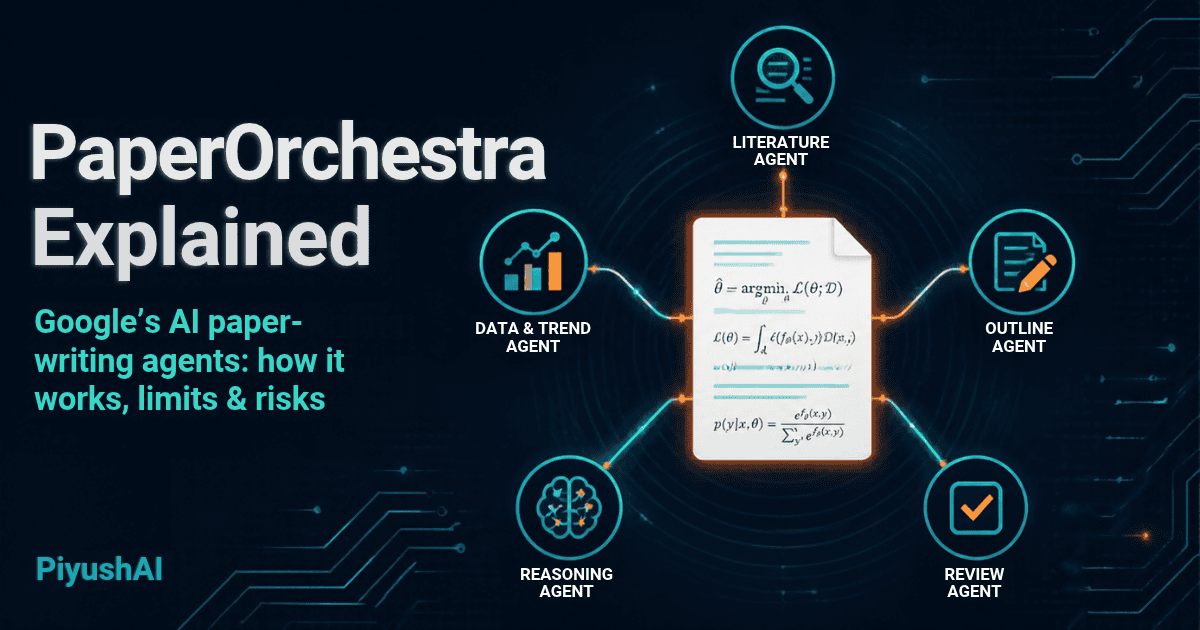
PaperOrchestra is Google Research's open-source multi-agent framework that turns an idea summary and experiment logs into a LaTeX research paper, and it is trending on GitHub this week. Here is what PaperOrchestra is, how it works, what the evaluations show, its limits, the integrity risks, and what it means for Indian students.
Gemini 4 Neon is Google's new middle model in the Gemini 4 family, released on 18 November 2026 at $3/$15 per million tokens with a 1M token context. Here is what Gemini 4 Neon is, how its thinking levels work, what independent tests found, its limits and safety caveats, and why it matters for Indian students.
Inkling 2 Mini is Thinking Machines Lab's new Apache 2.0 open-weight model, released on 20 November 2026: 26.4B parameters, about 3.4B active, and a looped transformer that runs its middle layers three times. Here is how Inkling 2 Mini works, what independent tests show, its limits, and why it matters for Indian students.
Genie 4 is Google DeepMind's real-time world model, opened to developers in the Gemini API on 19 November 2026: playable 720p worlds with native audio at about $0.10 per second. Here is what Genie 4 is, how it works, its limits, the deepfake risks, and why it matters for Indian students.
Shirudo is a new open-source Linux security runtime from OpenAI and Cisco, announced on 23 November 2026, that uses AI agents to write signed, temporary "shields" against exploits until a real patch lands. Here is how Shirudo works, its demanding requirements, limits, risks, and why it matters for Indian students.
Learn Daily, Wherever You Are
Free lectures, exam updates, PYQ discussions, and job alerts — delivered through our YouTube channel and Telegram communities.