
Last updated: 21 November 2026
On 18 November 2026, Google released Gemini 4 Neon, the latest addition to a Gemini 4 family that has grown rapidly since Gemini 4 Argon arrived at the end of September. Neon sits between the heavyweight Gemini 4 Carbon (for the hardest, longest projects) and the fast, cheap Gemini 4 Hydrogen (for everyday tasks). Google’s pitch is that Neon gives you close to Carbon-level intelligence at a lower cost per task and much higher speed, and its launch post lists a long column of first and second places on coding, agent and knowledge-work leaderboards.
Within a day, independent testers had started poking at those claims. Some of them hold up well: the price, the 1 million token context and the headline Artificial Analysis score of 61 are all confirmed. Others are murkier: the “third overall” ranking and the “32% cheaper than Carbon” figure depend heavily on which setting you measure, and Neon turns out to be one of the most talkative reasoning models on the market, which eats into its cost advantage on small tasks.
In this post I explain what Gemini 4 Neon is, how its thinking levels work, what it can do, how to try it through official channels, what independent tests actually found, the safety caveats in Google’s own model card, and why I think Indian CS, GATE DA, data science and cybersecurity students should pay attention to it for reasons that go beyond the leaderboard. (I covered the top model in the family earlier in Gemini 4 Carbon Explained.)
Quick summary
- What it is: A reasoning model from Google DeepMind, positioned between Gemini 4 Carbon and Gemini 4 Hydrogen. Google’s model card says it is adapted from Carbon.
- Released: 18 November 2026, announced by Koray Kavukcuoglu of Google DeepMind.
- Price (API): $3 per million input tokens, $15 per million output tokens, and $0.15 per million cached input tokens.
- Context: 1 million tokens of input. Text, image, audio and video in; text out.
- Thinking levels: Four (low, medium, high, extra high), with high as the default.
- Where: Gemini app (Google AI Pro and Ultra), Gemini API paid tier, Google AI Studio, Android Studio, Gemini for business and Google Antigravity. A separate cyber-defence version goes only to vetted defenders.
- Reality check: Independent data confirms a score of 61 on the Artificial Analysis Intelligence Index at extra high, but that site lists it sixth, not third, and flags it as slow per task and very verbose.
What is Gemini 4 Neon, in plain language?
Think of the Gemini 4 family as three engines of different sizes. Carbon is the big, slow, expensive engine you bring out for a multi-day research or engineering project. Hydrogen is the small, quick engine for chat, summaries and simple code. Neon is the middle engine: Google describes it as aiming for “frontier-level intelligence with fast end-to-end task completion” across software engineering, knowledge work and science.
“End-to-end” is the key phrase. Neon is designed to be used as an agent: you give it a goal, and it plans, calls tools, writes and runs code, reads files and checks its own work until the task is done, rather than just answering one question. Reports say Neon can operate a computer (computer use), run code, ground answers in Google Search, and even direct Hydrogen models as sub-agents for smaller jobs. It does not generate images or audio itself.
In the Gemini app, reports from 9to5Google and Android Headlines say Neon replaces the earlier Gemini 4 Argon in the model picker for paying subscribers.
How it works
Google has not disclosed Neon’s parameter count, architecture details or training data beyond saying the model card is adapted from Gemini 4 Carbon’s. What we do know is how you control it.
Thinking levels
Like most 2026 reasoning models, Neon “thinks” before it answers: it generates hidden reasoning tokens, then a final answer. You choose how much thinking it does:
- Low: fastest and cheapest, suitable for simple lookups and formatting.
- Medium: a middle ground.
- High (default): the setting Google uses for most of its cost comparisons.
- Extra high (xhigh): maximum reasoning; this is the setting behind the headline score of 61.
This matters more than it sounds. On Artificial Analysis, Neon’s Intelligence Index score is 61 at extra high, 60 at high, 55 at medium and 44 at low. But the number of output tokens it produced to complete that index ranged from about 28 million at low to about 283 million at extra high. More thinking means a better score, but also a bigger bill and a longer wait.
Long context and caching
Neon accepts up to 1 million tokens of input, enough for a large codebase, a stack of PDFs or hours of transcripts. According to the model card, it produces up to 64K output tokens by default in a normal request, with longer outputs (up to 1M) through a background “long decode” mode. Cached input costs $0.15 per million tokens, a 95% discount, which is useful when an agent keeps re-reading the same large document or repository. The model card gives a knowledge cutoff of March 2026.
What Google says it can do
The table below lists Google’s own reported results. Treat these as vendor claims: most have not been independently re-run, and Google chose which benchmarks to show.
| Area | Benchmark (Google-reported) | Gemini 4 Neon |
|---|---|---|
| General intelligence | Artificial Analysis Intelligence Index (xhigh) | 61 |
| Coding agents | Artificial Analysis Coding Agent Index | 58.6 (claimed #1) |
| Terminal tasks | Terminal-Bench 4.1 | 65.2% |
| Hard coding | FrontierCode 2.0 (high) | 46.2% |
| Software engineering | SWE-sweep (mini-SWE harness / in Antigravity) | 12.8% / 39.0% |
| Business automation | Zapier AutomationBench | 56.3% (claimed #1) |
| Knowledge work | Vals Index | 70.9% |
| Agent preference | Arena Agent Arena Index | 1336 (claimed #2) |
| Science and maths | Terminal-Bench Science / RiemannBench / HLE-Diamond | 70.5% / 84.0% / 71.3% |
| Charts and visuals | Chartography | 73.5% |
| Security | SEC-bench Pro / CWE-bench v2 / AutoBaxBench hard | 90.5% / 70.7% / 76% |
Two details in this table are worth noticing. First, the SWE-sweep score triples (12.8% to 39.0%) when Neon runs inside Google’s own Antigravity coding environment instead of a minimal neutral harness. That tells you how much the surrounding tooling, not just the model, drives agent results. Second, Neon is not first everywhere: Digital Trends noted that Google’s own comparison puts it behind Claude Opus 5.5 on Terminal-Bench 4.1 and FrontierCode 2.0, and behind GPT-6.2 Sol on Chartography.
Google also reports that, at its default high setting, Neon costs about 32% less per task than Carbon, and that at extra high it costs at least 36% less than competing models at their highest settings.
How to try it (official routes)
- Gemini app: Google AI Pro and Ultra subscribers can pick Neon from the model dropdown. Tasks in Gemini can also run on Neon.
- Google AI Studio: Google’s blog says Pro and Ultra subscribers can try it in AI Studio. Developers use the Gemini API paid tier with the model ID
gemini-4-neon. - Google Antigravity: Google’s agentic coding environment, for paid AI Pro and Ultra subscribers.
- Business: Gemini for business, and (per Digital Trends) Vertex AI for verified enterprise customers.
For developers, a minimal call with Google’s official Python SDK looks like this. Check the Gemini API documentation for the exact parameter used to set the thinking level, since I have not been able to confirm it for Neon.
# pip install google-genai
# export GEMINI_API_KEY=your_key   (paid tier required for Neon)
from google import genai

client = genai.Client()
response = client.models.generate_content(
    model="gemini-4-neon",
    contents="Explain the time complexity of Dijkstra's algorithm with a binary heap."
)
print(response.text)
Prices are listed in US dollars. Neither the global nor the India edition of Google’s announcement mentions INR pricing or India-specific restrictions.
What independent tests found
Artificial Analysis: score confirmed, ranking and speed less rosy
Artificial Analysis, whose index Google cites, confirms 61 at extra high and 60 at high. However, at the time I checked, its own page ranked Neon sixth of 95 models on intelligence, not third. I could not find an explanation for the gap; it may reflect how Google counts model families or a different snapshot date, but readers should know the two figures disagree.
The same page describes extra high as “notably slow per task and very verbose”. Its measurements:
- Output speed: about 101 to 110 tokens per second, depending on setting.
- Time to first answer token: about 56 seconds at extra high and 41 seconds at high, against a median of roughly 13 seconds for comparable models.
- Time per index task: 21.5 minutes at extra high and 14.8 minutes at high.
- Verbosity: about 283 million output tokens for the full index at extra high, near the bottom of the verbosity ranking.
- Cost to run the index at extra high: $6.44 per task.
Is it really 32% cheaper than Carbon? Sources conflict
This is the claim I would treat most carefully. OrcaRouter (an API reseller, so not neutral) compared Artificial Analysis figures for Neon at extra high ($6.44 per task) with Carbon at high ($4.90) and concluded Neon was about 31% more expensive, while admitting the settings were not matched. Analytics Vidhya, also citing Artificial Analysis, reported $3.74 per task for Neon at high against $7.76 for Carbon at high (at Carbon’s undiscounted price), which would make Neon roughly half the cost. The two Carbon figures do not agree, and I could not resolve why. The honest conclusion: Neon at its default setting is probably cheaper than Carbon at list price, but the exact saving is not independently settled, and Carbon is on a temporary promotional price of $2/$10 until the end of November.
Hands-on tests
Developer Flavio Copes ran small coding and search tests through OpenRouter at high effort, comparing Neon with Claude Opus 5.5 and Gemini 4 Carbon:
- All three models passed his parsing tests (30/30 and 27/27 test cases).
- Neon was far faster than Carbon (12.7 s against 78.0 s on one task) but slower than Opus 5.5 (6.8 s).
- On a CSV parsing task, Neon used about 5,500 reasoning tokens against Opus’s roughly 700, which made it about three times as expensive per task despite a lower price per token. As he put it: “On short tasks it thinks a lot, and that changes the math.”
- On a 100K token document search, both answered correctly and Neon was about 42% cheaper.
Analytics Vidhya ran four tasks in the Gemini app at medium thinking. Neon wrote a run-length encoding codec in Python that passed 781 round-trip checks and correctly read a vernier caliper photo (4.6 mm), but it miscounted pulses in an audio clip and failed to recompute a tournament table after a tie-break rule changed. Both reviewers used tiny samples, so read these as early signals, not verdicts.
Limits and criticism
- Most numbers are Google’s. As Digital Trends and Let’s Data Science point out, nearly all benchmark scores come from Google, and many headline comparisons use the most expensive setting.
- Verbosity costs money. Cheap per-token pricing does not guarantee cheap tasks if the model thinks at length.
- Latency. Waits of 40 to 60 seconds before the first answer token are fine for background agents but frustrating in interactive use.
- Harness dependence. Agent scores swing widely with the tools around the model.
- Opacity. No parameter count, no licence for the weights (it is not an open model), and the model card points to Carbon’s card for architecture and data.
- Naming confusion. Carbon, Hydrogen, Argon and now Neon arrived within weeks; Digital Trends called the naming scheme “a complete mess”.
Safety, privacy and the Indian angle
Google’s launch post reports encouraging agent-safety figures: a 0.09% misaligned-action rate on its agentic safety suite, 99.2% on an agent honesty evaluation, a 0% attack success rate from a Gray Swan prompt-injection test at the highest thinking level, and fewer coding shortcuts than other Gemini 4 models. These are internal evaluations.
The model card is more sobering. Under Google’s Frontier Safety Framework, it says Google cannot rule out that the model reaches critical capability levels for chemical, biological, radiological and nuclear uplift and for cyber uplift, nor certain loss-of-control thresholds; these results are carried forward from an earlier Gemini 4 model rather than re-measured. The full Safety and Security Report is marked “coming soon”, the card notes that hallucinations can still occur, and it says jailbreak resistance is still being improved. Because of its cyber capabilities, Google is releasing a separate cyber-defence variant only to trusted defenders through its Fairwind Program.
For Indian users, a few practical points (general information, not legal advice):
- Personal data: India’s Digital Personal Data Protection Act, 2023 places duties on organisations that process personal data. Colleges, coaching institutes and startups should not paste student records, Aadhaar-linked data or customer details into any AI tool without checking the provider’s data terms and their own obligations.
- Agents with access: A model that can operate your computer or run code can also make mistakes at machine speed. Use separate accounts, sandboxes and least-privilege API keys.
- Academic integrity: Neon is strong at exactly the kind of coding and analytical work used in assignments. Institutions need clear policies on what AI use is allowed.
Why this matters for Indian students and educators
Most students will never pay for the top tier of every model. Neon is interesting because it shows where the industry is heading: mid-priced models that are good enough for serious agent work, chosen by cost per completed task rather than raw intelligence. Understanding that trade-off is itself a skill.
The Neon story connects directly to your syllabus:
- Probability and Statistics (GATE DA): benchmark scores are sample estimates. A one-point gap on an index, or a single hands-on test, says little without variance and sample size.
- Machine Learning: Neon being “adapted from Carbon” hints at distillation and post-training, topics worth reading about beyond the GATE syllabus.
- Algorithms and Programming: the reviewers’ best tests used known inputs and round-trip checks. Writing tests is how you verify AI-written code.
- Operating Systems and Computer Networks: agents that use terminals and computers rely on processes, permissions and network calls you study in these subjects.
- Cybersecurity: the CWE and SEC-bench results, and the restricted Fairwind release, show AI is now central to both attack and defence.
Career-wise, roles in AI engineering, MLOps and security increasingly involve choosing models, setting thinking budgets and measuring cost per task. A useful exercise: take one problem from your coursework, run it on two models at two thinking levels, and record correctness, time and token counts. You will learn more from that small table than from any launch post.
Frequently asked questions
Is Gemini 4 Neon free?
Not in the API: it is on the Gemini API paid tier at $3/$15 per million tokens. In the Gemini app it is available to Google AI Pro and Ultra subscribers. Check Google’s current plans for any student offers in India.
How is Neon different from Gemini 4 Carbon and Hydrogen?
Carbon is Google’s largest Gemini 4 model for the hardest long-horizon work. Hydrogen is the fast, cheaper option (reported at half Neon’s price). Neon sits in between, aiming for near-Carbon quality at lower cost per task and higher speed.
Is Gemini 4 Neon better than Claude Opus 5.5 or GPT-6.2 Sol?
On the Artificial Analysis Intelligence Index, Neon at extra high (61) scores above the figures Google cites for Opus 5.5 (59) and GPT-6.2 Sol (57). But Google’s own table shows it behind Opus 5.5 on some coding benchmarks, and one hands-on test found Opus faster and cheaper on short tasks. “Better” depends on your task.
Can I run Gemini 4 Neon locally?
No. It is a closed model available only through Google’s services. If you need local models, look at open-weight options instead.
What context length does Gemini 4 Neon support?
1 million input tokens, with up to 64K output tokens by default and longer outputs through background long decode, according to the model card.
Is it safe to use for cybersecurity work?
The general model is available for normal use, but Google’s model card says it cannot rule out critical cyber uplift capabilities, and the specialised cyber-defence version is restricted to vetted defenders. Only test systems you own or are authorised to test.
The bottom line
Gemini 4 Neon is a solid, well-priced middle model with a genuine independent score of 61 at its highest setting, a 1 million token context and strong agent tooling around it. The marketing, however, leans on the most favourable settings. Independent data shows a lower ranking than Google claims, long waits before answers, and very verbose reasoning that can wipe out the per-token price advantage on small jobs. My advice: try it at the default or a lower thinking level on your own tasks, measure cost and correctness yourself, and treat every leaderboard number, including the ones in this post, as a starting point for your own testing.
Sources and further reading
- Google: Introducing Gemini 4 Neon
- Google India blog: Introducing Gemini 4 Neon
- Google DeepMind: Gemini 4 Neon model card (PDF)
- Artificial Analysis: Gemini 4 Neon intelligence, performance and price
- 9to5Google: Gemini 4 Neon announcement
- Digital Trends: Google says Gemini 4 Neon can hang with Claude Opus 5.5 and GPT-6.2 Sol for less
- Let’s Data Science: Google releases Gemini 4 Neon
- Android Headlines: Gemini 4 Neon release, pricing and features
- Flavio Copes: Gemini 4 Neon, I tested it against Opus 5.5
- Analytics Vidhya: Gemini 4 Neon review
- OrcaRouter: Gemini 4 Neon benchmarks, an independent look
- Interesting Engineering: Google Gemini 4 Neon for faster coding and research
Written by Piyush Wairale (M.Tech, IIT Madras), founder of PiyushAI Edtech. Benchmark scores, rankings and prices change frequently; figures are as reported on or before 21 November 2026.

Recent Post
Olala mini 7A1B is OVHcloud's first open language model, announced on 17 November 2026: 7B parameters, 1B active, Apache 2.0, and said to run on an 8 GB GPU or CPU. Here is how Olala mini works, what is unproven, and why it matters for Indian students.
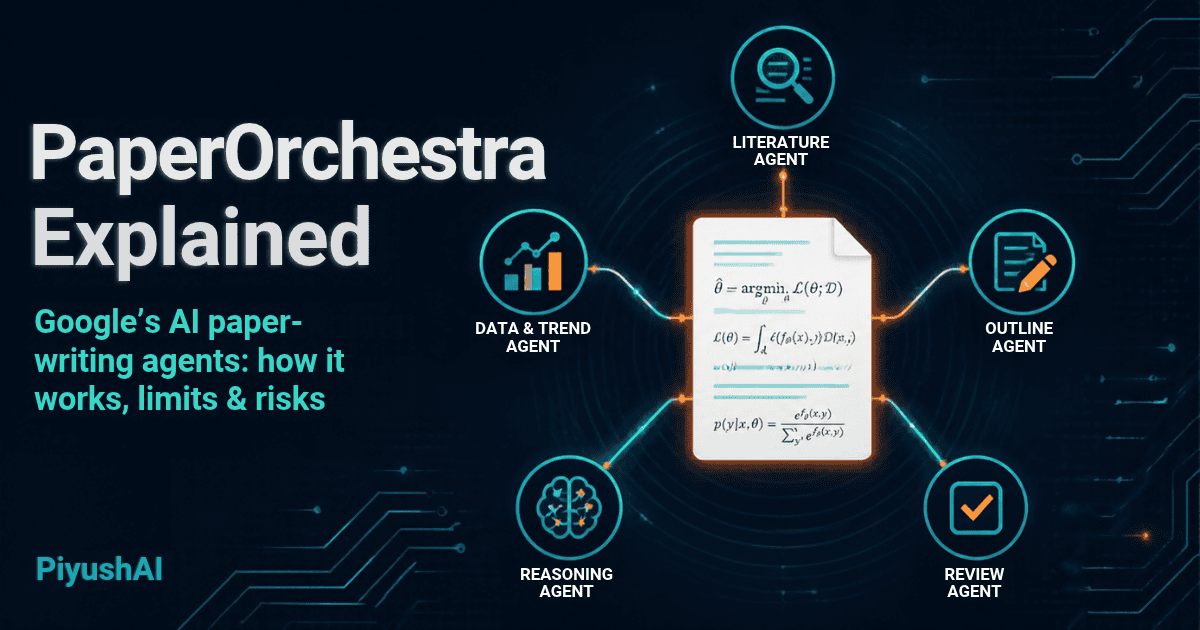
PaperOrchestra is Google Research's open-source multi-agent framework that turns an idea summary and experiment logs into a LaTeX research paper, and it is trending on GitHub this week. Here is what PaperOrchestra is, how it works, what the evaluations show, its limits, the integrity risks, and what it means for Indian students.
Inkling 2 Mini is Thinking Machines Lab's new Apache 2.0 open-weight model, released on 20 November 2026: 26.4B parameters, about 3.4B active, and a looped transformer that runs its middle layers three times. Here is how Inkling 2 Mini works, what independent tests show, its limits, and why it matters for Indian students.
Genie 4 is Google DeepMind's real-time world model, opened to developers in the Gemini API on 19 November 2026: playable 720p worlds with native audio at about $0.10 per second. Here is what Genie 4 is, how it works, its limits, the deepfake risks, and why it matters for Indian students.
Shirudo is a new open-source Linux security runtime from OpenAI and Cisco, announced on 23 November 2026, that uses AI agents to write signed, temporary "shields" against exploits until a real patch lands. Here is how Shirudo works, its demanding requirements, limits, risks, and why it matters for Indian students.
Ternary Bonsai 2.5 27B is PrismML's new Apache 2.0 model, released on 24 November 2026, that squeezes a 27B coding and agent model into a 5.9 GB file using weights of -1, 0 and +1. Here is how Ternary Bonsai 2.5 27B works, what its self-reported benchmarks show, its limits, and why it matters for Indian students.
Learn Daily, Wherever You Are
Free lectures, exam updates, PYQ discussions, and job alerts — delivered through our YouTube channel and Telegram communities.