Last updated: 23 November 2026
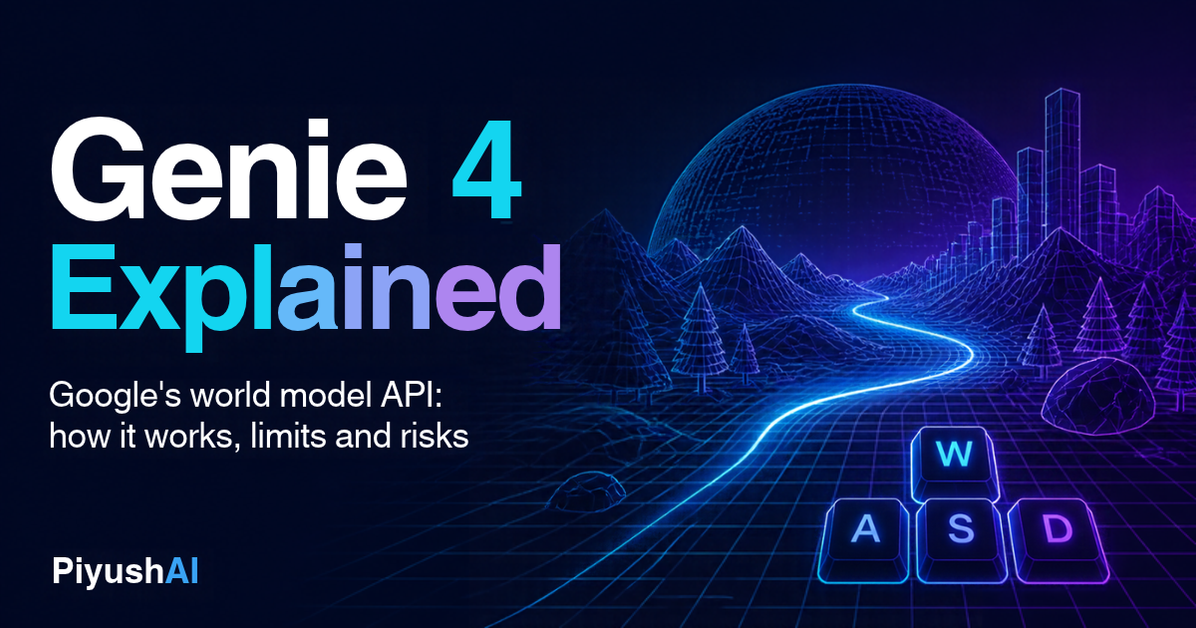
On 19 November 2026, Google made Genie 4, its newest “world model”, available to developers through the Gemini API and Google AI Studio. A day earlier it had started rolling Genie 4 out to eligible Google AI Ultra subscribers in the consumer app Project Genie. Until now, Genie was something most of us only watched in demo videos. Now anyone with a paid Gemini API key can type a prompt (or upload an image) and get a playable, 720p world with sound that reacts to keyboard controls and new text instructions in real time.
That is a genuinely new kind of API. A chatbot returns text; an image model returns a picture; Genie 4 returns a live stream of frames and audio that you can walk around in for up to two minutes. Google pitches it for prototyping games and scenes, spatial visualisation, and training robots and AI agents in simulated environments.
In my view, Genie 4 is worth understanding even if you never pay for it, because world models are becoming a core idea in robotics and agent research. But the launch also comes with real catches: it costs about $0.10 per second, sessions are capped at 120 seconds, there are no public benchmark scores, and it is served only from the US, Western Europe and Japan. In this post I explain what Genie 4 is, how it works, how the API is set up, what it can and cannot do, the safety and deepfake questions, and why it matters for Indian CS, GATE DA, robotics and data science students.
Quick summary
- What it is: A real-time interactive world model from Google DeepMind. It generates a continuous, explorable scene from text and/or an image, with native audio.
- Timeline: Announced as a research preview for trusted testers on 27 October 2026; Project Genie rollout to eligible AI Ultra subscribers on 18 November; Gemini API and AI Studio access on 19 November.
- Output: 1280×720 (16:9) video at 24 frames per second, with 48 kHz stereo audio, according to Google’s developer docs.
- Controls: WASD keys to move, arrow keys for the camera, and live text prompts to change weather, lighting, objects or events mid-session.
- Session length: Hard cap of 120 seconds through the API; Google says visual stability may degrade after 60 to 90 seconds.
- Price: Paid tier only. Billed as 240 video output tokens per frame, which Google’s docs put at roughly $0.10 per second (about $6 per minute) with audio included.
- Safety: Every output carries an invisible SynthID watermark; prompts or images with identifiable real people, public figures or brand IP can be blocked or can end a live session.
- Reality check: No independent benchmarks or detailed hands-on reviews were available at the time of writing. Most details come from Google.
What is Genie 4, in plain language?
A world model is an AI system that learns how an environment looks and behaves, then predicts what should happen next when something acts in it. If you press “move forward”, the model has to work out what the next frame should look like: the road ahead comes closer, a tree slides past, footsteps sound on gravel. It is not running a traditional game engine with 3D meshes and physics code. It is generating each frame, conditioned on what came before and on your inputs.
Genie 4 is the fourth generation of Google DeepMind’s Genie line. Genie 3, introduced in August 2025, already produced 720p worlds at 24 fps that you could explore for about a minute. Genie 4 adds three things Google highlights:
- Native audio: DeepMind calls it its “first real-time world model to generate audio natively”, including ambient sound, music and spoken dialogue from characters.
- Real-time steering with language: you can type instructions during a session, for example to change the weather, move the camera or add a character.
- Tighter integration with Gemini: other Gemini models help ground and plan the simulation (more on this below).
A simple way to picture it: Genie 4 is like an infinitely improvising video game level that you describe in a sentence. It looks impressive, but it has no memory of a permanent map, so things you walked past can quietly change when you come back.
How it works
Google has not published Genie 4’s architecture, parameter count or training data, so I will stick to what Google has said.
Frame-by-frame generation with Gemini in the loop
According to the DeepMind announcement, Gemini Omni (Google’s multimodal model family) helps anchor the simulations in realistic appearance and behaviour, while Gemini 3.8 Flash can act as a guiding agent for real-time planning. DeepMind also showed a robotics demo in which Gemini 4 Argon broke a checkers task into steps for an Apptronik Apollo humanoid robot inside a Genie world. One third-party write-up (APIYI, citing the model card) says Genie 4 is built on “Gemini Omni Flash”; I could not confirm that wording on Google’s own pages, so treat it as unverified.
Independent coverage describes the output as a rolling, continuous generation rather than a stored 3D scene. That explains both its strength (anything you can describe can appear) and its main weakness (consistency drifts over time).
Streaming, not request and response
Because the output is live video, the API is not a simple “send prompt, get answer” call. It uses Google’s Interactions API (currently v1beta). Your server creates an interaction for the model genie-4, mints a short-lived single-session token, and your app connects using WebRTC (for browsers) or WebSocket (for server code). You then send events: a world_setup event with the world prompt and an optional 16:9 reference image, user_action events for key presses, and text input events to steer the scene. The server streams back frames (as JPEG) and audio (as PCM) in step.delta events.
Latency you should expect
Google’s docs give rough timings: about 5 to 9 seconds to the first frame, about 0.2 to 0.5 seconds for movement keys to show up, and 1 to 2 seconds for a text prompt to change the scene. The docs also say round-trip latency under 150 ms is expected only in North America, Western and Central Europe and East Asia, which matters for Indian users (see below).
What Genie 4 can and cannot do
| Feature | Supported? | Notes (per Google’s docs and launch posts) |
|---|---|---|
| Text prompt to world | Yes | Describe a scene; Genie 4 generates it live |
| Image prompt to world | Yes | One 16:9 start image; keep JPEG seeds under about 48 KB on WebRTC |
| Keyboard control | Yes | WASD to move, arrow keys for camera |
| Live text steering | Yes | Change weather, lighting, objects or events mid-session |
| Native audio | Yes | 48 kHz stereo, synchronised with video |
| Portrait (9:16) or custom frame rates | No | Fixed 16:9 at 24 fps |
| Microphone or webcam input | No | Not accepted in live sessions |
| Function calling, Search grounding, structured output | No | Not available for genie-4 |
| Session resumption | No | Each session is one-off, hard cap 120 seconds |
| Batch, Flex or Priority inference | No | Reported by PPC Land and Unite.AI from the docs |
Google’s stated use cases include game and scene prototyping, filmmaking pre-visualisation, spatial visualisation, and training robots and agents. DeepMind’s early tester examples also mentioned journalism and manufacturing.
How to try it (official routes only)
- Google AI Studio: Google’s Genie page links directly to “Try in AI Studio”. You need a paid-tier Gemini API key; there is no free tier for Genie 4.
- Gemini API: use the model ID
genie-4through the Interactions API, following the official Genie 4 developer guide. - Project Genie (consumer): rolling out to eligible Google AI Ultra subscribers. Reports say AI Pro subscribers can join a waitlist. I could not confirm whether Project Genie is open to users in India; when Project Genie first launched in January 2026 it was limited to US Ultra subscribers.
The shape of a session, based on the endpoints and event names in Google’s guide, looks roughly like this. It is a sketch to show the flow, not copy-paste production code; use the official SDK examples for the exact syntax.
# 1. Your SERVER creates the interaction (never expose your API key in the browser)
POST https://generativelanguage.googleapis.com/v1beta/interactions
{ "model": "genie-4" }

# 2. Your server mints a single-session token for the client
POST https://generativelanguage.googleapis.com/v1beta/interactions/{id}/auth_tokens

# 3. The client connects (WebRTC in browsers, WebSocket on servers) and sends events:
{ "type": "world_setup", "world_prompt": { "text": "A rainy Mumbai street market at dusk" } }
{ "type": "user_action", "action": "key_down", "input": "key_w" }
{ "type": "input", "content": "make it stop raining" }

# 4. The server streams back step.delta events (JPEG frames + PCM audio)
# 5. Call complete() when done: closing a browser tab does NOT stop billing
That last point deserves emphasis. Unite.AI, summarising the docs, notes that closing a browser tab does not stop server-side billing, and the docs say only completing or cancelling the session does. If you build a demo, add a timer and an explicit “end session” call.
How much does it cost?
Google’s developer guide says Genie 4 bills 240 video output tokens per frame. At 24 fps that is 5,760 tokens per second, which the guide puts at “~$0.10/sec with stereo audio included”. So:
- One minute of play: about $6.
- One full 120-second session: about $12, plus small input charges.
TestingCatalog and Unite.AI report per-token rates of $1.50 per million input tokens, $9 per million text output tokens and $17.50 per million video output tokens. The video rate is consistent with the $0.10 per second figure (5,760 x $17.50 / 1,000,000 is about $0.10). However, PPC Land reported on 19 November that the main Gemini API pricing page it checked had no Genie 4 entry, and when I looked the pricing page also did not show one. Check the official pricing page before you budget. For an Indian student, roughly $12 for two minutes is a lot, so most of us will learn more from reading the docs and watching demos than from long experiments.
Limits, criticism and what independent sources found
No independent benchmarks yet
None of the sources I read, including DataCamp, PPC Land, TestingCatalog, Unite.AI and APIYI, reported a proper hands-on evaluation of Genie 4. APIYI states plainly that its review is not its own hands-on test. DataCamp, writing during the research preview, put it bluntly: “Nobody outside Google has evaluated it.” According to APIYI’s reading of the model card, Google reports “significant improvements” over Genie 3 in realism and steering, but without published numbers. Demo videos are selected by Google, so treat them as a best case.
Drift and object permanence
Google is unusually direct about the weaknesses. Its developer guide warns that if you look away from something for 8 or more seconds, or turn a full 360 degrees, landmarks can shift. DeepMind lists complex physical interactions, real-time audio accuracy, legible text, spatial accuracy and long-term consistency as open research problems. Signs, clocks and gauges tend to deform, and exact object counts drift.
Short sessions
The API’s hard cap is 120 seconds, but Google says stability may degrade after 60 to 90 seconds, and Google’s Genie page describes “around a minute” of continuous interaction for the consumer experience. Unite.AI notes that the lack of a persistent 3D scene is a real constraint for robotics and agent training, where you often need the same environment again and again.
Conflicting details
A few numbers disagree across sources, and I want to be transparent:
- Frame rate: Wikipedia’s Genie article mentions “up to 30 fps” (marked as needing a citation). Google’s developer docs say a fixed 24 fps, which I have used.
- Session length: about one minute on the consumer product page versus a 120-second API cap. These may simply be different surfaces.
- Rate limits: Unite.AI published a table of concurrent sessions per usage tier (for example, 2 concurrent sessions at Tier 1), but PPC Land found no Genie row on the rate-limits page it checked. Treat any specific limit as unconfirmed.
- Pro access: sources differ on whether AI Pro waitlist invitations have actually started.
Latency from India
Google says Genie 4 is served from data centres in the US, Western Europe and Japan, and that sub-150 ms round trips are expected in North America, Western and Central Europe and East Asia. India is not on that list. In practice, Indian users may see slower response to keyboard controls. Unite.AI notes that latency above 150 ms “noticeably delays” keyboard steering. I have not tested it from India myself, so this is an expectation based on Google’s own guidance, not a measurement.
Safety, deepfakes and the legal angle in India
Interactive, photorealistic video with dialogue raises obvious misuse questions. Google’s main safeguards, as described in its posts and docs:
- SynthID: every output carries Google’s imperceptible watermark.
- Filters: prompts or images containing identifiable real people, public figures or copyrighted brand IP can be blocked at the start, or can end a stream mid-session.
- Internal evaluations: DeepMind says it ran safety evaluations before the preview, but has not published details. APIYI reports that the model card concludes Genie 4 does not reach critical capability levels; I could not verify this on the primary page.
Critics raise fair open questions. PPC Land points out there is no training-data disclosure, it is unclear whether outputs carry C2PA content credentials in addition to SynthID, and the docs describe no appeal process when a filter wrongly blocks legitimate use. It also flagged a journalism concern: simulated scenes built from archival photos could be mistaken for real footage.
For India specifically (general information, not legal advice):
- Labelling AI content: In February 2026, MeitY notified amendments to the IT Rules that deal with “synthetically generated information”, including labelling requirements and faster takedown timelines for platforms. If you publish Genie 4 clips on social media or in a product, label them clearly as AI-generated and check how the rules apply to you.
- Personal data: do not upload photos of identifiable people as seed images. Apart from Google’s filters, the Digital Personal Data Protection Act, 2023 places duties on anyone processing personal data.
- Misinformation: a realistic street scene “from” an Indian city is not evidence of anything. Educators should use Genie-style demos to teach media literacy, not just to impress.
Why this matters for Indian students and educators
You do not need to spend $12 a session to benefit from Genie 4. The bigger story is that world models are moving from research papers to developer APIs, and the ideas behind them map directly onto subjects you already study:
- Machine Learning (GATE DA): world models are about learning a probability distribution over the next state given the current state and an action. That is conditional probability and sequence modelling in action, the same thinking behind Markov chains and autoregressive models.
- Probability and Statistics: drift is a nice, visible example of how small errors compound over many sequential predictions.
- Robotics and Automation (GATE RA): robots need huge amounts of varied training experience. Simulated worlds, like DeepMind’s Apollo checkers demo, are one way to get it, but the sim-to-real gap is a major research problem.
- Computer Networks: the API uses WebRTC and WebSocket, ephemeral tokens and latency budgets. This is a practical lesson in why a server’s location matters.
- Computer Graphics and Game Development: compare a generated world (flexible, inconsistent) with a game engine (consistent, hand-built). Knowing when each fits is a valuable design skill.
- Cybersecurity: realistic synthetic video makes deepfake detection, watermark verification and content provenance more important career areas.
For careers, roles in robotics simulation, AI for games and media, synthetic data generation and trust and safety are all touched by world models. A low-cost exercise for students: read Google’s Genie 4 developer guide, draw the full request and event flow as a sequence diagram, and write down where billing starts and stops. That alone teaches API design, streaming and cost control.
Frequently asked questions
Is Genie 4 free to use?
No. The Gemini API version needs a paid-tier key and costs roughly $0.10 per second of streamed output. The consumer Project Genie experience is for eligible Google AI Ultra subscribers, with reports of a waitlist for AI Pro users.
Can Genie 4 be used from India?
The Gemini API is generally available to developers in India, but Google says Genie 4 is served from the US, Western Europe and Japan, and low latency is expected only in North America, Europe and East Asia. Expect slower controls. I could not confirm whether Project Genie (the consumer app) is open in India.
How long can a Genie 4 session last?
Up to 120 seconds through the API, with Google warning that visual stability may degrade after 60 to 90 seconds. Sessions cannot be resumed.
Is Genie 4 a game engine?
No. It generates frames on the fly rather than building a 3D world with fixed geometry and physics code. That makes it flexible but inconsistent: objects can change if you look away.
Can I create videos of real people or famous characters with Genie 4?
Google says prompts or images with identifiable real people, public figures or copyrighted brand IP can be blocked or can end the session. Even where something slips through, publishing it could raise legal and ethical problems.
Is Genie 4 open source?
No. It is a closed model available only through Google’s services. There are no downloadable weights.
The bottom line
Genie 4 is the first time Google has put a real-time, interactive world model with native audio into the hands of ordinary developers, and that is a meaningful milestone for robotics, games and agent research. But it is a frontier research product with clear limits: two-minute sessions, visible drift, no public benchmarks, about $6 a minute, and servers far from India. My advice: read the official docs, watch the demos critically, understand the ideas (conditional generation, compounding error, streaming APIs, watermarking), and only spend money on it when you have a specific, short experiment in mind.
Sources and further reading
- Google: Genie 4 is now available on the Gemini API (19 November 2026)
- Google AI Studio docs: Interactive world generation with Genie 4
- Google DeepMind: Genie 4, a new generation of world simulation (27 October 2026)
- Google: Introducing Genie 4
- Google DeepMind: Genie model page
- PPC Land: Google charges developers about 10 cents a second for Genie 4 worlds
- TestingCatalog: Google opens Genie 4 world model to developers in Gemini API
- Unite.AI: Google opens Genie 4 world generation to Gemini API developers
- DataCamp: Genie 4, Google DeepMind’s new real-time world model
- APIYI: How powerful is Genie 4
- PPC Land: Google’s Genie 4 simulates people who talk back in real time
- Wikipedia: Genie (world model)
- Bar and Bench: Centre amends IT Rules to regulate AI-generated content
Written by Piyush Wairale (M.Tech, IIT Madras), founder of PiyushAI Edtech. Prices, availability and technical limits change frequently; figures are as reported on or before 23 November 2026.

Recent Post
Olala mini 7A1B is OVHcloud's first open language model, announced on 17 November 2026: 7B parameters, 1B active, Apache 2.0, and said to run on an 8 GB GPU or CPU. Here is how Olala mini works, what is unproven, and why it matters for Indian students.
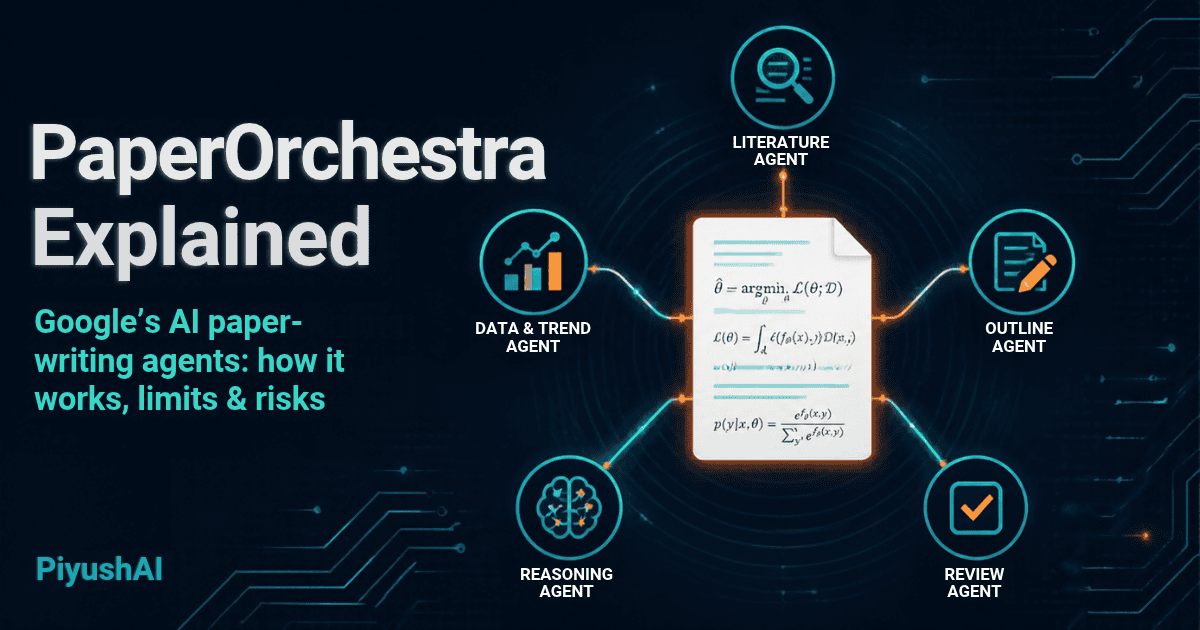
PaperOrchestra is Google Research's open-source multi-agent framework that turns an idea summary and experiment logs into a LaTeX research paper, and it is trending on GitHub this week. Here is what PaperOrchestra is, how it works, what the evaluations show, its limits, the integrity risks, and what it means for Indian students.
Gemini 4 Neon is Google's new middle model in the Gemini 4 family, released on 18 November 2026 at $3/$15 per million tokens with a 1M token context. Here is what Gemini 4 Neon is, how its thinking levels work, what independent tests found, its limits and safety caveats, and why it matters for Indian students.
Shirudo is a new open-source Linux security runtime from OpenAI and Cisco, announced on 23 November 2026, that uses AI agents to write signed, temporary "shields" against exploits until a real patch lands. Here is how Shirudo works, its demanding requirements, limits, risks, and why it matters for Indian students.

Ternary Bonsai 2.5 27B is PrismML's new Apache 2.0 model, released on 24 November 2026, that squeezes a 27B coding and agent model into a 5.9 GB file using weights of -1, 0 and +1. Here is how Ternary Bonsai 2.5 27B works, what its self-reported benchmarks show, its limits, and why it matters for Indian students.
Gemini 4 Hydrogen is Google's new fast, mid-priced model, released on 12 November 2026 for agentic work, coding and long documents. Here is what Gemini 4 Hydrogen is, how its thinking levels work, what independent tests found, how to try it free, its limits and risks, and why it matters for Indian students.
Learn Daily, Wherever You Are
Free lectures, exam updates, PYQ discussions, and job alerts — delivered through our YouTube channel and Telegram communities.