
Last updated: 27 November 2026
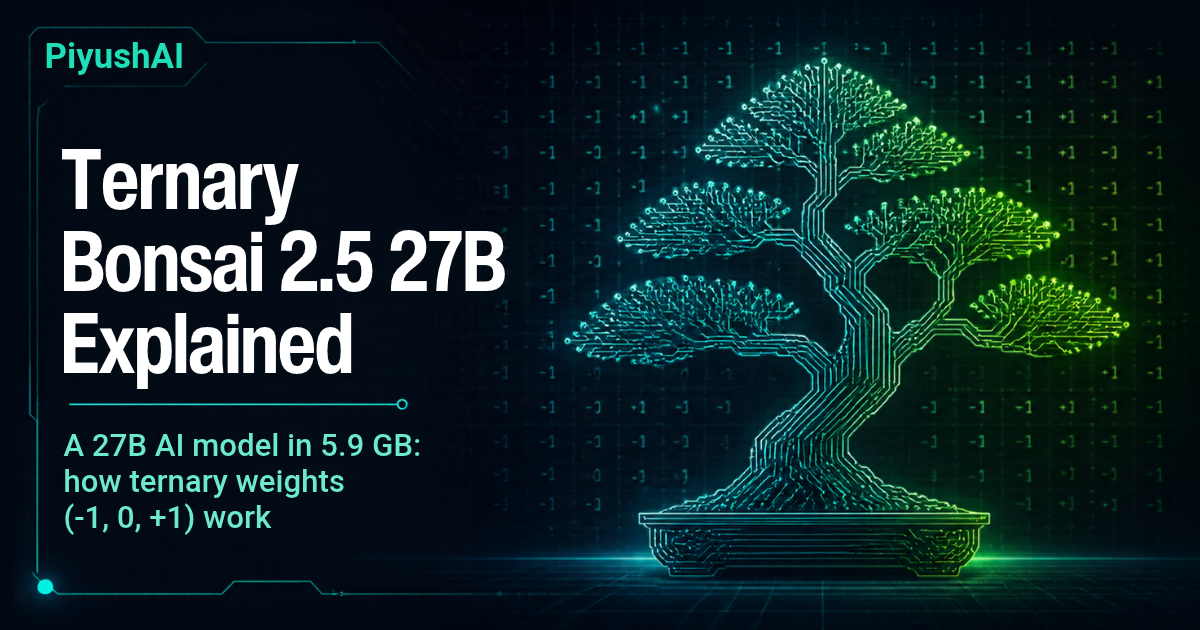
On 24 November 2026, a Pasadena-based startup called PrismML released Ternary Bonsai 2.5 27B, a 27 billion parameter language model whose main weight file is only about 5.9 GB. For comparison, the same model stored in ordinary 16-bit precision would be about 53.8 GB. The trick is that almost every weight in the network is allowed to take just three values: minus one, zero or plus one.
This is an upgrade to Ternary Bonsai 2 27B, which PrismML released in September. The headline claim this time is about agents: PrismML says version 2.5 closes most of the gap with the uncompressed base model on tool calling and coding tasks, which is exactly where heavily compressed models usually fall apart. The weights are free under the Apache 2.0 licence on Hugging Face.
I am writing about this one because it touches something most of my students care about deeply: running a serious AI model on hardware you can actually afford. In this post I explain what ternary weights mean in plain language, how the model works, what the benchmarks do and do not show, how to try it, where independent testers found problems, and why the underlying idea (quantization) is worth understanding for GATE DA, data science and ML engineering careers.
Quick summary
- What it is: A compressed version of Alibaba’s Qwen3.8 27B model in which nearly every weight is stored as -1, 0 or +1, built for agentic coding, tool use and private, on-device work.
- Who made it: PrismML, a startup that says it emerged from a team of Caltech researchers.
- Released: 24 November 2026, as an upgrade to Ternary Bonsai 2 27B (17 September 2026).
- Size: 27.36 billion parameters, about 1.76 bits per weight, 5.93 GB for the main GGUF file. The uncompressed FP16 base is about 53.8 GB.
- Context: Up to 262,144 tokens, according to the model card.
- Licence and price: Apache 2.0, free to download. No paid API was announced; PrismML sells custom post-training to companies.
- Headline claim: 75.6 on SWE-bench Verified (base model 80.6, previous Bonsai 60.8) and a tool-calling average of 77.2 against 77.7 for the full-precision base.
- Reality check: Every benchmark number so far is PrismML’s own. The fastest file formats still need PrismML’s fork of llama.cpp, and hands-on tests of the earlier version found real weaknesses in debugging and multilingual tasks.
What is Ternary Bonsai 2.5 27B, in plain language?
A language model is, at its core, billions of numbers called weights. In a normal model each weight is stored as a 16-bit floating point number, so a 27 billion parameter model needs roughly 54 GB just to hold its weights. That is far more memory than a typical student laptop or gaming GPU has.
Quantization is the general name for storing those weights with fewer bits. You have probably seen 8-bit or 4-bit versions of open models. PrismML pushes this to an extreme: ternary quantization, where each weight becomes one of three values. Three possible values carry log2(3), about 1.585 bits of information, so the model shrinks by roughly nine times.
PrismML did not train this model from scratch. It starts from Qwen3.8 27B, an open model from Alibaba’s Qwen team, and converts it to the ternary format, then post-trains it to recover lost ability. Version 2.5 keeps exactly the same file format and size as version 2; the improvements come from better training for multi-step agent work, plus faster software kernels.
How ternary weights actually work
If you simply rounded every weight to -1, 0 or +1, the model would be destroyed, because real weights have very different sizes. PrismML’s model card describes three ideas that make it workable:
- Group scales. Weights are split into groups of 128. Each group shares one 16-bit scale factor. So a weight is really “scale times -1, 0 or +1”, and the scale restores the right magnitude for that neighbourhood of the matrix.
- A rotation before rounding. Before the weights are rounded, each weight matrix is multiplied by a fixed orthogonal matrix (a blockwise Hadamard transform). This spreads out extreme values so that rounding to three levels loses less information. The rotation is folded into the stored weights ahead of time, so it costs no extra storage. The catch is that the software running the model must apply a matching rotation to the activations, which is why special kernels are needed.
- Tight packing. In the densest file format (called PTQ1_0) the trits and scales together take about 1.76 bits per weight. A small fraction of sensitive parameters stays in higher precision, and an optional vision encoder for image input is a separate file.
If you have studied linear algebra for GATE DA, this should feel familiar: an orthogonal transform preserves lengths and dot products, so you can rotate the problem into a basis where rounding hurts less, and rotate back without changing the maths. That is a lovely example of exam theory turning into an engineering trick worth real money.
Version 2.5 also ships optional multi-token prediction (MTP) files. These add a small extra “draft” layer that guesses the next few tokens, which the main model then checks. When the guesses are right, generation speeds up; PrismML says the gain on NVIDIA GPUs is about 1.5 to 1.8 times, depending on the text.
What the benchmarks show
All numbers below come from PrismML’s official announcement and Hugging Face model card. They were run in “thinking” mode at the highest reasoning effort. I have not seen independent replications yet.
| Benchmark | Qwen3.8 27B (FP16, about 53.8 GB) | Bonsai 2 27B (5.93 GB) | Bonsai 2.5 27B (5.93 GB) |
|---|---|---|---|
| SWE-bench Verified | 80.6 | 60.8 | 75.6 |
| Terminal-Bench 2.1 | 70.8 | 52.8 | 60.1 |
| DeepSWE v1.1 | 30.1 | 0 | 27.0 |
| AppWorld | 93.2 | 51.2 | 90.5 |
| τ³-Bench (tool use) | 72.8 | 69.1 | 73.9 |
| LiveCodeBench v6 | 87.6 | 83.8 | 83.0 |
| BigCodeBench | 61.5 | 57.2 | 60.3 |
A few things stand out to me. The jump from version 2 to 2.5 on long agent tasks (AppWorld, DeepSWE, SWE-bench Verified) is large, and that is where version 2 was weakest. On the model card’s five-benchmark tool-calling average, Bonsai 2.5 scores 77.2 against 77.7 for the full-precision base. On a three-benchmark coding average it scores 54.2 against 60.5, which PrismML describes as keeping about 90% of the base model’s coding ability (version 2 kept about 63%).
But the gap has not vanished. Terminal-Bench is still about 10 points behind, LiveCodeBench is slightly lower than version 2, and the model card itself notes that a conventional 3-bit build of Qwen3.8 (about 10.1 GB, 1.7 times larger) still has a higher coding average. Small differences like the 82.0 versus 80.6 on one tool benchmark are within the range where run-to-run noise matters, so I would not read “beats the original” into them.
There is also a minor inconsistency to note: PrismML’s tables give the base model 70.8 on Terminal-Bench 2.1, while an analysis of PrismML’s earlier technical report by XenoSpectrum gives 69.7 for the same model and benchmark. One press summary also quoted a tool-calling average of 82.2, which appears to be an average of only two benchmarks rather than the card’s five. When you see numbers about this model, check which set of benchmarks they average.
Speed and hardware
PrismML’s official figures, which use the MTP draft files and its own kernels:
- NVIDIA H100: about 291 tokens per second generation, about 3,200 tokens per second prompt processing on a 2,000-token prompt.
- RTX 4090: about 204 tokens per second generation, about 3,060 tokens per second prompt processing.
- Without MTP (plain decoding, model card): roughly 112 tokens per second on an RTX 4090 and about 30 tokens per second on an Apple M5 Pro laptop chip.
The model card also lists results for an Intel Core Ultra laptop (roughly 11 tokens per second without MTP, around 23 with it) and an experimental run on a Samsung Galaxy S26 Ultra phone’s NPU that depends on a fix not yet released. Treat those as early.
What about the cheaper GPUs Indian students actually own? The best data point I found is a community report on Hugging Face from a user with a 10 GB RTX 3080: with the default server settings it used about 9.5 GB of VRAM (including the desktop), dropping to about 7.8 GB after limiting the server to one parallel request with the -np 1 flag. PrismML has since added that tip to the model card. One blog also cites unnamed community posts claiming about 74 tokens per second on a 12 GB RTX 3060; I could not trace those posts, so treat that number as unverified.
Remember that the 5.9 GB is the weights only. The memory needed for the context (the KV cache) grows with how long your conversation or document is, so a 262K-token context will need far more than 6 GB in practice.
How to try it (official method)
The model is published on Hugging Face as prism-ml/Ternary-Bonsai-2.5-27B-GGUF. There are three file formats, and this is the part that confuses people:
- PTQ1_0 (5.93 GB): the smallest and, on NVIDIA GPUs, the fastest. Needs PrismML’s fork of llama.cpp.
- PQ2_0: stores each trit in a 2-bit slot. Also needs the fork; used for Apple Metal and the MLX export.
- Q2_0: llama.cpp’s standard 2-bit type, so it runs on ordinary llama.cpp from release b11556 onwards. It is somewhat larger (blogs report around 7 to 7.6 GB; check the file list).
The model card’s commands for an NVIDIA GPU look like this (drop the CUDA flag on a Mac):
# Build PrismML's llama.cpp fork
git clone https://github.com/PrismML-Eng/llama.cpp && cd llama.cpp
cmake -B build -DGGML_CUDA=ON && cmake --build build -j

# Download the smallest file
hf download prism-ml/Ternary-Bonsai-2.5-27B-gguf Ternary-Bonsai-2.5-27B-PTQ1_0.gguf --local-dir .

# Run with the recommended "thinking mode" sampling settings
./build/bin/llama-cli -m Ternary-Bonsai-2.5-27B-PTQ1_0.gguf -ngl 99 -fa on -c 32768 \
  --temp 1.0 --top-p 0.95 --top-k 20 --min-p 0 -n 16384 \
  -p "Explain gradient descent with a small example."
Three practical notes from the card. First, the model thinks before answering by default, so give it a large output limit; a small cap cuts it off mid-thought. Second, pass --min-p 0 because llama.cpp’s default differs from PrismML’s recommendation. Third, the card warns that older stock llama.cpp builds can load the Q2_0 file without any error and then produce garbage, so update first. For servers, tool calling, image input and MTP, PrismML points to its Bonsai-demo repository, which has scripts that choose flags for your hardware. Download only from PrismML’s official Hugging Face and GitHub accounts.
For Apple devices there is an MLX build through PrismML’s MLX fork. According to the documentation it is text-only, so image tasks need the GGUF route.
Limits, criticism and independent test results
This is the section I would ask every student to read twice.
- No independent benchmarks yet. Version 2.5 is three days old. Every score above was produced by PrismML. Vendor benchmarks are run with the vendor’s chosen settings (here, the highest reasoning effort and long output budgets), which tend to show a model at its best.
- Benchmarks versus real tasks. The only detailed hands-on test I found is of the previous version, Bonsai 2 27B, by MindStudio in September. In a Docker debugging task with a planted timezone bug, the model spotted the mismatch in its reasoning, then decided the code was fine and edited an unrelated chart instead, taking more than an hour. In a small HTML animation task it claimed three times to have fixed a broken reset button that still did not work. Its Tamil translation attempt got stuck in a repetitive reasoning loop. Image description was its strongest area. PrismML says version 2.5 targets exactly these agentic failures, but that needs to be shown independently.
- Averages hide trade-offs. XenoSpectrum’s analysis of the earlier version pointed out that a “98% of full precision” average did not hold on long agent tasks, where the figure was closer to 75%. Version 2.5 narrows that gap; it does not close it.
- Custom software. The smallest and fastest formats depend on PrismML’s forks of llama.cpp and MLX. Support for the dense PTQ1_0 format in mainstream llama.cpp is still under review. If you want something that just works in standard tools, use Q2_0 and accept a bigger file and lower speed.
- Speed claims vary by setup. MTP only helps when the draft guesses well, and the model card notes it can slow prompt processing by 9 to 23% on NVIDIA GPUs without the newer kernels. PrismML says output equivalence of its new kernels has been checked on H200 GPUs only so far.
- Memory is more than 5.9 GB. As explained above, long contexts and multiple parallel requests add a lot of memory on top of the weights.
Privacy, licence and safety
One of the genuinely useful things about a model this small is that it can run entirely on your own machine. Nothing you type has to leave your laptop, which matters if you are working with student records, unpublished research, company code or personal documents. For Indian institutions thinking about the Digital Personal Data Protection Act, 2023, local processing can reduce some data-sharing concerns, although it does not remove your other obligations. (This is general information, not legal advice.)
The licence is Apache 2.0, which allows commercial use. Because the model is derived from Qwen3.8, read the licence and NOTICE files shipped with the weights before building a product on it.
On safety: compression and extra post-training can change how a model behaves on refusals and risky requests, and PrismML’s announcement focuses on capability rather than safety evaluations. If you deploy it to users, test it yourself for harmful outputs and keep a human in the loop for any agent that can run commands or edit files. Running an agent locally does not make its actions safe; sandbox it.
Why this matters for Indian students and educators
For years the honest answer to “can I run a strong coding model at home?” has been “not really, unless you have expensive hardware”. Models like Ternary Bonsai 2.5 are changing that answer, and that has direct consequences for learners in India, where a 6 to 8 GB GPU or a 16 GB laptop is far more common than a data-centre card.
It also connects neatly to your syllabus:
- Linear Algebra (GATE DA): orthogonal matrices, Hadamard transforms and why rotations preserve dot products.
- Probability and Statistics: why spreading out a weight distribution reduces rounding error, and how to read benchmark scores with noise in mind.
- Machine Learning: quantization, post-training, distillation and the accuracy versus efficiency trade-off.
- Computer Organisation and Architecture: number representation, bit packing, memory bandwidth and why smaller weights mean faster decoding.
- Information theory basics: why three values carry log2(3) bits.
On the career side, “model compression and efficient inference” is becoming its own specialisation. Companies deploying AI on phones, laptops and edge devices, including many Indian startups trying to keep cloud bills low, need engineers who understand quantization formats, kernels and how to evaluate a compressed model properly. A good student project: run the same set of coding or reasoning questions on a Q4 build of a model and on a ternary build, measure memory, speed and accuracy yourself, and write up where they differ. That kind of careful, honest evaluation is exactly what this field currently lacks.
For educators, a small local model is also a practical way to give a computer lab an AI assistant without sending student data to a third party, as long as you test it carefully on your subject first.
Frequently asked questions
What does “ternary” mean in Ternary Bonsai?
It means each weight is stored as one of three values: -1, 0 or +1, multiplied by a shared scale for each group of 128 weights. That works out to about 1.76 bits per weight in the smallest file, compared with 16 bits in a normal model.
Can I run Ternary Bonsai 2.5 27B on an 8 GB GPU?
Possibly, for short contexts and one request at a time, using the 5.93 GB PTQ1_0 file and PrismML’s llama.cpp fork. A community user reported about 7.8 GB of VRAM use on a 10 GB card with the -np 1 setting. Long contexts need more memory, so test with your own workload.
Is it free?
Yes. The weights are released under the Apache 2.0 licence. PrismML did not announce a paid API; it offers custom training services to companies.
Is it as good as the original Qwen3.8 27B?
Not quite. On PrismML’s own numbers it is close on tool calling (77.2 versus 77.7 average) but behind on coding (for example 75.6 versus 80.6 on SWE-bench Verified and 60.1 versus 70.8 on Terminal-Bench 2.1). Independent tests have not been published yet.
Does it work with Ollama or LM Studio?
Hugging Face shows its usual auto-generated buttons for such apps, but the model card only documents llama.cpp and MLX. The standard Q2_0 file should work with tools built on a recent llama.cpp; the smaller PTQ1_0 and PQ2_0 files need PrismML’s fork.
Is my data private when I use it?
If you run it locally, your prompts stay on your machine. Privacy then depends on how you set up your computer, any tools you connect to the model, and where you download the files from.
The bottom line
Ternary Bonsai 2.5 27B is a serious step for local AI: a 27 billion parameter model that fits in under 6 GB of weights and, on its maker’s numbers, keeps most of its base model’s ability on agentic coding and tool use. The improvement over version 2 on long agent tasks is the real news.
My advice is to be excited and sceptical at the same time. The benchmarks are self-reported, the fastest path depends on a custom fork, and hands-on tests of the previous version found failures that averages did not reveal. Try it on your own problems, compare it with a normal 4-bit model, and judge it on what it actually gets right. For students, the bigger lesson is that the maths you study (rotations, information, error) is exactly what is making powerful AI cheap enough to run on your own desk.
Sources and further reading
- PrismML: Introducing Ternary Bonsai 2.5 27B (official announcement)
- Hugging Face: Ternary-Bonsai-2.5-27B-GGUF model card
- Hugging Face discussion: KV cache and VRAM tip on an RTX 3080
- PrismML Bonsai-demo repository on GitHub
- PR Newswire: PrismML launches Ternary Bonsai 2.5 27B
- Shattered: Ternary Bonsai 2.5 27B shrinks Qwen3.8 to 5.9 GB
- explainx.ai: Bonsai 2.5 27B, a 5.9 GB local agent model
- XenoSpectrum: analysis of Bonsai 2 27B compression and performance
- MindStudio: Bonsai 2 27B real-world test
- MindStudio: how ternary quantization works in Bonsai 2 27B
Written by Piyush Wairale (M.Tech, IIT Madras), founder of PiyushAI Edtech. Benchmark scores, speeds and file details are as reported by PrismML and the sources above on or before 27 November 2026, and may change as independent tests appear.

Recent Post
Olala mini 7A1B is OVHcloud's first open language model, announced on 17 November 2026: 7B parameters, 1B active, Apache 2.0, and said to run on an 8 GB GPU or CPU. Here is how Olala mini works, what is unproven, and why it matters for Indian students.
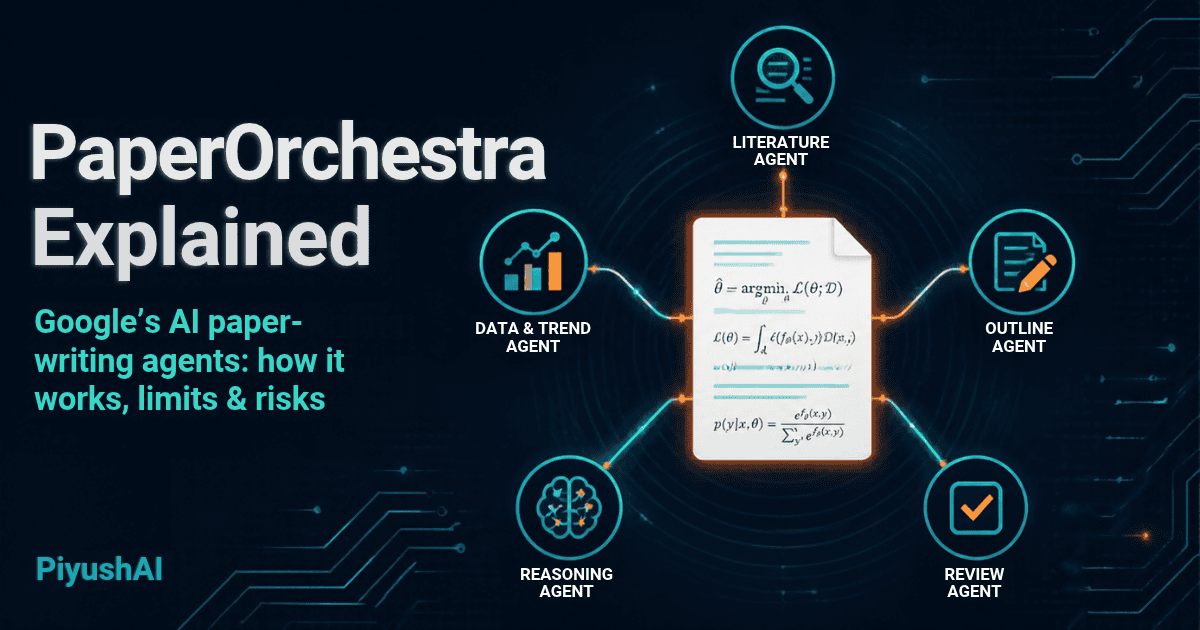
PaperOrchestra is Google Research's open-source multi-agent framework that turns an idea summary and experiment logs into a LaTeX research paper, and it is trending on GitHub this week. Here is what PaperOrchestra is, how it works, what the evaluations show, its limits, the integrity risks, and what it means for Indian students.

Gemini 4 Neon is Google's new middle model in the Gemini 4 family, released on 18 November 2026 at $3/$15 per million tokens with a 1M token context. Here is what Gemini 4 Neon is, how its thinking levels work, what independent tests found, its limits and safety caveats, and why it matters for Indian students.
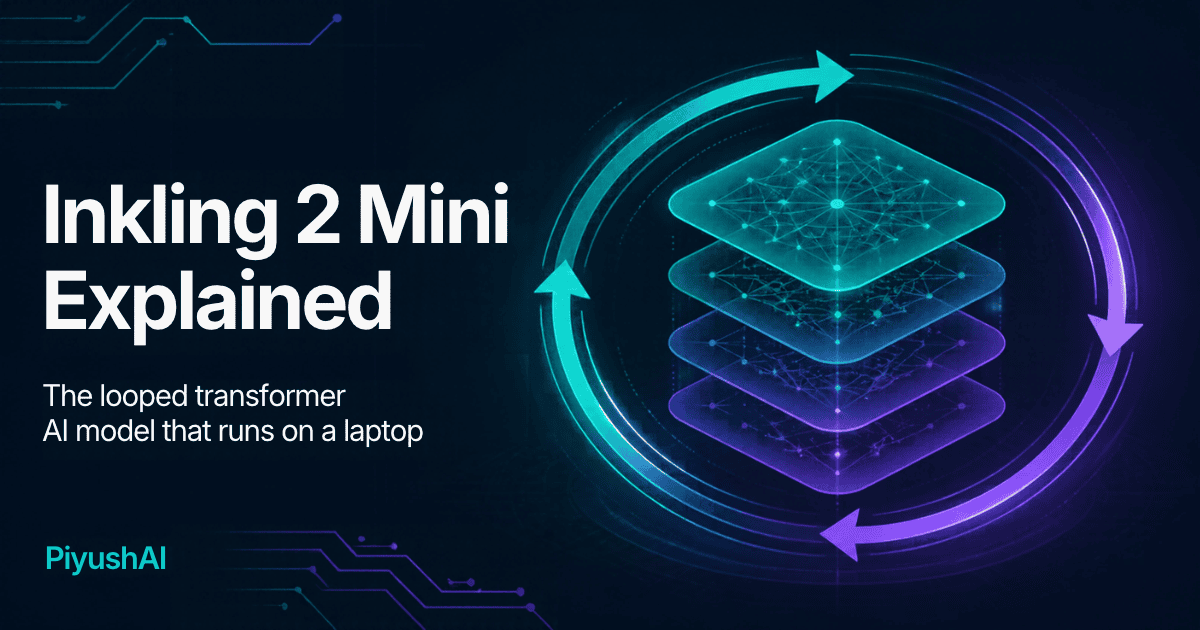
Inkling 2 Mini is Thinking Machines Lab's new Apache 2.0 open-weight model, released on 20 November 2026: 26.4B parameters, about 3.4B active, and a looped transformer that runs its middle layers three times. Here is how Inkling 2 Mini works, what independent tests show, its limits, and why it matters for Indian students.
Genie 4 is Google DeepMind's real-time world model, opened to developers in the Gemini API on 19 November 2026: playable 720p worlds with native audio at about $0.10 per second. Here is what Genie 4 is, how it works, its limits, the deepfake risks, and why it matters for Indian students.

Shirudo is a new open-source Linux security runtime from OpenAI and Cisco, announced on 23 November 2026, that uses AI agents to write signed, temporary "shields" against exploits until a real patch lands. Here is how Shirudo works, its demanding requirements, limits, risks, and why it matters for Indian students.
Learn Daily, Wherever You Are
Free lectures, exam updates, PYQ discussions, and job alerts — delivered through our YouTube channel and Telegram communities.