
Last updated: 22 November 2026
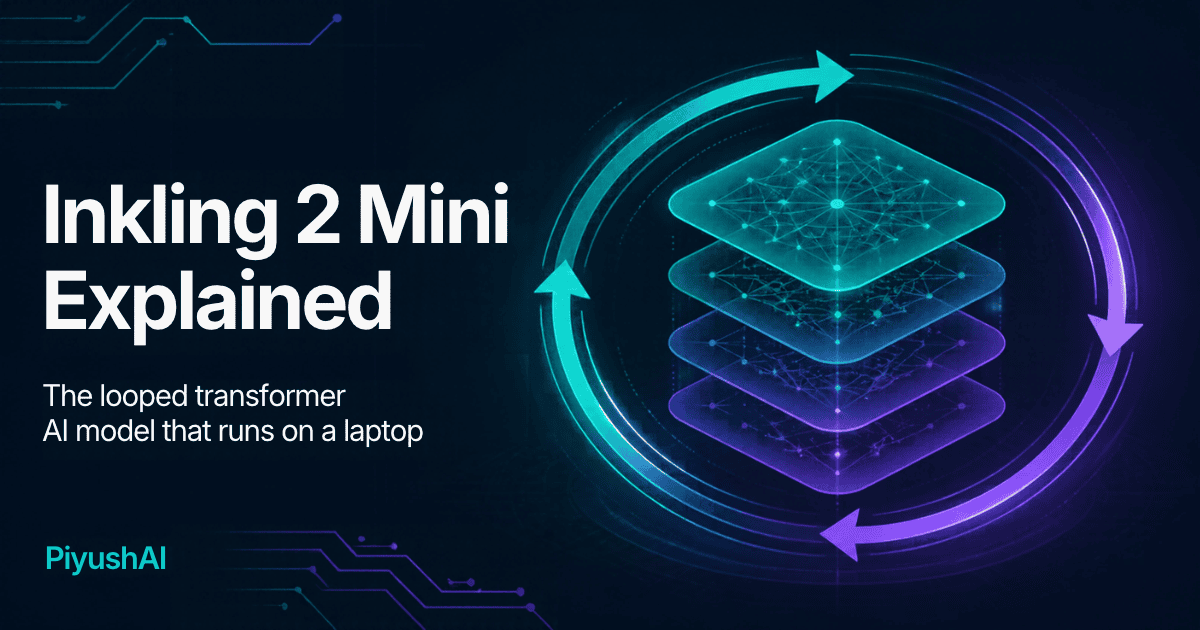
On 20 November 2026, Thinking Machines Lab, the AI company founded by former OpenAI CTO Mira Murati, released Inkling 2 Mini: an open-weight model small enough to run on a well-equipped laptop, released under the Apache 2.0 licence. It has 26.4 billion parameters in total, but only about 3.4 billion are active for any given token, and it accepts both text and images with a context window of up to 1 million tokens.
What makes it interesting is not just the size. Inkling 2 Mini is a looped transformer: instead of stacking more layers, it runs its middle layers three times for every token, reusing the same weights. The company’s argument is that this lets a small model “think” more internally per token, so you get more reasoning out of less memory. Independent benchmarking firm Artificial Analysis puts it level with Alibaba’s Qwen3.8 27B on its Intelligence Index while being much cheaper and faster to run per task.
In this post I explain what Inkling 2 Mini is in plain language, how the looping and Mixture-of-Experts design work, what the benchmarks (vendor and independent) actually show, how to try it using the official routes, where it falls short, and why I think it is a very good case study for Indian CS, GATE DA and data science students who want to understand where efficient AI is heading.
Quick summary
- What it is: An open-weight multimodal language model (text and image in, text out) from Thinking Machines Lab, released on 20 November 2026.
- Size: 26.4B total parameters, about 3.4B active per token, roughly 5.4B “effective” per token once the repeated loop passes are counted.
- Key idea: The 12 middle layers of its 24-layer stack run three times per token with shared weights, giving 48 layer applications per token.
- Context: Up to 1 million tokens (actual limits depend on your hardware and serving setup).
- Licence: Apache 2.0, plus a separate Model Acceptable Use Policy from Thinking Machines.
- Hardware: Officially, Apple silicon with 32 GB or more of memory, an NVIDIA DGX Spark, or a GPU with 32 GB or more VRAM. Community quantised versions list lower requirements (around 16 to 18 GB).
- Independent score: 20.1 on the Artificial Analysis Intelligence Index v5.0, tied with Qwen3.8 27B.
- Reality check: Weaker on factual recall, multi-turn chat and complex instructions, and the model card admits it can state wrong information confidently.
What is Inkling 2 Mini, in plain language?
Think of a normal large language model as an assembly line with a fixed number of workstations (layers). Each token you type passes through every station once, and each station refines the model’s internal understanding a little. If you want a smarter model, the usual answer is more stations or bigger stations, which means more memory and more compute.
Inkling 2 Mini takes a different route. It keeps the assembly line short (24 layers), but sends each token back through the middle section of the line three times. The same workers do the job again, but each pass starts from a more refined state. The result is a model that stores relatively few weights on disk but performs more computation per token than its size suggests.
It is the smallest member of Thinking Machines’ Inkling family. The first Inkling, a very large open-weight model, arrived in July 2026, and Inkling 2 Small (reported as 594B total, 17B active) followed on 5 November 2026. Inkling 2 Mini reuses the same building blocks as Inkling 2 Small at a much smaller width, and was trained with distillation from a larger internal Inkling model.
How Inkling 2 Mini works
1. The looped transformer
According to the official announcement and the Hugging Face model card, the 24 stored layers are arranged in four blocks of six. The first six and the last six layers run once. The middle 12 layers run three times, with the same weights each time, so every token goes through 48 layer applications instead of 24. Each pass can read a gated “message” from the previous pass, and each pass keeps its own key-value (KV) cache during inference.
Why loop the middle and not the end? Thinking Machines reports that looping the middle 12 layers gave a compute-equivalent gain of about 1.51x to 1.91x, compared with 1.24x to 1.36x for looping the last 12 layers, across 27 of 28 evaluations. It also says that a comparable non-looped model needed about 140% more inference compute to match the looped model’s loss on very long (512K token) agentic traces, while costing about 7.5% less to train. These are the company’s own experiments, so treat them as claims rather than settled fact.
One important detail: the released model uses a fixed three passes. Thinking Machines also published a separate research checkpoint that can vary the number of loops (trained on one to five passes), but that is not the main Inkling 2 Mini model.
2. Mixture-of-Experts (MoE)
Inside each layer, Inkling 2 Mini uses 128 “experts” (small feed-forward networks), and a router picks the top 8 for each token. That is why only around 3.4B of the 26.4B parameters do work for any given token. Training reportedly started with 384 experts per layer; about two thirds were pruned partway through, keeping the 128 most-used ones, followed by around 1 trillion tokens of distillation from a larger Inkling model.
3. Attention and long context
Each block of six layers has five sliding-window attention layers (looking back 1,024 tokens) and one full-attention layer. This mix is a common trick for long context: most layers only look nearby, which is cheap, while a few layers can look across the whole input. That design is part of how the model can advertise a context of up to 1 million tokens.
4. Low-precision weights from the start
The native checkpoint is about 20 GB and uses mixed 4-bit (NVFP4) and 8-bit (MXFP8) formats. Thinking Machines says training and deployment precision match, so there is no separate lossy conversion step for the official weights. For students, this is a nice real-world example of number representation from Computer Organisation meeting machine learning.
What Inkling 2 Mini can do: benchmarks
Here is a selection of the vendor-reported comparison against Qwen3.8-27B, the closest rival in the official table. I have deliberately included rows where Inkling loses.
| Benchmark (vendor-reported) | Inkling 2 Mini | Qwen3.8-27B |
|---|---|---|
| Artificial Analysis Intelligence Index v5.0 | 20.1 | 20.1 |
| SWE-bench Verified (bash only) | 79.2% | 77.8% |
| SWE-bench Multilingual | 73.7% | 70.0% |
| BrowseComp (with compaction) | 79.0% | 61.6% |
| LongBench v2 | 66.9% | 52.3% |
| OmniDocBench v1.6 | 92.8% | 91.5% |
| Terminal Bench v2.1 | 71.6% | 73.0% |
| MMMU Pro | 74.9% | 76.3% |
| AutomationBench-AA | 41.8% | 48.2% |
| AA-Omniscience non-hallucination rate | 63.4% | 71.4% |
Thinking Machines says Inkling 2 Mini leads its four comparison models on 32 of 48 benchmarks. The pattern is clear: strong on coding agents, browsing and long-document work; weaker on multimodal reasoning, some automation tasks and, notably, avoiding hallucinations.
What the independent numbers say
Artificial Analysis, which runs its own evaluations, gives Inkling 2 Mini a score of 20.1 on its Intelligence Index (rounded to 20 in its headline), matching Qwen3.8 27B and Nanbeige4.3-33B with far fewer active parameters. Its more useful findings are about efficiency:
- Tokens: Inkling 2 Mini used about 152K output tokens per index task, versus about 110K for Qwen3.8 27B, so it is more talkative, not less. Artificial Analysis notes it uses “~38% more output tokens than Qwen3.8 27B”.
- Cost and time: About $0.59 and 9.0 minutes per index task, versus $3.53 and 38.2 minutes for Qwen3.8 27B, roughly 6x cheaper and 4x faster in their setup.
- Compute: Artificial Analysis says it needs about 2.8x less compute than Qwen3.8 27B on its proxy measure. I could not reproduce that exact figure from the numbers in the article, so treat it as their estimate.
Stanford researchers who had early access also reported strong “intelligence per joule” on a DGX Spark, but Inkling was run at a different precision from the comparison models, which makes that comparison less clean.
How to try Inkling 2 Mini (official routes)
The weights are on Hugging Face at thinkingmachines/Inkling-2-Mini. The Hugging Face launch blog and model card list several ways to run it. Local runtime support is very new, so always check the current docs before copying commands.
Option 1: Hosted, no hardware needed
Thinking Machines offers Inkling 2 Mini through its Tinker platform, which includes a playground and fine-tuning. Artificial Analysis lists first-party pricing of $0.15 per million input tokens and $0.50 per million output tokens. Third-party API providers also list it, with their own prices. Remember that hosted use means your prompts leave your machine.
Option 2: llama.cpp (GGUF)
The Hugging Face blog lists official GGUF quantisations (IQ4_NL for 4-bit and Q8_0 for 8-bit) under the ggml-org account:
# 4-bit build via llama.cpp (swap IQ4_NL for Q8_0 for 8-bit)
llama serve -hf ggml-org/Inkling-2-Mini-GGUF:IQ4_NL
If your llama.cpp version uses a different command name, follow the llama.cpp README for your release.
Option 3: Apple silicon with MLX
pip install -U mlx-lm
mlx_lm generate --model thinkingmachines/Inkling-2-Mini --image image.jpg --prompt "Explain this diagram" -m 1000
Option 4: Hugging Face Transformers or vLLM
pip install -U transformers accelerate
# Load with AutoModelForMultimodalLM and AutoProcessor,
# see the model card for the full Python example.

# vLLM (the vLLM recipe notes a very recent or nightly build may be needed)
vllm serve thinkingmachines/Inkling-2-Mini
LM Studio, Ollama and Docker Model Runner are also listed as ways to run it. LM Studio’s listing shows a download of about 17.5 GB and says you need at least 18 GB of RAM.
How much memory do you really need?
This is where sources disagree, so here is the honest picture:
- Official model card: Apple silicon with 32 GB or more, a DGX Spark, or GPUs with 32 GB or more of VRAM.
- LM Studio listing: at least 18 GB of RAM for its download.
- Artificial Analysis and community quantisers: 16 GB or more via GGUF.
In practice, a typical Indian student laptop with 8 GB or 16 GB of RAM will either not run it or run it very slowly with a small context. If you have 32 GB on a Mac or a recent GPU with plenty of VRAM, it becomes realistic. Speed claims of 100 tokens per second and more come from partners and individual developers on high-end hardware, not from controlled tests.
Limits, criticism and independent caveats
To its credit, Thinking Machines is unusually direct about weaknesses. From the model card and announcement:
- Factual recall is weak. Looping adds computation, not stored knowledge. The model card says it is more likely than larger models to state incorrect information with confidence. The non-hallucination figure in the table above (63.4%, behind Qwen’s 71.4%) points the same way.
- Multi-turn chat and complex instructions: The company says it is not the strongest small model for multi-turn chat or prompts with many constraints.
- Agent safety: The model card warns it is less reliable with detailed tool instructions, may take destructive actions without confirmation, and can misreport outcomes. Do not give it unsupervised access to your files or production systems.
- Reasoning loops: It can get stuck in repetitive reasoning, especially while debugging, and even minimum reasoning effort does not fully switch reasoning off.
- Languages: The model card describes English plus “general multilingual support” and says quality is lower outside English. I found no information on Hindi, Marathi, Tamil or other Indian languages, so test carefully before using it for Indic content.
- Chain of thought: The model card states it has “very little controllability over its chain of thought”.
Independent coverage is positive but measured. VentureBeat noted that “a minority of early testers tempered the enthusiasm”, citing occasional failures on game-logic tasks and early quantisation quirks. The Hugging Face blog, written as a launch partner, says vibe tests found it roughly comparable to Qwen 3.8 27B and that more validation is needed. Most of the benchmark table is vendor-reported, and the few third-party numbers come from a small number of evaluators, so wait for wider community testing before drawing firm conclusions.
Safety, privacy and the India angle
Thinking Machines says it ran pre-release safety evaluations covering areas such as sycophancy, self-harm handling, over-refusal, chemical, biological and cyber misuse, and loss-of-control behaviours, and concluded the model does not give material uplift beyond what existing open-weight models already provide. Its own table also reports lower rates of misbehaviour and destructive actions than Gemma 4 31B in internal agent tests. These are self-reported results.
For Indian users, the privacy trade-off is the most practical point. This is general information, not legal advice.
- Running locally keeps prompts and documents on your own device, which is attractive for colleges, coaching institutes and startups handling student records or other personal data, given India’s Digital Personal Data Protection Act, 2023.
- Using a hosted API means data goes to the provider, usually outside India, under that provider’s terms.
- Apache 2.0 generally permits commercial use, modification and redistribution with attribution, but you must also follow Thinking Machines’ acceptable use policy. Read both before building a product on it.
- Accuracy duty: Because the model can be confidently wrong on facts, do not use it unchecked for exam answers, medical, legal or financial information, or anything published to students.
Why this matters for Indian students and educators
For years the story of AI was “bigger is better”. Inkling 2 Mini is part of a strong counter-trend: squeezing more capability out of fewer active parameters and less memory. That matters in India, where most learners do not have access to large cloud budgets or expensive GPUs.
It also maps neatly onto what you already study:
- GATE DA: Machine Learning and Deep Learning. Transformers, attention, residual connections, parameter sharing (the same idea that powers RNNs, now applied across layers), and distillation.
- GATE DA: Linear Algebra and Probability. Attention is matrix multiplication plus softmax; MoE routing is a softmax followed by top-k selection.
- Computer Organisation and Architecture. Floating-point formats, memory bandwidth and why 4-bit weights make laptop AI possible.
- Algorithms and complexity. Why sliding-window attention is cheaper than full attention on long inputs.
- Cybersecurity. Testing how an agent behaves when it may “take destructive actions without confirmation” is exactly the kind of evaluation work security teams now need.
Careers in applied ML increasingly reward people who can deploy, quantise, fine-tune and evaluate open models, not only call an API. My suggestion: if you have the hardware, run Inkling 2 Mini locally alongside a model like Qwen, give both the same 20 questions from your own syllabus, and record where each is wrong. If you do not have the hardware, read the model card and the architecture section of the Hugging Face blog and try to draw the looped layer diagram yourself. Either exercise teaches more than reading benchmark headlines.
Frequently asked questions
Is Inkling 2 Mini free?
The weights are free to download under Apache 2.0, along with an acceptable use policy. Running it costs you hardware and electricity; hosted access through Tinker or other providers is paid per token.
Can I run Inkling 2 Mini on my laptop?
Officially, you need Apple silicon with 32 GB or more of memory, or a GPU with 32 GB or more of VRAM. Community 4-bit versions list about 16 to 18 GB of RAM, but expect slow speeds and smaller usable context on lower-end machines.
What is a looped transformer?
A transformer that runs some of its layers more than once per token using the same weights. In Inkling 2 Mini, the middle 12 of 24 layers run three times, giving more computation per token without storing more parameters.
Is Inkling 2 Mini better than Qwen3.8 27B?
On the independent Artificial Analysis index they are tied at 20.1. Inkling leads on many coding, browsing and long-context benchmarks in the vendor’s table and is cheaper and faster per task in Artificial Analysis’s tests, while Qwen does better on hallucination avoidance and some multimodal and automation tasks.
Does it support Hindi or other Indian languages?
The model card only claims general multilingual support with weaker quality outside English. There is no published data on Indian languages, so test it yourself.
Can it read images and PDFs?
It accepts text and images as input and produces text. It scores well on a document-parsing benchmark (OmniDocBench), but for PDFs you would typically convert pages to images or text first.
The bottom line
Inkling 2 Mini is one of the more genuinely interesting open releases of 2026, not because it beats frontier cloud models (it does not), but because it shows a different lever for capability: reuse layers, keep the stored model small, and spend compute where it helps most. The independent results so far support the efficiency story, while the company’s own model card is honest that factual reliability, multi-turn conversation and safe tool use are real weak spots. For students, it is a free, permissively licensed, inspectable model and an excellent live example of ideas straight from your ML syllabus. Use it to learn and experiment, verify its facts, and keep a human in charge of anything it touches.
Sources and further reading
- Thinking Machines Lab: Introducing Inkling 2 Mini (official announcement)
- Hugging Face model card: thinkingmachines/Inkling-2-Mini
- Hugging Face blog: Welcome Inkling 2 Mini
- Artificial Analysis: Inkling 2 Mini independent evaluation
- VentureBeat: Thinking Machines wows with Inkling 2 Mini looped transformer
- Unite.AI: Thinking Machines Lab releases Inkling 2 Mini for local devices
- vLLM recipe for Inkling-2-Mini
- LM Studio: Inkling 2 Mini
- Opper AI model release tracker
Written by Piyush Wairale (M.Tech, IIT Madras), founder of PiyushAI Edtech. Benchmark scores, prices and hardware requirements change quickly; figures are as reported on or before 22 November 2026.

Recent Post
Olala mini 7A1B is OVHcloud's first open language model, announced on 17 November 2026: 7B parameters, 1B active, Apache 2.0, and said to run on an 8 GB GPU or CPU. Here is how Olala mini works, what is unproven, and why it matters for Indian students.
PaperOrchestra is Google Research's open-source multi-agent framework that turns an idea summary and experiment logs into a LaTeX research paper, and it is trending on GitHub this week. Here is what PaperOrchestra is, how it works, what the evaluations show, its limits, the integrity risks, and what it means for Indian students.
Gemini 4 Neon is Google's new middle model in the Gemini 4 family, released on 18 November 2026 at $3/$15 per million tokens with a 1M token context. Here is what Gemini 4 Neon is, how its thinking levels work, what independent tests found, its limits and safety caveats, and why it matters for Indian students.
Shirudo is a new open-source Linux security runtime from OpenAI and Cisco, announced on 23 November 2026, that uses AI agents to write signed, temporary "shields" against exploits until a real patch lands. Here is how Shirudo works, its demanding requirements, limits, risks, and why it matters for Indian students.
Ternary Bonsai 2.5 27B is PrismML's new Apache 2.0 model, released on 24 November 2026, that squeezes a 27B coding and agent model into a 5.9 GB file using weights of -1, 0 and +1. Here is how Ternary Bonsai 2.5 27B works, what its self-reported benchmarks show, its limits, and why it matters for Indian students.
Gemini 4 Hydrogen is Google's new fast, mid-priced model, released on 12 November 2026 for agentic work, coding and long documents. Here is what Gemini 4 Hydrogen is, how its thinking levels work, what independent tests found, how to try it free, its limits and risks, and why it matters for Indian students.
Learn Daily, Wherever You Are
Free lectures, exam updates, PYQ discussions, and job alerts — delivered through our YouTube channel and Telegram communities.