
Quick answer: You can take a free JEE NEET mock test with AI on JEENEETAI by PiyushAI. It combines AI-generated questions at real exam difficulty, about 10 years of previous year papers (PYQs), full mock tests, step-by-step doubt solving and chapter-wise weak-area tracking for JEE Main, JEE Advanced and NEET. It is free to start.
Every year lakhs of students prepare for JEE and NEET, and most of them work hard. The difference between a good rank and an average one is rarely effort. It is feedback: knowing exactly which chapters are costing you marks and fixing them before exam day. A free JEE NEET mock test powered by AI gives you that feedback after every attempt, not once a month.
In this guide, I (Piyush Wairale, M.Tech IIT Madras, former instructor in the IIT Madras BS Degree Programme) explain how to use AI mock tests, PYQs and weak-area analysis together, and share a 7-step routine you can start today on JEENEETAI.
Table of Contents
Key Takeaways
- A free JEE NEET mock test is most useful when it is followed by analysis, not just a score.
- JEENEETAI combines AI practice questions, about 10 years of PYQs, mock tests, stepwise doubt solving and chapter-wise weak-area tracking in one place.
- Use the 7-step loop below: diagnose, practise PYQs, target weak chapters, clear doubts, take a full mock, analyse, repeat.
- It works for JEE Main, JEE Advanced and NEET UG aspirants in Class 11, Class 12 and droppers.
What Is JEENEETAI?
JEENEETAI is an AI-powered exam preparation platform built by PiyushAI Edtech for JEE Main, JEE Advanced and NEET aspirants. Its tagline sums it up: AI mock tests, PYQs and doubt solving for JEE and NEET. Instead of giving you a fixed book of questions, it generates fresh questions at exam difficulty, so you never run out of practice and never simply memorise answers.
If you want an overview of the full platform and its AI tutor features, read our JEE NEET AI Learning Platform page. This article focuses on how to use the free mock tests to actually raise your score.
Features of the Free JEE NEET Mock Test Platform
| Feature | What it does | Why it helps your score |
|---|---|---|
| AI-generated questions | Creates new questions at JEE and NEET difficulty | Unlimited fresh practice, no answer memorisation |
| Previous year papers (PYQs) | About 10 years of past papers | Shows what the exam actually asks and how often |
| Mock tests | Full-length timed tests | Builds speed, stamina and time management |
| Stepwise doubt solving | Explains solutions step by step | Fixes the concept, not just the answer |
| Chapter-wise weak-area tracking | Tracks accuracy by chapter | Tells you exactly where to spend your next hour |
| Free to start | No payment needed to begin | Every student can try it today |
Why a Free JEE NEET Mock Test Beats Random Practice
After teaching more than 20,000 students, I see the same pattern every season. Students solve hundreds of questions a day, but their mock score stays flat. The reason is simple: they keep practising chapters they are already good at, because it feels productive.
A mock test followed by honest analysis breaks that cycle. It answers three questions:
- Where am I losing marks? Chapter-wise accuracy, not just a total score.
- Why am I losing them? Concept gap, calculation error, silly mistake or time pressure.
- What should I do next? Targeted practice on those exact chapters.
This is called deliberate practice, and AI makes it fast. What used to need a teacher checking your answer sheet for an hour now happens the moment you submit.
How to Use a Free JEE NEET Mock Test: 7 Proven Steps
Step 1: Take a Diagnostic Mock Test
Start with one free JEE NEET mock test on JEENEETAI before you change anything in your routine. Do it under real exam conditions: timed, no phone, no notes. Your goal is not a high score. Your goal is an honest baseline.
Step 2: Read Your Chapter-Wise Weak-Area Report
Look at accuracy by chapter, not your total. List your bottom five chapters in Physics, Chemistry and Mathematics (JEE) or Physics, Chemistry and Biology (NEET). These five chapters are your focus for the next week.
Step 3: Solve PYQs for Those Chapters First
PYQs show how the exam tests a concept. For each weak chapter, solve the previous year questions from the last several years before anything else. Notice which sub-topics repeat. That pattern is your priority list.
Step 4: Practise AI-Generated Questions on the Same Chapters
Once PYQs are done, switch to AI-generated questions at exam difficulty. Because they are new every time, you test your understanding instead of your memory. Aim for 20 to 30 questions per weak chapter per day.
Step 5: Clear Every Doubt Step by Step
Never skip a wrong answer. Use the stepwise doubt solver to see where your method went wrong. Write a one-line note on the mistake in a separate “error notebook”. Revising this notebook before every mock is one of the highest-return habits in exam preparation.
Step 6: Take a Full-Length Mock Every Week
Once a week, take a complete free JEE NEET mock test at the same time slot as your actual exam. This trains your brain to peak at the right hour and builds the stamina needed for a three-hour paper.
Step 7: Analyse, Update, Repeat
Compare your new chapter-wise report with last week’s. Chapters that improved move out of your focus list. New weak chapters move in. This loop, repeated every week, is how scores rise steadily instead of randomly.
Weekly Study Plan Using JEENEETAI
| Day | JEE aspirants | NEET aspirants |
|---|---|---|
| Monday | PYQs on 2 weak Maths chapters | PYQs on 2 weak Biology chapters |
| Tuesday | AI practice: Physics weak chapters | AI practice: Physics weak chapters |
| Wednesday | AI practice: Chemistry weak chapters | AI practice: Chemistry weak chapters |
| Thursday | Mixed AI practice + doubt solving | Biology (NCERT-based) AI practice + doubt solving |
| Friday | Revise error notebook | Revise error notebook |
| Saturday | Full-length JEE mock test | Full-length NEET mock test |
| Sunday | Analyse report, set next week’s 5 chapters | Analyse report, set next week’s 5 chapters |
Adjust the plan to your school or coaching timetable. Even 90 focused minutes a day on this loop beats four unfocused hours.
AI Mock Tests vs Traditional Test Series
| Aspect | Traditional test series | JEENEETAI AI mock tests |
|---|---|---|
| Number of questions | Fixed set | Fresh AI-generated questions |
| Feedback speed | Often days later | Instant after submission |
| Weak-area analysis | Subject-level at best | Chapter-wise tracking |
| Doubt solving | Wait for a teacher | Step-by-step explanation |
| Cost to start | Usually paid | Free to start |
AI does not replace good teachers or NCERT. It removes the waiting: you find a gap and work on it the same day.
How to Analyse a Mock Test in 30 Minutes
The analysis after a mock test matters more than the test itself. Here is a simple 30-minute routine you can follow right after every free JEE NEET mock test.
- Minutes 0 to 5: Sort your mistakes. Put every wrong or skipped question into one of four buckets: did not know the concept, knew the concept but used the wrong method, calculation or silly mistake, and ran out of time.
- Minutes 5 to 15: Fix the concept gaps. For the “did not know” bucket, open the stepwise solution and re-read the related NCERT section. Do not move on until you can explain the idea in your own words.
- Minutes 15 to 22: Redo the method errors. Solve those questions again without looking at the solution. If you get them right, the method is now fixed.
- Minutes 22 to 27: Log silly mistakes. Write each one in your error notebook: sign errors, unit conversions, misreading the question, wrong option marked.
- Minutes 27 to 30: Plan the time. Note how long you spent on each subject and which questions you should have skipped earlier.
Students who follow this routine every week usually find that silly mistakes and time pressure, not hard concepts, are the biggest and easiest marks to recover.
JEE vs NEET: How Your Mock Test Strategy Should Differ
The same AI platform serves both exams, but the way you practise should match the exam you are writing.
| Area | JEE Main and JEE Advanced | NEET UG |
|---|---|---|
| Main focus | Problem solving depth in Physics, Chemistry and Mathematics | Speed and accuracy, with Biology carrying the largest share |
| Best use of PYQs | Learn patterns of multi-concept problems | Spot repeated NCERT lines and facts |
| Best use of AI questions | Fresh numerical and multi-step problems on weak chapters | High-volume chapter-wise practice to build speed |
| Common weak spot | Calculation errors and time spent on one long question | Careless reading and confusing similar NCERT statements |
| Mock test tip | Practise skipping and returning to tough questions | Practise finishing Biology quickly to save time for Physics |
JEE Advanced is a different level from JEE Main. Once your JEE Main mock scores are stable, use chapter-wise AI practice at higher difficulty to build the depth that JEE Advanced needs.
Using a Free JEE NEET Mock Test in the Final 60 Days
The last two months before the exam are about revision and exam temperament, not new chapters. Change your routine like this:
- Increase full mocks to two or three per week, always at your actual exam time slot.
- Keep analysis strict. Every mock still gets the 30-minute review above.
- Revise from your error notebook daily. It is the most personal and valuable revision material you have.
- Use AI practice only for weak chapters, in short sets of 15 to 20 questions.
- Solve the most recent PYQs as full papers to get comfortable with the latest exam style.
- Protect sleep and health. A rested mind scores more than a tired one with one extra mock.
Tips for Parents and Teachers
Parents and teachers can use the chapter-wise weak-area report as a calm, factual way to talk about progress. Instead of asking “what was your score?”, ask “which chapter improved this week, and which one needs work next?”. This keeps the focus on effort and learning, reduces pressure and helps students build a steady weekly habit. Teachers can also assign AI practice on the same weak chapters to a whole batch and discuss common mistakes in class.
Who Should Use This Free JEE NEET Mock Test?
- Class 11 students who want to build strong basics chapter by chapter.
- Class 12 students balancing board exams with JEE or NEET.
- Droppers who need sharp, data-driven revision.
- Students in smaller cities without access to large coaching test series.
- Teachers and parents who want a clear view of a student’s weak chapters.
Common Mistakes Students Make with Mock Tests
- Taking mocks without analysis. A score alone teaches you nothing.
- Taking too many mocks too early. Build concepts first, then test weekly.
- Skipping PYQs. They are the most reliable signal of what the exam values.
- Ignoring silly mistakes. Track them; they often cost more marks than hard questions.
- Comparing only total scores. Compare chapter-wise accuracy week to week.
Official Exam Information
Always confirm exam dates, syllabus and pattern from the official National Testing Agency (NTA) websites: JEE Main (NTA) and NEET UG (NTA). JEE Advanced is conducted by the IITs; check its official site once the information bulletin is released.
About the Author
Piyush Wairale is the founder and CEO of PiyushAI Edtech, holds an M.Tech from IIT Madras and is a former instructor in the IIT Madras BS Degree Programme. He has taught more than 20,000 students and received the Vidarbha Ratna Puraskar 2026 for Best Data Science and AI Educator. Read more about AI in learning in our guide on AI literacy for students, or browse all PiyushAI articles.
Frequently Asked Questions
Is the JEE NEET mock test on JEENEETAI really free?
Yes. JEENEETAI is free to start, so you can take a free JEE NEET mock test, practise PYQs and try AI questions without paying.
Which exams does JEENEETAI cover?
It covers JEE Main, JEE Advanced and NEET UG.
Are AI-generated questions as good as real exam questions?
They are generated at JEE and NEET difficulty and are best used together with PYQs. Use PYQs to learn what the exam asks, and AI questions for unlimited fresh practice on the same concepts.
How many years of previous year questions are available?
JEENEETAI includes about 10 years of previous year papers.
How often should I take a full mock test?
For most students, one full-length mock test per week, followed by chapter-wise analysis, works best. Increase to two or three per week in the final two months before the exam.
Can Class 11 students use it?
Yes. Class 11 students can practise chapter by chapter and use the weak-area report to strengthen basics early.
Find your weak chapters in one test
AI mock tests, 10 years of PYQs and stepwise doubt solving for JEE and NEET. Free to start.
Take the Free JEE NEET Mock TestRecent Post
DeepTutor, the open-source AI tutor from the University of Hong Kong, hit number one on GitHub trending in late October 2026. Here is what DeepTutor is, how it works, how to install it, what its research really shows, the privacy risks, and what it means for Indian students and teachers.
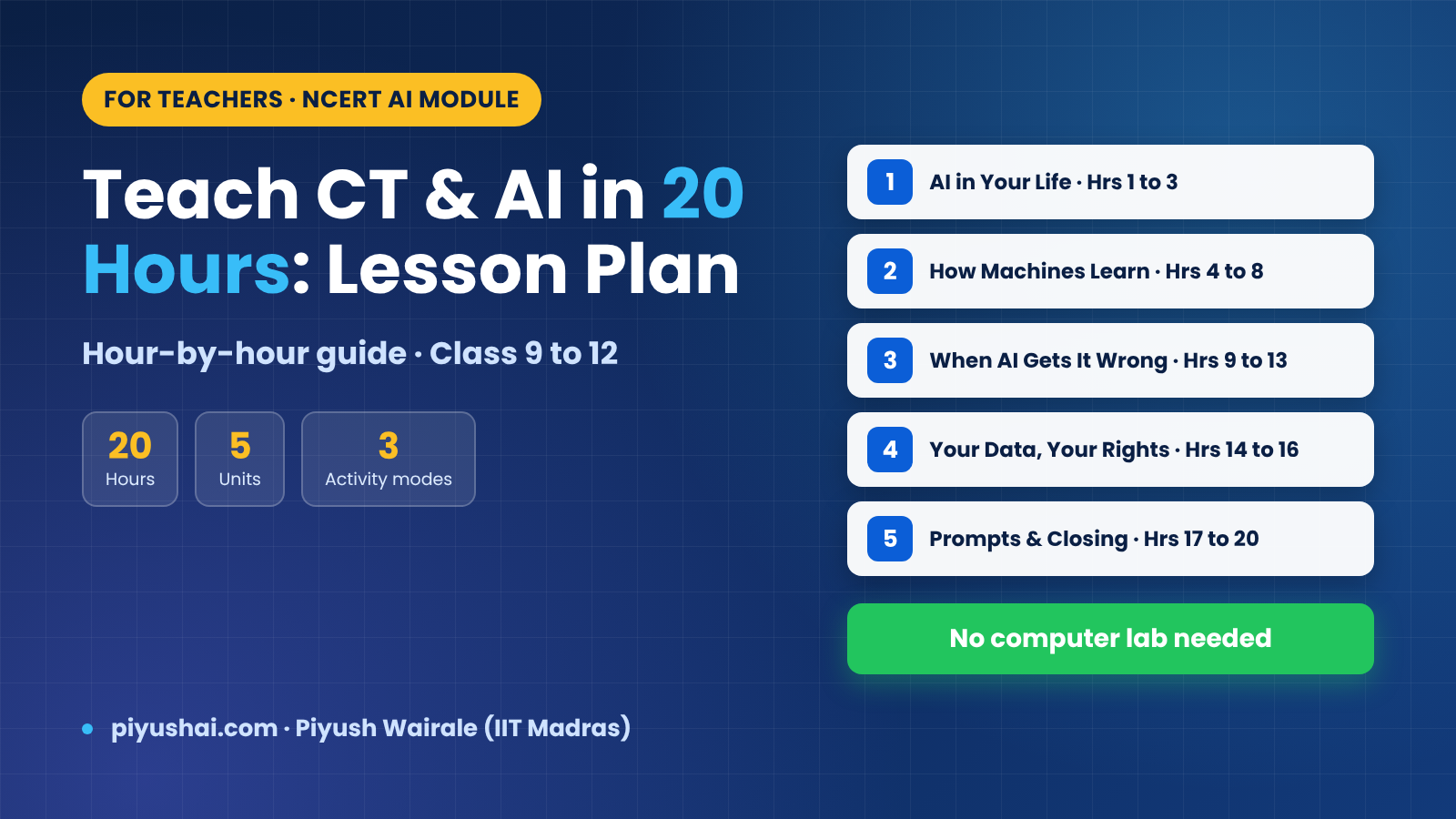
An hour-by-hour plan for teaching NCERT's 20-hour Computational Thinking and AI module to Classes 9 to 12, based on the official Note for the Teacher. Covers the three activity modes, core and enrichment activities for every hour, Curious Notebook assessment, handling sensitive topics, and practical tips for schools with no computer lab.
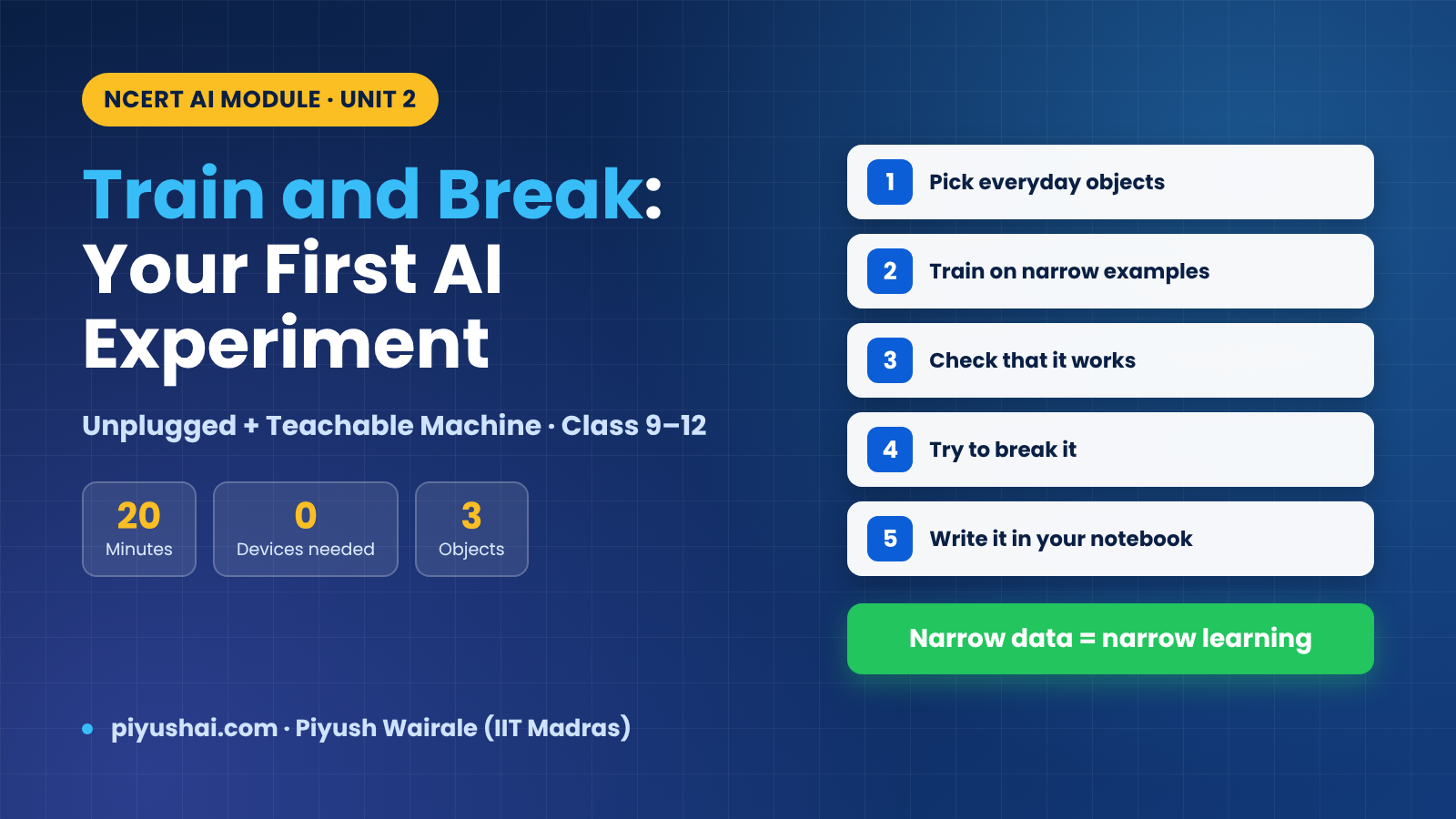
Train and Break is the main hands-on activity in Unit 2 of NCERT's Computational Thinking and AI module for Classes 9 to 12. Here is how to run it step by step, both as the unplugged Human Classifier and on a free image-classifier tool, plus the concepts it teaches (training, validation, test and live data, overfitting) and the Curious Notebook write-up.
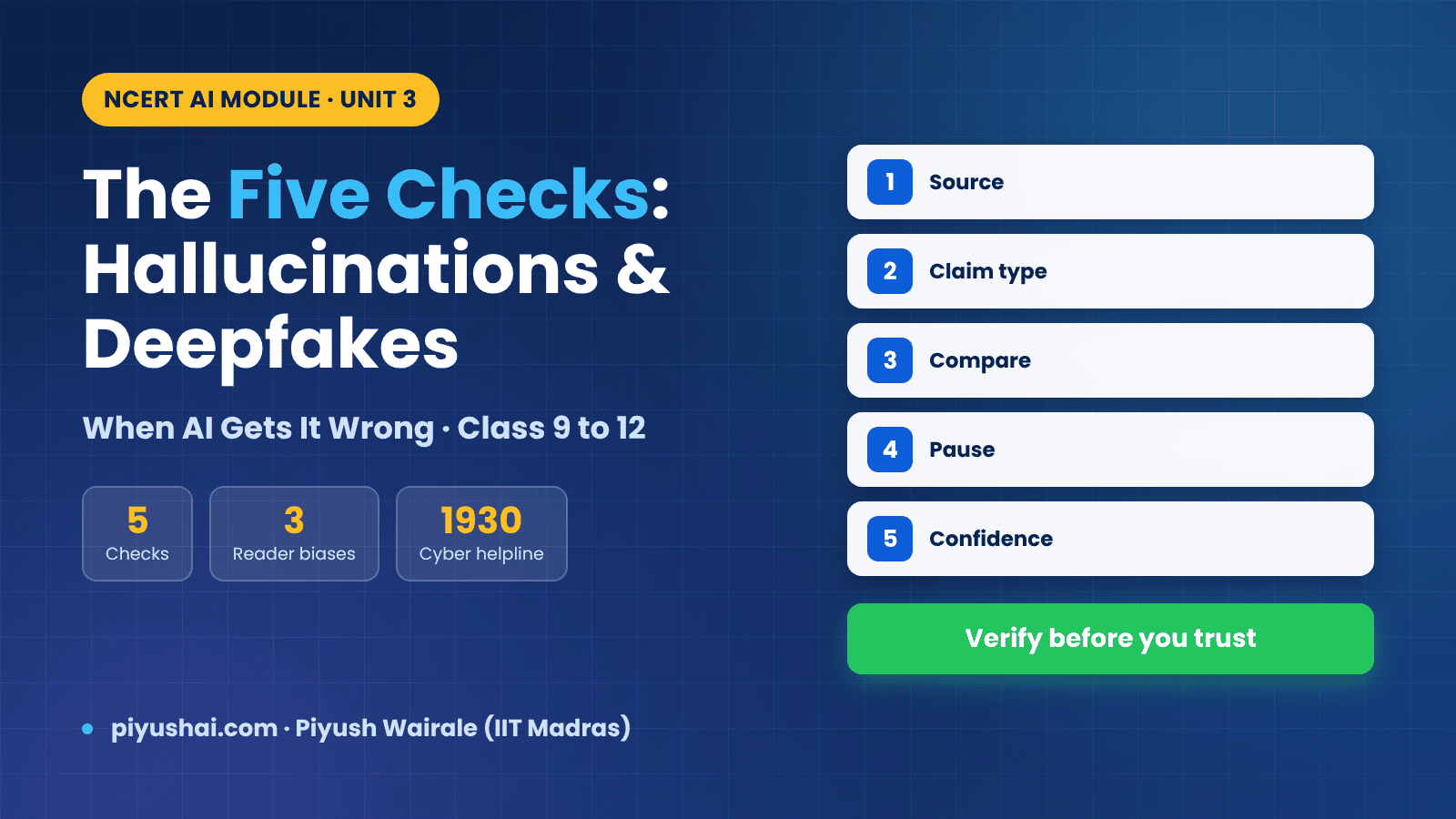
Unit 3 of NCERT's Computational Thinking and AI module, "When AI Gets It Wrong", teaches Class 9 to 12 students why AI is confidently wrong, how deepfakes work, the three reader biases, and the Five Checks: Source, Claim type, Compare, Pause and Confidence. Full explainer with the Hallucination Hunt activity and answers to the unit's key questions.
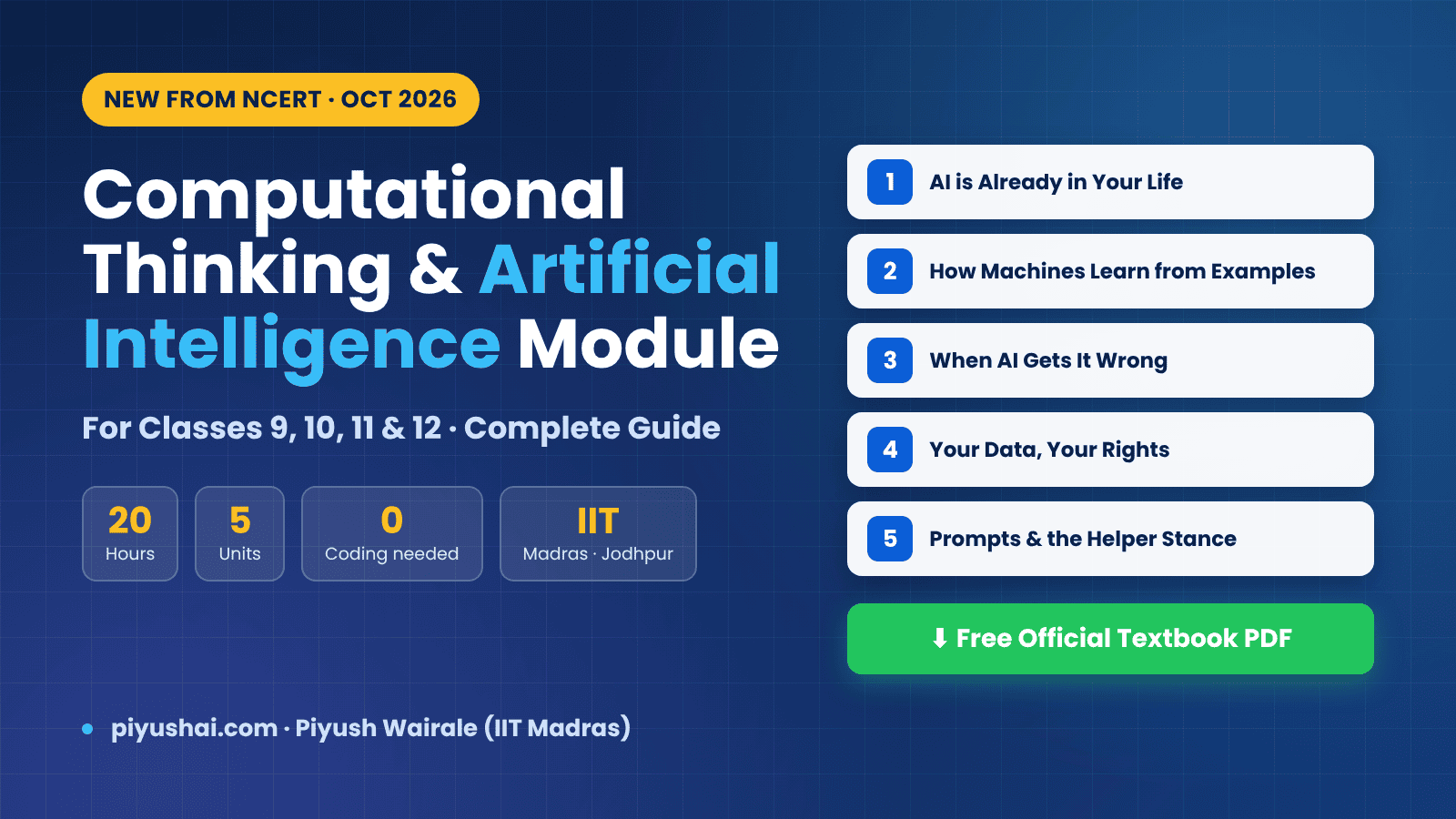
NCERT has released a 20-hour, five-unit Computational Thinking and AI module for Classes 9 to 12, developed with IIT Madras and IIT Jodhpur. Here is the complete unit-wise breakdown, the 20-hour plan, the Five Checks, the Curious Notebook assessment, and the official NCERT textbook PDF download.
A complete five-hour teaching guide for Chapter 4 of CBSE Class 6 AI: digital footprints, privacy, passwords, online safety and ethical use of technology. Includes period plans, six diagrams, three unplugged activities, a worksheet with answer key, misconceptions, a rubric and India-specific reporting channels for schools.
Learn Daily, Wherever You Are
Free lectures, exam updates, PYQ discussions, and job alerts — delivered through our YouTube channel and Telegram communities.