
Last updated: 20 November 2026
This week an open-source repository from Google Research called PaperOrchestra shot up GitHub’s trending list. According to a report on 18 November 2026, it gained more than 1,500 stars in a single day and reached about 3,700 stars, and by 20 November the official repository google-research/paper-orchestra was showing roughly 4,500 stars and 550 forks. For a project that had been gaining only a handful of stars a week, that is a sudden jump.
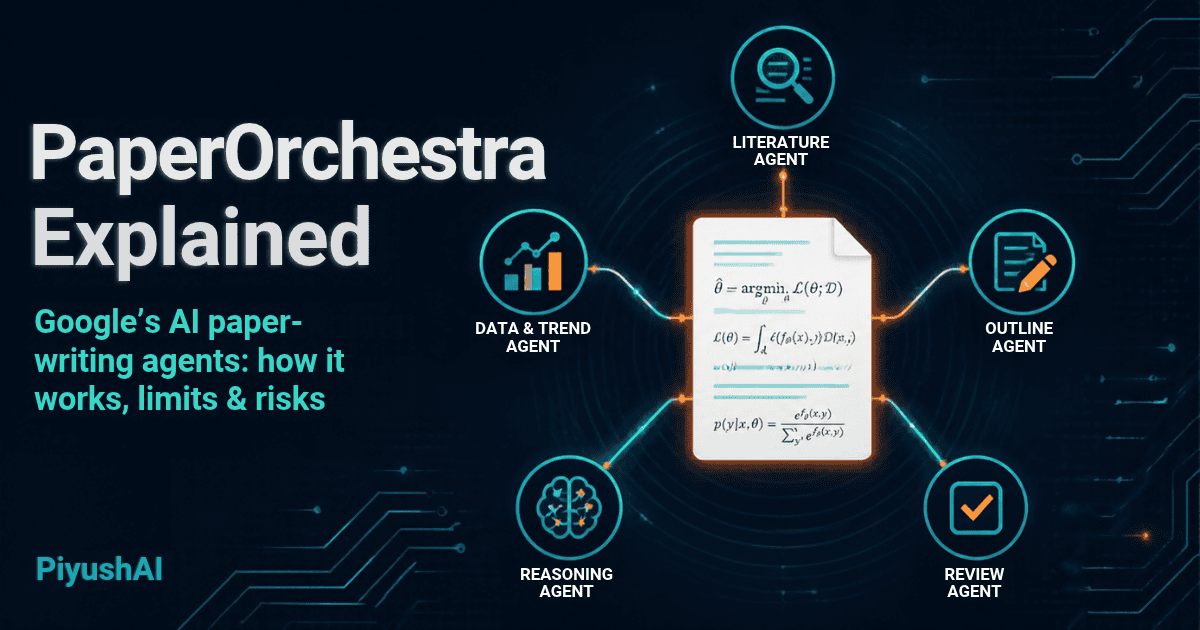
The pitch is easy to understand and hard to ignore: give the system a short summary of your research idea, your raw experiment logs and a conference LaTeX template, and a team of AI agents produces a complete, formatted research paper with a literature review, citations, plots and diagrams. The research behind it was first published on arXiv in April 2026, but the code is now what everyone is talking about.
I want to explain this one carefully, because it touches something close to every M.Tech, PhD and final-year B.Tech student in India: writing up research. In this post I cover what PaperOrchestra actually does, how its five agents work, how to set it up, what the evaluations really show (including where it loses to humans), the academic integrity rules you must know, and my honest view on how students should and should not use it.
Quick summary
- What it is: An open-source, multi-agent framework from Google Cloud AI Research that converts pre-writing materials (an idea summary and experimental logs) into a submission-style LaTeX manuscript.
- Who made it: Yiwen Song, Yale Song, Tomas Pfister and Jinsung Yoon. The paper is arXiv 2604.05018, submitted on 6 April 2026.
- How it works: Five specialised agents handle the outline, plots and diagrams, literature review, section writing, and iterative refinement based on simulated peer review.
- Licence and cost: Apache 2.0 code, free to download. You pay for the LLM API calls it makes (Gemini or OpenAI models) and need a Semantic Scholar API key for citation checks.
- Results: In blind human evaluations it beat two AI baselines, but human-written papers still won clearly.
- What it does not do: It does not run your experiments, discover new results, or take responsibility for what it writes. That stays with you.
What is PaperOrchestra, in plain language?
Think of the last stage of a research project. The experiments are done, the numbers are sitting in log files and spreadsheets, and you have a rough idea of the story. What remains is the slow part: reading and citing related work, structuring the paper, making figures, writing each section in the venue’s style, and revising until it reads well. Many students find this stage harder than the experiments themselves.
PaperOrchestra automates exactly that stage. It is not an “AI scientist” that invents hypotheses and runs experiments. The authors deliberately scoped it to writing: their benchmark assumes the experiments are complete and drafting has not started. That narrow scope is one reason it performs better than broader systems on the writing task, and also the main reason you should not over-read the results.
A note on names: the official project lives at google-research/paper-orchestra. Several community ports with similar names have appeared, including agent “skill” versions for coding assistants. These are not Google’s code, so check the owner before you install anything.
How PaperOrchestra works
The system takes three kinds of input:
- Raw materials: an idea summary (a short description of the problem, method and contribution) and an experimental log (the numbers, settings and observations from your runs).
- A LaTeX template: for example the CVPR template that ships with the repository.
- Venue guidelines: page limits and formatting rules for the target conference.
These are then passed through five agents:
| Agent | What it does |
|---|---|
| Outline Agent | Turns the idea summary and logs into a structured plan for the paper: sections, key claims, which results go where, and which figures are needed. |
| Plotting Agent | Generates statistical plots from the logged results and conceptual diagrams of the method. This step is optional and off by default. |
| Literature Review Agent | Runs targeted web searches for related work, then checks that each paper actually exists and is relevant using the Semantic Scholar API before it can be cited. |
| Section Writing Agent | Writes the full LaTeX for each section in the venue’s template, weaving in the verified citations and figures. |
| Content Refinement Agent | Reviews the draft as a simulated peer reviewer would and revises it over several rounds. |
The design point worth noticing is the citation step. A common failure of AI-written text is invented references: plausible titles, real-sounding authors, papers that do not exist. PaperOrchestra tries to block that by grounding every reference in a real bibliographic database. That reduces fake citations, but it does not prove that a real paper actually supports the sentence it is attached to. I come back to this below.
The authors also report that some agents can run in parallel, and an independent review estimates around 50 to 70 model calls per manuscript, with timed runs averaging about 40 minutes. No official cost per paper has been published, and it will depend heavily on which model you choose.
How to set it up (official method)
The README describes a straightforward Python setup. At the time of writing it looks like this:
# Create an environment (Python 3.11)
conda create -n paper_orchestra python=3.11
conda activate paper_orchestra
pip install -r requirements.txt

# Add API keys to a .env file in the project root, for example:
# SEMANTIC_SCHOLAR_API_KEY=...
# GEMINI_API_KEY=...   (or Vertex AI project details)
# OPENAI_API_KEY=...   (optional)

# Run the pipeline
python paper_writing_cli.py \
  --raw_materials_dir /path/to/raw_materials/ \
  --latex_template_dir /path/to/latex_template/ \
  --output_dir /path/to/output/ \
  --use_plotting true
The repository also includes a Streamlit web demo in the frontend folder and the automatic evaluation scripts (“autoraters”) used in the paper. Command-line flags let you choose separate models for the writing agents and the reflection agents. The README carries the standard note that this is not an officially supported Google product, so treat it as research code. Always check the current README, because flags and defaults can change.
Privacy tip: everything you put in the raw materials folder, including unpublished results, is sent to whichever LLM provider you configure. If your work is under an NDA, part of a patent filing, or belongs to a sponsored project, check your institution’s rules before uploading it to any external API.
What the evaluations show
To test the system, the authors built PaperWritingBench: they took 200 accepted papers (100 from CVPR 2025 and 100 from ICLR 2025) and reverse-engineered the raw materials each one would have started from, so different systems could be asked to write the same paper from the same inputs.
The headline results from the paper:
- Against AI baselines: In blind side-by-side human evaluations, PaperOrchestra beat a single-call LLM writer and Sakana’s AI Scientist-v2 by win-rate margins of 50% to 68% on literature review quality and 14% to 38% on overall manuscript quality.
- Study size: According to an independent review of the paper, 11 AI researchers judged 40 sampled papers across 180 paired comparisons.
- Against humans: The same review reports that when compared with the original human-written papers, PaperOrchestra lost by large margins (about 38 points on literature review and about 76 points on overall quality). The project page itself acknowledges that a quality gap remains.
- Automated reviewers: Summaries of the paper report simulated acceptance rates of up to 84% (CVPR) and 81% (ICLR) using an AI reviewer called ScholarPeer, against 86% and 94% for the real human papers. Remember these are AI judges scoring AI writing, not real conference decisions.
| Comparison | Literature review margin | Overall quality margin |
|---|---|---|
| vs single-call LLM writer | about +68 points | about +38 points |
| vs AI Scientist-v2 | about +50 points | about +14 points |
| vs original human paper | about -38 points | about -76 points |
Margins are net win rates (wins minus losses) as reported in the paper and summarised by Wavect’s review. Figures as reported on or before 20 November 2026.
Limits and criticism
The more careful coverage is far less breathless than the headlines claiming that Google’s AI “writes papers for you”. The main limits:
- It can silently drop results. A hands-on review by Wavect (16 November 2026) compared a public CVPR example against the original paper and found that a generated results table had left out one of the original metric columns, while the remaining numbers matched. The reviewer is careful to say two samples cannot show how often this happens, but it is exactly the kind of error that a tired student might not catch.
- Verified citation does not mean correct citation. Semantic Scholar can confirm that a paper exists. It cannot confirm that the paper says what your sentence claims. You still need to read the sources behind your strongest claims.
- The benchmark is narrow. PaperWritingBench measures writing up finished work. It says nothing about whether the research itself is good, novel or reproducible.
- Possible data contamination. The test papers are published, so the underlying LLMs may have seen them during training. The authors themselves flag this risk.
- Figures depend on outside tools. The paper notes that visual generation relies on external systems that can also hallucinate.
- Some details are still unsettled. The README says the benchmark dataset will be released later, while the project page already links to a Hugging Face dataset. Early news reports also described the system as working “without human intervention”, which does not match the authors’ own ethics statement that humans must stay fully accountable.
Risks: academic integrity, policies and the law in India
This section is general information, not legal advice. Your university’s and publisher’s own rules always apply.
The biggest risk with a tool like this is not technical. It is people submitting AI-written papers they do not fully understand. The authors are clear on this point: their ethics statement positions PaperOrchestra as an assistive tool that cannot be an author, and says human researchers keep full accountability for the output.
Conferences have already drawn hard lines:
- ICLR: For ICLR 2026, the programme chairs said authors must disclose LLM use and are responsible for its output, and that hallucinated content, including fake references, is a Code of Ethics violation that leads to desk rejection. The ICLR 2027 author policy requires a dedicated section explaining how LLMs were used in the work.
- Journals: Major publishers such as Nature and Science do not allow AI tools to be listed as authors and expect AI use to be disclosed.
In India, the UGC (Promotion of Academic Integrity and Prevention of Plagiarism in Higher Educational Institutions) Regulations, 2018 set graded penalties based on similarity levels, ranging from revising a thesis to cancelling a student’s registration, and for faculty, bans on publishing and supervising. Many universities now also have their own AI-use policies for theses and assignments. An AI-generated draft that paraphrases existing papers can still raise similarity scores, and misreported results or fabricated references can be treated as misconduct regardless of which tool produced them.
My view: using PaperOrchestra to see how a good paper is structured, or to get a first draft of a related-work section that you then check line by line, is reasonable if your institution allows it and you disclose it. Submitting its output as your own thesis chapter is not.
Why this matters for Indian students and educators
PaperOrchestra is a clear sign of where research work is heading. Writing is becoming cheaper, which means verification and judgement become the scarce skills. The student who can look at a generated table and immediately notice a missing baseline is far more valuable than the one who can only press “run”.
How this connects to what you study:
- GATE DA and ML courses: Understanding evaluation (win rates, benchmarks, data contamination, overfitting to a test set) is exactly what lets you read results like the ones above critically.
- Probability and Statistics: 180 paired judgements over 40 papers is a modest sample. Knowing about variance and confidence intervals helps you avoid over-reading a margin.
- AI and LLM fundamentals: Multi-agent design, tool use, retrieval and hallucination are now core interview topics for AI engineering roles.
- Research careers: For M.Tech, MS and PhD aspirants, a well-written, honest paper is still the strongest signal you can send. AI can help with polish; it cannot give you the insight.
For educators and guides: this is a good moment to update lab and department policies. Ask students to submit their experiment logs alongside drafts, require an AI-use statement in theses, and grade the reasoning in vivas rather than only the final document. A simple and effective classroom exercise: give students a PaperOrchestra draft and its source logs, and ask them to find every place the paper misstates the data.
Frequently asked questions
Is PaperOrchestra free?
The code is free and open source under the Apache 2.0 licence. Running it is not free in general, because it calls paid LLM APIs (Gemini or OpenAI models). The cost depends on the model you choose and the length of the paper.
Does PaperOrchestra run experiments or generate new research ideas?
No. It is built for the writing stage only. You supply the idea summary and the experimental results; it turns them into a manuscript.
Can I submit a PaperOrchestra paper to a conference?
Only if you take full responsibility for every claim, verify every number and citation, and follow the venue’s AI disclosure policy. Several conferences, including ICLR, desk-reject papers with hallucinated content or undisclosed heavy LLM use.
Does it make up citations?
It is designed to reduce that by checking each reference against Semantic Scholar. It can still attach a real paper to a claim that paper does not support, so you must read the key sources yourself.
Can I use it for my M.Tech or PhD thesis?
Check your university’s rules first. Many Indian institutions require disclosure of AI use, and UGC plagiarism regulations still apply. Treat it as a drafting aid at most, never as the author.
Is my unpublished data safe?
Your materials are sent to the LLM provider you configure, under that provider’s data policy. Avoid uploading confidential, sponsored or patent-sensitive work without permission.
The bottom line
PaperOrchestra is a well-designed piece of research engineering: it splits paper writing into sensible stages, grounds citations in a real database, and clearly outperforms simpler AI writers in blind tests. It is also clearly not as good as the human-written papers it was tested against, it can quietly drop results, and it shifts the hard work from writing to checking. For Indian students, the lesson is the same one I keep repeating about AI tools: they amplify your fundamentals. If you understand your experiments and your field, PaperOrchestra can save you time. If you do not, it will help you produce a convincing paper you cannot defend.
Sources and further reading
- PaperOrchestra official repository (google-research/paper-orchestra)
- arXiv: PaperOrchestra, a multi-agent framework for automated AI research paper writing
- PaperOrchestra project page
- Blockchain.News: PaperOrchestra gains momentum on GitHub (18 November 2026)
- Wavect: Is a PaperOrchestra manuscript ready to submit?
- Scribendi: on PaperOrchestra, authorship and accountability
- Decrypt: Google’s PaperOrchestra converts lab notes into research papers
- Emergent Mind: paper summary and results
- ICLR 2026: response to LLM-generated papers and reviews
- ICLR 2027 AI policy for authors
- Careers360: UGC plagiarism regulation 2018 explained
Written by Piyush Wairale (M.Tech, IIT Madras), founder of PiyushAI Edtech. Star counts and repository details change daily; figures are as reported on or before 20 November 2026.

Recent Post
Olala mini 7A1B is OVHcloud's first open language model, announced on 17 November 2026: 7B parameters, 1B active, Apache 2.0, and said to run on an 8 GB GPU or CPU. Here is how Olala mini works, what is unproven, and why it matters for Indian students.
Gemini 4 Neon is Google's new middle model in the Gemini 4 family, released on 18 November 2026 at $3/$15 per million tokens with a 1M token context. Here is what Gemini 4 Neon is, how its thinking levels work, what independent tests found, its limits and safety caveats, and why it matters for Indian students.
Inkling 2 Mini is Thinking Machines Lab's new Apache 2.0 open-weight model, released on 20 November 2026: 26.4B parameters, about 3.4B active, and a looped transformer that runs its middle layers three times. Here is how Inkling 2 Mini works, what independent tests show, its limits, and why it matters for Indian students.
Genie 4 is Google DeepMind's real-time world model, opened to developers in the Gemini API on 19 November 2026: playable 720p worlds with native audio at about $0.10 per second. Here is what Genie 4 is, how it works, its limits, the deepfake risks, and why it matters for Indian students.
Shirudo is a new open-source Linux security runtime from OpenAI and Cisco, announced on 23 November 2026, that uses AI agents to write signed, temporary "shields" against exploits until a real patch lands. Here is how Shirudo works, its demanding requirements, limits, risks, and why it matters for Indian students.
Ternary Bonsai 2.5 27B is PrismML's new Apache 2.0 model, released on 24 November 2026, that squeezes a 27B coding and agent model into a 5.9 GB file using weights of -1, 0 and +1. Here is how Ternary Bonsai 2.5 27B works, what its self-reported benchmarks show, its limits, and why it matters for Indian students.
Learn Daily, Wherever You Are
Free lectures, exam updates, PYQ discussions, and job alerts — delivered through our YouTube channel and Telegram communities.