
Last updated: 24 November 2026
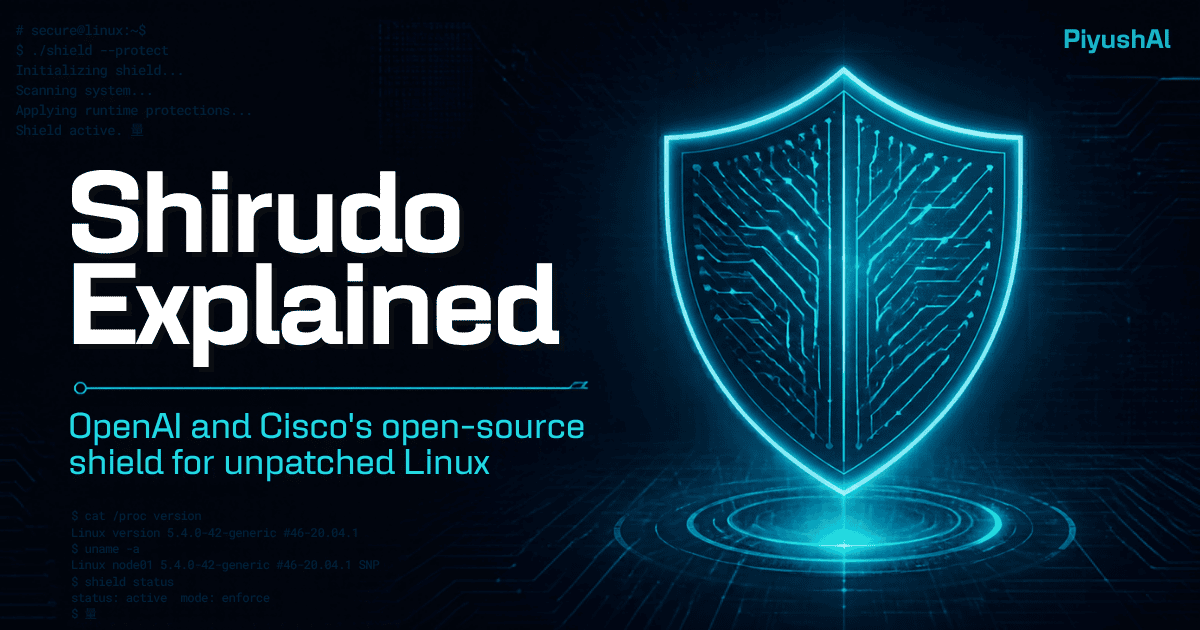
On 23 November 2026, OpenAI and Cisco announced Shirudo (the name comes from the Japanese word for “shield”), an open-source security runtime for Linux. The idea is easy to state and hard to build: when a new vulnerability is disclosed, an AI agent writes a small, targeted protection, called a shield, that blocks attempts to exploit that specific bug on running machines. The shield is signed, loaded without rebooting or restarting the application, and removed once the proper patch has been rolled out.
Why does this matter now? Over the past few months we have seen AI systems find vulnerabilities faster than humans can patch them. On this blog I have already covered OpenAI’s pipeline that reported 948 Linux kernel vulnerabilities and the misuse of AI pentest tools. The defender’s problem is the gap between “a bug is public” and “every server is patched”, which in real organisations can take days or weeks. Cisco’s argument is that attackers now move inside that gap within a day, sometimes before disclosure. Shirudo is a high-profile open-source attempt to use AI on the defensive side of that race, directly inside the operating system.
In this post I explain what Shirudo is in plain language, how it works under the hood (eBPF, signed packages, TPM attestation), what the Java4Shell demo actually showed, how to try it officially, and, most importantly, its limits. My view up front: this is an important idea and a well-engineered early project, but it is pre-release software with very demanding requirements, and it is not something you can install on your college lab server tomorrow.
Quick summary
- What it is: An open-source Linux security runtime from OpenAI and Cisco (built by Cisco’s Isovalent team) that loads small, signed, temporary protections called shields against specific vulnerabilities.
- Announced: 23 November 2026, on the OpenAI website and the Isovalent and Cisco blogs.
- Role of AI: An agent (OpenAI’s Codex in the demo) reproduces an exploit, writes a mitigation, tests it, and repeats until it works. Shields then go through signing and rollout.
- Technology: eBPF programs in the Linux kernel, plus Java bytecode guards for JVM applications. Packages are signed with post-quantum ML-DSA-87 keys and loads are recorded in a TPM 2.0 chip.
- Licence: BSD-2-Clause, with the BPF programs dual-licensed BSD/GPL. Code at github.com/shirudo-dev/shirudo.
- Demo: A shield blocked the Java4Shell bug (CVE-2026-114938) in a running Elasticsearch server without a restart, in a controlled test.
- Reality check: Pre-release. It needs a development (bpf-next) Linux kernel with extra patches, TPM 2.0, systemd 256 or newer and a measured boot setup. There is no fallback for ordinary kernels.
What is Shirudo, in plain language?
Think of a building where a lock manufacturer has just announced a flaw in every lock it sells. New locks will take two weeks to arrive and install. In the meantime, you post a guard at each door with one very specific instruction: “stop anyone using this exact trick”. That guard is a shield. It does not fix the lock; it buys time until the real fix is installed, and then it goes home.
Shirudo is the system that writes those guard instructions (using an AI agent), checks they are genuine (cryptographic signatures), sends them to every affected machine (a package registry), keeps a tamper-evident record of which guards were posted (the TPM), and counts how often each guard turned someone away (a “hit” count).
OpenAI’s announcement is clear that shields are a temporary safeguard, not a replacement for patching. Cisco says the same: a shield is retired when the real patch lands.
How Shirudo works
The agent loop
The Isovalent blog, written by Thomas Graf and Liz Rice, describes four stages:
- Discovery: the agent searches for vulnerabilities itself or ingests a public disclosure.
- Mitigation generation: it reproduces the exploit, confirms it works, picks a place to block it (inside the kernel with eBPF, inside the Java runtime, or elsewhere), writes the mitigation, and validates that the exploit now fails. If not, it tries again.
- Rollout: the shield is signed and delivered to affected machines.
- Monitoring: each machine reports how many exploitation attempts the shield blocked.
eBPF: the engine underneath
eBPF lets you load small, sandboxed programs into a running Linux kernel without writing a kernel module or rebooting. Before an eBPF program runs, the kernel’s verifier checks that it cannot crash the kernel or loop forever. eBPF already powers well-known networking and observability tools, and Shirudo grew out of Isovalent’s open-source security tool Tetragon (open-sourced in 2022). Isovalent calls Shirudo “a rewrite of Tetragon designed for agents”, while The Hacker News describes it as built on Tetragon’s foundations; the official wording is “rewrite”.
Trust: signatures, keyrings and the TPM
Letting an AI write code that runs inside your kernel sounds alarming, so most of Shirudo’s engineering is about trust. According to the official documentation:
- Signing: the operator compiles a shield with
shirudo buildand signs it with an ML-DSA-87 key (a post-quantum signature scheme). The result is an.upatchfile, bundled into a.beepackage and pushed to an OCI container registry. The registry itself is treated as untrusted. - Kernel enforcement: at boot,
shirudo initseals a dedicated kernel keyring and installs BPF LSM hooks so that only signed loader programs can load BPF code. In the words of OpenAI’s announcement, “Shields are cryptographically signed and verified before loading.” - Attestation: every load and unload is measured into a TPM 2.0 register.
shirudo attestproduces TPM-signed evidence that an operator can verify offline, so you can prove exactly which shields a machine is running. - Delivery: it is a one-shot command-line tool rather than a permanent daemon, but on targets systemd timers pull package updates and export telemetry roughly every minute.
One small disagreement worth noting: news reports (and the Isovalent blog) say TPMs “validate” shield signatures. The project documentation is more precise: the kernel checks signatures against the sealed keyring, and the TPM measures and attests what was loaded.
Who approves a shield?
Sources differ in emphasis. OpenAI says security teams control what gets deployed, Interesting Engineering reports that operators must approve a shield before it becomes active, and Cisco (quoted by The Hacker News) says “The shield only graduates to active blocking when the evidence says it’s safe.” The Isovalent blog, however, calls its demo a fully automated process and says the rollout step can be made more or less autonomous. In practice, how much human review happens will be an organisation’s own policy choice.
The Java4Shell demo: what it actually showed
The headline demonstration used Java4Shell (CVE-2026-114938), a memory-corruption bug in OpenJDK’s Base64 decoder disclosed in November 2026. According to the security firm Calif, which coordinated disclosure:
| Detail | As reported by Calif |
|---|---|
| Affected software | OpenJDK 17.0.6 and newer, including major vendor builds (Temurin, Corretto, Zulu, Oracle and others) |
| Hardware condition | Only x86-64 CPUs with AVX-512 VBMI (for example Intel Ice Lake and AMD Zen 4 and newer); ARM64 is not affected |
| Severity | CVSS 4.0 score 9.2 (Critical) |
| Impact | Remote code execution in several popular Java servers, some before login; Elasticsearch is listed as post-authentication |
| Patch | OpenJDK advisory and Oracle patch released on 17 November 2026 |
| Official workaround | Start the JVM with -XX:-UseBASE64Intrinsics |
In the demo, Codex produced a guard that adds an input check to Java’s Base64 decoding path, attached it to a running Elasticsearch 9.5.5 process, and the malicious input was rejected while Elasticsearch kept running. Two details matter. First, Isovalent says this particular mitigation was written as Java bytecode, not as an eBPF kernel program, so Shirudo is broader than “eBPF shields”. Second, this was a controlled test. One developer write-up on DEV Community summed it up as “a controlled demonstration, not a production deployment”. Cisco also says Shirudo’s agent wrote protections for a recent PHP vulnerability, but fewer technical details have been published for that case.
A note on credit: Cisco’s blog says both bugs were found by Calif using “the OpenAI Cyber model”, while Calif’s own page says it found Java4Shell with Codex in October. Calif’s page also acknowledges that the underlying bug had been reported publicly in an Adoptium issue in June 2026 and a proposed fix had not been merged. So “AI discovered Java4Shell” needs that context.
How to try Shirudo (official method)
Do not try this on a production server or your personal laptop’s main OS. The official route is the VM quickstart at docs.shirudo.dev, which builds Shirudo, boots a test virtual machine with a software TPM, and walks you through signing, loading, attesting and unloading one test shield.
Prerequisites (from the quickstart): a Linux host on x86-64 or arm64 with KVM, clang and LLVM 23 with the BPF target, OpenSSL 3.5 or newer, QEMU, swtpm, tpm2-tools, dracut, Docker or Podman, and a few libraries. Root is not needed for the test VM.
# From a checkout of github.com/shirudo-dev/shirudo (operator host)
testing/vm/kernel-artifact.sh fetch
make
make shirudo-build
export PATH="$PWD:$PWD/tools/shirudo-build:$PATH"

# Boot and log in to the test VM (the "target")
make -C testing vm VM_NAME=quickstart
make -C testing vm-ssh VM_NAME=quickstart

# Inside the VM: check that protections are active
shirudo-runtime status

# Back on the operator host: build and sign the sample shield
KEYS=/tmp/shirudo-test-vm-private-$(id -u)/operator-keys/keys
shirudo build testing/fixtures/basic.bpf.c --keys-dir "$KEYS" \
  --vmlinux vendor/linux/vmlinux.h -o basic.upatch
shirudo upatch info basic.upatch
The quickstart then shows how to load the shield inside the VM, request TPM evidence with shirudo attest, verify it on the host, unload, and clean up. Follow the full page, because commands and kernel versions may change while the project is pre-release (the docs themselves currently show two different test kernel versions on different pages). There is also a free self-guided lab from Isovalent and a public webinar announced for 15 December 2026.
Limits, criticism and open questions
- Pre-release status. The GitHub README describes the project as pre-release, and it was announced only on 23 November, so community testing has barely begun.
- Very demanding requirements. The system requirements page states that “shirudo has no compatibility mode and no fallback for an older kernel.” Targets need a bpf-next development kernel with the signed-loader ABI and several specific patches, TPM 2.0, systemd 256 or newer, a unified kernel image booted through systemd-stub, and dm-verity. None of the mainstream distributions you see in Indian data centres ships that by default, and the official announcement does not stress this.
- Shields can be wrong. A shield written for one exploit may miss a variant of the same bug, or block legitimate traffic. The quality of the agent’s own testing is the key unknown, and no independent red-team results have been published yet.
- Timing questions in the Java case. Calif says the Java4Shell out-of-bounds write happens during decoding, before Java rejects the input. No source I found explains whether Shirudo’s guard runs before the vulnerable fast path in every case. The demo logs show the guard rejecting the input, which is encouraging, but this deserves independent analysis.
- No published overhead numbers. I could not find benchmarks on CPU or latency cost, or a general availability date.
- Kernel-level code is high stakes. eBPF’s verifier and Shirudo’s signing chain reduce risk, but the documentation itself warns that on x86-64 a missing upstream fix can make detaching a BPF program “crash tasks” in some situations. Kernel-level tools need careful operations.
- eBPF cuts both ways. Security researchers have documented eBPF-based rootkits. Shirudo’s strict “only signed loaders” design is partly a response to that, but it also shows why you should never load unsigned or unknown BPF code.
Risks, safety and the Indian angle
This is general information, not legal or compliance advice.
For Indian organisations, two existing obligations are relevant. CERT-In’s April 2022 directions require specified cyber incidents to be reported within six hours of noticing them, and the Digital Personal Data Protection Act, 2023 expects data fiduciaries to take reasonable security safeguards to prevent personal data breaches. A tool that blocks exploitation of a known bug during the patch window could, in principle, help reduce incidents, but it does not change any reporting duty, and a shield is not a patch. Auditors and regulators will still ask whether you patched.
Practical safety rules if you experiment:
- Use only the official repository, docs and Isovalent lab. Viral security tools attract fake copies, as we saw with REA earlier this year.
- Run it in a disposable VM, never on a machine with personal or college data.
- Treat any AI-generated security code as untrusted until you have read and tested it yourself.
- If you run Java servers on recent x86-64 hardware, the real fix for Java4Shell is the 17 November OpenJDK patch, or the official JVM flag as a stopgap. You do not need Shirudo for that.
Why this matters for Indian students and educators
Shirudo is a great case study because it joins topics that usually sit in separate chapters of your syllabus:
- Operating Systems (GATE CS): kernel versus user space, system calls, boot process, loadable code, and why patching a running kernel is hard.
- Computer Organisation and Architecture: Java4Shell only affects CPUs with a particular vector instruction extension (AVX-512 VBMI). Hardware details decide security outcomes.
- Compiler Design: eBPF is a small instruction set with a verifier; Java bytecode is another virtual machine language; JIT intrinsics are where this bug lived.
- Computer Networks and Cryptography: digital signatures, key management, post-quantum signatures (ML-DSA), and TLS.
- AI and machine learning (GATE DA): AI agents in a loop of generate, test, refine, and the reliability question of when an automated system’s output can be trusted.
Career-wise, eBPF, Linux internals and cloud security are high-value skills for DevSecOps, SOC, cloud and platform engineering roles, including at Indian banks, PSUs and IT services firms. My suggestion for students: learn the basics of Linux system calls and write a simple eBPF “hello world” with existing tutorials before touching Shirudo. Then read the Shirudo “how it works” page and try to explain each step to a friend. If you can explain why the kernel verifies a signature before the verifier runs, you understand more security engineering than most interview candidates.
For educators, Shirudo is an excellent discussion topic for an OS or security class: should AI-written code be allowed to run in the kernel, under what checks, and who is accountable if it blocks something it should not?
Frequently asked questions
Is Shirudo free and open source?
Yes. It is released under the BSD-2-Clause licence, with the BPF programs dual-licensed BSD/GPL. The code is on GitHub at shirudo-dev/shirudo.
Does Shirudo replace patching?
No. OpenAI calls shields a temporary safeguard, and Cisco says they are retired when the real patch is applied. Shirudo is meant to protect systems during the patch window.
Can I install Shirudo on Ubuntu or my college server today?
Not on a normal installation. Production targets need a bpf-next development kernel with specific patches, TPM 2.0, systemd 256 or newer and a measured boot setup. The supported way to try it is the official test VM quickstart.
Does Shirudo need OpenAI’s models to work?
The runtime that signs, loads and attests shields is ordinary open-source software. The AI agent that writes shields was Codex in the demo. You can build and load a sample shield by hand in the quickstart without any AI model.
What is Java4Shell and am I affected?
Java4Shell (CVE-2026-114938) is a critical memory-corruption bug in OpenJDK’s Base64 decoder affecting OpenJDK 17.0.6 and newer on x86-64 CPUs with AVX-512 VBMI. A patch was released on 17 November 2026. Check your vendor’s advisory and update.
Is Shirudo the same as Tetragon?
No. Isovalent describes Shirudo as a rewrite of Tetragon designed for AI agents. Tetragon remains a separate open-source project.
The bottom line
Shirudo is one of the most interesting defensive AI releases of the year. It takes a real problem (AI-speed exploitation versus human-speed patching) and answers it with careful engineering: AI writes the shield, but cryptography, a kernel verifier and a TPM decide whether it runs and record that it did. That is the right instinct.
It is also very early. The Java4Shell demo was a controlled test, the requirements rule out almost every server running today, independent testing has not happened yet, and the sources disagree on how much humans stay in the loop. For students, the value right now is educational: Shirudo is a perfect window into kernels, signatures, attestation and AI agents working together. Learn those fundamentals now, because the people who can check what the AI wrote will be the ones trusted to deploy it.
Sources and further reading
- OpenAI: OpenAI and Cisco introduce Shirudo
- Isovalent (Cisco) blog by Thomas Graf and Liz Rice
- Cisco blog: Expanding the defender’s window with self-defending infrastructure
- Shirudo GitHub repository
- Shirudo docs: VM quickstart
- Shirudo docs: How it works
- Shirudo docs: System requirements
- Calif: Java4Shell (CVE-2026-114938) write-up
- The Hacker News: OpenAI and Cisco unveil AI-assisted Linux security tool
- Interesting Engineering: OpenAI’s Codex builds security shields for running Linux systems
- Cyber Press: OpenAI and Cisco launch Shirudo
- DEV Community: Shirudo shields running Linux systems while patches roll out
Written by Piyush Wairale (M.Tech, IIT Madras), founder of PiyushAI Edtech. Shirudo is pre-release software and details change quickly; figures and requirements are as reported on or before 24 November 2026.

Recent Post
Olala mini 7A1B is OVHcloud's first open language model, announced on 17 November 2026: 7B parameters, 1B active, Apache 2.0, and said to run on an 8 GB GPU or CPU. Here is how Olala mini works, what is unproven, and why it matters for Indian students.
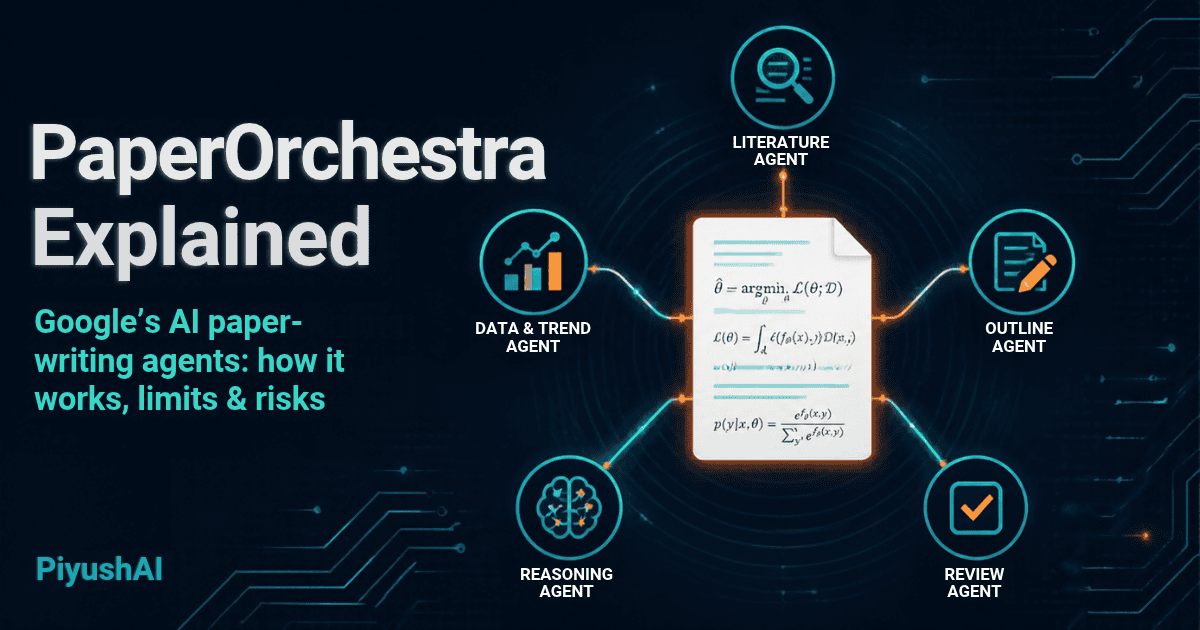
PaperOrchestra is Google Research's open-source multi-agent framework that turns an idea summary and experiment logs into a LaTeX research paper, and it is trending on GitHub this week. Here is what PaperOrchestra is, how it works, what the evaluations show, its limits, the integrity risks, and what it means for Indian students.
Gemini 4 Neon is Google's new middle model in the Gemini 4 family, released on 18 November 2026 at $3/$15 per million tokens with a 1M token context. Here is what Gemini 4 Neon is, how its thinking levels work, what independent tests found, its limits and safety caveats, and why it matters for Indian students.
Inkling 2 Mini is Thinking Machines Lab's new Apache 2.0 open-weight model, released on 20 November 2026: 26.4B parameters, about 3.4B active, and a looped transformer that runs its middle layers three times. Here is how Inkling 2 Mini works, what independent tests show, its limits, and why it matters for Indian students.
Genie 4 is Google DeepMind's real-time world model, opened to developers in the Gemini API on 19 November 2026: playable 720p worlds with native audio at about $0.10 per second. Here is what Genie 4 is, how it works, its limits, the deepfake risks, and why it matters for Indian students.
Ternary Bonsai 2.5 27B is PrismML's new Apache 2.0 model, released on 24 November 2026, that squeezes a 27B coding and agent model into a 5.9 GB file using weights of -1, 0 and +1. Here is how Ternary Bonsai 2.5 27B works, what its self-reported benchmarks show, its limits, and why it matters for Indian students.
Learn Daily, Wherever You Are
Free lectures, exam updates, PYQ discussions, and job alerts — delivered through our YouTube channel and Telegram communities.